Bitcoin ETF inflows hit $3.8B in strongest three-week stretch of 2026

cointelegraphPublished on 2026-09-05Last updated on 2026-09-05

Abstract

US-listed spot Bitcoin ETFs recorded their strongest three-week inflow stretch of 2026, attracting $3.8 billion as Bitcoin traded near $80,000. Total net assets reached $101.3 billion. This marks a sharp turnaround from earlier outflows, though year-to-date flows remain slightly negative. Daily inflows cooled to $174.6 million on Friday, led by BlackRock's IBIT, after a surge the previous day. Concurrently, inflows into US spot Ether and XRP ETFs fell significantly compared to the prior week. Despite this slowdown, both Ether and XRP ETFs maintain positive net inflows for the year.

US-listed spot Bitcoin exchange-traded funds (ETFs) have recorded their strongest three-week inflow stretch of 2026 as Bitcoin traded around $80,000.

The funds attracted $986.9 million in the week ending Friday, bringing net inflows over the past three weeks to $3.8 billion, according to SoSoValue data.

Total net assets across the funds stood at $101.3 billion on Friday after briefly rising to $103.3 billion a day earlier, while cumulative net inflows reached $55.6 billion.

ETF demand marks a sharp turnaround from heavy outflows earlier in 2026, though year-to-date net flows remain roughly $1 billion negative.

Bitcoin ETF inflows cool after Thursday surge

US spot Bitcoin ETFs attracted $174.6 million in net inflows on Friday, down sharply from the nearly $731 million recorded a day earlier.

BlackRock’s iShares Bitcoin Trust (IBIT), the largest spot Bitcoin ETF by assets, drew $117.4 million on Friday, accounting for about 67% of the day’s total net inflows, according to Farside Investors data.
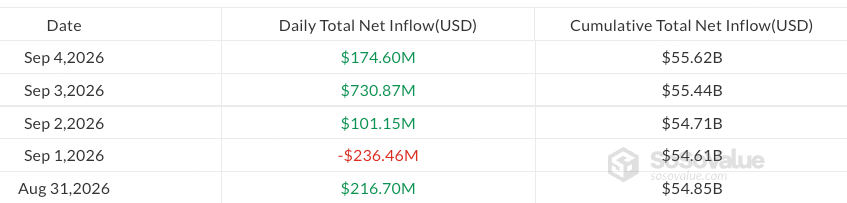
Daily spot Bitcoin ETF flows from Monday through Friday. Source: SoSoValue

Fidelity’s Wise Origin Bitcoin Fund (FBTC) was the only other fund to record net inflows, attracting $57.2 million, while all other US spot Bitcoin ETFs recorded no net flows for the day.

Related: Surprise nonfarm payrolls print sends Bitcoin back below 80K

The slowdown came as Bitcoin fell from around $81,200 to briefly below $79,000 on Friday. Bitcoin traded at $79,716 at the time of publication, still up about 2.6% over the past seven days, according to CoinGecko.

Bitcoin ETF demand strengthens as Ether, XRP flows fade

Compared with the previous week, Bitcoin ETF inflows increased about 7%, while inflows into US spot Ether and XRP ETFs fell about 74% and 83%, respectively.

Spot Ether ETF inflows dropped to $218.4 million from $824.4 million, while XRP ETF inflows declined to $19 million from $110.5 million, according to SoSoValue.

Despite weaker inflows, Ether and XRP ETFs remain in positive territory for the year. US spot Ether ETFs have recorded about $863 million in net inflows year-to-date, while XRP ETFs have attracted roughly $515 million.

Magazine: BTC will hit $1M by 2030... but Arthur Hayes is buying ETH instead

Related Questions

QWhat was the total net inflow for US-listed spot Bitcoin ETFs over the strongest three-week stretch of 2026?

AThe total net inflow for US-listed spot Bitcoin ETFs over the strongest three-week stretch of 2026 was $3.8 billion.

QWhich specific Bitcoin ETF accounted for the majority of net inflows on Friday, and how much did it attract?

ABlackRock’s iShares Bitcoin Trust (IBIT) accounted for the majority of net inflows on Friday, attracting $117.4 million, which was about 67% of the day's total.

QHow did the weekly net inflows into Bitcoin ETFs compare to those of Ether and XRP ETFs in the same period?

ACompared to the previous week, Bitcoin ETF inflows increased about 7%. In contrast, inflows into US spot Ether ETFs fell about 74% and inflows into XRP ETFs fell about 83%.

QWhat were the cumulative net inflows for US spot Bitcoin ETFs as of the Friday mentioned in the article?

AAs of the Friday mentioned in the article, the cumulative net inflows for US spot Bitcoin ETFs reached $55.6 billion.

QWhat is the year-to-date net flow status for Bitcoin ETFs despite the recent strong three-week inflow stretch?

ADespite the recent strong three-week inflow stretch, the year-to-date net flows for Bitcoin ETFs remain roughly $1 billion negative.

Related Reads

Hyperliquid API Wallet Permissions Keep Expanding: Once an AI Agent Is Attacked, It Could Drain the Main Account

As personal AI agents take over everyday financial decisions, Hyperliquid is seen as an ideal decentralized trading foundation thanks to its deep liquidity and composability. However, the API wallets that underpin automated trading have quietly seen their security boundaries erode across network upgrades over the past year. Lacking fine-grained permission policies, a compromised API wallet can even trigger staking slashing, spot locking, and priority fee burning, exposing the main account to total loss. The article traces how API wallets—originally scoped to prevent direct withdrawals or external transfers—have accumulated expanded permissions through successive upgrades, with no cap on margin exposure. A maliciously altered API wallet controlling an account with over ~$40M could buy 500,000 HYPE, stake it, link it to a malicious HIP-3 market, invite slashing, and lock the main account's funds for 183 days. Because API wallets are now the default trading method across the Hyperliquid frontend and third-party apps, and agents must interact with untrusted internet environments, prompt injection or key leakage can let attackers drain funds without ever stealing a private key. Existing fine-grained control via HyperEVM smart contracts introduces too much latency for high-frequency trading, while custodial solutions outsource trust to centralized middleware. The proposed fix is a lightweight bitmap permission field set at API wallet creation, recording which operation types the wallet may trigger—mirroring the mechanism already used in HIP-3 deployer sub-lists. Validating the signer against the main account's bitmap adds negligible overhead, and critically, old API wallets would never auto-inherit new permissions from future L1 upgrades. This would safely unlock staking and transfer interfaces, remove reliance on centralized custody, and pave the way for large-scale personal AI agent adoption on HyperCore.

marsbit20m ago

Hyperliquid API Wallet Permissions Keep Expanding: Once an AI Agent Is Attacked, It Could Drain the Main Account

marsbit20m ago

Upbit and Bithumb Customer Deposits Plunge 31.86%, Falling $1.87 Billion in 2026

Customer deposits in South Korean won at Upbit and Bithumb, South Korea's two largest crypto exchanges, fell 31.86% in the first nine months of 2026, according to regulatory disclosures published November 17. The platforms held about ₩5.36 trillion ($4 billion) in customer cash at end-September, down from ₩7.87 trillion at end-2025—a reduction of roughly ₩2.51 trillion ($1.87 billion). Upbit operator Dunamu saw deposits drop 31.9% from ₩5.83 trillion to ₩3.97 trillion, while Bithumb fell 31.8% from ₩2.04 trillion to ₩1.39 trillion. The figures were disclosed via South Korea's Financial Supervisory Service electronic filing system. Customer crypto holdings also lost value: Upbit's book value fell 10.9% from ₩62.23 trillion to ₩55.46 trillion, and Bithumb declined 13.1% from ₩17.90 trillion to ₩15.56 trillion. However, quantities of several major cryptocurrencies held for customers increased despite lower valuations—Upbit added 13,259 Bitcoin, 337,609 Ether and 1.22 million Solana versus year-end levels, and Bithumb reported higher holdings of Bitcoin, Ether, XRP and Solana. The data indicate the deposit decline does not necessarily mean investors withdrew entirely from the crypto market; disclosures do not explain whether funds went to bank accounts, crypto purchases or elsewhere. The drop comes amid weaker trading activity in South Korea's digital asset market, adding pressure on major exchanges.

TheNewsCrypto51m ago

Upbit and Bithumb Customer Deposits Plunge 31.86%, Falling $1.87 Billion in 2026

TheNewsCrypto51m ago

Trading

Spot
活动图片