As Muse was just released, the Meta TBD Lab that created it is seeing people depart once again.
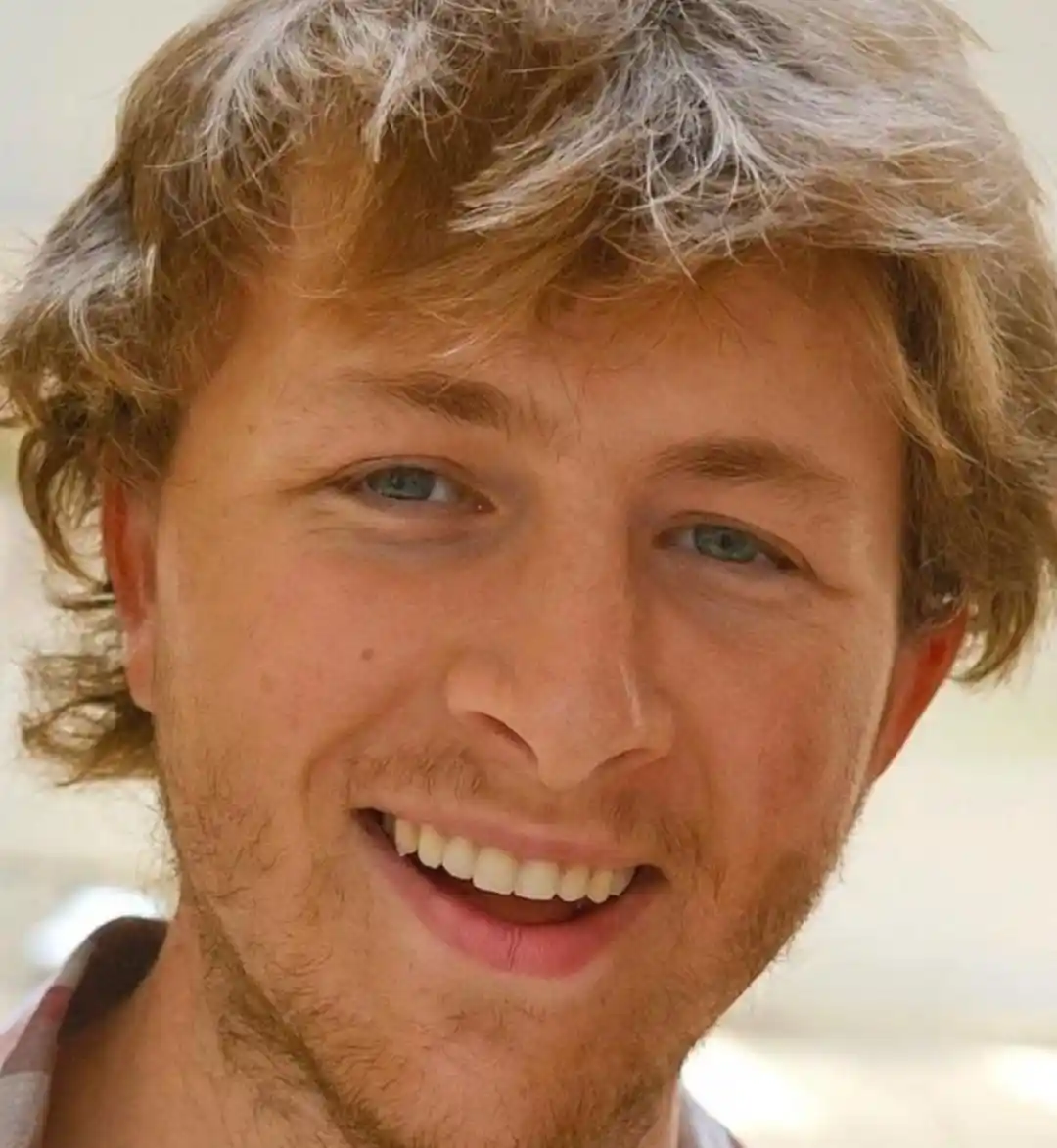
The person leaving this time is the most expensive and controversial candidate from Meta's aggressive AI talent grab last year—Andrew Tulloch.
Before accepting a sky-high offer to return to his former employer, he had already worked at Meta (formerly Facebook) for over 11 years. Following that, he was involved in training GPT-4o, GPT-4.5, and o3 at OpenAI, and co-founded Thinking Machines Lab with OpenAI's former CTO Mira Murati.
△
Last August, Meta's Zuckerberg and Alexandr Wang messaged him repeatedly, offering him a compensation package valued at up to $1.5 billion (approximately RMB 10.8 billion) to invite Tulloch back.
But in a dramatic turn, Tulloch initially rejected the massive olive branch Meta extended;
It wasn't until two months later that Tulloch changed his mind, left the Thinking Machines Lab he helped found, returned to Meta, and joined the TBD Lab led by Alexandr Wang to research superintelligence, taking charge of Muse's related development.
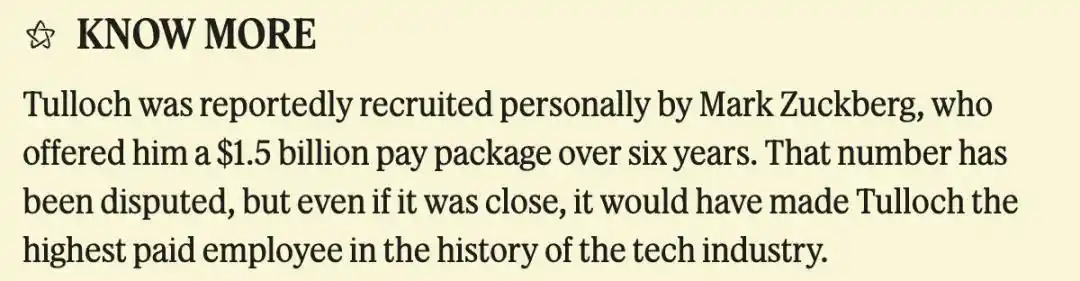
From his return at the end of October 2025 to the news of his departure in September 2026, Tulloch's second tenure at Meta lasted about 11 months.

Just now, A-She sources revealed: Andrew Tulloch will join Anthropic's inference and performance team next week, focusing on optimizing the Claude Code training pipeline and improving the model's responsiveness to user instructions. (Specific team details to be announced)

△
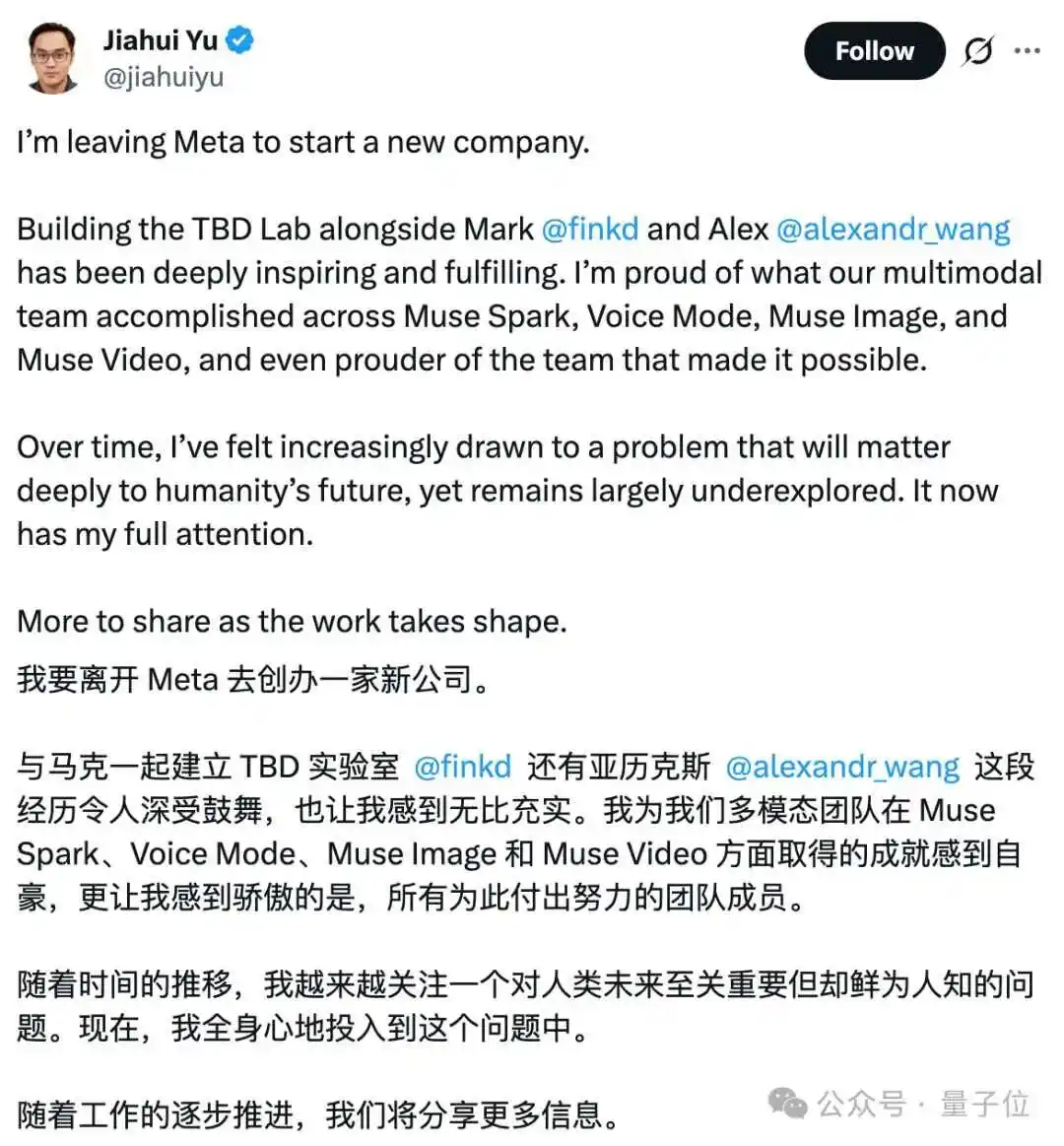
This inevitably brings to mind another of Meta's 'Mr. AI' — Jiahui Yu.
Similarly a top talent heavily recruited by Meta, Jiahui Yu announced his departure just eight days after the release of Muse Spark 1.2.
Now, less than a month later, Tulloch has chosen to leave just two days after Muse's launch.
For Meta, this perhaps once again illustrates: People can be bought with immense sums, but not necessarily retained.
With Muse Just Launched, Key Product Leaders Depart One After Another
The timing of Tulloch's departure is more telling than the specific reasons.
On September 8th, Meta officially launched the personal AI assistant Muse, which can not only answer questions but also break down long tasks, coordinate time and resources, help people fill out forms, send emails, book trips, and complete shopping.
According to Meta's official website, Muse is powered by Muse Spark.
Meta proudly calls it their most capable model to date, built for real agent tasks.
For Zuckerberg, this is not just another AI assistant, but a crucial product milestone for his 'personal superintelligence' strategy.
And it was only after delivering this product that Tulloch decided to officially leave.
This reminds people of Jiahui Yu, who left Meta to start his own venture just over half a month ago. The circumstances of their joining and leaving are strikingly similar:
Last June, Meta poached Jiahui Yu from OpenAI with an annual salary of $700 million to join Meta, where he worked with Zuckerberg, Alexandr Wang, and others to build the TBD Lab, overseeing the multimodal direction.
Yet, this August, barely over a week after the release of Muse Spark 1.2, Yu announced his departure to start a company, having been at Meta for just over a year and a month.
Only, Yu waited for Muse Spark 1.2, while Tulloch waited for the full Muse.
Now, the product has moved forward a step, but two key figures have left in succession.

△
And the story between Tulloch and Meta begins in 2012.
His Name Was the Most Expensive in Last Year's Meta Talent Scramble
This isn't Tulloch's first time leaving Meta.
Andrew Tulloch is from Australia, having graduated from the University of Sydney and University of Cambridge.
From 2012 to 2023, Tulloch worked at Meta for about 11 years, rising from a Machine Learning Engineer to Distinguished Engineer.
On his personal homepage, he summarizes his early years at Meta in just one sentence:
Worked on machine learning systems at Meta.
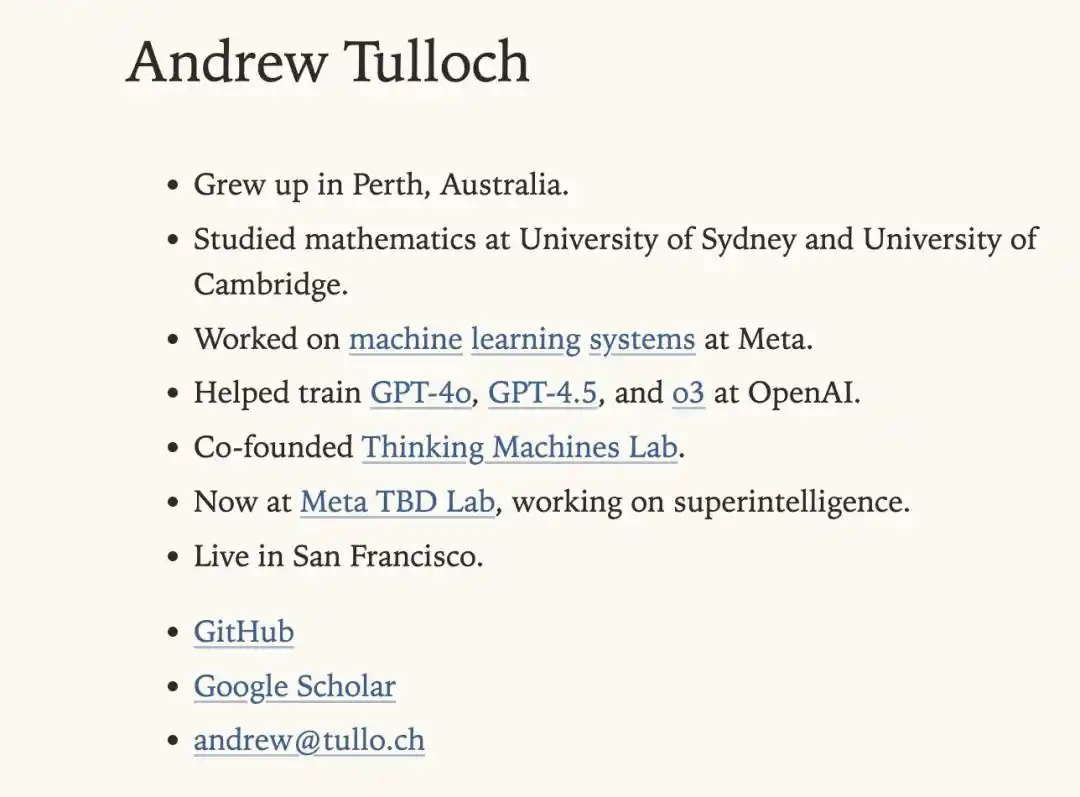
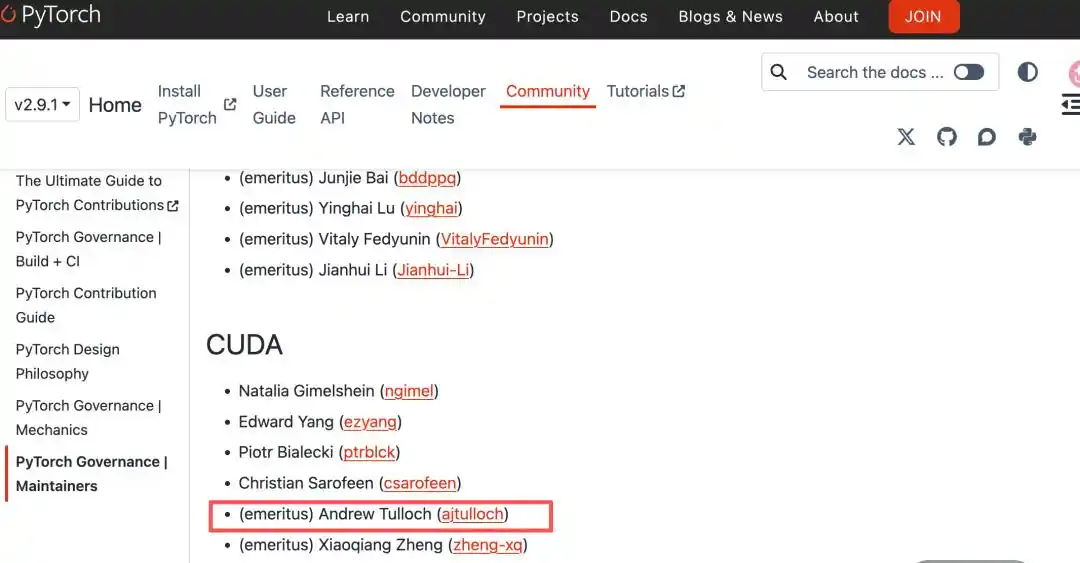
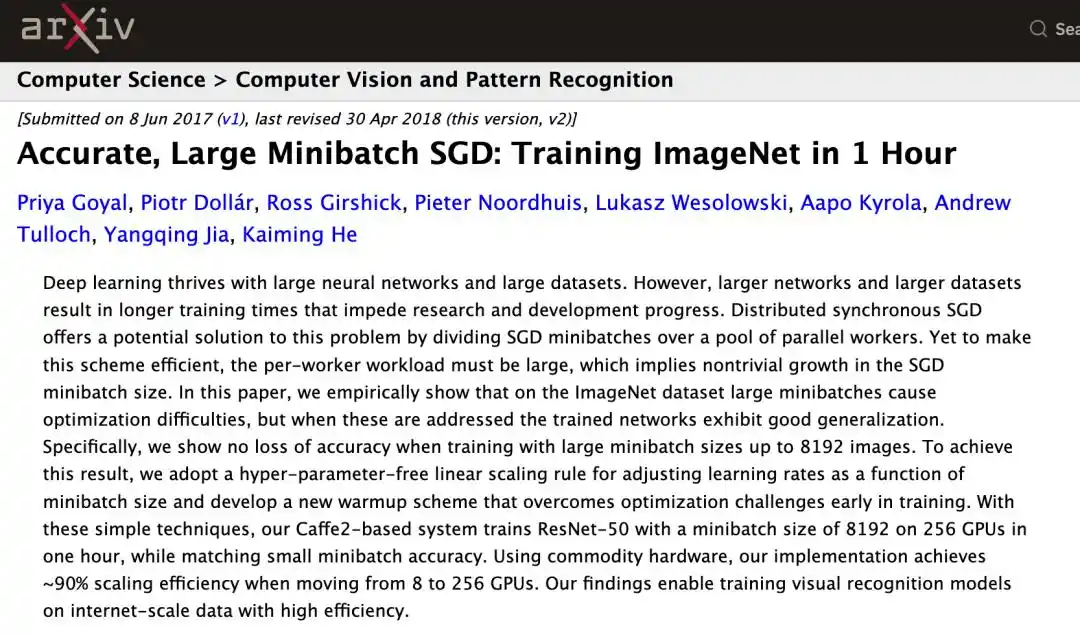
But behind this simple statement lie connections to three projects: PyTorch, ResNet-50, and FBGEMM:
- He is an honorable maintainer for PyTorch CUDA, indicating his involvement in underlying framework work;
- He participated in classic work that compressed ResNet-50 training time on ImageNet to one hour, achieving ~90% scaling efficiency using 256 GPUs;
- He contributed to building FBGEMM, a high-performance low-level operator library for model training and inference, particularly serving recommendation systems, quantization, and generative AI.

Additionally, he worked on Facebook datacenter deep learning inference, on-device inference, model quantization, and projects like AITemplate.
In other words, Tulloch's greatest value isn't in designing a chat product, but in making large-scale models trainable, faster, and cheaper to deploy.
In 2023, Tulloch left Meta to join OpenAI, contributing to the training of models like GPT-4o, GPT-4.5, and o3.
He then followed OpenAI's former CTO Mira Murati to become a co-founder of Thinking Machines Lab.

In 2025, after Llama 4's performance fell short of expectations, Zuckerberg personally took charge of Meta's AI strategy.
He first invested $14.3 billion in Scale AI, bringing founder Alexandr Wang into Meta, then formed the Meta Superintelligence Labs, launching a massive talent war against OpenAI, Google, Anthropic, and several star startups.
Thinking Machines Lab naturally became a prime target for Meta.
According to The Wall Street Journal, Zuckerberg approached Mira Murati hoping to acquire the newly founded AI company;
After being refused, Meta turned to contacting over a dozen Thinking Machines employees, attempting to directly poach them and dismantle the company.

Among them, Tulloch was the number one target.
Zuckerberg and Alexandr Wang bombarded him with messages, inviting him back to Meta.
Furthermore, to lure him away from the company he helped create, Meta offered a compensation package valued in the $1-1.5 billion range.
But surprisingly to Silicon Valley, not only did Tulloch reject it initially, but not a single Thinking Machines employee accepted Meta's offer at the time.

However, the situation changed two months later.
In October 2025, Tulloch announced he was leaving Thinking Machines for personal reasons and returning to Meta, joining the TBD Lab led by Alexandr Wang.
Now, less than a year later, he has left Meta again.
Exactly how much compensation Andrew Tulloch received from Meta remains unconfirmed, with figures ranging from $1 billion to $1.5 billion.
But regardless of the number, it's enough to place Andrew Tulloch among the highest-paid non-founder employees in the tech industry.

OpenAI and Anthropic Are Also Poaching Each Other, Five Months Counts as a Stint
However, the frequent movement of top talent isn't a problem unique to Meta.
From Ruoming Pang, who led Apple's foundational model team before moving to Meta and OpenAI, to Schulman, who jumped from OpenAI to A-She...
For these researchers who have achieved financial freedom and hold invitations from multiple labs, money no longer seems to be the primary motivator for staying.

△
Axios summarized this talent war as:
Attracting top AI talent is already difficult, but even with sky-high salaries, prestigious titles, and abundant computing power, retaining them might be just as hard.
For these top AI talents, choosing a lab might no longer be just about picking the next job, but about choosing the version of the AI future they believe is most likely to be realized.

△
Until 'Only a Few Can Do It' Becomes History
So, how long will this high-salary talent churn in AI companies continue?
The answer might depend on "how much longer top talent will remain scarce".

After all, "rarity breeds value". There's only a small handful of top-notch, battle-tested, and experienced researchers worldwide.
This talent market frenzy will likely only cool down when companies no longer need to "buy" the exclusive knowledge in a star researcher's mind, but instead require a set of engineering capabilities that can be stably replicated and repeatedly invoked by the organization.
Until then, top AI talent will still resemble free agents in professional sports—picking between tech giants and startups based on compensation, computing power, strategic direction, teammates, and the stage.

△
For Meta, the successive departures of Jiahui Yu, Andrew Tulloch, and others are the most vivid footnote to this talent game.
Talent comes and goes, and Zuckerberg's superintelligence gamble will likely continue its bumpy journey amidst organizational turmoil~(doge

References:
[1]https://about.fb.com/news/2026/09/introducing-muse-personal-ai-agent/
[2] https://tullo.ch/
[3] https://www.semafor.com/article/09/09/2026/ai-researcher-andrew-tulloch-is-leaving-meta
[4] https://iq.wiki/zh/wiki/andrew-tulloch
[5] https://archive.ph/no70G
[6] https://apnews.com/article/meta-ai-yann-lecun-313159512bb9961f324e0c93bccf4cf5
[7] https://www.axios.com/2026/08/03/ai-talent-wars-openai-google-meta-anthropic
[8] https://www.lemonde.fr/en/economy/article/2026/01/16/yann-le-cun-why-i-m-leaving-meta-to-launch-my-own-ai-start-up_6749498_19.html
[9] https://jiahuiyu.com/
[10] https://www.businessinsider.com/andrew-tulloch-ditches-meta-for-training-and-inference-at-anthropic-2026-9
This article is from the WeChat public account "QbitAI", author: Wenting