Author: Jae, PANews
On the early morning of September 4th, Bitcoin briefly broke through $82,000. Although it subsequently fell back to around $80,000, the crypto market has actually experienced its strongest rebound since October 2025 starting from mid-August. Bitcoin recorded a gain of about 25% in the past month, while U.S. spot Bitcoin ETFs saw net inflows of $3.52 billion in a single month, setting a new yearly record.
However, what has been more dramatic than the spot market action is the collective explosion of the Digital Asset Treasury (DAT) sector. According to PANews statistics, all 10 leading DAT stocks closed higher in August, with an average monthly gain of about 106%, while the average increase in their treasury assets was only about 45%. Even excluding extreme outliers, the excess returns of DAT stocks relative to their underlying assets remain remarkably significant.
It can be said that capital is assigning an additional capital market premium to certain DATs. This premium is composed of the beta from rising coin prices, the amplification from financing leverage, the boost from staking yields, and the imagination fueled by ecosystem narratives.
All Green in August, Doubling Returns Unfolded
According to PANews observations, the total market cap of the 10 leading DAT stocks included in the statistics currently exceeds $82 billion, up 46% month-on-month; August trading volume was about 2.5 billion shares, a month-on-month increase of 33%, indicating that capital's attention has returned to the DAT track.
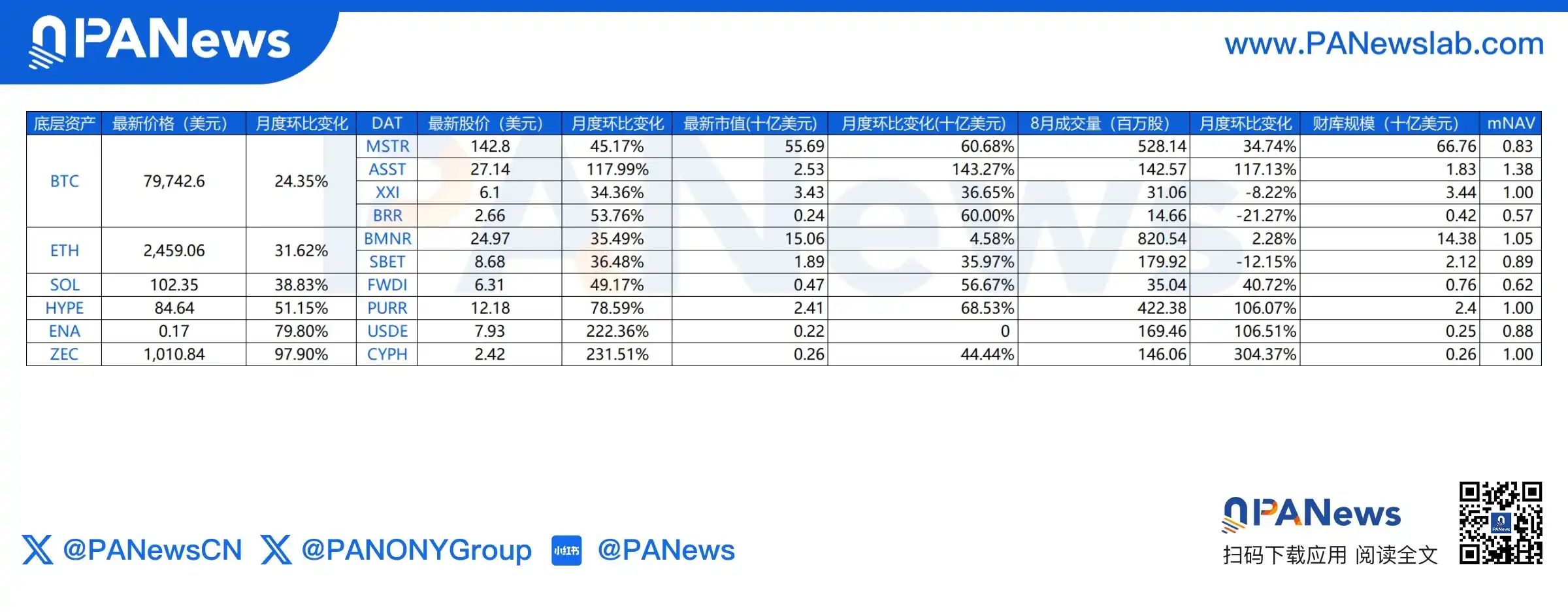
The most interesting phenomenon in this round of market action is that DAT stock gains have generally outperformed their treasury assets, exhibiting a strong "Beta+Leverage" characteristic. In terms of price performance, all 10 leading DAT stocks achieved excess returns relative to their treasury assets. Among them, three DAT stocks are particularly noteworthy:
-
ASST: Treasury asset BTC rose 24.35% during the same period, while the stock surged 117.99%, achieving an excess return of about 94 percentage points.
-
CYPH: Treasury asset ZEC rose 97.9% during the same period, while the stock surged 231.51%, achieving an excess return of about 134 percentage points;
-
USDE: Treasury asset ENA rose 79.8% during the same period, while the stock surged 222.36%, achieving an excess return of about 143 percentage points;
In contrast, the sector leader MSTR showed relative restraint, rising 45.17% in the past month with an excess return of only about 21 percentage points.
A pattern has emerged: the smaller the DAT's market cap, the lower the stock liquidity, and the newer the narrative, the greater the price elasticity relative to its treasury assets often is. This is the most obvious difference between this round of DAT action and the era of "Strategy's dominance": as DAT holdings expand from Bitcoin to more assets, mid-to-small cap stocks, with their smaller float and more diversified narratives, have shown more aggressive price action than the leading stock.
MSTR Holds Nearly 70% of Top DAT Market Cap, Treasury Leverage Creates Bidirectional Elasticity
However, Strategy remains the most mature example of the DAT model, with MSTR's market cap accounting for about 68% of the cumulative market cap of the 10 leading DAT stocks.
The fundamental business logic of a DAT is not a linear mapping of "coin up → stock up", but rather a leveraged tool that amplifies the return on treasury assets.
On August 23rd, BTC surged over 20% within a week. Strategy held 840,447 BTC at the time, with a net BTC asset value of approximately $49.68 billion. On August 31st, Strategy announced the purchase of approximately 4,603 BTC for about $370 million, at an average price of about $80,318, bringing its total holdings to 845,050 BTC.
This is precisely the capital cycle of the DAT model: BTC rises → balance sheet improves → equity financing capability strengthens → obtains more funds to buy BTC → per-share BTC exposure further increases.
This positive feedback mechanism endows DAT stocks with stronger elasticity than their treasury assets. When treasury asset prices rise, the compounded return rate of DAT stocks naturally far exceeds the simple coin price increase. This characteristic also makes DAT stocks a "return amplifier" during rebound phases.
The most attractive aspect of a DAT is leverage, and the most dangerous aspect is also leverage. The flywheel works both ways; the stronger the upward momentum, the more violent the downward move can be.
The total treasury asset size of the 10 DAT stocks is approximately $92.62 billion, while their combined stock market cap is only 88.8% of their treasury size. This means that the DAT sector does not universally trade at high premiums; in fact, some stocks are already trading below the value of their treasury assets.
It is important to note that an mNAV (market-to-net asset value) below 1 does not equate to "risk-free arbitrage." In addition to treasury assets, companies have liabilities, preferred shares, dilution risks, management fees, financing costs, asset staking, regulatory risks, operational losses, and a series of other deductions.
According to a Bloomberg report, Nakamoto, a Bitcoin DAT backed by crypto entrepreneur David Bailey, who helped turn U.S. President Trump towards supporting BTC, has seen its stock price plummet about 99% from its peak, wiping out its market premium.
The volatility of DATs stems both from the underlying coin price and from the expansion and contraction of valuation premiums, with the amplitude of the latter often being greater than the former.
From BTC to ETH/SOL, DATs Add a Layer of Staking Yield
Strategy represents the playbook of the first-generation "hodling" DAT. Another clear change is that the DAT model is expanding to more crypto assets, and its mechanics are also evolving, giving DATs the attributes of "productive assets."
Ethereum treasuries are a classic example of this evolution. Take Bitmine, for example. As of now, it holds over 5.9 million ETH, accounting for about 5% of ETH's total supply, along with 211 BTC and over $500 million in cash and tradable securities, with the combined value of crypto assets and cash reaching $15.6 billion. Among these, about 5.07 million ETH have been staked to earn on-chain yields.
SharpLink adopts a similar approach, holding over 890,000 ETH, which it consistently deploys into staking and on-chain yield strategies.
Solana treasuries followed suit. Forward Industries holds approximately 7.807 million SOL and its equivalent assets, accounting for about 1.3% of Solana's circulating supply, with almost all of it staked.
Compared to BTC treasuries, which are highly dependent on price fluctuations, ETH/SOL treasuries add a layer of value support through staking yields.
This means the valuation model for DATs is undergoing a second-order evolution:
-
Stage One: Treasury Value ≈ Asset Price × Holdings, price-driven;
-
Stage Two: Treasury Value ≈ Asset Price × Holdings + Staking/On-Chain Yields, supported by cash flow;
This model may become the main battleground for competition in the next phase of the DAT sector.
Sector Divergence Emerges, Risk Appetite Spills into Altcoin DATs
Capital is flowing from BTC and ETH treasuries into higher-Beta altcoin treasuries, with market interest in DAT stocks like HYPE and ZEC significantly increasing. This is also a signal that the market is entering its second phase: after mainstream assets attract incremental capital, funds spill over into mid-to-small cap targets, and risk appetite cascades down the hierarchy.
Altcoin DATs are smaller in scale and more prone to extreme price movements.
PURR is a prime example. As of now, it holds approximately 30.1 million HYPE, with a holding value as high as $2.54 billion. Simultaneously, the company has repurchased about 5.8 million shares of PURR, tightening the float.
More importantly, PURR's value anchor points are not just the HYPE price, but a whole suite of combined narratives: HYPE price volatility + HYPE holdings growth + Hyperliquid ecosystem growth + HYPE buyback and burn + DAT financing capability.
Among these, Hyperliquid's ecosystem revenue and token economics provide the primary value support. Over the past 12 months, the Hyperliquid ecosystem generated approximately $712 million in retained earnings, with a staggering 99% of that value flowing to HYPE holders through a buyback mechanism. Investors buying PURR are essentially betting on the growth of the Hyperliquid ecosystem.
CYPH, which holds ZEC, also possesses significant potential. As of now, it holds 323,394 ZEC, accounting for about 1.91% of Zcash's circulating supply. Subsequently, the company also entered the Zcash mining field through a related transaction with Winklevoss Capital, controlling about 18% of the network's total hashrate. CYPH's valuation incorporates ZEC treasury value, mining operations, and the privacy asset narrative.
USDE is a newcomer among DATs, listed on Nasdaq at the end of June, with ENA as its treasury asset. USDE holds approximately 3.029 billion ENA, valued at about $510 million, representing 20% of ENA's total supply. USDE's business model simultaneously covers six major segments: Ethena ecosystem infrastructure, validation nodes, LayerZero DVN, stablecoin Harness, USDe distribution, and the ENA treasury.
In other words, USDE is attempting to build a complete flywheel: Ethena ecosystem growth → infrastructure revenue increases → ENA value appreciates → capital market financing → further expands ENA treasury and its ecosystem footprint.
Ecosystem narrative + low market cap + scarce newly listed float collectively catalyzed a single-month gain of over 200%, but it appears more like a special case of a "small-cap, high-volatility, strong-narrative DAT."
Currently, divergence in the DAT market is already evident. Capital and attention are concentrating towards the top, while elasticity and imaginative potential lie with mid-to-small cap targets.
The collective outperformance of DATs relative to coin prices in the recent period sends a signal: DATs are becoming a high-beta instrument connecting traditional stock markets and crypto assets.
More worthy of in-depth investigation than the percentage gains is the source of the excess returns. If it primarily stems from genuine growth in assets per share, cash flows from staking and ecosystem businesses, then DATs are evolving into a brand-new mode of crypto asset management.
From "comparing who holds more coins" to "comparing who creates more value per share," competition in the DAT sector is entering a higher dimension. And ultimately, all leverage and premiums must be tested by the cycle.