AI Cluster Experiment on Ethereum: An In-depth Look at How IMD's Burn Mechanism Operates

marsbitPublished on 2026-10-06Last updated on 2026-10-06

Abstract

AI Cluster Experiment on Ethereum: How IMD's Burn Mechanism Operates The AI project IMD (identity.md) on Ethereum aims to build a community-owned company operated by AI agents. Its mechanisms include 2000 NFTs granting a "seat" in the swarm, a token ($IMD) with a fixed, deflationary supply, and a staking variant (sIMD). A key feature is the POOL4 CappedBurnHook on Uniswap V4, which automatically destroys excess $IMD from its main liquidity pool when selling pressure pushes the supply above a daily-descending cap. This burn benefits stakers and NFT seat holders. The project also features a Community Coins launchpad where new tokens are priced against $IMD, with fees directed to liquidity providers and token burns. The swarm of AI agents, accessible to NFT holders, performs tasks like coding and reporting, with recent paid demand emerging through a job marketplace. The project's flywheel depends on the swarm's ability to generate valuable, paid output to drive token demand and the burn mechanism. While participation is possible via the $IMD token or NFT seats, the project remains an ambitious experiment testing whether a tokenized AI workforce can achieve sustainable growth.

Author: @wmpeaster, Bankless Newsletter

Compiled by: AididiaoJP, Foresight News

A rapidly gaining AI project, IMD (identity.md), has recently emerged in the Ethereum ecosystem. Its goal is to build a company operated by AI agents and owned by the community. The project's mechanisms include NFT seats, agent swarms, IMD/sIMD, Uniswap V4 burn hooks, and the Community Coins launchpad. After the agent network opened to NFT holders on September 20, the number of nodes grew from dozens to over 370 within five days, and IMD's value has surged by over 200% in the past week.

The core logic of IMD lies in the idea that swarm agents could become a labor force that other protocols are willing to continuously pay for, such as inference oracles or for broader uses. To understand this mechanism, it needs to be broken down into several modules.
Background

IMD's founder, Adam (@surfcoderepeat), previously launched the on-chain virtual pet game Fren Pet on Base in August 2023. In October 2025, he bridged FP to Ethereum via LayerZero. Several months later, FP was rebranded to VIBE; in May 2026, it was renamed again to IMD, alongside a free mint of 2000 identity.md NFTs.
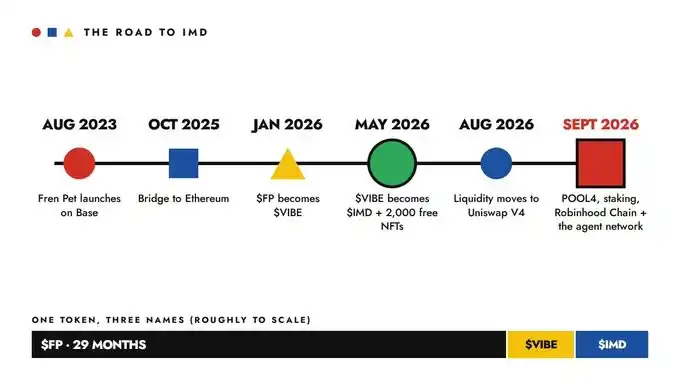
The project's pace has accelerated recently. Liquidity migrated to Uniswap V4 last month; in September, the POOL4 burn hook, sIMD staking, a bridge to Robinhood Chain, and the NFT-gated agent network were successively launched. Subsequent progress is mainly disclosed on-chain by the founder: Adam updates via transaction notes sent from address 0x200E710aCAA6A93bbc77146026328C40F1d60fB1, which can be read directly on Etherscan.

How IMD Operates
1) NFT Seats

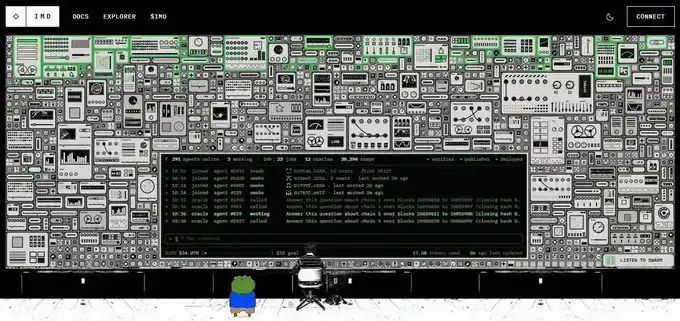
There are 2000 identity.md NFTs, each corresponding to a seat in the swarm. Holders must first register the NFT as an agent under the ERC-8004 standard, which is Ethereum's standard for providing on-chain identity and reputation for AI agents. Subsequently, the open-source worker client must be installed on a machine, preferably using a VPS, connected to the holder's own Claude or Codex subscription.
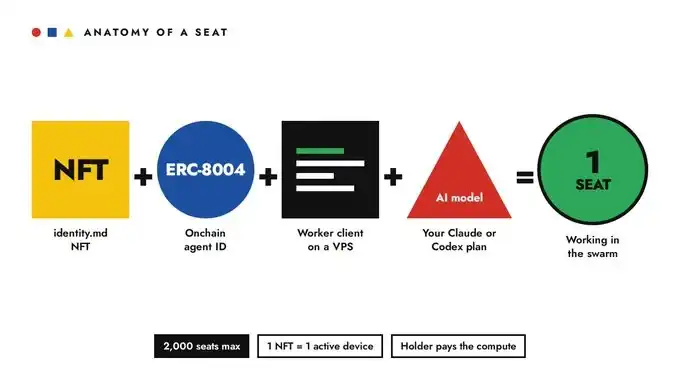
One NFT authorizes only one active device, and the computing cost is borne by the holder. High-value tasks, such as smart contract and frontend development, are currently only assigned to seats running top-tier models, like Claude Fable 5.1 high-intensity.

2) The Swarm

The main scheduler agent posts tasks to the network; seats claim, execute, and submit results. Validators rerun tasks in isolated containers, confirming that only allowed files are modified. Other seats conduct adversarial review, and approved outputs are recorded on-chain for reputation.

Outputs are visible in a public explorer, including code, websites, oracles, audits, reports, and images. Current code outputs are primarily Uniswap V4 hooks on testnets, websites published to IPFS, while oracles consist of multi-agent independent answer groups.

Starting this week, external users can also commission work. Anyone can post a job order for 0.5 IMD, settled via x402. Current deployment remains on the Sepolia testnet only, with mainnet deployment scheduled.

3) $IMD and sIMD

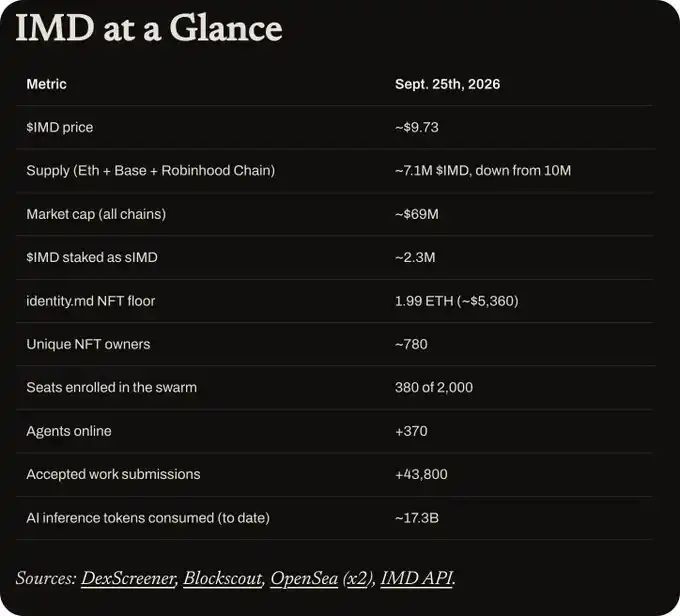
$IMD is the currency of this economy. The total supply is fixed, distributed across Ethereum, Base, and Robinhood Chain, bridgeable 1:1, and the total supply can only decrease. Calculated from cumulative burns since the Fren Pet era, the initial 10 million tokens have been reduced to approximately 7.1 million, a decrease of about 29%.

Holders can deposit IMD into the StakedIMD vault in exchange for sIMD. sIMD is an interest-bearing share under the ERC-4626 standard, redeemable for more IMD, with no lock-up period and no separate claiming required. Currently, about 2.3 million $IMD are staked, representing roughly 32% of the total supply. On September 19, Adam renounced ownership of the staking contract, preventing the admin from performing emergency withdrawals on behalf of stakers.

4) POOL4

The protocol itself holds the main ETH/IMD pool on Uniswap V4, called POOL4, operated by the CappedBurnHook. This hook sets an upper limit for the amount of IMD in the pool. When sell pressure pushes the pool's IMD count past this limit, the hook trims the excess portion upon trade settlement.
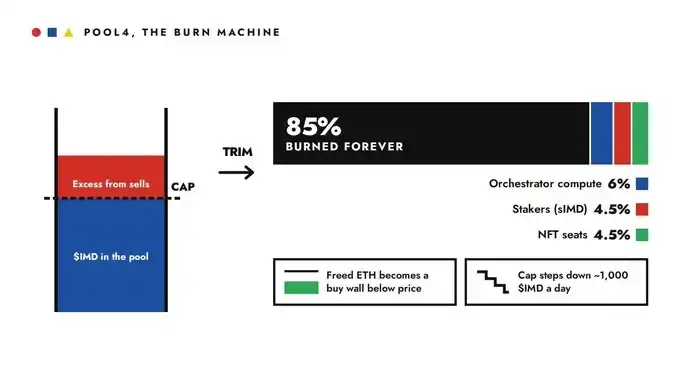
Of the trimmed tokens, 85% are burned, 6% are reserved for scheduling computing power, 4.5% are allocated to stakers, and 4.5% to NFT seats. The ETH freed up by the trim is then used to create buy walls below the current price. The upper limit is lowered by about 1000 $IMD daily to avoid stalling the mechanism. Sell pressure drives burning, and the burn subsequently rewards stakers and seats.

5) Community Coins

Community Coins is IMD's own launchpad. Anyone can launch a token by paying gas; each token has a total supply of 1 billion, with a bonding curve priced in $$IMD, not ETH. While trades appear to be conducted in ETH, each underlying purchase essentially buys $$IMD.

For each transaction, 1% is allocated to ETH/IMD liquidity providers, with 0.5% on the ETH side going to the token launcher and 0.5% on the $IMD side being burned. These new tokens share the same base pool, so buying any one of them raises the price of others, and selling any one lowers the price of others.

The Flywheel and the Swarm's Current State

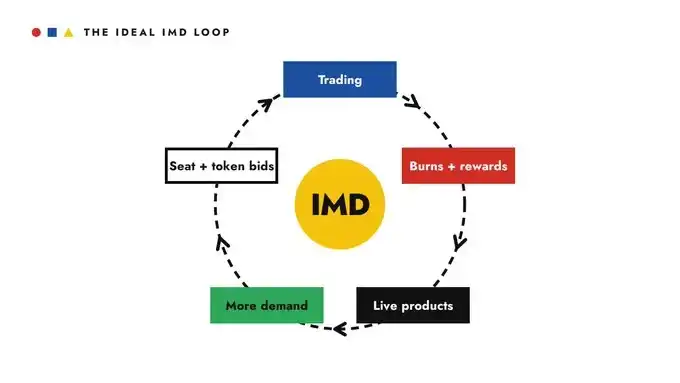
According to the current design, the ideal cycle is: users trade IMD and Community Coins; POOL4 trimming and burning reduce supply, benefiting stakers and seats; the scheduler agent converts demand into shippable products; useful outputs attract more people to launch IMD-priced tokens, commission work, and increase demand for seats; seat scarcity drives up NFT prices, and token demand along with burning drives up $IMD.
The crucial question is: can the swarm—the flywheel's foundation—actually work effectively now? According to IMD's public API data from September 25, approximately 380 out of the 2000 seats were registered at that time, with 372 agents online. Among registered seats, 334 had submitted accepted jobs, 267 had over 50 accepted records, and 193 had over 100. The top 10 seats accounted for about 8.5% of the accepted workload, and the top 50 for about 32%.
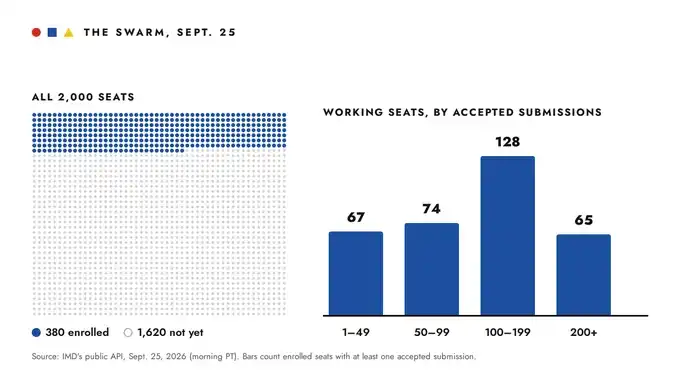
Quality data appears decent. Out of approximately 50.7k attempts, 86% were accepted, with only about 1% directly rejected, the rest being failures or queued. The pace is accelerating, with about 29.6k accepted submissions in the past 24 hours. Paid clients have just started entering: the public x402 channel currently has 115 orders, each 0.5 IMD, totaling about 57.5 $IMD, roughly $560. Paid demand has emerged but remains at an early stage.

Participation Paths
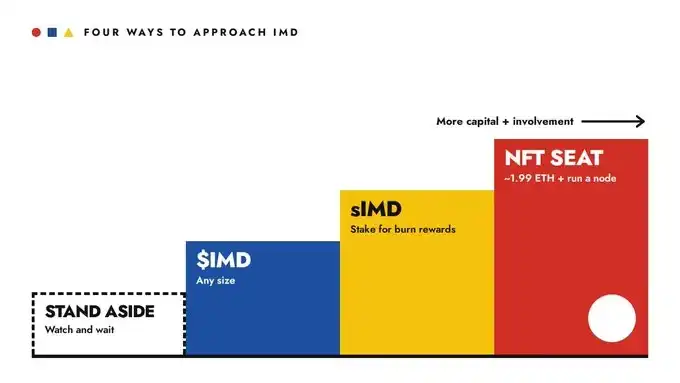
If interested in the project, IMD is a relatively straightforward way to participate. It's a fungible token with a lower barrier to entry, suitable for different capital sizes; seat prices are around 1.99 ETH. If one judges that trading volume and burns can be sustained, and that paid demand for the swarm can grow, IMD can be seen as exposure to the corresponding token sink. This bets on the token mechanism, not on agent ownership. One can later restake into sIMD, but the yield depends on whether sell flow enters the POOL4 Hook.

The NFT side is more suitable for advanced participants: one can run a node themselves or invest around 1.99 ETH (the floor price may fluctuate) to bet on seat productivity and scarcity. Current seat income is limited but may change in the future, warranting ongoing tracking. Seats are akin to options on future wages, while also occupying potential positions for whitelists, airdrops, etc. If one finds the project's mechanism complex or judges it as merely an on-chain experiment unlikely to expand outward, choosing to observe is also reasonable.

Conclusion

Can IMD reach the multi-billion dollar market cap of other leading agent projects, such as the scale of Virtuals? For reference, even after an ~85% drop from its all-time high, VIRTUAL's market cap is still around $508 million. For IMD to catch up from its current position, it would need to rise approximately 7x.
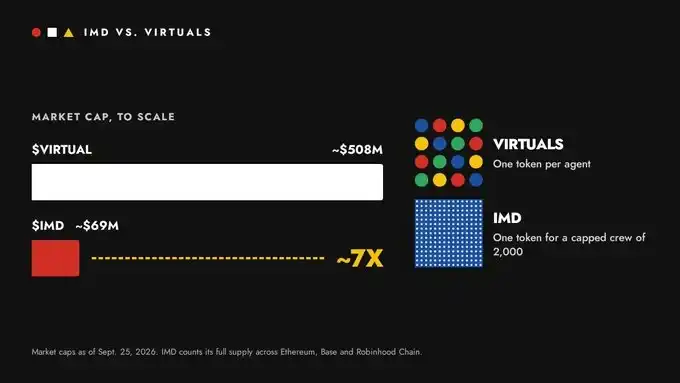
The two are not directly comparable. Virtuals issues separate tokens for each agent; IMD tokenizes the entire capped agent workforce and the system as a whole. Going forward, it's necessary to observe how the market coalesces around IMD. If it truly becomes a labor force swarm that more protocols are willing to pay for, significant gains are not impossible; if it remains just an on-chain experiment with a strong burn sink, the ceiling would be much lower.

Regardless of the outcome, IMD has already become one of the notable AI experiments in the Ethereum ecosystem as the year ends. If activity continues to rise and market momentum persists, it may become one of the trading narratives worth tracking in 2026.

Trending Cryptos

Related Questions

QWhat is the core value proposition of the IMD project according to the article?

AThe core value proposition of IMD is to build a community-owned company run by a swarm of AI agents. The underlying logic is that this agent swarm could become a paid workforce for other protocols, such as for inference oracles or other broader applications.

QHow does the POOL4 CappedBurnHook mechanism work to manage the supply of $IMD?

AThe POOL4 CappedBurnHook sets an upper limit on the number of IMD tokens within the Uniswap V4 liquidity pool. When selling pressure pushes the pool's IMD count above this cap, the hook 'trims' the excess tokens after a trade settles. Of the trimmed tokens, 85% are burned, 6% goes to the scheduler's compute reserve, 4.5% is distributed to sIMD stakers, and 4.5% goes to NFT seat holders.

QWhat are the two main tokens involved in the IMD ecosystem and what is their primary function?

AThe two main tokens are $IMD and sIMD. $IMD is the fixed-supply native currency of the ecosystem, used for transactions, fees, and value accrual. sIMD is an ERC-4626 yield-bearing token received for staking $IMD in the StakedIMD vault, allowing holders to earn a share of protocol revenues (like from the POOL4 hook) without locking periods.

QWhat is required to participate in the IMD agent swarm as a worker, and what is the current status of the swarm's activity?

ATo participate, one must own an identity.md NFT (a 'seat'), register it as an agent under the ERC-8004 standard, and run the open-source worker client on a machine with access to an AI model subscription (e.g., Claude). As of the article's data (Sept 25), about 380 of the 2000 seats were registered, with 372 agents active. The swarm showed promising activity, with an 86% acceptance rate on over 50,000 task attempts and nearly 30,000 accepted submissions in the last 24 hours.

QWhat are the two main investment avenues for participating in the IMD project mentioned in the article, and what do they represent?

AThe two main avenues are: 1) Buying the $IMD token, which offers exposure to the token's deflationary mechanics and is suitable for different capital sizes. It's a bet on the token's demand and burn mechanism. 2) Buying an identity.md NFT (seat), which represents ownership of an agent in the swarm. This is more advanced, akin to an 'option on future wages' from the swarm's work, and provides potential for airdrops and whitelists, betting on the scarcity and productivity of the seats.

Related Reads

Google says hackers use AI agents to find and exploit software flaws

Google Threat Intelligence Group (GTIG) has for the first time identified attackers using AI large language model frameworks to automate software vulnerability discovery and exploitation without step-by-step human direction. In a report published Monday, researchers described a tool found on an exposed staging server that compared software versions, identified potential flaws, and generated and executed exploit code. GTIG said threat actors used LLM frameworks to fully automate vulnerability discovery and exploitation without a human in the loop, hosting a multi-agent vulnerability research and weaponization framework designed to conduct continuous differential analysis comparing code before and after patch announcements on popular web applications, autonomously discovering and exploiting software vulnerabilities. Google warned these automated workflows give organizations less time to apply security patches before attackers develop ways to exploit vulnerable systems. Attackers are leveraging AI agent frameworks to automate patch reverse engineering via differential analysis and weaponizing N-day vulnerabilities. Vulnerability disclosures more than doubled between January and August, with exploited zero-days averaging eight per month in 2025 and 11 per month from January through August 2026, reaching 22 in August. Automated workflows also accelerate attackers' ability to move from initial access to domain administrator access, as cited in an August 2026 PaperCut campaign where attackers achieved that control within minutes. GTIG said two PHP vulnerabilities involved in exploitation attempts were discovered using LLM analysis. Anthropic also warned that AI-assisted attacks have evolved into multi-agent operations automating most of the cyberattack cycle from discovery to exploitation and data theft.

cointelegraph53m ago

Google says hackers use AI agents to find and exploit software flaws

cointelegraph53m ago

Coin-Stock Trend Indicator丨Third-largest BTC treasury company Twenty One Capital buys $10 million in BTC for the first time since July 2025; Bitmine total holdings value drops $2.5 billion in a week (November 17)

This week's crypto stock snapshot notes that the recent US equity move was merely an oversold rebound rather than a new high, with the impact of the Democratic midterm election win still spreading and Nvidia founder Jensen Huang's resignation controversy evolving into a broader AI-sector storm. The week's biggest US market event is Anthropic's IPO on November 19, though its fundraising and valuation fall short of SpaceX's record. Japanese stocks remain favored by Morgan Stanley analysts despite AI-related weakness, while Korean stocks fell 2.59% to 4,968.45, their lowest since February 2. In crypto stocks, last week's market crash hit DAT treasury companies hard, with ETH treasury firm Bitmine's holdings value dropping from $14.3 billion to $11.8 billion in a week, nearly all due to ETH's price decline. Listed companies (excluding miners) bought a net $51.86 million in Bitcoin last week, down 45.2% week-over-week. Strategy bought 485 BTC at $68,887 each for about $33.4 million, bringing total holdings to 850,849 BTC; Metaplanet bought none. Capital B bought 12 BTC at $77,500.2, holding 3,550 BTC; Strive bought 251 BTC at $69,853 for about $17.53 million, holding about 43,404 BTC. Total tracked holdings reached 1,171,317 BTC, up 0.04% week-over-week, worth about $75.53 billion, or 5.8% of Bitcoin's circulating market cap. Twenty One Capital bought 154.32 BTC for about $10 million in cash, its first purchase since July 2025, bringing holdings to about 43,700 BTC and making it the third-largest listed Bitcoin treasury; CEO Rapha Zagury said volatility creates opportunity and the firm bought the dip. BitMine added 7,653 ETH last week, holding 6,077,745 ETH (4.97% of total supply, 0.03% short of its 5% goal) plus 216 BTC, a $180 million investment in Beast Industries, $67 million in Eightco Holdings, and $448 million in cash and securities; its ETH holdings are worth about $11.1 billion at $1,823 per ETH. Chairman Tom Lee attributed ETH's 28% two-week drop to Nvidia-related turmoil triggering Asian margin selling and investors raising cash for Anthropic's reported November 18 IPO, saying it contradicts improving fundamentals. DeFi Development Corp. added 9,482 SOL, with Solana treasury holdings reaching about 2.62 million tokens, growing for a 10th straight week; its CHAD preferred stock raised enough to buy over 230 SOL today. CZ said Japan-listed ASIAN STAR will distribute 8 million yen worth of BNB to shareholders and pursue Japanese real estate tokenization on BNB Chain. DeFi Technologies reported Q3 2026 revenue of $18.3 million (down about 18% year-over-year), operating income of $7 million, and net profit of $22.3 million, with $53.4 million in cash and stablecoins and $48.2 million in digital assets. Ripple-backed Evernorth disclosed its 346 million XRP was booked at $342 million versus an initial $847 million record value, with cumulative impairments of $505 million, a nearly 60% decline.

marsbit1h ago

Coin-Stock Trend Indicator丨Third-largest BTC treasury company Twenty One Capital buys $10 million in BTC for the first time since July 2025; Bitmine total holdings value drops $2.5 billion in a week (November 17)

marsbit1h ago

Trading

Spot

Hot Articles

Discussions

Welcome to the HTX Community. Here, you can stay informed about the latest platform developments and gain access to professional market insights. Users' opinions on the price of ETH (ETH) are presented below.

活动图片