After Losing Tens of Millions of Dollars, Abstract Announced Shutdown. Is a Wave of L2 Exits Coming?

marsbitPublished on 2026-10-08Last updated on 2026-10-08

Abstract

Layer 2 blockchain project Abstract, backed by the Pudgy Penguins team (Igloo Inc.), has announced its shutdown scheduled for December 15th, after nearly two years of operation. The project, which positioned itself as a "consumer-grade blockchain network," reportedly incurred tens of millions of dollars in operational losses. The closure has sparked debate within the crypto community. Supporters commend the team for responsibly winding down without a token launch (TGE) to potentially "cash out." Critics, however, argue that users who invested significant time and money into the ecosystem—through activities like badge systems and network interactions—are left with nothing, feeling misled by earlier optimistic promises from leadership. Analysis points to several key reasons for Abstract's failure: 1) Underdeveloped DeFi ecosystem with low TVL and trading volume, limiting fee-based revenue; 2) Lack of institutional participation and liquidity, missing major trends like RWA; 3) High operational costs for infrastructure, partnerships, and marketing; 4) Unclear product-market fit, as the network failed to attract either a vibrant meme culture like Solana or significant institutional capital flows. The article suggests Abstract's shutdown, following similar moves by other L2s like Blast, may signal the beginning of a broader consolidation wave for unsustainable Layer 2 networks. This trend highlights the intense competition and challenges projects face in achieving viable economi...

Original|Odaily Planet Daily(@OdailyChina)

Author|Wenser(@wenser 2010)

On October 7th, Abstract, the L2 project under Igloo, the parent company of Pudgy Penguins, officially announced it will shut down on December 15th of this year. This "consumer-grade L2 public chain," once placed with high hopes by the Pudgy Penguins team and numerous NFT players, is concluding its nearly two-year operation, ending in a somewhat regrettable manner.

After the announcement, market opinions diverged sharply. One faction believes that the Pudgy Penguins team did not choose to "conduct a final round of token distribution (TGE) and cash out" as some other L2 teams have, showing integrity from start to finish. However, another faction strongly disagrees. They argue that the tens of millions of dollars in operational losses mentioned by Pudgy Penguins CEO Luca Netz in his lengthy announcement, as well as Abstract's previous operational activities like the badge system which were somewhat "PUA-style," were largely paid for by users. Many had pinned their hopes on Abstract's potential token launch to recoup losses, a hope now completely dashed.

Behind Abstract's shutdown, the hype surrounding Robinhood Chain's launch has cooled, and Blast has also announced its shutdown. Following the wave of some CEX closures, perhaps more unsustainable L2s will face a wave of shutdowns.

"Consumer-Grade Blockchain Network" Finds No Takers: DeFi, Meme, and Institutional Capital All Fail to Gain Traction

Looking back at Abstract's development, its positioning as a "consumer-grade encrypted blockchain network" might not have been a good business idea from the start.
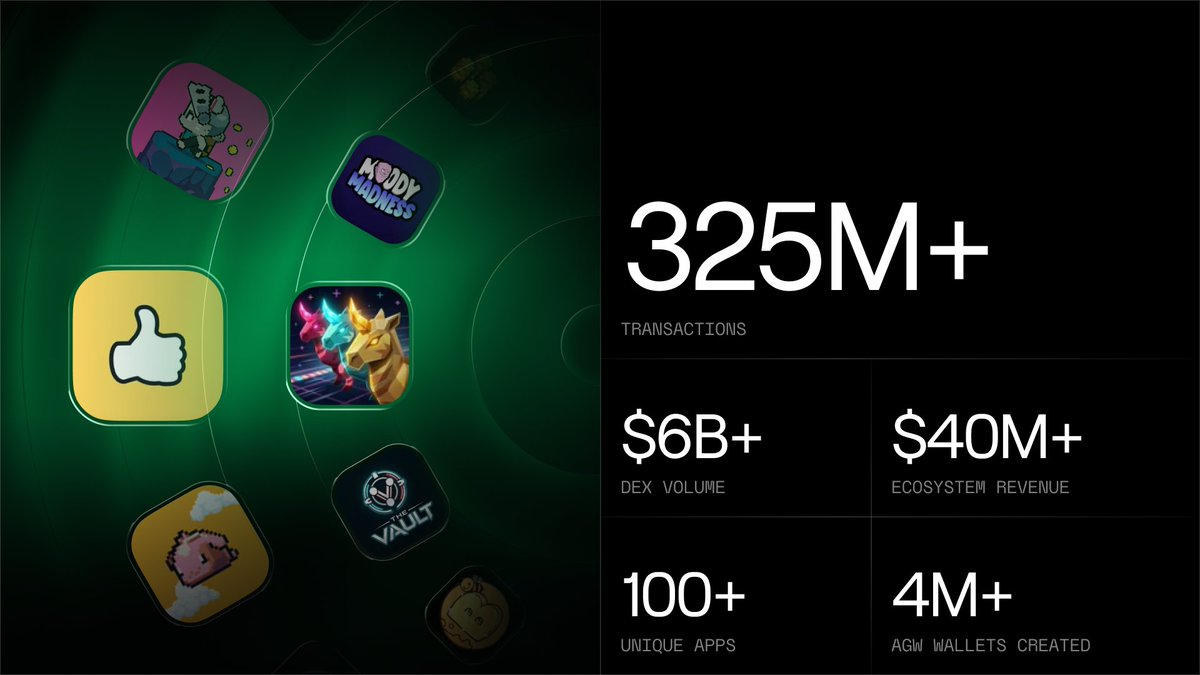
According to Abstract's official statements, the L2 network had attracted over 400,000 cumulative users and deployed more than 144 applications. Pudgy Penguins CEO Luca Netz also stated that Abstract had processed over 325 million on-chain transactions, launched Portal and AGW, and attracted global brands like Disney and Red Bull. On the surface, Abstract's performance seemed decent. However, what ultimately led it into an "operational dead end" might be similar to a strategic miscalculation made by Base in recent years regarding "crypto-social + on-chain consumption"—it neither followed the grassroots route like Solana and Robinhood Chain to develop its own Meme ecosystem, nor did it deeply cultivate DeFi around institutional and large investor needs to attract liquidity and complete its business self-sufficiency loop.

Main Reasons for Shutdown: Insufficient DeFi Ecosystem, Lack of Institutional Involvement, High Operational Costs, and Unclear PMF

Based on official announcements from Abstract and posts by Pudgy Penguins CEO Luca Netz, we can glimpse the "main causes of death" for this L2 network:

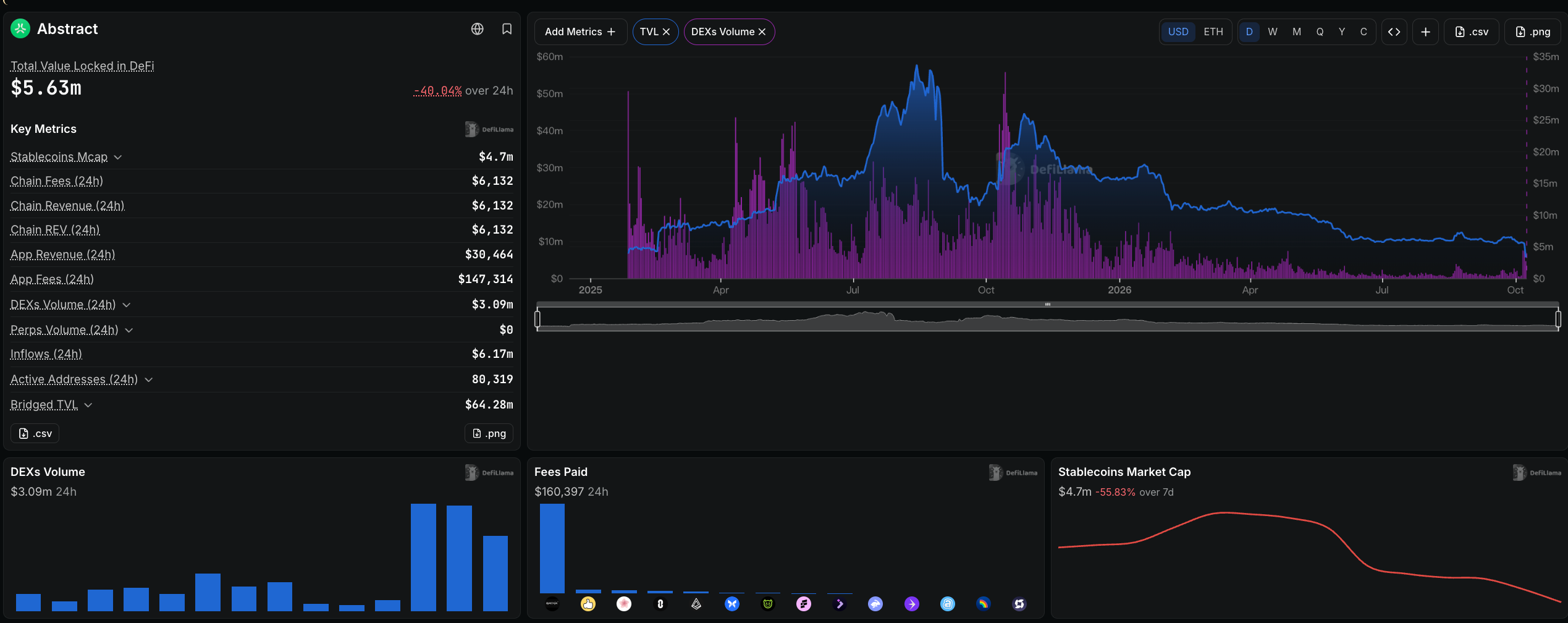
First, insufficient DeFi ecosystem; Although Abstract claimed its DEX trading volume reached $6 billion, considering its nearly two-year operational period, this is hardly an impressive figure. According to Defilama data, Abstract's DeFi TVL is currently around $5.6 million, ranking 90th among major L1 and L2 networks, with a 24-hour drop of about 40%. While heavily impacted by the shutdown news, its DEX trading volume had long fluctuated between $300k-$1 million; its stablecoin market cap saw a nearly 60% drop over 7 days, now standing at only $4.7 million.

For an L2 network, a failed DeFi ecosystem development almost inevitably means limited ecological activity, limited real user base, and difficulty in generating revenue and achieving self-sufficiency through fees.
Second, low institutional participation and limited liquidity. This is one of the important reasons for Abstract's shutdown. Taking RWA asset data as an example, Abstract is essentially "absent" on RWA asset TVL network rankings. It also largely missed out on the major crypto and traditional finance trends of the past two years, such as institutional investment channels, the RWA asset wave, and stock tokenization trading. From this perspective, it represents an extremely serious strategic misjudgment.
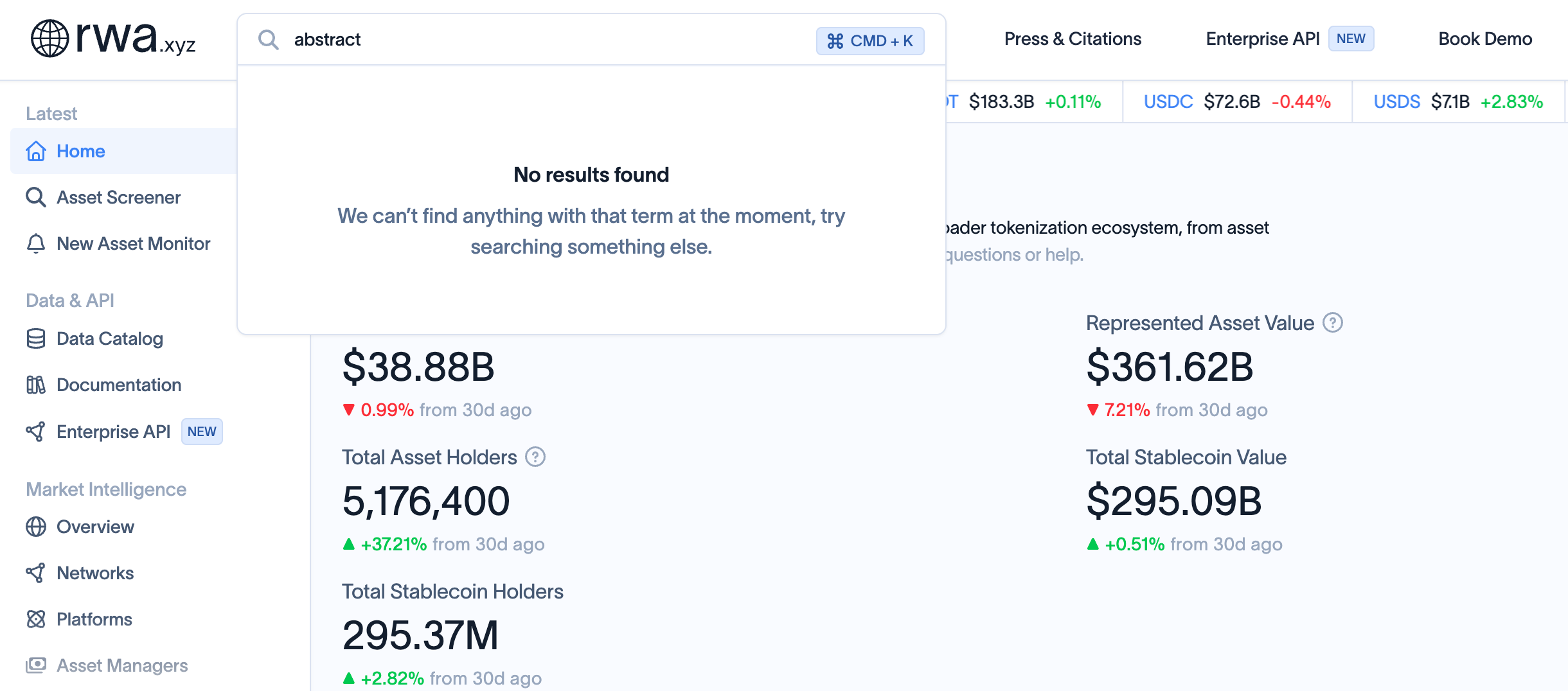
Third, excessively high operational costs. Beyond the fixed operating expenses of an L2 (Odaily Planet Daily Note: including sequencer operations, ZK-related data availability and proof costs, bridging and front-end maintenance, infrastructure development, team operational costs, ecosystem incentives/developer support, etc.), Abstract's collaborations with traditional brands, partnerships, and offline events also required significant spending. The seemingly glamorous L2 path is not as low-cost as many imagine. Early technical development, mid-term growth operations, and long-term ecosystem building all require continuous capital investment. Abstract's shutdown also carries a sense of cutting losses in time.

Fourth, declining demand for related products and unclear PMF. Unlike the favorable situation Pudgy Penguins previously enjoyed due to its NFT community, physical toy IP, PENGU token launch, and a favorable crypto bull market, the current crypto market's demands on L2 networks, and even L1 public chains, are no longer limited to small-scale project prosperity. Instead, it requires "ecosystem-level hubs" like Hyperliquid and Robinhood Chain, which enable pre-pricing of traditional financial assets and introduce liquidity and institutional capital from traditional financial markets, thereby reaping the benefits of "fee harvesting." This is precisely the market that Abstract and numerous other L2 networks have been unable to tap into.

Beyond these reasons, homogeneous competition among L2 networks and the rapid alternation of crypto market bull and bear cycles are also contributing factors to Abstract's reluctant shutdown. And following Abstract's closure, heated debates have emerged in the market.

Praise vs. Criticism: No Intent to Cash Out or "PUA to the End"?

After Abstract's official shutdown announcement, the crypto community engaged in fierce debate. Here are some representative viewpoints:

Yuga Labs VP 0xQuit posted: "Abstract did a decent thing. They could have followed Blast's model and directly launched a token (TGE) to raise a massive amount of money. Instead, they admitted failure, choosing to wind down the project without a TGE. Sure, people still lost money, but it could have been much worse. Respect."

Community member Loki agreed: "Abstract could have done a TGE at any point before shutting down, like countless L2 projects with no users, but they didn't. Pudgy Penguins co-founder and CCO @chefgoyardi and CEO @LucaNetz bought the project with their own money and never cashed out from the community. Now, with Abstract, they've shown their integrity again. The best news: refocusing on the Pudgy Penguins project." His words express continued confidence in the Pudgy Penguins team.

However, others expressed extreme dissatisfaction, particularly users who invested real money, time, and effort into Abstract's ecosystem and network interactions.

Abstract power user Micka posted on X: "I participated in @AbstractChain during the testnet in July 2024. I built the French community, posted thousands of tweets about Abstract, and streamed over 1500 hours of Abstract mainnet content in 2025. I spent thousands of dollars over one year and ten months, accumulating 4 million Abstract interaction XP." Now, Abstract has fallen even before completing the first phase of its three-stage roadmap. He is "speechless" and "will no longer trust Luca."

Another community member, Chris, criticized sharply: "I sold all my PENGU tokens. That Space they used to announce the shutdown of Abstract services was awful, like they hadn't discussed it beforehand and hastily threw it together last minute. I somewhat understand their move because they didn't want to shut down after launching the ABS token via TGE. But what I really dislike is the overall narrative framework. Their response was a cold 'badges are useless anyway' and 'you supported our startup project.' The worst blow was when someone asked Luca if any Abstract users would receive any rewards from the Pudgy Penguins ecosystem, he immediately said no without hesitation, basically stating that what users can currently access in the ecosystem is it. This went on for far too long, completely unnecessarily. As a streamer, someone who diamond-handed tokens to zero for engagement, who invested massive time and effort weekly for six months, creating content series around this vision, I'm deeply disappointed in how this turned out."

Others even dug up an interview video of Luca from last year's Paris NFT conference, where he expressed full confidence in Abstract's future, claiming "Abstract will become the biggest L2 network in the future," and asked everyone to wait and see. Now, many received the official notice of Abstract's shutdown.

The brutal reality checks in the crypto market seem to keep happening. Often, you can't foresee that the project you invest heavily in will definitely be the winner at the table, just as you can't guarantee you'll reach the South Pole as long as you keep walking.

Conclusion: After the CEX Shutdown Wave, the L2 Shutdown Wave Has Arrived

After years in the space, I've seen too many failures—in sectors like NFT, GameFi, SocialFi, and the recent wave of CEX closures. Earlier, I even interviewed Luca Netz around January 2025. Back then, similar to his state at the NFT Paris conference, he was full of grand ambitions for the future of Abstract, Pudgy Penguins, and the Igloo group, placing high hopes on PENGU's prospects.

However, the development of things often doesn't follow individual will. The success or failure of a crypto project depends on numerous factors: beyond the usual track, strategy, and direction, there's also funding, business model, ecosystem building. It relies on the participation of institutions, market makers, and retail investors, and sometimes requires a bit of time and luck.

Just as I wrote numerous articles last year discussing "L2 is a detour for Ethereum," the shutdowns of Abstract and Blast are not the end of the exodus for these "ghost town" L2s. In the current climate where various models and projects are being proven unviable, projects unable to connect with traditional financial markets may need to reconsider their future direction and path forward.

Related Questions

QWhat is the main reason given for the shutdown of the Abstract L2 network?

AThe main reasons include insufficient DeFi ecosystem development, lack of institutional participation and liquidity, high operational costs, unclear product-market fit (PMF), intense homogenized competition among L2s, and the fast-paced shifts between crypto bull and bear markets.

QHow did some community members, like Yuga Labs VP 0xQuit, view Abstract's decision to shut down?

AYuga Labs VP 0xQuit viewed Abstract's shutdown as a decent move. He stated that the team could have chosen to conduct a TGE (Token Generation Event) to raise significant funds but instead admitted failure and chose to wind down the project without issuing a token, showing integrity.

QWhat was a major point of criticism from users like Micka regarding Abstract's shutdown?

AUsers like Micka criticized the shutdown because they had invested significant time, money, and effort into the Abstract ecosystem since the testnet phase, building communities and creating content. They felt betrayed that the project shut down before completing its roadmap, rendering their contributions and hopes for rewards meaningless.

QAccording to the article, what strategic misjudgment did Abstract make regarding institutional participation?

AThe article states that Abstract made a severe strategic misjudgment by largely missing out on major trends like institutional investment channels, the RWA (Real World Assets) wave, and stock tokenization trading over the past two years, failing to attract institutional liquidity.

QWhat broader trend does the article suggest might follow the shutdown of Abstract and Blast?

AThe article suggests that after the wave of CEX (Centralized Exchange) shutdowns, a wave of L2 (Layer 2) network shutdowns may have begun, indicating that projects unable to establish meaningful connections with traditional finance might struggle to survive.

Related Reads

Google says hackers use AI agents to find and exploit software flaws

Google Threat Intelligence Group (GTIG) has for the first time identified attackers using AI large language model frameworks to automate software vulnerability discovery and exploitation without step-by-step human direction. In a report published Monday, researchers described a tool found on an exposed staging server that compared software versions, identified potential flaws, and generated and executed exploit code. GTIG said threat actors used LLM frameworks to fully automate vulnerability discovery and exploitation without a human in the loop, hosting a multi-agent vulnerability research and weaponization framework designed to conduct continuous differential analysis comparing code before and after patch announcements on popular web applications, autonomously discovering and exploiting software vulnerabilities. Google warned these automated workflows give organizations less time to apply security patches before attackers develop ways to exploit vulnerable systems. Attackers are leveraging AI agent frameworks to automate patch reverse engineering via differential analysis and weaponizing N-day vulnerabilities. Vulnerability disclosures more than doubled between January and August, with exploited zero-days averaging eight per month in 2025 and 11 per month from January through August 2026, reaching 22 in August. Automated workflows also accelerate attackers' ability to move from initial access to domain administrator access, as cited in an August 2026 PaperCut campaign where attackers achieved that control within minutes. GTIG said two PHP vulnerabilities involved in exploitation attempts were discovered using LLM analysis. Anthropic also warned that AI-assisted attacks have evolved into multi-agent operations automating most of the cyberattack cycle from discovery to exploitation and data theft.

cointelegraph23m ago

Google says hackers use AI agents to find and exploit software flaws

cointelegraph23m ago

Coin-Stock Trend Indicator丨Third-largest BTC treasury company Twenty One Capital buys $10 million in BTC for the first time since July 2025; Bitmine total holdings value drops $2.5 billion in a week (November 17)

This week's crypto stock snapshot notes that the recent US equity move was merely an oversold rebound rather than a new high, with the impact of the Democratic midterm election win still spreading and Nvidia founder Jensen Huang's resignation controversy evolving into a broader AI-sector storm. The week's biggest US market event is Anthropic's IPO on November 19, though its fundraising and valuation fall short of SpaceX's record. Japanese stocks remain favored by Morgan Stanley analysts despite AI-related weakness, while Korean stocks fell 2.59% to 4,968.45, their lowest since February 2. In crypto stocks, last week's market crash hit DAT treasury companies hard, with ETH treasury firm Bitmine's holdings value dropping from $14.3 billion to $11.8 billion in a week, nearly all due to ETH's price decline. Listed companies (excluding miners) bought a net $51.86 million in Bitcoin last week, down 45.2% week-over-week. Strategy bought 485 BTC at $68,887 each for about $33.4 million, bringing total holdings to 850,849 BTC; Metaplanet bought none. Capital B bought 12 BTC at $77,500.2, holding 3,550 BTC; Strive bought 251 BTC at $69,853 for about $17.53 million, holding about 43,404 BTC. Total tracked holdings reached 1,171,317 BTC, up 0.04% week-over-week, worth about $75.53 billion, or 5.8% of Bitcoin's circulating market cap. Twenty One Capital bought 154.32 BTC for about $10 million in cash, its first purchase since July 2025, bringing holdings to about 43,700 BTC and making it the third-largest listed Bitcoin treasury; CEO Rapha Zagury said volatility creates opportunity and the firm bought the dip. BitMine added 7,653 ETH last week, holding 6,077,745 ETH (4.97% of total supply, 0.03% short of its 5% goal) plus 216 BTC, a $180 million investment in Beast Industries, $67 million in Eightco Holdings, and $448 million in cash and securities; its ETH holdings are worth about $11.1 billion at $1,823 per ETH. Chairman Tom Lee attributed ETH's 28% two-week drop to Nvidia-related turmoil triggering Asian margin selling and investors raising cash for Anthropic's reported November 18 IPO, saying it contradicts improving fundamentals. DeFi Development Corp. added 9,482 SOL, with Solana treasury holdings reaching about 2.62 million tokens, growing for a 10th straight week; its CHAD preferred stock raised enough to buy over 230 SOL today. CZ said Japan-listed ASIAN STAR will distribute 8 million yen worth of BNB to shareholders and pursue Japanese real estate tokenization on BNB Chain. DeFi Technologies reported Q3 2026 revenue of $18.3 million (down about 18% year-over-year), operating income of $7 million, and net profit of $22.3 million, with $53.4 million in cash and stablecoins and $48.2 million in digital assets. Ripple-backed Evernorth disclosed its 346 million XRP was booked at $342 million versus an initial $847 million record value, with cumulative impairments of $505 million, a nearly 60% decline.

marsbit48m ago

Coin-Stock Trend Indicator丨Third-largest BTC treasury company Twenty One Capital buys $10 million in BTC for the first time since July 2025; Bitmine total holdings value drops $2.5 billion in a week (November 17)

marsbit48m ago

SMIC Closes In on Global No. 2

SMIC is closing in on the global foundry industry's second place. In the first three quarters of 2026, the company reported revenue of 60.618 billion yuan (up 22.43% year-on-year) and net profit of 7.314 billion yuan (up 91.57%), with gross margin hitting a four-year high of 25.59%. In Q2, Samsung held 5.9% of the global foundry market versus SMIC's 5.4%—a gap of just 0.5 percentage points, down from 1.4 points the previous quarter. Revenue-wise, the two were only about $254 million apart in Q2, and SMIC's Q4 guidance of $3.32–3.38 billion would exceed Samsung's Q2 level. Growth is no longer driven mainly by smartphones, whose share of wafer revenue fell from 21.5% to 14.3%, amid a 15.2% decline in domestic smartphone shipments. Instead, industrial and automotive revenue nearly doubled, rising from 11.9% to 19.3% of revenue, while computer and tablet revenue grew about 55%. SMIC has invested in BCD processes covering battery management, digital isolation, and smart power switches, with some processes meeting Grade 0 automotive standards. AI demand is also creating new opportunities in mature-node chips such as power management, controllers, and specialty memory; customer pull for these AI-supporting chips exceeded expectations, prompting SMIC to trim engineering and R&D wafers to prioritize mass-production orders. Q3 wafer shipments exceeded 3 million 8-inch equivalent wafers for the first time, with utilization at 97.3%. A key financial inflection point: after tripling capacity over a decade (from 339,000 to 1.1168 million wafers per month), SMIC's capital expenditure is falling—Q3 capex dropped 56.5% year-on-year to 7.423 billion yuan, and cash paid for fixed assets fell over 30% versus 2024 and 2025. Major expansion projects in Shanghai, Beijing, Tianjin, and Shenzhen are 95–98% complete, with construction-in-progress declining from 92.619 billion to 62.652 billion yuan as projects transfer to fixed assets. However, management cautions that longer equipment lead times could disrupt capex pacing, and Q4 gross margin guidance of 26–28% is below Q3's 29.9% due to new capacity and R&D costs. The next decade's challenge is not just overtaking Samsung, but proving that past massive investments can steadily convert into real profits and cash flow.

marsbit57m ago

SMIC Closes In on Global No. 2

marsbit57m ago

Trading

Spot
活动图片