A Once-in-300-Years Event? Independent Solo Miner "Hits the Jackpot," Claims $220K Bitcoin Block Reward Alone

marsbitPublished on 2026-04-10Last updated on 2026-04-10

Abstract

A solo Bitcoin miner with only 70 TH/s of hashrate has successfully mined block 944,306, earning the full 3.128 BTC block reward (approx. $222,000). This miner’s computing power represents just 0.000007% of the total network hashrate, making the probability of such an event roughly once every 300 years on average. The miner used CKpool’s solo mining service, which allows individual miners to work independently rather than in a pool, keeping the full reward minus a 2% fee. This is the 313th solo block mined via CKpool since 2014. Remarkably, this is the second such unlikely event within ten days, highlighting the lottery-like nature of solo mining—where small miners occasionally win big despite extremely low odds.

Author: Claude, Shenchao TechFlow

Shenchao Guide: An independent miner with only 70 TH/s of computing power successfully mined Bitcoin block 944,306 through CKpool's solo mode, claiming the full reward of 3.128 BTC (approximately $222,000 USD). This computing power represents only 0.000007% of the entire network's total, theoretically taking an average of 300 years to mine a single block.

An independent Bitcoin miner has just accomplished a feat of probability.

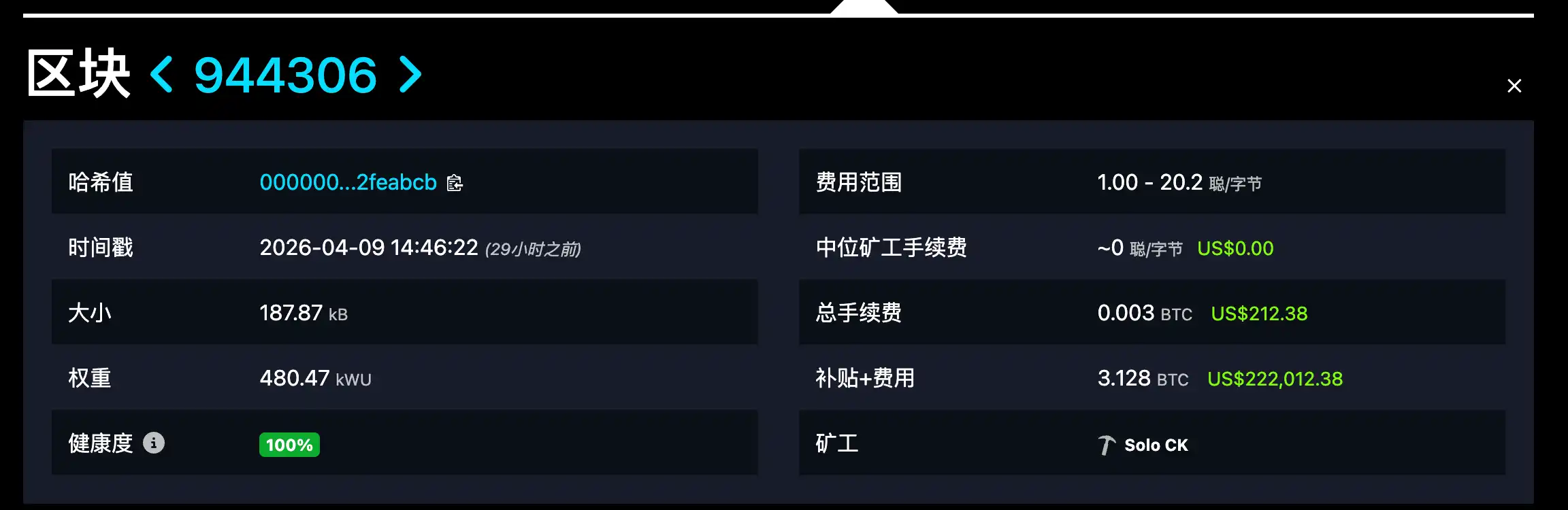
On April 9th, a miner with approximately 70 TH/s of power successfully solved Bitcoin block 944,306 using CKpool's solo mining service, receiving the full block reward of 3.128 BTC, worth about $222,000 USD at the time. This consisted of a 3.125 BTC block subsidy and 0.003 BTC in transaction fees.

70 TH/s is roughly equivalent to a Bitmain Antminer S17+ produced in 2019. Compared to the current Bitcoin network's total hashrate of about 1.02 ZH/s (1,020,000,000 TH/s), this single miner's share was a mere 0.000007%.
A One-in-a-Hundred-Thousand Daily Probability, Theoretically a Once-in-300-Years Event

CKpool developer Con Kolivas confirmed the event on platform X, noting that a miner of this hashpower size has a daily probability of solving a block of about one in a hundred thousand, translating to an expected value of roughly once every 300 years.

CKpool is a mining pool service that allows miners to operate in solo mode. Unlike traditional pools that aggregate hashrate and distribute rewards proportionally, solo mode involves miners accepting an extremely low probability of success individually, but should they succeed, they keep the full block reward (minus a 2% platform charge). Miners do not need to operate their own full Bitcoin node; they simply point their mining hardware to CKpool's servers to participate.

This is the 313th solo block produced by CKpool since its launch in 2014.

Second Solo Jackpot in Ten Days, Small Miners Score Surprise Wins

This is not the only recent solo mining surprise. Just about a week earlier, another CKpool miner mined block 943,411, receiving a reward of approximately $210,000 USD. That miner had higher hashrate but was considered small-scale nonetheless, with a daily success probability of about one in twenty-eight thousand.

Two solo wins within ten days constitutes a rare clustering phenomenon in statistical terms, but it does not change the fundamental landscape. Currently, Bitcoin mining is dominated by large mining pools. According to public data, Foundry USA, AntPool, and ViaBTC collectively control over 65% of the network's total hashrate. The operational hashrate of listed mining companies like Bitdeer and MARA Holdings reaches 71 EH/s and 61.7 EH/s respectively, representing a difference of six orders of magnitude compared to 70 TH/s.

For independent miners, solo mining is essentially a lottery ticket: daily electricity costs are only a few dollars, but the winning payout exceeds $220,000 USD. The expected value is negative, but the asymmetric return structure continues to attract a group of mining enthusiasts to participate persistently.

Trending Cryptos

Related Questions

QWhat was the hashrate of the solo miner who successfully mined Bitcoin block 944,306, and how much was the block reward worth?

AThe solo miner had a hashrate of 70 TH/s and received a full block reward of 3.128 BTC, which was worth approximately $222,000 at the time.

QWhat is the 70 TH/s hashrate as a percentage of the total Bitcoin network hashrate, and what is the theoretical average time for such a miner to find a block?

AThe 70 TH/s hashrate represents 0.000007% of the total network hashrate (approximately 1.02 ZH/s). Theoretically, a miner of this size would find a block on average once every 300 years.

QWhat is CKpool and how does its solo mining mode differ from traditional pooled mining?

ACKpool is a mining pool service that allows miners to operate in solo mode. Unlike traditional pooled mining, where miners combine their hashrate and share rewards proportionally, solo miners work alone, face extremely low success probability, but keep the full block reward (minus a 2% platform fee) if they successfully mine a block, without needing to run a full Bitcoin node.

QHow many solo blocks has CKpool produced since its launch in 2014?

ACKpool has produced a total of 313 solo blocks since its launch in 2014.

QWhat was notable about solo mining events on CKpool in the 10 days prior to this article?

AApproximately a week before this event, another CKpool solo miner with a small hashrate (though higher than 70 TH/s) successfully mined block 943,411, receiving a reward of about $210,000. Two such unlikely solo mining successes within ten days is a statistically rare clustering event.

Related Reads

Polygon's Tokenomics Inflection Point: Base Fee Burn Approaches New Coin Minting, POL Valuation Multiple Only Half of TRX

Polygon is undergoing a key tokenomics transition from a single scaling solution to a payment settlement base. Its acquisition of Coinme brought money transmitter licenses covering 48 U.S. states, and combined with its high-frequency on-chain stablecoin payment network, Polygon's base fee revenue has exceeded current token inflation minting for several months. In 2025, base network fees paid by users equaled only 5% of newly minted POL that year; from January to September 2026, that ratio climbed to 86%, and in five separate months burned base fees fully surpassed new minting. By September 2026, Polygon was the busiest stablecoin settlement network, processing 17.6 million stablecoin transfers daily—one-third of the nine major chains' total. Median transfer fees rose fivefold over 18 months while transfer counts surged 7.5x, showing strong payment demand. POL trades at less than half of TRX's valuation multiple: 41.2x trailing 12-month on-chain fees versus TRX's 87.5x. The base fee burn reserve is now nearly equal to newly minted POL, and stakers receive half of the validator priority fee pool via PIP-85. Stablecoin transfers drove 72% of gas consumption in the first nine months of 2026, with average transfer size of $175 versus $1,254 on Solana and $3,850 on Ethereum. POL's valuation multiple has compressed to around 30x, with a market cap of about $949 million against $31.6 million in annualized fees, suggesting the market is lagging in repricing Polygon's payment fundamentals.

marsbit49m ago

Polygon's Tokenomics Inflection Point: Base Fee Burn Approaches New Coin Minting, POL Valuation Multiple Only Half of TRX

marsbit49m ago

Behind the US Stock Market Crash and Rebound: Is Deleveraging Nearing Its End, or the Prelude to Medium- and Long-Term Risks?

U.S. stocks experienced extreme volatility over two trading days. On November 5, the market suffered its sharpest single-day selloff in 19 months, led by AI-related stocks, fueling social media rumors of hedge fund liquidations. The next day, however, chip stocks spearheaded a rebound: the Philadelphia Semiconductor Index rose 4.2%, AMD jumped 11%, and the Nasdaq gained 1.1%. Vanda Research showed retail investors turned net buyers in the final ten minutes of the previous session, purchasing over $100 million. A key factor was leveraged ETFs, which Nomura estimated needed to sell about $47 billion in equity exposure before the close on November 5—the second-largest single-day sale since records began in 2006. Once this passive selling concluded, short-term pressure eased, and dip buyers, short covering, and portfolio rebalancing combined to drive prices higher. JPMorgan noted the deleveraging cleared crowded trades, improving positioning. However, longer-term issues—policy expectations and doubts over AI capital spending returns—remain unresolved. The "hedge fund blowup" narrative was exaggerated. Bloomberg reported Tiger Global's flagship fund lost about 8.5% in October, Walleye Capital fell 5.9%, and Lone Pine lost 8.8%. Yet business contraction does not equal liquidation. Importantly, hedge funds began deleveraging in October. Goldman Sachs data showed global fundamental equity long/short funds lost about 3.5% in October, with systematic strategies down 3.6%—the first time both exceeded 3% losses in the same month since 2016. In mid-October, Goldman's hedge fund clients net sold $20 billion in tech stocks in just two weeks, fully unwinding AI long positions built since early 2025. By end-October, net leverage fell to 73.4%, down 4.2 percentage points—the largest monthly drop since March. Morgan Stanley reported the largest active reduction in stock-picking hedge funds in over a decade. Performance varied widely: Coatue gained 0.2%, Citadel rose 1.7%, and Quantedge surged 7.2%. Capital did not disappear but migrated. The first destination was U.S. Treasuries, with the 10-year yield falling to 4.84%, a September low. The second was the dollar, which regained safe-haven support. Meanwhile, oversold Korean won and Taiwan dollar drew attention; Bank of America noted their large current account surpluses would support long positions, and AI supply chain capital spending and export orders would not be canceled due to U.S. stock declines, providing underlying support over 6-12 months. The rapid rebound raises the question: is this the end of the decline or just a temporary recovery? History offers parallels. In August 2007, quant fund deleveraging saw the sharpest drop concentrated in four days, but the process lasted until year-end. In March 2020, the S&P 500 fell about 34% over a month with violent single-day rebounds, only recovering by August. Current action resembles the first case: the most intense selling may be over, but full positioning rebalancing and risk appetite recovery are far from complete. Optimists like Tom Lee see the selloff as a short-term buying opportunity, while analyst Mark Minervini warns of a possible 10-15% SPY decline or a 20-25% Nasdaq drop resembling a cyclical bear market. The Nasdaq's 1.1% gain barely offsets the prior 5.52% drop. After two days of turbulence, U.S. stocks stand at a crossroads—short-term leverage clearing may be ending, but mid-term debates over industrial policy and AI investment returns are just entering deep waters.

marsbit2h ago

Behind the US Stock Market Crash and Rebound: Is Deleveraging Nearing Its End, or the Prelude to Medium- and Long-Term Risks?

marsbit2h ago

TSMC Enters 3D DRAM?

On November 6, foreign media outlet The Information reported that TSMC has begun planning a production scheme for 3D DRAM, driven directly by its largest customer, Nvidia. The AI computing race has caused memory shortages and price surges, pushing Nvidia to seek supply paths beyond the traditional three major memory makers, with TSMC thrust into the spotlight. If realized, TSMC would expand from logic chip foundry and advanced packaging into memory manufacturing long dominated by Samsung, SK Hynix, and Micron. However, the move appears to be a long-term game anchored to 2029 rather than an imminent production line investment. The plan is reportedly led by Hsu Kuo-chin, TSMC's vice president of advanced packaging, who previously served as chairman of Micron Taiwan, suggesting the consideration is backed by experienced leadership rather than a whim. TSMC's official response was cautious, stating it does not comment on market rumors and remains focused on its core foundry business. TSMC's technical accumulation shows patents preceding official roadmaps: it applied for US patents on high-density 3D DRAM cells and capacitor structures in 2020, and published vertical DRAM structure patents in 2025. Additional patents cover vertical channel transistors, stacked capacitors, multiple patterning, and thin-film transistor-based 3D arrays. These should be understood as technology exploration rather than production readiness. A stronger signal comes from TSMC's roadmap, which lists DRAM-on-logic for 2029, targeting roughly 3x the bandwidth of HBM5E at under 1 pJ/bit. TSMC's potential advantage lies not in making memory cells but in stacking logic and memory with high density and low power. If TSMC enters, it faces rivals already years into the 3D DRAM race. Samsung's roadmap is clearest, using 4F2 vertical channel transistors across 10a, 10b, and 10c nodes before shifting to 3D stacked DRAM at 10d, with 16-layer stacking verification completed. SK Hynix lists 3D DRAM as a core R&D direction below 10nm. Micron plans to skip 4F2 and extend 6F2 until 3D DRAM matures, emphasizing it as a parallel R&D路线 rather than a fixed plan. All three possess engineering experience, yield control, cost optimization, and capacity ramp-up that TSMC cannot easily replicate short-term. Building new lines could take years, and the memory industry's strong cyclicality poses profit volatility risks for TSMC, whose gross margins长期 exceed 50%. In conclusion, TSMC's wisest role may not be a fourth memory maker but an indispensable integrator in the 3D DRAM era—memory cells could be made by third parties, while TSMC excels at bonding memory and logic with minimal power and maximum bandwidth. Whether it takes the further step for Nvidia remains to be seen.

marsbit2h ago

TSMC Enters 3D DRAM?

marsbit2h ago

US Political Landscape Shifts, AI Selloff Spreads—Where Does the Crypto Market Go from Here?

On November 5, US stocks suffered their largest single-day selloff since April 2025 after Democrats swept both chambers of Congress in the midterm elections. Markets feared AI data center construction would slow, and chip stocks led the decline. The Nasdaq Composite fell 5.52%, entering a technical correction, while the Philadelphia Semiconductor Index plunged 12.25%, its second-worst single-day drop on record, with Nvidia down over 9% and Micron and AMD each falling about 17%. About $3 trillion in market value was wiped out. The selloff spread to Asia-Pacific markets on Friday, with South Korea's KOSPI triggering a circuit breaker and falling as much as 8.8%, Japan's Nikkei dropping over 6%, and Taiwan shares falling more than 8%. UBS estimated that about 30% of planned US data center capacity for 2028 could be affected by potential construction pauses, particularly in Texas, where the new governor has advocated halting new data centers. Crypto markets moved in tandem. Bitcoin briefly climbed above $80,000 after the election results, then reversed sharply, falling below $76,000 to a mid-September low and breaking its 50-week moving average, while Ethereum dropped below $2,250. Over 24 hours, total liquidations exceeded $1.2 billion, with long positions accounting for nearly 90% and 239,896 traders liquidated. US spot Bitcoin ETFs saw $430 million in net outflows on November 5, with none of the 12 funds recording inflows, and total net assets falling below $100 billion. The Fear and Greed Index dropped to 27, down 24 points in a day. Crypto-related stocks fell broadly. Coinbase dropped 9.69%, Robinhood 10.32%, and Circle 8.72%. Bitcoin miners that have pivoted to AI data centers were hit hardest: Bitdeer fell 18.68%, IREN 16.95%, CleanSpark 16.47%, and Cipher 14.62%. Bernstein cut price targets for seven miners, citing tighter financing and uncertain Texas prospects. Markets are awaiting two key events: Anthropic's IPO, which may be delayed given the AI selloff and could see its valuation revised down from $1.5 trillion toward $1 trillion, and Nvidia's Q3 earnings on November 17, with guidance of about $108 billion in revenue. On policy, Democratic wins may stall crypto legislation. French Hill will lose his House Financial Services Committee chairmanship, with Maxine Waters likely to succeed him, while crypto critic Elizabeth Warren is expected to chair the Senate Banking Committee. The CLARITY Act is seen as unlikely to advance in the current Congress.

marsbit2h ago

US Political Landscape Shifts, AI Selloff Spreads—Where Does the Crypto Market Go from Here?

marsbit2h ago

Trading

Spot

Hot Articles

What is $BITCOIN

DIGITAL GOLD ($BITCOIN): A Comprehensive Analysis Introduction to DIGITAL GOLD ($BITCOIN) DIGITAL GOLD ($BITCOIN) is a blockchain-based project operating on the Solana network, which aims to combine the characteristics of traditional precious metals with the innovation of decentralized technologies. While it shares a name with Bitcoin, often referred to as “digital gold” due to its perception as a store of value, DIGITAL GOLD is a separate token designed to create a unique ecosystem within the Web3 landscape. Its goal is to position itself as a viable alternative digital asset, although specifics regarding its applications and functionalities are still developing. What is DIGITAL GOLD ($BITCOIN)? DIGITAL GOLD ($BITCOIN) is a cryptocurrency token explicitly designed for use on the Solana blockchain. In contrast to Bitcoin, which provides a widely recognized value storage role, this token appears to focus on broader applications and characteristics. Notable aspects include: Blockchain Infrastructure: The token is built on the Solana blockchain, known for its capacity to handle high-speed and low-cost transactions. Supply Dynamics: DIGITAL GOLD has a maximum supply capped at 100 quadrillion tokens (100P $BITCOIN), although details regarding its circulating supply are currently undisclosed. Utility: While precise functionalities are not explicitly outlined, there are indications that the token could be utilized for various applications, potentially involving decentralized applications (dApps) or asset tokenization strategies. Who is the Creator of DIGITAL GOLD ($BITCOIN)? At present, the identity of the creators and development team behind DIGITAL GOLD ($BITCOIN) remains unknown. This situation is typical among many innovative projects within the blockchain space, particularly those aligning with decentralized finance and meme coin phenomena. While such anonymity may foster a community-driven culture, it intensifies concerns about governance and accountability. Who are the Investors of DIGITAL GOLD ($BITCOIN)? The available information indicates that DIGITAL GOLD ($BITCOIN) does not have any known institutional backers or prominent venture capital investments. The project seems to operate on a peer-to-peer model focused on community support and adoption rather than traditional funding routes. Its activity and liquidity are primarily situated on decentralized exchanges (DEXs), such as PumpSwap, rather than established centralized trading platforms, further highlighting its grassroots approach. How DIGITAL GOLD ($BITCOIN) Works The operational mechanics of DIGITAL GOLD ($BITCOIN) can be elaborated on based on its blockchain design and network attributes: Consensus Mechanism: By leveraging Solana’s unique proof-of-history (PoH) combined with a proof-of-stake (PoS) model, the project ensures efficient transaction validation contributing to the network's high performance. Tokenomics: While specific deflationary mechanisms have not been extensively detailed, the vast maximum token supply implies that it may cater to microtransactions or niche use cases that are still to be defined. Interoperability: There exists the potential for integration with Solana’s broader ecosystem, including various decentralized finance (DeFi) platforms. However, the details regarding specific integrations remain unspecified. Timeline of Key Events Here is a timeline that highlights significant milestones concerning DIGITAL GOLD ($BITCOIN): 2023: The initial deployment of the token occurs on the Solana blockchain, marked by its contract address. 2024: DIGITAL GOLD gains visibility as it becomes available for trading on decentralized exchanges like PumpSwap, allowing users to trade it against SOL. 2025: The project witnesses sporadic trading activity and potential interest in community-led engagements, although no noteworthy partnerships or technical advancements have been documented as of yet. Critical Analysis Strengths Scalability: The underlying Solana infrastructure supports high transaction volumes, which could enhance the utility of $BITCOIN in various transaction scenarios. Accessibility: The potential low trading price per token could attract retail investors, facilitating wider participation due to fractional ownership opportunities. Risks Lack of Transparency: The absence of publicly known backers, developers, or an audit process may yield skepticism regarding the project's sustainability and trustworthiness. Market Volatility: The trading activity is heavily reliant on speculative behavior, which can result in significant price volatility and uncertainty for investors. Conclusion DIGITAL GOLD ($BITCOIN) emerges as an intriguing yet ambiguous project within the rapidly evolving Solana ecosystem. While it attempts to leverage the “digital gold” narrative, its departure from Bitcoin's established role as a store of value underscores the need for a clearer differentiation of its intended utility and governance structure. Future acceptance and adoption will likely depend on addressing the current opacity and defining its operational and economic strategies more explicitly. Note: This report encompasses synthesised information available as of October 2023, and developments may have transpired beyond the research period.

4.8k Total ViewsPublished 2025.05.14Updated 2025.05.14

What is $BITCOIN

Discussions

Welcome to the HTX Community. Here, you can stay informed about the latest platform developments and gain access to professional market insights. Users' opinions on the price of BTC (BTC) are presented below.

活动图片