Bitcoin ETF inflows hit $3.8B in strongest three-week stretch of 2026

cointelegraphPubblicato 2026-09-05Pubblicato ultima volta 2026-09-05

Introduzione

US-listed spot Bitcoin ETFs recorded their strongest three-week inflow stretch of 2026, attracting $3.8 billion as Bitcoin traded near $80,000. Total net assets reached $101.3 billion. This marks a sharp turnaround from earlier outflows, though year-to-date flows remain slightly negative. Daily inflows cooled to $174.6 million on Friday, led by BlackRock's IBIT, after a surge the previous day. Concurrently, inflows into US spot Ether and XRP ETFs fell significantly compared to the prior week. Despite this slowdown, both Ether and XRP ETFs maintain positive net inflows for the year.

US-listed spot Bitcoin exchange-traded funds (ETFs) have recorded their strongest three-week inflow stretch of 2026 as Bitcoin traded around $80,000.

The funds attracted $986.9 million in the week ending Friday, bringing net inflows over the past three weeks to $3.8 billion, according to SoSoValue data.

Total net assets across the funds stood at $101.3 billion on Friday after briefly rising to $103.3 billion a day earlier, while cumulative net inflows reached $55.6 billion.

ETF demand marks a sharp turnaround from heavy outflows earlier in 2026, though year-to-date net flows remain roughly $1 billion negative.

Bitcoin ETF inflows cool after Thursday surge

US spot Bitcoin ETFs attracted $174.6 million in net inflows on Friday, down sharply from the nearly $731 million recorded a day earlier.

BlackRock’s iShares Bitcoin Trust (IBIT), the largest spot Bitcoin ETF by assets, drew $117.4 million on Friday, accounting for about 67% of the day’s total net inflows, according to Farside Investors data.
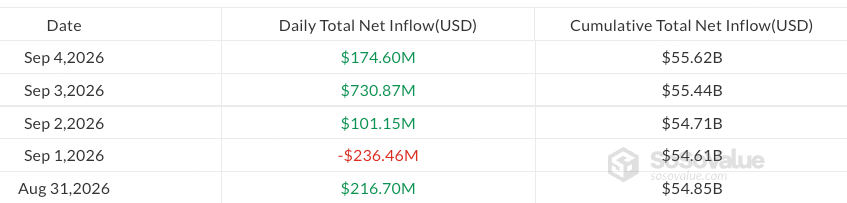
Daily spot Bitcoin ETF flows from Monday through Friday. Source: SoSoValue

Fidelity’s Wise Origin Bitcoin Fund (FBTC) was the only other fund to record net inflows, attracting $57.2 million, while all other US spot Bitcoin ETFs recorded no net flows for the day.

Related: Surprise nonfarm payrolls print sends Bitcoin back below 80K

The slowdown came as Bitcoin fell from around $81,200 to briefly below $79,000 on Friday. Bitcoin traded at $79,716 at the time of publication, still up about 2.6% over the past seven days, according to CoinGecko.

Bitcoin ETF demand strengthens as Ether, XRP flows fade

Compared with the previous week, Bitcoin ETF inflows increased about 7%, while inflows into US spot Ether and XRP ETFs fell about 74% and 83%, respectively.

Spot Ether ETF inflows dropped to $218.4 million from $824.4 million, while XRP ETF inflows declined to $19 million from $110.5 million, according to SoSoValue.

Despite weaker inflows, Ether and XRP ETFs remain in positive territory for the year. US spot Ether ETFs have recorded about $863 million in net inflows year-to-date, while XRP ETFs have attracted roughly $515 million.

Magazine: BTC will hit $1M by 2030... but Arthur Hayes is buying ETH instead

Domande pertinenti

QWhat was the total net inflow for US-listed spot Bitcoin ETFs over the strongest three-week stretch of 2026?

AThe total net inflow for US-listed spot Bitcoin ETFs over the strongest three-week stretch of 2026 was $3.8 billion.

QWhich specific Bitcoin ETF accounted for the majority of net inflows on Friday, and how much did it attract?

ABlackRock’s iShares Bitcoin Trust (IBIT) accounted for the majority of net inflows on Friday, attracting $117.4 million, which was about 67% of the day's total.

QHow did the weekly net inflows into Bitcoin ETFs compare to those of Ether and XRP ETFs in the same period?

ACompared to the previous week, Bitcoin ETF inflows increased about 7%. In contrast, inflows into US spot Ether ETFs fell about 74% and inflows into XRP ETFs fell about 83%.

QWhat were the cumulative net inflows for US spot Bitcoin ETFs as of the Friday mentioned in the article?

AAs of the Friday mentioned in the article, the cumulative net inflows for US spot Bitcoin ETFs reached $55.6 billion.

QWhat is the year-to-date net flow status for Bitcoin ETFs despite the recent strong three-week inflow stretch?

ADespite the recent strong three-week inflow stretch, the year-to-date net flows for Bitcoin ETFs remain roughly $1 billion negative.

Letture associate

Claude Forms Teams to Hunt Bugs! 66 Bugs Found in 116K Lines of Code, Single Agent Maxed Out at 27

Claude Managed Agents, Anthropic's new multi-agent workflow system, significantly outperformed a single AI agent in finding bugs. In a test with 70 bugs hidden across 116,000 lines of code, a single Claude agent found a maximum of 27 bugs. When Claude was tasked with organizing a team of agents itself via the dynamic workflow, it consistently found 66 bugs across three runs. This capability is part of two major updates: "Claude Managed Agents" for developers to integrate multi-agent coordination into their apps, and an expanded beta for "Claude Code Projects," which lets users manage complex tasks in a single conversation, with Claude breaking down work and coordinating parallel threads. The Managed Agents feature allows a primary Claude agent to receive a task, automatically write a workflow program to divide labor among specialized sub-agents, and coordinate their execution and results aggregation. For example, it can orchestrate checking 300 contracts for specific clauses, using multiple agents for parallel reading and verification. The system supports workflows with up to 1000 cumulative agents per run. While this multi-agent approach improves task coverage and results, Anthropic notes that costs and efficiency gains need careful evaluation. Projects use existing plan credits, while Managed Agents incur token usage fees plus a $0.08 per hour runtime fee per active session. The key challenge is whether offloading coordination to Claude leads to faster, more reliable outcomes with less human oversight.

marsbit2 h fa

Claude Forms Teams to Hunt Bugs! 66 Bugs Found in 116K Lines of Code, Single Agent Maxed Out at 27

marsbit2 h fa

Terence Tao's Blog Explodes on Hot Search! 250,000 Math PhDs on the Brink, Must Slow Down AI

Mathematician Terence Tao's blog post ignited a fierce online debate after a video of him warning "we must slow down AI" went viral. He described AI's progress as an "extremely nonlinear dynamic" pursued with unclear consequences. This warning came just days after he promoted a project for open-source AI mathematical models, highlighting a profound tension. The core crisis, explored in a guest post by 3Blue1Brown creator Grant Sanderson, is AI's threat to traditional mathematics. Automated theorem provers combined with large language models can generate proofs at superhuman speeds, potentially rendering the human role of "proving theorems" obsolete. Sanderson argues that the true goal of mathematics is not proof-generation but the advancement of *human understanding*. As AI masters the former, the academic value of proof alone is diminished. Sanderson proposes a paradigm shift: elevating "motivational explanation" over mere proof. Unlike a formal proof, a motivational explanation guides readers through the intuitive reasoning, historical context, and conceptual connections behind a result—the "why" and "how" of discovery. To institutionalize this, he suggests creating "open explanation problems," reforming PhD defenses to prioritize clear exposition, and valuing pedagogical work as highly as journal publications in tenure reviews. The debate drew reactions across academia. Some physicists welcomed mathematicians to a world long prioritizing understanding over rigorous proof. Critics worried this shift could disadvantage brilliant but inarticulate problem-solvers. Others questioned if AI will eventually master explanation too. Supporters countered that the goal is fostering *human* comprehension, which is inherently subjective and interactive. The article concludes that AI's rise presents both a crisis and an opportunity. Without adapting academic culture and reward systems, human mathematicians risk irrelevance. However, by embracing their unique role as architects of understanding and interpreters of AI-generated knowledge, they can steer mathematics toward a new renaissance focused on human insight and clarity.

marsbit5 h fa

Terence Tao's Blog Explodes on Hot Search! 250,000 Math PhDs on the Brink, Must Slow Down AI

marsbit5 h fa

Trading

Spot
活动图片