Robinhood Chain nears $1B TVL as Uniswap drives liquidity: Standard Chartered

cointelegraphPubblicato 2026-08-13Pubblicato ultima volta 2026-08-13

Introduzione

Standard Chartered reports that Robinhood Chain is nearing $1 billion in total value locked (TVL), achieving rapid growth largely driven by its partnership with Uniswap. Uniswap's V2, V3, and V4 protocols are meeting virtually all of Robinhood Chain's liquidity needs, allowing the new blockchain to leverage established DeFi infrastructure without building from scratch. This arrangement is also significantly impacting Uniswap's tokenomics, with fees generated through Robinhood now being the largest source of UNI token burns, doubling the burn rate since late July. Launched on July 1 with a focus on real-world assets, Robinhood Chain is part of the brokerage's broader expansion into crypto, tokenization, and prediction markets, a strategy identified by analysts as a key growth driver despite mixed trends in its overall crypto trading volumes.

Robinhood’s partnership with Uniswap is helping the brokerage rapidly build liquidity on its new blockchain, potentially removing a key obstacle to attracting users and assets, according to Standard Chartered.

In a recent note, Standard Chartered analyst Geoffrey Kendrick said Robinhood Chain has grown to nearly $1 billion in total value locked (TVL), which he described as the fastest growth of any blockchain by that measure. Virtually all of Robinhood Chain’s liquidity needs are being met through Uniswap V2, V3 and V4, Kendrick said.

The arrangement gives Robinhood access to established decentralized finance infrastructure as it scales its blockchain, potentially strengthening its ability to attract users without having to build liquidity from scratch.

The partnership is also having a significant impact on Uniswap’s token economics. According to Standard Chartered, protocol fees generated through Robinhood are now the largest source of UNI token burns.

The UNI burn rate has roughly doubled since a Robinhood-linked fee switch was activated on July 27, reaching an annualized pace of about $90 million. At UNI’s current price of roughly $3.50 apiece, that would translate to 25 million UNI tokens, or just over 4% of the circulating supply, being burned annually.
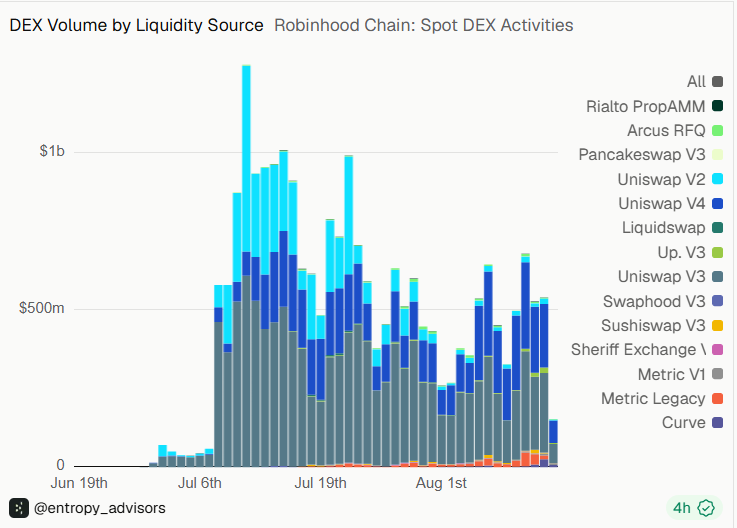
Robinhood Chain’s liquidity sources. Source: Standard Chartered

Robinhood Chain launched on July 1 with a focus on bringing real-world assets onchain. Adoption accelerated quickly after launch, reaching 194,000 daily active users during its first week.

Related: Robinhood Chain sees over $70M in ETH bridged during first week

Robinhood’s crypto push expands into tokenization and prediction markets

Robinhood Chain is part of the brokerage’s broader push beyond traditional stock trading, with the company expanding into crypto, prediction markets and tokenization. The strategy has drawn attention from Wall Street, with analysts at Bernstein raising their price target for Robinhood (HOOD) stock to $160 per share and identifying tokenization and prediction markets as key growth drivers.
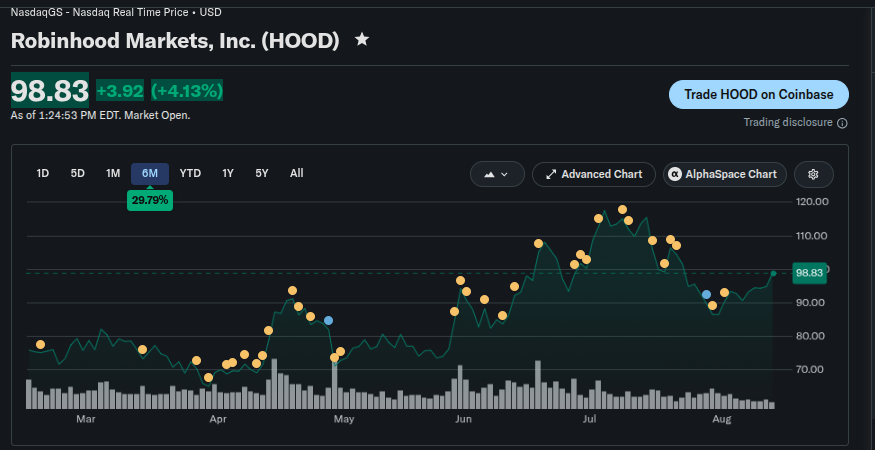
HOOD shares were up more than 4% on Thursday, extending six-month gains to almost 30%. Source: Yahoo Finance.

The expansion has coincided with mixed trends across Robinhood’s crypto business. The company reported record revenue and earnings in the second quarter, even as crypto trading volumes and revenues declined.

Related: Robinhood in talks with Crypto.com over prediction markets: WSJ

Domande pertinenti

QWhat key partnership is helping Robinhood Chain build liquidity rapidly according to Standard Chartered?

ARobinhood's partnership with Uniswap is helping the brokerage rapidly build liquidity on its new blockchain, providing access to established decentralized finance infrastructure.

QWhat is the current Total Value Locked (TVL) of Robinhood Chain and how does its growth compare?

ARobinhood Chain has grown to nearly $1 billion in Total Value Locked (TVL), which Standard Chartered analyst Geoffrey Kendrick described as the fastest growth of any blockchain by that measure.

QHow is the Robinhood Chain partnership affecting Uniswap's UNI token economics?

AProtocol fees generated through Robinhood are now the largest source of UNI token burns. The UNI burn rate has roughly doubled since the Robinhood-linked fee switch was activated, reaching an annualized pace of about $90 million.

QWhat is the primary focus of Robinhood Chain that launched on July 1st?

ARobinhood Chain launched on July 1st with a focus on bringing real-world assets onchain.

QWhat broader strategic expansion does Robinhood Chain represent for the company, and what did Bernstein analysts identify as key growth drivers?

ARobinhood Chain is part of the brokerage's broader push beyond traditional stock trading into crypto, prediction markets, and tokenization. Bernstein analysts identified tokenization and prediction markets as key growth drivers for Robinhood.

Letture associate

Samsung HBM, Achieving a Comeback?

The competition in next-generation HBM is extending from DRAM chip performance to advanced packaging technology. A recent report, based on technician interviews, suggests Samsung has begun delivering samples using hybrid bonding to customers, potentially gaining an early lead in verification. SK Hynix reportedly faces challenges in developing its hybrid bonding process but has already delivered 12-layer HBM4E samples using its existing Advanced MR-MUF packaging, indicating it continues to progress on its current path. Hybrid bonding, which directly connects copper interconnects between chips, is seen as crucial for future HBM with 16+ layers, offering benefits like higher interconnect density, lower signal loss, and improved thermal performance. Samsung has promoted its Hybrid Copper Bonding (HCB) technology for such applications. However, the real challenge lies in manufacturing. Achieving stable, high-yield production requires precise control over processes like Chemical Mechanical Planarization (CMP), surface cleanliness, and managing wafer thinness and warpage. Moving from lab samples to mass production involves overcoming hurdles in yield, cost, and reliability across multiple bonded interfaces. While delivering samples provides a potential lead in customer validation, it doesn't guarantee commercial success. SK Hynix's continued progress with MR-MUF shows that traditional packaging remains viable. The competition is shifting to a systemic contest involving memory design, bonding technology, thermal management, and advanced packaging. The ultimate winner will be determined by which company can achieve stable high-volume production at a competitive cost. Separately, market data indicates Samsung's HBM market share rose from 21% in Q1 to 33% in Q2, closing the gap with SK Hynix. Analysts project Samsung's HBM revenue and its proportion of HBM4 sales to grow significantly by 2027.

marsbit2 min fa

Samsung HBM, Achieving a Comeback?

marsbit2 min fa

The Mystery of Ledger Hardware Wallet Theft: Implanted with Spy Modules, Chinese-Background Distributor Surfaces

A major security breach involving Ledger hardware wallets has been traced to the official authorized distributor CryptoBilis in Southeast Asia. Users who purchased devices from this supplier reported significant cryptocurrency losses, with initial estimates from on-chain analysts ranging from $72 million to over $92 million across Bitcoin, Ethereum, and USDT wallets. This incident is potentially the largest recorded supply chain attack on a hardware wallet. Ledger has warned affected customers and instructed those who bought from CryptoBilis in the past 90 days to transfer assets to a new device with a freshly generated seed phrase if already in use, or not to power on unused devices. Investigations reveal that CryptoBilis underwent a change in ownership in March 2026, with full control transferred to an individual based in China. Technical analysis by experts, including a former Mt. Gox CEO, suggests the attack was executed via a sophisticated hardware implant. A spy module containing a SIM/eSIM chip was allegedly hidden inside some devices, intercepting and transmitting the seed phrase as it appeared on the screen during setup, bypassing the device's secure element. While Ledger has not officially confirmed the exact attack vector, possibilities include this hardware tampering, pre-seeded wallets, or phishing. The event underscores a critical vulnerability: even "official authorized" distributors can become an attack vector in the supply chain. The key takeaway for users is to purchase hardware wallets directly from the manufacturer whenever possible to minimize third-party risks.

marsbit3 min fa

The Mystery of Ledger Hardware Wallet Theft: Implanted with Spy Modules, Chinese-Background Distributor Surfaces

marsbit3 min fa

From Start to Give-up: Why I'm No Longer Working on Web3 Payments

Title: From Start to Abandonment: Why I Stopped Working on Web3 Payments Summary: This article details the author's six-month journey from exploring to ultimately leaving the Web3 payments space. Initially drawn by the promise of faster, cheaper, and more transparent cross-border settlements—seemingly a solution to long-standing frictions in global business—the author immersed in the industry. This involved field research in key global trade hubs and hands-on development of Web3 payment tools. However, deeper engagement revealed a fundamental mismatch between perception and reality. The author concluded that Web3 payments is not a "build a better product and win" industry. Its core competencies lie not in product features but in long-term infrastructure: bank relationships, licenses, compliance, risk management, and capital efficiency. Much perceived profitability is actually "risk premium"—revenue from operations that have not yet encountered problems, rather than sustainable capability advantages. The industry's essence is a "water flow" business. Success depends not on diverting the flow but on possessing the structural capacity to control its volume, pressure, and purity while withstanding regulatory scrutiny—capabilities built over years, not through rapid iteration. While the author remains convinced of the long-term, structural opportunity for Web3 in backend treasury and settlement upgrades, especially in emerging markets, these require a specific resource profile. Ultimately, the decision to step back was one of respecting resource constraints. The team's strengths did not align with the heavy, long-term, relationship-intensive nature of the payments battlefield. The author shifts focus from competing for the "waterway" to analyzing the flow itself, exploring how to help users understand and manage assets once they enter the Web3 ecosystem, seeing this as the next logical layer of value creation.

marsbit1 h fa

From Start to Give-up: Why I'm No Longer Working on Web3 Payments

marsbit1 h fa

The Real Challenge of Tech Business Schools: Scientists Understand Business, So Why Hasn't Their Behavior Changed?

The core challenge discussed in the article is the gap between acquiring business knowledge and changing real-world behavior for scientist-entrepreneurs. It begins with an anecdote where a robotics founder with a technical PhD and an MBA sought an introduction to a CEO using vague, non-actionable language. This illustrates that merely understanding commercial concepts does not automatically translate into effective action in complex business scenarios. The article argues that forming true business capability involves three layers: cognitive understanding, the ability to execute specific actions in context, and the development of stable behavioral patterns. A significant issue is that scientist-founded startups often fail to conduct "commitment design"—transforming a technology's potential value into concrete, low-risk next steps that various stakeholders within a client organization are willing to undertake. This involves addressing not just technical performance but also integration costs, workflow changes, and risk allocation. The role of technology managers is redefined beyond simple matchmaking. They are categorized into three responsibility levels: facilitating transactions, managing conversion projects, and building viable enterprises. For deep-tech startups, the most critical need is for operational partners who co-own business decisions, not just advisors. True complementarity between a scientist and a business partner requires the scientist to delegate authority over key commercial judgments—such as product priorities and spending—not just assign tasks. This delegation is a fundamental behavioral shift. Finally, the article proposes that science and business schools should evolve. Education must move beyond lectures to include practical, team-based training on real tasks—like preparing a partnership proposal or conducting a pilot—and must assess whether effective actions are repeated and whether clear operational roles with proper authority are established within the venture. The ultimate measure of success is not whether the founder "speaks business," but whether the company has someone consistently responsible for commercial execution.

marsbit1 h fa

The Real Challenge of Tech Business Schools: Scientists Understand Business, So Why Hasn't Their Behavior Changed?

marsbit1 h fa

Trading

Spot
活动图片