The AI Industrial Revolution: Where Are We Now?

marsbitPubblicato 2026-05-27Pubblicato ultima volta 2026-05-27

Introduzione

This article explores the current stage of the AI industrial revolution, arguing we are still merely attaching new tools to old workflows rather than fundamentally redesigning production. The author compares this to the early Industrial Revolution, where factories simply replaced waterwheels with steam engines without changing their core structure. Similarly, today we embed AI chat windows into existing software but leave organizational processes unchanged. While massive investment floods into AI infrastructure (data centers, chips), akin to railway manias of the past, the real transformation lies in "dismantling the old workshop"—reorganizing companies around AI. Examples include Notion's use of hundreds of AI Agents and Y Combinator's experiments with self-improving AI systems that operate autonomously. The author notes a critical gap: while China has vast AI user growth, few companies have rebuilt core workflows. AI is beginning to impact entry-level jobs, and early adopters are gaining a compounding advantage. The conclusion is that the pivotal moment will not be the invention of better models, but when organizations decide to tear down old structures and rebuild around AI, shifting the bottleneck from human coordination to computing power. The future workplace and job titles are yet to be defined, but the imperative is to move away from legacy processes and position oneself where the new "railway" is being built.

Written by: Will Awang

Over the past year, I've attended several AI-themed industry conferences. Guests on stage took turns demonstrating the wonders of AI, while people in the audience held up their phones to film the screen, posted on social media, and then went back to scrolling. But back in the office, it was the same weekly meetings, the same approval processes, the same status reports. Big tech companies have already written token consumption into KPIs; some become model employees by writing scripts to inflate usage. Those same people on social media—Claude revolution today, Codex amazing tomorrow, Gemini long live the day after—is this embracing revolution, or just rushing from one spectacle to another?

All of this is noise, not the answer I'm looking for.

The real question isn't whether AI is powerful enough—the steam engine has been built. The question is who will be the first to tear down the old workshop.

The day the Industrial Revolution truly began wasn't when Watt improved the steam engine; it was when the factory owners in Lancashire decided to move away from the river and rebuild their workshops around the steam engine. The most important moment for AI is the same—not the day the large language model was invented, but the day the first organization decides to dismantle its old processes and rebuild its mode of production around AI. That day hasn't arrived yet. But it's on its way.

Two people saw this early. Notion CEO Ivan Zhao wrote an article at the end of 2025 titled "Steam, Steel, and Infinite Minds", offering a cold judgment: we are still in the "replacing the waterwheel" stage—attaching AI chatbots to existing tools, but no one is redesigning the factory. Former OpenAI employee Leopold Aschenbrenner took another path: he wrote a 165-page document titled "Situational Awareness", then started a fund that grew from $225 million to $13.68 billion, all betting on AI infrastructure. One looks inward, the other bets outward.

This article is not about them. It's about us—where we stand now, and which part of history we are repeating.
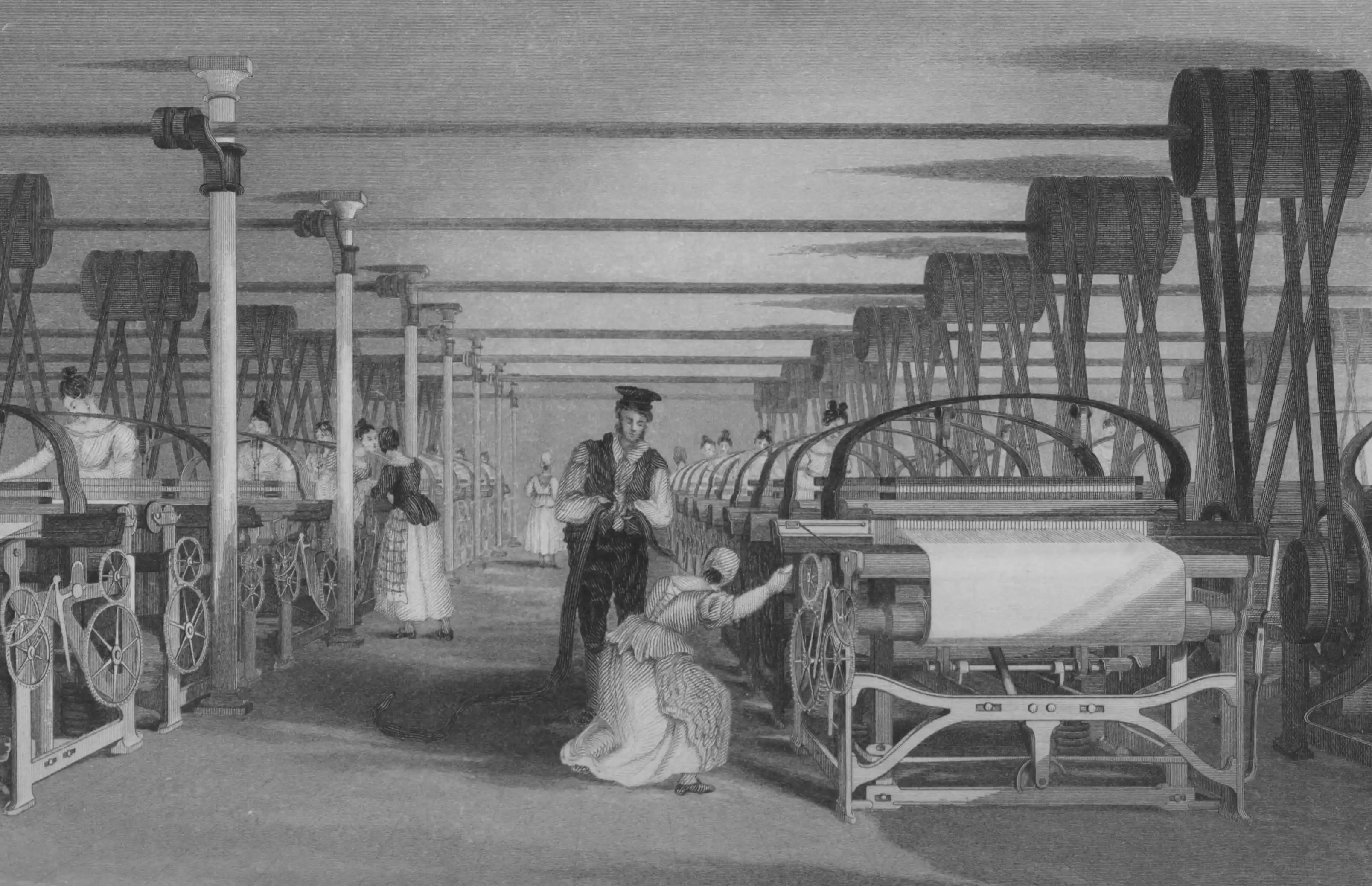
( Power-loom weaving, engraving by J. Tingle after Thomas Allom, 1835 / Wikimedia Commons )

I. The Workshop Is Still Old

Most people's day goes like this: use AI to write an email in the morning, saving ten minutes; then spend two hours in an unnecessary weekly meeting; copy and paste the same set of data between three tools in the afternoon; post on social media at night saying "AI is so great." The ten minutes saved are completely eaten back by the old processes.

Similarly, when the steam engine first appeared, factory owners initially just replaced the waterwheel with the steam engine, leaving everything else unchanged—factories were still built by the river, still multi-story buildings, still with a central drive shaft powering the entire production line. We embed ChatGPT into Slack, add Copilot to Office, place AI chat windows into workflows—we're doing the same thing. The tool is upgraded, but the workshop remains the same.

But replacing the machine is not the same as replacing the workshop. As McLuhan famously said:

We look at the present through a rear-view mirror. We march backwards into the future. Using old processes to accommodate new tools is like early films being merely recorded stage plays. The real breakthrough comes when someone completely frees the steam engine from the river and redesigns the entire production system around the new power source.

Looking at the Industrial Revolution timeline and comparing it to AI, we can roughly locate where we are on the map:
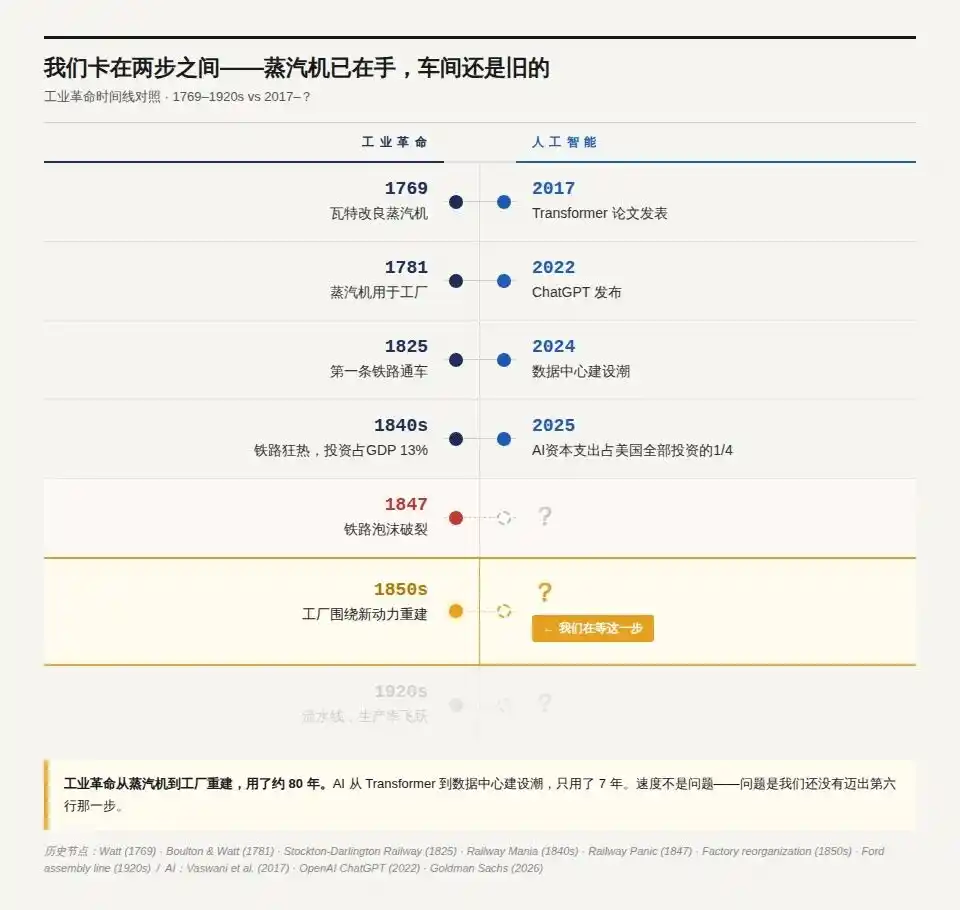
Now the timeline is extremely compressed. The Industrial Revolution took 60 years from the steam engine to the railway mania; AI took only 7 years from Transformer to the data center construction boom.

Speed is not the problem; the problem is where we are stuck—the first four rows are still the stage of installing new machines in old workshops. The steam engine is installed, railways are being laid, but the mode of production remains intact. The sixth row is the real watershed. We are most likely stuck between these two steps.

The steam engine is in our hands, but the workshop is still old.

II. All the Money Is Bet on the Layer Farthest from the Factory

Infrastructure is always overbuilt. It's the investors who go bankrupt, not the infrastructure.

In 1846, the British Parliament passed 263 Railway Acts, approving the construction of 9,500 miles of new railway. At its peak, railway investment accounted for 13% of Britain's GDP. Railway shares could be bought with only a 10% down payment, and the middle class flocked to invest. The bubble burst in 1847. One-third of the approved lines were never built, and countless investors lost everything. Darwin lost 60% on railway stocks, and he was luckier than most.

But the railways remained.

Today's AI infrastructure is following the same path. Goldman Sachs' latest estimate puts global AI infrastructure capital expenditure at $765 billion in 2026, projected to reach $1.6 trillion annually by 2031. The proportion of capital expenditure to operating cash flow for hyperscale cloud providers has risen from about 40% in 2023 to nearly 70% in 2025. AI-related investments already account for about a quarter of all US investment. Aschenbrenner's $13.68 billion is betting on this layer—he's not betting on which application will win, but on the underlying compute power itself.

This capital cycle is isomorphic to real estate development. Building data centers is like building buildings: land is electricity, building materials are GPUs and storage, contractors are data center builders, developers are cloud providers, tenants are AI application companies, and rent is API revenue. The cloud providers' business model is to "rent to cover the loan"—using API revenue to cover data center capital expenditure, waiting for the valuation leap brought by the explosion of AI applications.
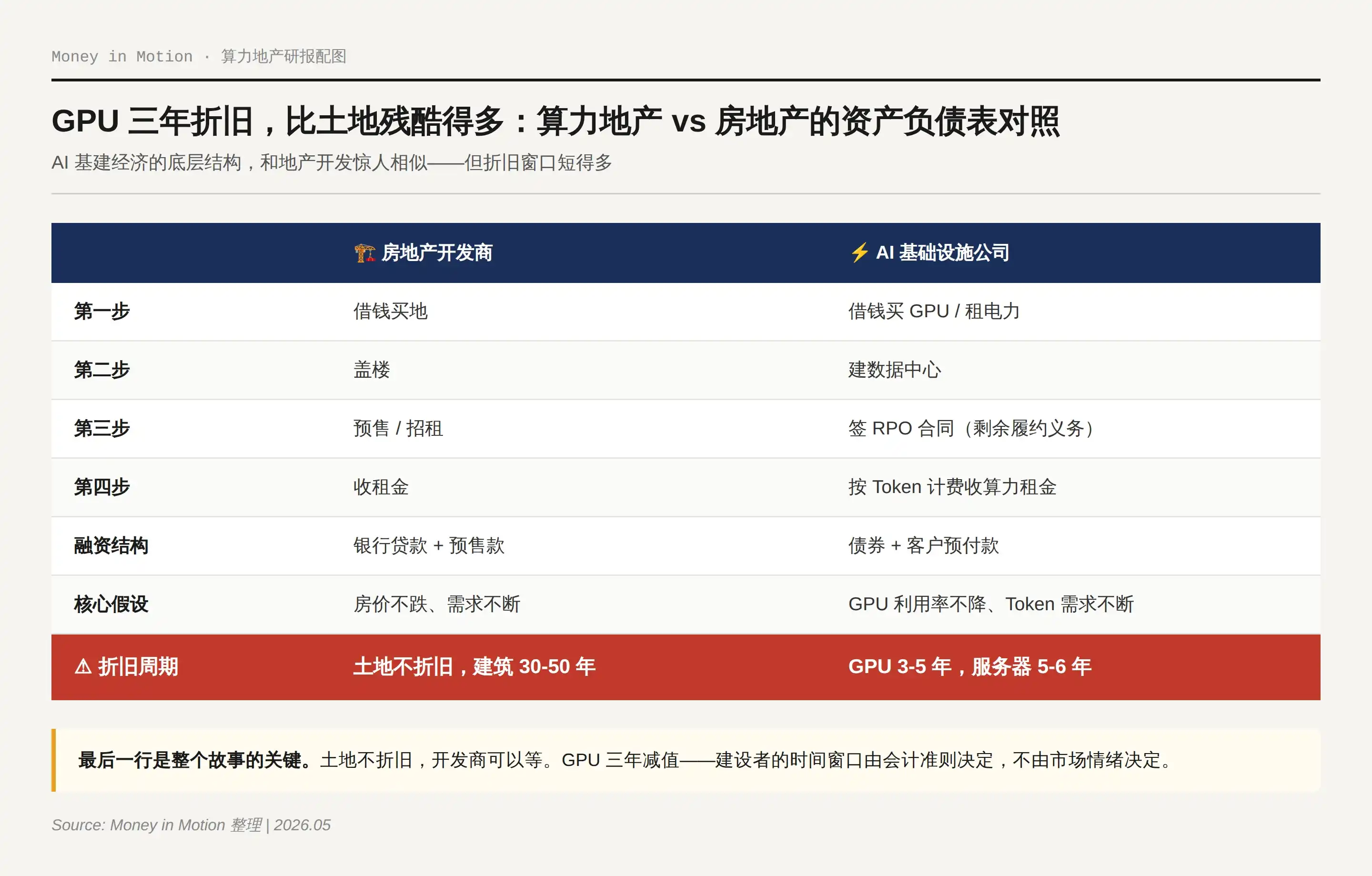
(Compute Power Real Estate: Each generation has its own infrastructure)

The core risk is the same: is the growth rate of API call volume offsetting the decline in API unit price? If rent falls below the loan repayment line—this is a nightmare familiar to real estate developers. The lesson of 2008 was not that too many houses were built, but that the structure of the houses built did not match the structure of real demand. The equivalent risk for AI is: an oversupply of general-purpose compute power, while specialized capabilities that can truly handle high-value scenarios like financial compliance or medical diagnosis remain scarce.

Railways, real estate, AI—infrastructure investments across three eras share the same rule: overbuilding is the norm, material suppliers always lose pricing power, and long-term returns always belong to the owners of "prime locations." Look at the Q1 fund holdings on Wall Street—probably 80% is concentrated in this infrastructure layer: NVIDIA, data centers, cloud infrastructure. But the railway mania teaches us: this is not the full picture of the AI revolution, and it's not even the layer with the highest returns.

What is the prime location for AI? It's unique industry data and deeply embedded workflows. For individuals, the real "prime location" is not the stocks you hold, but your own irreplaceable judgment and industry knowledge—provided you have already rebuilt the way you use them around AI.

The real returns are in the next layer. But between infrastructure and value creation, there is no seamless connection. There is a gap in the middle—historically, this gap has swallowed decades.

III. Who Is Tearing Down the Workshop

Those tearing down the workshop and those "using AI for efficiency" are not doing the same thing.

Notion co-founder Simon used to be a "10x programmer"; now he rarely writes code himself—he simultaneously controls three or four AI coding agents, achieving 30x to 40x efficiency. Notion now has 1,000 employees and over 700 AI agents. The gap isn't the tools; it's that Simon tore down his old workshop, while most people just replaced their waterwheel.

600 million Chinese users have used generative AI tools, a year-on-year increase of 142%—this is the world's largest pool of AI demand. But almost no Chinese company has rebuilt its core workflows around AI. The world's largest demand side, paired with a nearly stagnant supply side in terms of organizational change. This contrast itself is a signal: it's not that the tools are lacking, it's that organizations haven't kept up. The context of knowledge work is scattered across dozens of tools and dozens of minds, outputs are not verifiable, and no one knows how to judge whether a strategic memo is effective.
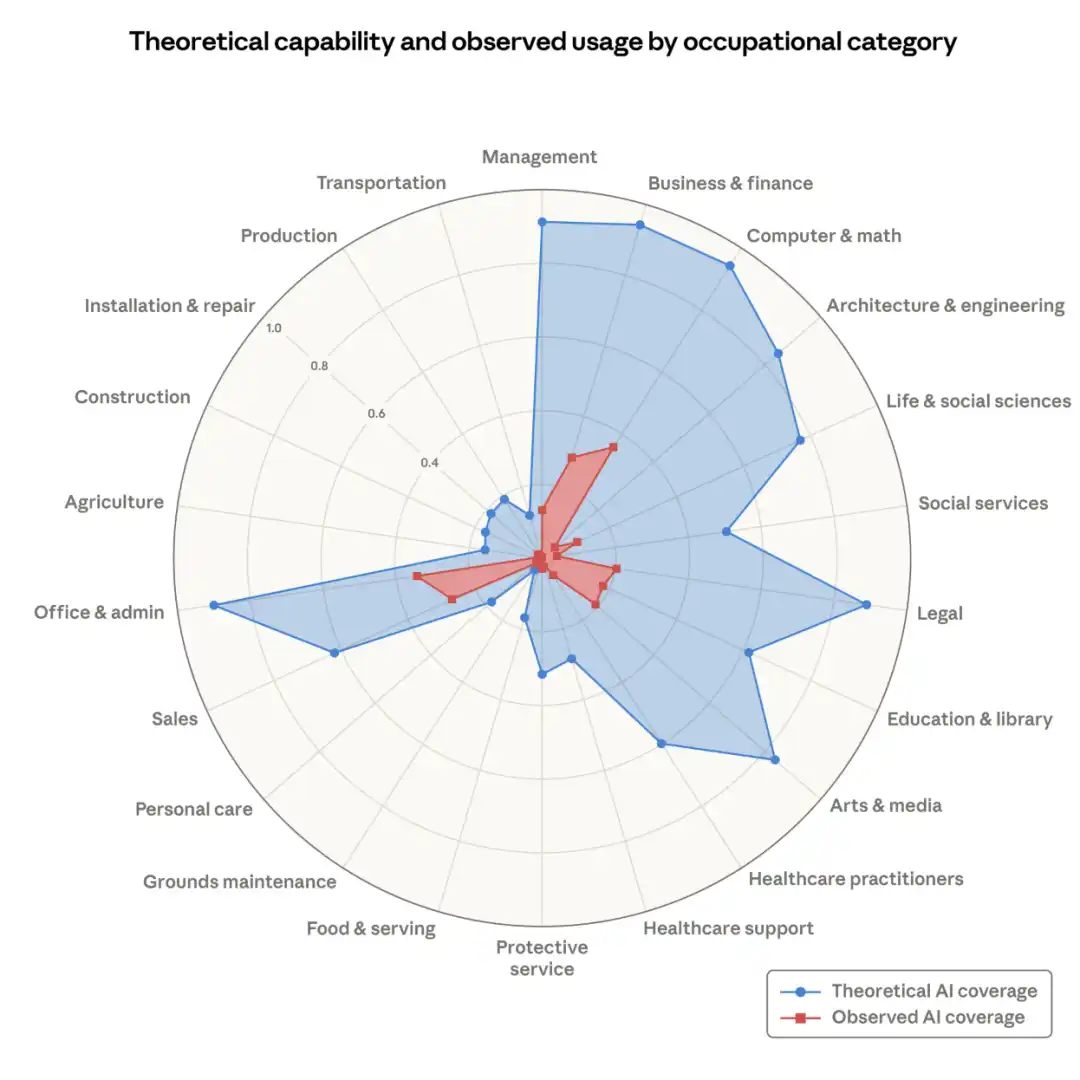
(Labor market impacts of AI: A new measure and early evidence)

Anthropic is already moving on a larger scale. They released an Economic Index, using real usage data to depict which tasks and industries AI is replacing first, then building according to this blueprint: forming a joint venture AI-native enterprise services company with Goldman Sachs, Blackstone, and Hellman & Friedman; establishing a global alliance with KPMG, connecting 276,000 employees to Claude; Accenture forming a business group, training 30,000 people, focusing on finance, life sciences, and healthcare.

The role these consulting firms play is not that of AI users, but AI railway engineers—they don't build steam engines or lay tracks; they help enterprises tear down old factories and rebuild production lines around the new power source. Without this role, most factory owners wouldn't know where to start.

The signals are already flashing. One of the sharpest comes from the job market.

Young people aged 22-25 entering AI-high-exposure professions are 14% less likely to find a job than their peers entering low-exposure professions. Junior positions are already being squeezed.

If I were a new graduate, this number would directly affect my job search. If I were a manager, the next batch of junior positions I hire might not be people.

Organizations are dismantling. What about individuals? My degree, my resume, the industry experience I've accumulated over the years—these are my waterwheels. They once drove my entire production line, but the steam engine has arrived. A degree from a top university is no longer a moat; it just proves I once built a decent factory by the river.

Now the question is, do we have the ability to leave that river?

Anthropic's data shows that users who have used AI tools for more than 6 months have a task success rate 10% higher than new users. Those who started half a year earlier are already leading by 10%, and this gap compounds over time.

But no company has gone bankrupt yet from not using AI, at least my law firm is still advancing full steam ahead around AI. The winners haven't been selected by the market yet. The learning curve is real—early adopters are already accumulating advantages, but most are still at the starting line.

IV. My Next Job Doesn't Have a Name Yet

Will my current job title exist ten years from now? How many of the tools I used daily five years ago are still used today? The answers are likely both negative. But I don't know what the things that replace them are called—because those things don't exist yet.

It's been this way every time in history. New things aren't planned; they grow on their own after old constraints disappear.

Before railways were built, Britain was a collection of isolated local economies. The price of cotton cloth in Manchester and London could differ by 30%. Each city had its own time standard, and no one saw a problem. In the twenty years after railways were built, everything changed. A national unified market appeared for the first time, price differences were smoothed out; standard time was forced by railways, not invented; stationmasters, telegraph operators, travel agents—these jobs didn't exist at all before railways.

No one foresaw department stores when laying railways. No one foresaw standard time when building steam engines.

(Steam, Steel, and AI Infinite Intelligence)

The history of cities tells the same story. Cities hundreds of years ago were human-scale—forty minutes to walk across Florence. Steel frames made skyscrapers possible, railways connected cities to their hinterlands, and elevators, subways, and highways followed. Tokyo, Chongqing, Dallas—these are not bigger versions of Florence; they are entirely new ways of life.

Current knowledge work is also human-scale. Teams of a few dozen people, meetings and emails set the rhythm, becoming unmanageable beyond a few hundred people. We are building Florence with stone and wood. AI makes "Tokyo" possible—organizations composed of thousands of AI agents and people, with workflows running continuously across time zones. Old weekly meetings, quarterly planning, annual reviews may no longer make sense.

Simon no longer writes code—his job has become "managing AI agents." This position didn't exist two years ago. My next job title might not have a name yet. But someone is already building that future we cannot yet name.

V. What Does the New Workshop Look Like

After tearing down the old workshop, what do you build? Y Combinator's answer is: let the company improve itself.

Their internal system now modifies its own code at night. An employee ran a query during the day that failed. A supervising agent read about this failure, deduced the cause, wrote code to fix it, submitted it for review, and deployed it. The same query ran successfully the next day. The whole thing happened while everyone was asleep.

This isn't AI helping people produce 30% more. This is the system running through an entire closed loop on its own, figuring out how to become better.

In an internal talk, YC partner Tom Blomfield called this company form a "recursive self-improving AI loop." His judgment is direct: most companies are still Roman legions—information trickles down layer by layer and aggregates up layer by layer, with people acting as conduits. What AI breaks is not the efficiency of a certain link, but the very premise of this entire hierarchical structure.

His new logic is: burn tokens, not headcount. The bottleneck is shifting from manpower to compute power. The data YC sees shows that companies reaching Demo Day have about 5 times higher revenue per capita than 18 months ago. The role of middle management is being taken over by AI—"coordination" no longer requires humans. Everyone should be an IC, a builder, an operator. Every task has a named owner, not a committee.

There's another prerequisite: the company must be "readable" to AI. Things that aren't recorded are, to AI, as if they never happened. YC now archives all partner emails, records all Slack messages and office hour recordings. One partner used 2,000 hours of recordings accumulated over three months to have AI regenerate a 150-page internal manual—much better than the old version. This manual updates automatically every month, becoming a perpetually fresh "living brain."

Tom left a question:

If you were building your company from scratch today, would you set it up in this form? If your company already has a hierarchical structure, you face a harder question—will the pain of rebuilding be less than the cost of continuing to operate as a Roman legion?

People are not at the center of the workshop; they are on the periphery—responsible for the places AI can't yet reach: on-the-ground judgment, entirely new situations, high-stakes, high-emotion moments. The center of the company is a "corporate brain" pieced together from data, records, and industry knowledge. The software running on it is consumable—if it can be generated, it can be regenerated. What's valuable resides in people's minds—how the business runs, which steps involve judgment; this understanding is the real asset.

What Ivan Zhao describes in "Steam, Steel, and Infinite Minds" is the other side of this direction—an organization of 1,000 employees and over 700 AI agents collaborating, where people are responsible for judgment, and agents are responsible for execution. Aschenbrenner bets on compute infrastructure; Zhao bets on organizational reconstruction. Both paths ultimately point to the same destination: a new mode of production rebuilt around AI.

VI. Conclusion

Between the 1840s and 1850s—the railways were laid, but the factories hadn't been rebuilt.

Where are we? Simon no longer writes code. He tore down his own waterwheel.

The question has never been whether the steam engine is good enough. The question is who will be the first to tear down the old workshop.

I don't intend to predict the future department stores. I only intend to take care of myself—ensuring I stand along the railway line, not guarding a river that is drying up.

What about you?

Domande pertinenti

QWhat is the central argument of the article regarding our current phase in the 'AI Industrial Revolution'?

AThe central argument is that we are currently in the 'steam engine' phase of the AI revolution. We have powerful new tools like Large Language Models, but are largely using them to perform old tasks within existing organizational structures and workflows ('the old workshop'). The real revolution hasn't begun yet. It will start not when AI is invented, but when organizations fundamentally dismantle old processes and rebuild their core production methods around AI.

QAccording to the author, what is the key difference between simply 'using AI for efficiency' and truly transforming work?

AThe key difference is between 'replacing the waterwheel' and 'dismantling the old workshop.' Using AI for efficiency means attaching AI chatbots to existing tools (like adding ChatGPT to Slack) to save time on discrete tasks, but leaving the underlying workflows and organizational logic unchanged. True transformation involves redesigning the entire 'factory' around the new 'engine'—reimagining processes, roles, and structures from the ground up with AI as the core driver, as exemplified by individuals like Notion's Simon who manage AI agents instead of writing code.

QWhat historical parallel does the author draw to the massive investment in AI infrastructure (like data centers and GPUs), and what warning does this imply?

AThe author draws a parallel to the British 'Railway Mania' of the 1840s. This implies a warning of a potential investment bubble where capital is overwhelmingly poured into foundational infrastructure (the 'rail lines' and 'real estate' of AI—data centers, chips, cloud capacity), far ahead of proven, high-value applications. The risk is that the 'rent' (API revenue) may not cover the 'mortgage' (capital expenditure) if the growth in usage doesn't outpace price declines, leading to overcapacity in generic compute while specialized, industry-transforming capabilities remain scarce.

QWhat does the author suggest is the 'core location' or most valuable asset for individuals in the AI era, and why?

AFor individuals, the author suggests the true 'core location' is not stock holdings in infrastructure companies, but their own 'irreplaceable judgment and industry knowledge.' This is because AI commoditizes execution and information retrieval. The unique value lies in human capabilities like offline judgment, navigating novel situations, and high-stakes emotional intelligence—areas where AI currently cannot reach. However, this knowledge is only a valuable asset if the individual has already rebuilt their way of working to leverage AI effectively.

QWhat is the 'recursive self-improving AI loop' described in the Y Combinator example, and what does it signify about future organizations?

AThe 'recursive self-improving AI loop' is when an AI system autonomously identifies a failure in its own operations, diagnoses the cause, writes and deploys code to fix it, and verifies the solution—all without human intervention. This signifies a move beyond AI as a productivity tool for humans. It points to future organizations where AI forms a 'company brain' from data and communications, enabling systems to self-optimize. This undermines traditional hierarchical ('Roman legion') structures, as coordination and middle-management tasks are automated. The future organization is 'AI-readable,' with humans focused on high-judgment roles at the periphery.

Letture associate

Agentized OS: It's Not About AI, It's About the Foundation

The Agentic OS: Beyond AI, It's About the Foundational Stack In 2026, major operating systems like Android, iOS, HarmonyOS, and Windows are entering the "Agentic" era, integrating proactive AI assistants deeply into the system layer. However, the real competition lies not in the flashy AI features showcased at events, but in the three-layer foundational stack that enables them: the system-level AI Runtime, proprietary/controllable chips, and the on-device/cloud model matrix. The AI Runtime acts as the central scheduler, managing model inference, resource allocation, and exposing capabilities to apps. Controllable chips (e.g., Apple Silicon, Google Tensor, Huawei Kirin) are crucial for deep hardware-software co-optimization, determining the efficiency and experience limits of on-device Agents. The on-device/cloud model matrix provides the "intelligence," with proprietary, chip-optimized small models (like Gemini Nano, Apple's ~3B model) handling daily tasks locally for low latency, privacy, and reliability, while cloud models tackle complex requests. Deep synergy between these three layers enables key Agent differentiators: ultra-low latency and power efficiency, genuine "on-device first" privacy, access to system-level personal context across apps, and reliable performance as a system service even offline. OS vendors with strong integration across this stack (like Apple, Google, and Huawei) build a deeper moat. Beyond this core stack, long-term competitiveness depends on variables like structured App integration (e.g., App Intents/AppFunctions) for reliable multi-step workflows, and robust privacy frameworks that build user trust. This shift towards Agentic OS extends beyond phones and PCs to IoT, cars, and XR glasses via existing multi-device ecosystems. The race is won not in a keynote, but through generations of meticulously co-developed chips, models, and system software.

marsbit1 h fa

Agentized OS: It's Not About AI, It's About the Foundation

marsbit1 h fa

Why Sam Altman's 'Water and Electricity Theory' Sparks Copyright Controversy

OpenAI CEO Sam Altman's recent statement that "intelligence will become a utility like electricity or water" has sparked significant controversy, primarily around copyright issues and the nature of AI development. While positioning AI as a utility serves as a compelling narrative for infrastructure investors, critics argue the analogy is flawed in three key areas. First, there's a fundamental "property gap." Traditional utilities like water and power create new, physical infrastructure from scratch. In contrast, major AI models are trained by reorganizing vast amounts of existing human-created content—books, articles, code, etc.—often scraped from the web without explicit permission or compensation to creators. This "free acquisition, paid resale" model is seen by many as ethically problematic. Second, there's a "pricing gap." True public utilities are typically regulated to ensure universal service with non-discriminatory, cost-plus pricing. AI's token-based pricing, however, involves significant price discrimination (e.g., output tokens costing much more than input tokens) and is designed for revenue maximization, not equitable access. Third, a "governance gap" exists. Utilities operate under public oversight, while AI pricing and development are currently controlled by a few private companies. Furthermore, the industry's own shift toward buying licensed training data (e.g., deals with Reddit or news publishers) undermines its previous legal reliance on "fair use" for freely scraped data. In conclusion, while AI is indeed becoming a foundational technology, calling it a public utility remains contentious. The title requires not just scale and a pay-per-use model, but also credible solutions for data provenance, equitable pricing, and public governance.

marsbit1 h fa

Why Sam Altman's 'Water and Electricity Theory' Sparks Copyright Controversy

marsbit1 h fa

Trading

Spot
Futures

Articoli Popolari

Cosa è GROK AI

Grok AI: Rivoluzionare la Tecnologia Conversazionale nell'Era Web3 Introduzione Nel panorama in rapida evoluzione dell'intelligenza artificiale, Grok AI si distingue come un progetto notevole che collega i domini della tecnologia avanzata e dell'interazione con l'utente. Sviluppato da xAI, un'azienda guidata dal rinomato imprenditore Elon Musk, Grok AI cerca di ridefinire il modo in cui interagiamo con l'intelligenza artificiale. Mentre il movimento Web3 continua a prosperare, Grok AI mira a sfruttare il potere dell'IA conversazionale per rispondere a query complesse, offrendo agli utenti un'esperienza che è non solo informativa ma anche divertente. Cos'è Grok AI? Grok AI è un sofisticato chatbot di intelligenza artificiale conversazionale progettato per interagire dinamicamente con gli utenti. A differenza di molti sistemi di intelligenza artificiale tradizionali, Grok AI abbraccia un'ampia gamma di domande, comprese quelle tipicamente considerate inappropriate o al di fuori delle risposte standard. Gli obiettivi principali del progetto includono: Ragionamento Affidabile: Grok AI enfatizza il ragionamento di buon senso per fornire risposte logiche basate sulla comprensione contestuale. Supervisione Scalabile: L'integrazione dell'assistenza degli strumenti garantisce che le interazioni degli utenti siano sia monitorate che ottimizzate per la qualità. Verifica Formale: La sicurezza è fondamentale; Grok AI incorpora metodi di verifica formale per migliorare l'affidabilità delle sue uscite. Comprensione del Lungo Contesto: Il modello di IA eccelle nel trattenere e richiamare una vasta storia di conversazione, facilitando discussioni significative e consapevoli del contesto. Robustezza Adversariale: Concentrandosi sul miglioramento delle sue difese contro input manipolati o malevoli, Grok AI mira a mantenere l'integrità delle interazioni degli utenti. In sostanza, Grok AI non è solo un dispositivo di recupero informazioni; è un partner conversazionale immersivo che incoraggia un dialogo dinamico. Creatore di Grok AI Il cervello dietro Grok AI non è altri che Elon Musk, un individuo sinonimo di innovazione in vari campi, tra cui automotive, viaggi spaziali e tecnologia. Sotto l'egida di xAI, un'azienda focalizzata sull'avanzamento della tecnologia AI in modi benefici, la visione di Musk mira a rimodellare la comprensione delle interazioni con l'IA. La leadership e l'etica fondamentale sono profondamente influenzate dall'impegno di Musk nel superare i confini tecnologici. Investitori di Grok AI Sebbene i dettagli specifici riguardanti gli investitori che sostengono Grok AI rimangano limitati, è pubblicamente riconosciuto che xAI, l'incubatore del progetto, è fondato e supportato principalmente dallo stesso Elon Musk. Le precedenti imprese e partecipazioni di Musk forniscono un robusto sostegno, rafforzando ulteriormente la credibilità e il potenziale di crescita di Grok AI. Tuttavia, al momento, le informazioni riguardanti ulteriori fondazioni di investimento o organizzazioni che supportano Grok AI non sono facilmente accessibili, segnando un'area per potenziali esplorazioni future. Come Funziona Grok AI? Le meccaniche operative di Grok AI sono innovative quanto il suo framework concettuale. Il progetto integra diverse tecnologie all'avanguardia che facilitano le sue funzionalità uniche: Infrastruttura Robusta: Grok AI è costruito utilizzando Kubernetes per l'orchestrazione dei container, Rust per prestazioni e sicurezza, e JAX per il calcolo numerico ad alte prestazioni. Questo trio garantisce che il chatbot operi in modo efficiente, si scaldi efficacemente e serva gli utenti prontamente. Accesso alla Conoscenza in Tempo Reale: Una delle caratteristiche distintive di Grok AI è la sua capacità di attingere a dati in tempo reale attraverso la piattaforma X—precedentemente nota come Twitter. Questa capacità consente all'IA di accedere alle informazioni più recenti, permettendole di fornire risposte e raccomandazioni tempestive che altri modelli di IA potrebbero perdere. Due Modalità di Interazione: Grok AI offre agli utenti la scelta tra “Modalità Divertente” e “Modalità Normale”. La Modalità Divertente consente uno stile di interazione più giocoso e umoristico, mentre la Modalità Normale si concentra sulla fornitura di risposte precise e accurate. Questa versatilità garantisce un'esperienza su misura che soddisfa varie preferenze degli utenti. In sostanza, Grok AI sposa prestazioni con coinvolgimento, creando un'esperienza che è sia arricchente che divertente. Cronologia di Grok AI Il viaggio di Grok AI è segnato da traguardi fondamentali che riflettono le sue fasi di sviluppo e distribuzione: Sviluppo Iniziale: La fase fondamentale di Grok AI si è svolta in circa due mesi, durante i quali sono stati condotti l'addestramento iniziale e il perfezionamento del modello. Rilascio Beta di Grok-2: In un significativo avanzamento, è stata annunciata la beta di Grok-2. Questo rilascio ha introdotto due versioni del chatbot—Grok-2 e Grok-2 mini—ognuna dotata delle capacità per chattare, programmare e ragionare. Accesso Pubblico: Dopo lo sviluppo beta, Grok AI è diventato disponibile per gli utenti della piattaforma X. Coloro che hanno account verificati tramite un numero di telefono e attivi per almeno sette giorni possono accedere a una versione limitata, rendendo la tecnologia disponibile a un pubblico più ampio. Questa cronologia racchiude la crescita sistematica di Grok AI dall'inizio all'impegno pubblico, enfatizzando il suo impegno per il miglioramento continuo e l'interazione con gli utenti. Caratteristiche Chiave di Grok AI Grok AI comprende diverse caratteristiche chiave che contribuiscono alla sua identità innovativa: Integrazione della Conoscenza in Tempo Reale: L'accesso a informazioni attuali e rilevanti differenzia Grok AI da molti modelli statici, consentendo un'esperienza utente coinvolgente e accurata. Stili di Interazione Versatili: Offrendo modalità di interazione distinte, Grok AI soddisfa varie preferenze degli utenti, invitando alla creatività e alla personalizzazione nella conversazione con l'IA. Avanzata Struttura Tecnologica: L'utilizzo di Kubernetes, Rust e JAX fornisce al progetto un solido framework per garantire affidabilità e prestazioni ottimali. Considerazione del Discorso Etico: L'inclusione di una funzione di generazione di immagini mette in mostra lo spirito innovativo del progetto. Tuttavia, solleva anche considerazioni etiche riguardanti il copyright e la rappresentazione rispettosa di figure riconoscibili—una discussione in corso all'interno della comunità AI. Conclusione Come entità pionieristica nel campo dell'IA conversazionale, Grok AI incarna il potenziale per esperienze utente trasformative nell'era digitale. Sviluppato da xAI e guidato dall'approccio visionario di Elon Musk, Grok AI integra conoscenze in tempo reale con capacità di interazione avanzate. Si sforza di spingere i confini di ciò che l'intelligenza artificiale può realizzare, mantenendo un focus su considerazioni etiche e sicurezza degli utenti. Grok AI non solo incarna il progresso tecnologico, ma rappresenta anche un nuovo paradigma conversazionale nel panorama Web3, promettendo di coinvolgere gli utenti con sia conoscenze esperte che interazioni giocose. Man mano che il progetto continua a evolversi, si erge come testimonianza di ciò che l'incrocio tra tecnologia, creatività e interazione simile a quella umana può realizzare.

475 Totale visualizzazioniPubblicato il 2024.12.26Aggiornato il 2024.12.26

Cosa è GROK AI

Cosa è ERC AI

Euruka Tech: Una Panoramica di $erc ai e delle sue Ambizioni in Web3 Introduzione Nel panorama in rapida evoluzione della tecnologia blockchain e delle applicazioni decentralizzate, nuovi progetti emergono frequentemente, ciascuno con obiettivi e metodologie uniche. Uno di questi progetti è Euruka Tech, che opera nel vasto dominio delle criptovalute e del Web3. L'obiettivo principale di Euruka Tech, in particolare del suo token $erc ai, è presentare soluzioni innovative progettate per sfruttare le crescenti capacità della tecnologia decentralizzata. Questo articolo si propone di fornire una panoramica completa di Euruka Tech, un'esplorazione dei suoi obiettivi, della funzionalità, dell'identità del suo creatore, dei potenziali investitori e della sua importanza nel contesto più ampio del Web3. Cos'è Euruka Tech, $erc ai? Euruka Tech è caratterizzato come un progetto che sfrutta gli strumenti e le funzionalità offerte dall'ambiente Web3, concentrandosi sull'integrazione dell'intelligenza artificiale nelle sue operazioni. Sebbene i dettagli specifici sul framework del progetto siano piuttosto sfuggenti, è progettato per migliorare l'engagement degli utenti e automatizzare i processi nello spazio crypto. Il progetto mira a creare un ecosistema decentralizzato che non solo faciliti le transazioni, ma incorpori anche funzionalità predittive attraverso l'intelligenza artificiale, da cui il nome del suo token, $erc ai. L'obiettivo è fornire una piattaforma intuitiva che faciliti interazioni più intelligenti e un'elaborazione delle transazioni più efficiente all'interno della crescente sfera del Web3. Chi è il Creatore di Euruka Tech, $erc ai? Attualmente, le informazioni riguardanti il creatore o il team fondatore di Euruka Tech rimangono non specificate e piuttosto opache. Questa assenza di dati solleva preoccupazioni, poiché la conoscenza del background del team è spesso essenziale per stabilire credibilità nel settore blockchain. Pertanto, abbiamo classificato queste informazioni come sconosciute fino a quando dettagli concreti non saranno resi disponibili nel dominio pubblico. Chi sono gli Investitori di Euruka Tech, $erc ai? Allo stesso modo, l'identificazione degli investitori o delle organizzazioni di supporto per il progetto Euruka Tech non è prontamente fornita attraverso la ricerca disponibile. Un aspetto cruciale per i potenziali stakeholder o utenti che considerano di impegnarsi con Euruka Tech è la garanzia che deriva da partnership finanziarie consolidate o dal supporto di società di investimento rispettabili. Senza divulgazioni sulle affiliazioni di investimento, è difficile trarre conclusioni complete sulla sicurezza finanziaria o sulla longevità del progetto. In linea con le informazioni trovate, anche questa sezione rimane allo stato di sconosciuto. Come funziona Euruka Tech, $erc ai? Nonostante la mancanza di specifiche tecniche dettagliate per Euruka Tech, è essenziale considerare le sue ambizioni innovative. Il progetto cerca di sfruttare la potenza computazionale dell'intelligenza artificiale per automatizzare e migliorare l'esperienza dell'utente all'interno dell'ambiente delle criptovalute. Integrando l'IA con la tecnologia blockchain, Euruka Tech mira a fornire funzionalità come operazioni automatizzate, valutazioni del rischio e interfacce utente personalizzate. L'essenza innovativa di Euruka Tech risiede nel suo obiettivo di creare una connessione fluida tra gli utenti e le vaste possibilità presentate dalle reti decentralizzate. Attraverso l'utilizzo di algoritmi di apprendimento automatico e IA, mira a ridurre le sfide degli utenti alle prime armi e semplificare le esperienze transazionali all'interno del framework Web3. Questa simbiosi tra IA e blockchain sottolinea l'importanza del token $erc ai, fungendo da ponte tra le interfacce utente tradizionali e le avanzate capacità delle tecnologie decentralizzate. Cronologia di Euruka Tech, $erc ai Sfortunatamente, a causa delle limitate informazioni disponibili riguardo a Euruka Tech, non siamo in grado di presentare una cronologia dettagliata dei principali sviluppi o traguardi nel percorso del progetto. Questa cronologia, tipicamente preziosa per tracciare l'evoluzione di un progetto e comprendere la sua traiettoria di crescita, non è attualmente disponibile. Man mano che le informazioni su eventi notevoli, partnership o aggiunte funzionali diventano evidenti, gli aggiornamenti miglioreranno sicuramente la visibilità di Euruka Tech nella sfera crypto. Chiarimento su Altri Progetti “Eureka” È importante sottolineare che più progetti e aziende condividono una nomenclatura simile con “Eureka.” La ricerca ha identificato iniziative come un agente IA della NVIDIA Research, che si concentra sull'insegnamento ai robot di compiti complessi utilizzando metodi generativi, così come Eureka Labs ed Eureka AI, che migliorano l'esperienza utente nell'istruzione e nell'analisi del servizio clienti, rispettivamente. Tuttavia, questi progetti sono distinti da Euruka Tech e non dovrebbero essere confusi con i suoi obiettivi o funzionalità. Conclusione Euruka Tech, insieme al suo token $erc ai, rappresenta un attore promettente ma attualmente oscuro nel panorama del Web3. Sebbene i dettagli sul suo creatore e sugli investitori rimangano non divulgati, l'ambizione centrale di combinare intelligenza artificiale e tecnologia blockchain si erge come un punto focale di interesse. Gli approcci unici del progetto nel promuovere l'engagement degli utenti attraverso l'automazione avanzata potrebbero distinguerlo mentre l'ecosistema Web3 progredisce. Con l'evoluzione continua del mercato crypto, gli stakeholder dovrebbero tenere d'occhio gli sviluppi riguardanti Euruka Tech, poiché lo sviluppo di innovazioni documentate, partnership o una roadmap definita potrebbe presentare opportunità significative nel prossimo futuro. Così com'è, attendiamo ulteriori approfondimenti sostanziali che potrebbero svelare il potenziale di Euruka Tech e la sua posizione nel competitivo panorama crypto.

497 Totale visualizzazioniPubblicato il 2025.01.02Aggiornato il 2025.01.02

Cosa è ERC AI

Cosa è DUOLINGO AI

DUOLINGO AI: Integrare l'apprendimento delle lingue con Web3 e innovazione AI In un'era in cui la tecnologia rimodella l'istruzione, l'integrazione dell'intelligenza artificiale (AI) e delle reti blockchain annuncia una nuova frontiera per l'apprendimento delle lingue. Entra in scena DUOLINGO AI e la sua criptovaluta associata, $DUOLINGO AI. Questo progetto aspira a fondere la potenza educativa delle principali piattaforme di apprendimento delle lingue con i benefici della tecnologia decentralizzata Web3. Questo articolo esplora gli aspetti chiave di DUOLINGO AI, esaminando i suoi obiettivi, il framework tecnologico, lo sviluppo storico e il potenziale futuro, mantenendo chiarezza tra la risorsa educativa originale e questa iniziativa indipendente di criptovaluta. Panoramica di DUOLINGO AI Alla sua base, DUOLINGO AI cerca di stabilire un ambiente decentralizzato in cui gli studenti possono guadagnare ricompense crittografiche per il raggiungimento di traguardi educativi nella competenza linguistica. Applicando smart contracts, il progetto mira ad automatizzare i processi di verifica delle competenze e le allocazioni di token, aderendo ai principi di Web3 che enfatizzano la trasparenza e la proprietà da parte degli utenti. Il modello si discosta dagli approcci tradizionali all'acquisizione linguistica, facendo forte affidamento su una struttura di governance guidata dalla comunità, che consente ai detentori di token di suggerire miglioramenti ai contenuti dei corsi e alle distribuzioni delle ricompense. Alcuni degli obiettivi notevoli di DUOLINGO AI includono: Apprendimento Gamificato: Il progetto integra traguardi blockchain e token non fungibili (NFT) per rappresentare i livelli di competenza linguistica, promuovendo la motivazione attraverso ricompense digitali coinvolgenti. Creazione di Contenuti Decentralizzati: Apre opportunità per educatori e appassionati di lingue di contribuire con i propri corsi, facilitando un modello di condivisione dei ricavi che beneficia tutti i collaboratori. Personalizzazione Guidata dall'AI: Utilizzando modelli avanzati di machine learning, DUOLINGO AI personalizza le lezioni per adattarsi ai progressi individuali, simile alle funzionalità adattive presenti nelle piattaforme consolidate. Creatori del Progetto e Governance A partire da aprile 2025, il team dietro $DUOLINGO AI rimane pseudonimo, una pratica comune nel panorama decentralizzato delle criptovalute. Questa anonimato è inteso a promuovere la crescita collettiva e il coinvolgimento degli stakeholder piuttosto che concentrarsi su sviluppatori individuali. Lo smart contract distribuito sulla blockchain di Solana annota l'indirizzo del wallet dello sviluppatore, che segna l'impegno verso la trasparenza riguardo alle transazioni, nonostante l'identità dei creatori sia sconosciuta. Secondo la sua roadmap, DUOLINGO AI mira a evolversi in un'Organizzazione Autonoma Decentralizzata (DAO). Questa struttura di governance consente ai detentori di token di votare su questioni critiche come l'implementazione di funzionalità e le allocazioni del tesoro. Questo modello si allinea con l'etica dell'empowerment della comunità presente in varie applicazioni decentralizzate, enfatizzando l'importanza del processo decisionale collettivo. Investitori e Partnership Strategiche Attualmente, non ci sono investitori istituzionali o capitalisti di rischio identificabili pubblicamente legati a $DUOLINGO AI. Invece, la liquidità del progetto proviene principalmente da scambi decentralizzati (DEX), segnando un netto contrasto con le strategie di finanziamento delle aziende tradizionali di tecnologia educativa. Questo modello di base indica un approccio guidato dalla comunità, riflettendo l'impegno del progetto verso la decentralizzazione. Nel suo whitepaper, DUOLINGO AI menziona la formazione di collaborazioni con “piattaforme educative blockchain” non specificate, mirate ad arricchire la sua offerta di corsi. Sebbene partnership specifiche non siano ancora state divulgate, questi sforzi collaborativi suggeriscono una strategia per mescolare innovazione blockchain con iniziative educative, ampliando l'accesso e il coinvolgimento degli utenti attraverso diverse vie di apprendimento. Architettura Tecnologica Integrazione AI DUOLINGO AI incorpora due componenti principali guidate dall'AI per migliorare la sua offerta educativa: Motore di Apprendimento Adattivo: Questo sofisticato motore apprende dalle interazioni degli utenti, simile ai modelli proprietari delle principali piattaforme educative. Regola dinamicamente la difficoltà delle lezioni per affrontare le sfide specifiche degli studenti, rinforzando le aree deboli attraverso esercizi mirati. Agenti Conversazionali: Utilizzando chatbot alimentati da GPT-4, DUOLINGO AI offre una piattaforma per gli utenti per impegnarsi in conversazioni simulate, promuovendo un'esperienza di apprendimento linguistico più interattiva e pratica. Infrastruttura Blockchain Costruito sulla blockchain di Solana, $DUOLINGO AI utilizza un framework tecnologico completo che include: Smart Contracts per la Verifica delle Competenze: Questa funzionalità assegna automaticamente token agli utenti che superano con successo i test di competenza, rinforzando la struttura di incentivi per risultati di apprendimento genuini. Badge NFT: Questi token digitali significano vari traguardi che gli studenti raggiungono, come completare una sezione del loro corso o padroneggiare competenze specifiche, consentendo loro di scambiare o mostrare digitalmente i loro successi. Governance DAO: I membri della comunità dotati di token possono partecipare alla governance votando su proposte chiave, facilitando una cultura partecipativa che incoraggia l'innovazione nell'offerta di corsi e nelle funzionalità della piattaforma. Cronologia Storica 2022–2023: Concettualizzazione I lavori per DUOLINGO AI iniziano con la creazione di un whitepaper, evidenziando la sinergia tra i progressi dell'AI nell'apprendimento delle lingue e il potenziale decentralizzato della tecnologia blockchain. 2024: Lancio Beta Un lancio beta limitato introduce offerte in lingue popolari, premiando i primi utenti con incentivi in token come parte della strategia di coinvolgimento della comunità del progetto. 2025: Transizione DAO Ad aprile, avviene un lancio completo della mainnet con la circolazione di token, stimolando discussioni nella comunità riguardo a possibili espansioni nelle lingue asiatiche e ad altri sviluppi dei corsi. Sfide e Direzioni Future Ostacoli Tecnici Nonostante i suoi obiettivi ambiziosi, DUOLINGO AI affronta sfide significative. La scalabilità rimane una preoccupazione costante, in particolare nel bilanciare i costi associati all'elaborazione dell'AI e nel mantenere una rete decentralizzata reattiva. Inoltre, garantire la creazione e la moderazione di contenuti di qualità in un'offerta decentralizzata presenta complessità nel mantenere standard educativi. Opportunità Strategiche Guardando al futuro, DUOLINGO AI ha il potenziale per sfruttare partnership di micro-credentialing con istituzioni accademiche, fornendo validazioni verificate dalla blockchain delle competenze linguistiche. Inoltre, l'espansione cross-chain potrebbe consentire al progetto di attingere a basi utenti più ampie e a ulteriori ecosistemi blockchain, migliorando la sua interoperabilità e portata. Conclusione DUOLINGO AI rappresenta una fusione innovativa di intelligenza artificiale e tecnologia blockchain, presentando un'alternativa focalizzata sulla comunità ai sistemi tradizionali di apprendimento delle lingue. Sebbene il suo sviluppo pseudonimo e il modello economico emergente comportino alcuni rischi, l'impegno del progetto verso l'apprendimento gamificato, l'istruzione personalizzata e la governance decentralizzata illumina un percorso per la tecnologia educativa nel regno di Web3. Man mano che l'AI continua a progredire e l'ecosistema blockchain evolve, iniziative come DUOLINGO AI potrebbero ridefinire il modo in cui gli utenti interagiscono con l'istruzione linguistica, potenziando le comunità e premiando il coinvolgimento attraverso meccanismi di apprendimento innovativi.

452 Totale visualizzazioniPubblicato il 2025.04.11Aggiornato il 2025.04.11

Cosa è DUOLINGO AI

Discussioni

Benvenuto nella Community HTX. Qui puoi rimanere informato sugli ultimi sviluppi della piattaforma e accedere ad approfondimenti esperti sul mercato. Le opinioni degli utenti sul prezzo di AI AI sono presentate come di seguito.

活动图片