Morgan Stanley Research Report Analysis: S&P Equal-Weight Drops 5%, AI Concentration Risk Builds Up Before Year-End

marsbitPublished on 2026-10-12Last updated on 2026-10-12

Abstract

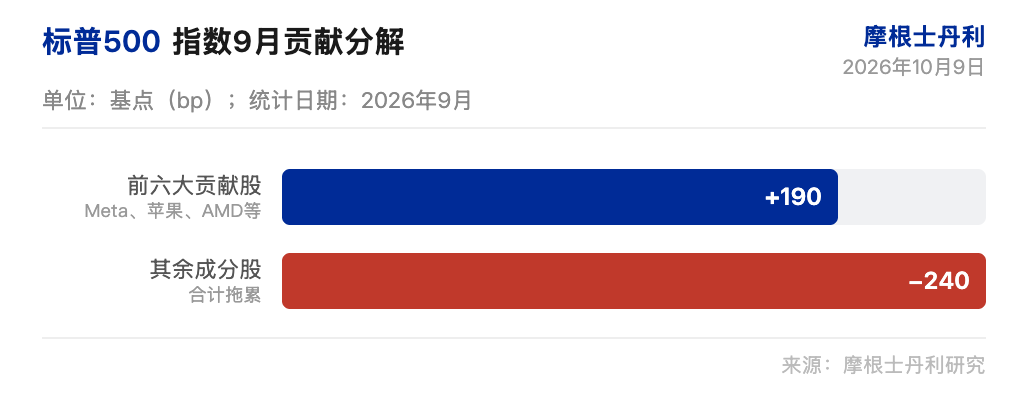
Morgan Stanley's research report highlights a divergence in the S&P 500: while the market-cap weighted index fell only 0.5% in September, the equal-weight version dropped 5%. This resilience masks broad market weakness, concentrated in the outperformance of the top six contributors (like Meta, Apple, Nvidia), which added about 190 basis points, while the rest dragged the index down by ~240 basis points. The report notes a "flight to quality," with AI and semiconductor stocks still supported by capex expansion and earnings revisions. However, their elevated valuations (median forward P/E ~32x vs. 10-year average of ~19x) and rising interest rates pose sustainability challenges, drawing parallels to the dot-com bubble in terms of price action and potential supply pressures from IPOs/secondary offerings. For Japanese markets, seasonal foreign capital inflows are expected to resume from October, potentially supporting AI-related stocks there. Morgan Stanley's strategy advises selectively maintaining AI/semiconductor exposure while gradually reducing theme concentration. It recommends tactically adding low-volatility stocks for downside protection and allocating to financially sound value stocks, which may benefit if the AI rally broadens out. The core message is to prepare for potential turning points by year-end/early 2027 by de-risking concentrated positions and adding defensive elements to portfolios.

Author: Rita

The S&P 500 Index fell 0.5% in September, while the equal-weight version declined 5%. The top six contributing stocks collectively contributed approximately 190 basis points, while the remaining constituents collectively dragged down about 240 basis points. The index's resilience masks broad weakness.

In a global strategy report released on October 9, 2026, Morgan Stanley pointed out that AI and semiconductor-related stocks remain supported by capital expenditure expansion and earnings revisions, but rising interest rates and elevated valuations pose challenges to the sustainability of the rally. The report suggests selectively maintaining AI positions, gradually reducing thematic concentration, tactically increasing holdings in low-volatility stocks, and allocating to financially robust value stocks.

The article begins by examining market structure, analyzing fund flows related to the quality factor, and then discusses allocation directions and potential turning point risks before year-end.

Index Resilience Masks Broad Weakness

In September, the global high-yield bond index fell sharply. The equal-weight S&P 500 dropped 5%, while the market-cap-weighted version declined only 0.5%. The index's resilience stems from support by a few strong individual stocks, indicating the overall market strength is not solid.

The divergence between market-cap-weighted and equal-weight indices illustrates that capital is concentrating towards high-quality assets. Morgan Stanley refers to this as a "flight to quality." The top six contributors were Meta, Apple, AMD, Nvidia, Intel, and Micron, collectively contributing about 190 basis points. The remaining constituents collectively dragged down about 240 basis points.
Returns for the quality factor in US equities have steadily risen, with low-volatility factor valuations at the 98th historical percentile. The quality factor in the Japanese market began to strengthen in late September, while the value factor weakened during the same period. In an environment of rising interest rates, investor concerns over financial fragility have outweighed preferences for valuation.

Capital expenditure from hyperscalers continues to expand, with earnings forecasts for AI and semiconductor stocks persistently revised upward. Morgan Stanley believes such companies possess thematic appeal in the current market, primarily stemming from earnings visibility and quality attributes. High return on equity and other profitability metrics align with definitions of quality stocks.

Foreign Inflows Support Japanese AI Stocks

Seasonal behavior of foreign capital in the Japanese stock market warrants attention. Data from 2011 to 2025 shows foreigners were typically net sellers in August and September, turning net buyers in October and beyond.

In the first half of 2026, foreign buying of Japanese AI-related stocks provided support. Morgan Stanley anticipates similar fund flows could reappear. Following net selling in August and September, the tendency for net buying starting in October will form a support base.

In a report on August 14 titled "The Second Half of the AI Rally," Morgan Stanley recommended holding AI and semiconductor stocks, citing strong earnings. The current view remains unchanged, but market recognition of entering the second half is strengthening. The report advises against further concentration in the theme, suggesting gradually reducing concentration and selectively investing in stocks with earnings support.

Risks for AI and semiconductor stocks also exist. In a May 14 report, "Are We Going Back to 1999?" Morgan Stanley noted multiple similarities between the AI-driven market and the internet bubble. A July 6 report further analyzed the causes of the internet bubble, with the overlap between the two periods increasing.

Elevated Valuations Coexist with Supply Pressure

The median forward price-to-earnings ratio for core AI and semiconductor stocks is around 32x, compared to about 38x three months ago. This level remains above the ten-year average of approximately 19x.

Earnings revisions remain positive but have retreated from recent peaks. A comparison of the SOX index trajectory with the internet bubble period shows high similarity in the patterns of sharp rises, sharp declines, and rebounds.

Supply-side pressure is accumulating. IPOs, new issuances, and secondary offerings could disperse investment capital, creating pressure on stock supply and demand. During the internet bubble, the number of shares available for sale after lock-up expirations increased leading up to the March 2000 peak. The current market harbors similar potential for supply expansion.

The interest rate environment also warrants attention. The internet bubble peaked in March 2000, in the middle of a Federal Reserve rate-hiking cycle. The recent Fed pivot towards tightening monetary policy could undermine market sustainability. Debates persist regarding overinvestment in data centers and the credit conditions of AI-related companies. While capital expenditure expansion supports near-term earnings, concerns over mid-term investment returns may rise.

Concentration Risk Calls for Defensive Allocation

Morgan Stanley recommends selectively maintaining AI and semiconductor exposure while gradually reducing thematic concentration. Tactically adding low-volatility stocks can enhance resilience against broader market pullbacks.

Low-volatility stocks are suitable as a defensive allocation to cope with overall market corrections. Morgan Stanley also believes investor positioning in these stocks is relatively light.

Financially robust value stocks represent another allocation avenue. The Japanese value factor has shown weakness since late September, primarily pressured by the rise of AI and quality stocks. Value stocks typically have weaker financial strength compared to growth and quality stocks, raising investor concerns about their financial fragility during rising rates. If the AI stock consolidation dissipates and preferences broaden, relative performance of value stocks may improve. The value factor has a seasonal tendency to rise towards year-end, and its medium-term allocation value remains.

Morgan Stanley maintains its judgment on earnings support for AI and semiconductor stocks but reminds investors to prepare for a potential turning point from December to early 2027. Concentration risk is accumulating. Reducing concentration and increasing allocations to low-volatility and financially sound value stocks are the core strategic directions at present. Foreign capital flows and changes in earnings forecasts are subsequent observation points.

Disclaimer

This article is a compilation and interpretation by Chao Xiang Research of a third-party brokerage research report (Morgan Stanley, October 9, 2026), combined with the organization of publicly available market information. The ratings, target prices, earnings forecasts, and related judgments cited herein are the views of the analyst(s) at the mentioned brokerage firm, representing only the stance of their affiliated institution. They do not represent the views of Chao Xiang Research nor constitute any investment advice.

Markets involve risks, and decisions require independence. This article should not serve as the basis for trading any securities.

Related Questions

QAccording to Morgan Stanley's report, what is the main contrast in performance between the S&P 500 capitalization-weighted index and the equal-weighted index in September, and what does this divergence indicate?

AIn September, the S&P 500 capitalization-weighted index fell only 0.5%, while the equal-weighted index fell 5%. This divergence indicates that the index's resilience is being supported by a handful of strong-performing stocks, masking broader market weakness and a concentration of capital into high-quality assets.

QWhat specific investment strategy does Morgan Stanley recommend regarding AI and semiconductor stocks in the current market environment?

AMorgan Stanley recommends selectively maintaining positions in AI and semiconductor stocks while gradually reducing thematic concentration. Additionally, they advise tactically increasing exposure to low-volatility stocks and allocating to financially sound value stocks to enhance defensive capabilities against a potential market downturn.

QWhat key risk parallels does the Morgan Stanley report draw between the current AI-driven market and the internet bubble of 1999-2000?

AThe report draws parallels in several areas: the sharp rise, correction, and rebound pattern of the SOX index compared to the internet bubble era; high valuations; and accumulating supply-side pressures from potential IPOs and secondary offerings, similar to the increase in lock-up expirations before the March 2000 peak.

QHow does Morgan Stanley analyze the role of foreign capital flows in the Japanese stock market, particularly concerning AI-related stocks?

AMorgan Stanley notes that foreign investors in Japanese stocks have a seasonal pattern of net selling in August and September, often turning to net buying from October onward. They expect similar supportive foreign capital inflows for Japanese AI-related stocks to potentially reoccur following this seasonal pattern.

QWhat are the two main defensive asset classes Morgan Stanley suggests adding to a portfolio to prepare for a potential market turning point around year-end?

AMorgan Stanley suggests two main defensive asset classes: 1) Low-volatility stocks, which are suitable for defending against a broad market pullback, and 2) Financially sound value stocks, which may see improved relative performance if the concentration in AI stocks dissipates and preferences broaden, especially given value factors' historical tendency for a seasonal rise toward year-end.

Related Reads

Backed by $80 Million, Alta is Building the Infrastructure to Bring Global Banking Onchain

Alta, a financial infrastructure company building institutional-grade blockchain infrastructure for global finance, has announced $80 million in total funding, including a $47.5 million Series A led by Index Ventures with participation from GV, Blackbird Ventures, Square Peg, and Capital 49, plus $32.5 million in prior seed financing. Unlike blockchains built mainly for crypto-native applications, Alta is designed to meet the privacy, compliance, neutrality, and operational needs of regulated financial institutions while supporting transactions across assets, chains, and jurisdictions. Its architecture is built on recursive zero-knowledge cryptography, keeping balances, transactions, identities, and compliance policies private while verifying that transactions meet required rules. CEO Loong Wang said existing blockchains aren't designed for institutional privacy and compliance requirements, and Alta builds these features directly into the chain. President Catherine Porter noted that as AI agents increasingly make financial decisions and execute transactions, trust becomes even more critical. Airwallex has chosen to build on Alta, connecting its global payments infrastructure to Alta's blockchain technology, supporting stablecoin pay-ins and pay-outs plus connectivity to local fiat payment networks across 200 countries and 90 currencies. Alta's first product will help businesses manage liquidity more efficiently, reducing cash buffers tied up in prefunded accounts—an estimated $4 trillion globally—through tokenized assets, just-in-time funding, more efficient foreign exchange, and instant movement in and out of yield-bearing tokenized assets. Investors praised the founding team's deep-tech blockchain engineering, institutional go-to-market knowledge, and track record of scaling multi-billion-dollar businesses. The new funding will support continued development of Alta's blockchain infrastructure, expansion of institutional partnerships and global financial connectivity, and growth of its engineering and compliance teams.

TheNewsCrypto6h ago

Backed by $80 Million, Alta is Building the Infrastructure to Bring Global Banking Onchain

TheNewsCrypto6h ago

Hitting a Record for U.S. Tech IPO Fundraising, Anthropic to Raise Up to $90.4 Billion, Fully Diluted Valuation of $1.4 Trillion

Anthropic is pursuing what would be the largest tech IPO in U.S. history, targeting a fully diluted valuation of $1.4 trillion and aiming to become the first publicly listed frontier AI lab. According to its SEC filing, Anthropic seeks to raise up to $90.4 billion through an IPO and private placement—a base IPO of up to $64.4 billion plus $26 billion from seven tech giants (Alphabet, Nvidia, AMD, Broadcom, Micron, Microsoft and TSMC). Shares are priced at $70–78; at the top end the valuation is about $1.02 trillion, slightly above its $965 billion private valuation. The stock will list on Nasdaq under ANT, with Goldman Sachs and Morgan Stanley as lead underwriters, pricing on Nov 18. Including the greenshoe, proceeds could approach $100 billion, surpassing SpaceX's $86.5 billion record. The filing reveals rapid growth: Q3 revenue neared $17 billion versus $1.4 billion a year earlier, with annualized revenue around $81 billion as of Oct 31 and over 11,900 customers spending more than $100,000 annually. Profitability remains unstable—Q3 operating expenses jumped 292% to $17.5 billion, producing a $567 million operating loss after a brief Q2 profit, hit by $5 billion in short-term compute contracts and $2 billion in non-cash charitable matching costs. Price cuts trimmed Q3 revenue growth by about $600 million. Costs are enormous: total committed spending is $895 billion, mostly for compute and chips, with about $70 billion due within a year. Revenue depends almost entirely on AI services. Anthropic is embedding Claude in healthcare, life sciences, legal and accounting work, with over 90% of its codebase now contributed by Claude. It lists as a public benefit corporation with a Long-Term Benefit Trust controlling board elections, and warns AI could pose catastrophic or existential risks. Rival OpenAI targets a 2027 IPO at a $1.25 trillion valuation. Each of Anthropic's seven co-founders holds about 1.4%.

marsbit7h ago

Hitting a Record for U.S. Tech IPO Fundraising, Anthropic to Raise Up to $90.4 Billion, Fully Diluted Valuation of $1.4 Trillion

marsbit7h ago

Trading

Spot
活动图片