At the September meeting, the Federal Reserve raised the target range for the federal funds rate by 25 basis points to 3.75%—4.00%. The backdrop for this decision is not complicated: inflation remains above target, energy prices are rising again, and the U.S. labor market has not yet shown significant deterioration.
But for investors, the more important question is not "how much was raised this time," but rather: if the U.S. re-enters a high-interest-rate environment, what will happen to stocks and bonds next?
The answer provided by BlackRock's Americas iShares investment strategist, Kristy Akullian, in her latest report is not pessimistic. Historically, the first rate hike does not necessarily mean that stocks and bonds will definitely fall; on the contrary, as long as the economy remains resilient and interest rate volatility is kept under control, investment opportunities can still arise in a high-interest-rate environment.
The following is the original text translation:
The Federal Reserve has started raising interest rates again.
In September, the Federal Reserve raised the target range for the federal funds rate by 25 basis points to 3.75%—4.00%, the first rate hike since July 2023.
BlackRock believes there are three main reasons behind this rate hike: overall inflation remains high, rising energy prices are pushing up price pressures again, and the U.S. labor market remains resilient.
Therefore, the Fed currently still has room to continue suppressing inflation without immediately worrying about significant deterioration in the economy and employment.
But for the market, a more important question has emerged: if interest rates rise again, will stocks and bonds definitely fall?
BlackRock's answer: Not necessarily.
A Rate Hike Does Not Mean Stocks and Bonds Will Definitely Fall
The market usually interprets rate hikes as negative.
The reason is simple. After interest rates rise, corporate financing costs increase, and stock valuations may be suppressed; at the same time, rising bond yields may also cause existing bond prices to fall.
But historical data shows that there is no such direct relationship between rate hikes and asset declines.
BlackRock analyzed seven Federal Reserve rate hike cycles since 1983. The results show that in the 12 months following the first rate hike, U.S. stocks rose by an average of 4.7%, U.S. bonds rose by an average of 3.07%, and high-yield bonds rose by an average of 4.68%.
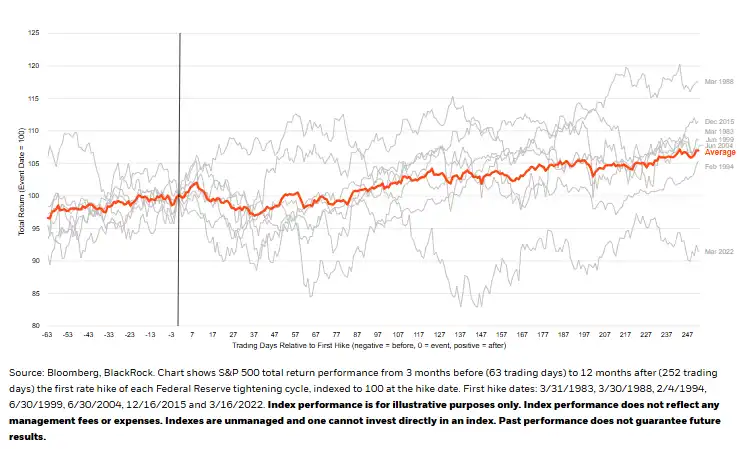
Of course, this does not mean that "rate hikes are good for the market." More accurately, a single rate hike itself does not determine the direction of asset prices over the next year.
The Federal Reserve typically raises interest rates when the economy is still relatively strong. If corporate profits are still growing and the labor market is not significantly deteriorating, the economy's inherent growth momentum may offset some of the pressure from high interest rates.
Therefore, compared to simply judging whether "a rate hike is negative or positive," the more important question is: Why is the Fed raising rates? And can the economy withstand higher interest rates?
For Bonds, High Interest Rates Also Mean Higher Yields
One of the biggest differences in this rate hike environment compared to previous years is that bonds themselves can already provide higher interest income. BlackRock believes that the currently higher risk-free rate and real yield provide a more attractive starting point for fixed-income assets.
In other words, while rising interest rates may depress the prices of existing bonds, for investors preparing to buy new bonds, the yields they can obtain are also higher.
Therefore, high interest rates are not purely bad news for bonds. BlackRock currently prefers bonds with higher credit quality, including investment-grade bonds and quality high-yield bonds, while emphasizing earning income through coupons rather than excessively betting on bond price increases.
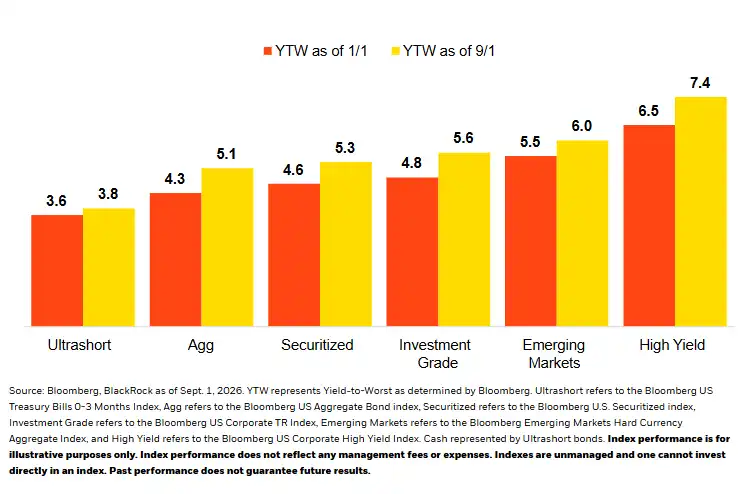
However, large issuances of U.S. Treasury and corporate bonds may still push up long-term interest rates. Therefore, BlackRock believes that investors should not simply bet on a rapid decline in long-term rates but need to manage bond durations more flexibly.
It is worth noting that long-term real yields are currently at relatively high levels. BlackRock mentions that the real yield on the 30-year U.S. Treasury Inflation-Protected Securities (TIPS) has exceeded 3%.
This means that even without relying on significant bond price increases, long-term bonds themselves are beginning to provide relatively substantial real returns.
What U.S. Stocks Really Fear Is Not Necessarily High Interest Rates
Compared to bonds, the issue for stocks is slightly more complex.
BlackRock remains relatively positive on U.S. stocks. Its reasoning is that U.S. corporate earnings remain strong, and historically, stocks do not automatically enter a downtrend just because the Fed raises rates for the first time.
BlackRock's data shows that in the past seven rate hike cycles, the S&P 500 still tended to rise overall in the 12 months following the first rate hike.
But there is a very important prerequisite: interest rates must not fluctuate violently. The market can gradually adapt to a relatively high but stable interest rate environment. For example, if investors already believe that the policy rate will remain around 4% for some time, this level will eventually be gradually reflected in stock valuations and corporate financing costs.
The real trouble is when the market constantly reassesses how high interest rates will ultimately go. If inflation repeatedly exceeds expectations, investors keep raising their expectations for future interest rates, and long-term Treasury yields rise rapidly, then stock valuations also need to be constantly readjusted.
Therefore, what BlackRock is really watching is not just "how high interest rates are," but whether interest rates will suddenly become highly volatile.
In such an environment, BlackRock prefers large, high-quality, dividend-paying companies and is relatively cautious about small-cap stocks, which are more sensitive to financing costs.
Buying Both Stocks and Bonds May Not Diversify Risk as Effectively as Before
Another thing that is changing is the relationship between stocks and bonds.
An important reason why the traditional 60/40 investment portfolio was popular is that stocks and bonds often hedged each other in the past. When the economy weakened, stocks typically fell; but at the same time, the Fed might cut rates, causing bond prices to rise and offsetting some of the stock losses. However, in recent years, this relationship has become less stable.
According to data from BlackRock and Morningstar, the correlation coefficient between stocks and bonds was approximately -0.22 from 2010 to 2019; since 2020, this number has risen to 0.51. In other words, instances of stocks and bonds moving together—both up or both down—have become more common in recent years.
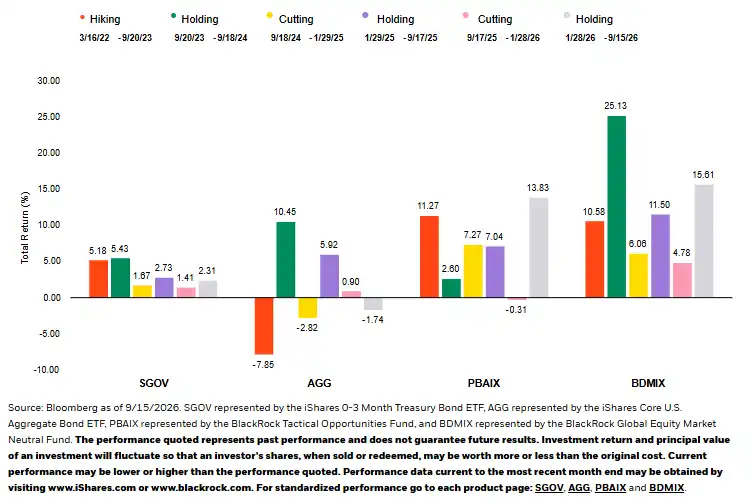
The reason lies in the shift in the primary risk facing the market.
If the market's biggest worry is an economic recession, bonds typically benefit when stocks fall. But if the market's biggest worry is inflation, the situation may be entirely different: rising inflation pushes interest rates higher, causing bond prices to fall, while higher interest rates also depress stock valuations.
This is also why BlackRock believes that the traditional "stocks + bonds" portfolio may no longer be as stable as before, and there is a need to add other assets or strategies with different sources of return to further diversify risk.
What's Next Is Not Just About Whether the Fed Will Raise Rates Again
BlackRock's baseline judgment is that the Federal Reserve may raise rates once more in 2026, but it currently does not believe this will develop into a very aggressive rate hike cycle.
For the market, what is truly worth watching next may not be "one more rate hike or two," but three more important variables.
The first is whether inflation will continue to rise.
If energy prices gradually fall and inflation cools again, the pressure on the Fed to continue raising rates will decrease; conversely, if inflation spreads further, the market may need to raise its interest rate expectations again.
The second is whether the economy and corporate earnings can withstand high interest rates.
Historically, stocks still rising after rate hikes often occurred when the economy continued to grow. If employment, consumption, and corporate earnings all weaken significantly, the historical experience will also have less reference value.
Finally, and most importantly in this BlackRock report: what truly needs to be guarded against may not be high interest rates, but interest rates suddenly becoming very unstable.
If the economy remains resilient and the market can gradually adapt to a higher but stable interest rate environment, then stocks may still rise, and bonds can also provide income through higher coupons. But if inflation fluctuates, causing the market to constantly raise interest rate expectations and long-term rates to surge rapidly, then both stocks and bonds may face renewed pressure.
Therefore, what really matters in this rate hike cycle is not just when the Fed will act next. More importantly: can high interest rates remain stable, and for how long can the U.S. economy still endure them?