The Revived Codex, Carrying OpenAI's Hopes for IPO

marsbitPubblicato 2026-05-24Pubblicato ultima volta 2026-05-24

Introduzione

This article analyzes the intense recent development of OpenAI's Codex, positioning it as a crucial component for OpenAI's impending IPO. Over the past two months, Codex has seen a rapid series of major updates focused on integrating into real enterprise workflows. Key new features include enhanced context capture (Appshots, file previews, built-in browser), long-running task execution ("Goal Mode"), remote operation (phone control, lock-screen access), and enterprise management tools (plugin sharing, access tokens, automated risk review). These updates aim to make Codex a comprehensive AI workbench that can "see the scene, push tasks, and manage risks." The author argues that while ChatGPT proves OpenAI's massive user base and API provides foundational revenue, Codex represents OpenAI's clearest path to demonstrating tangible, high-value commercial viability. It targets developers and engineering teams—a segment already accustomed to paying for efficiency gains in costly software development cycles. This is critical because, despite higher overall revenue, OpenAI's adjusted operating margins remain deeply negative, highlighting the challenge of outrunning immense compute costs. The pressure is amplified by competitor Anthropic's success with Claude Code, which has shown that a focused approach on high-value enterprise and developer workflows can lead to a path toward profitability. Codex's aggressive evolution is thus seen as OpenAI's strategic move to capture a similar en...

Codex's update frequency has been utterly insane recently.

Over the past two months, OpenAI has been cramming new features into Codex almost every few days.

First came plugins, a built-in browser, computer operation, PR review, remote SSH, mobile access... Then on May 21st, Codex had its own "Crazy Thursday," releasing several major features in one go: one-click screen sharing with Codex, letting Codex work persistently on a goal, continued remote use after computer lock, and support for team-shared plugins and usage data viewing.

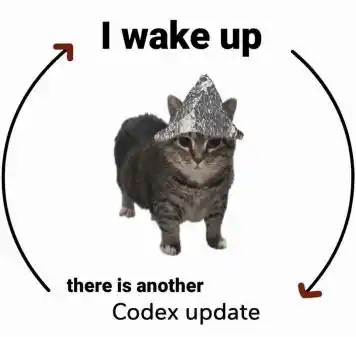
There was a widely circulated meme online before: waking up to see another Claude update. Now Codex is following suit.

It's just that Claude's updates are more "fragmented" and refined, while Codex has released more major features.
Notably, their updates are all heading in the same direction—enterprise entry points and real-world workflows.

Claude Code has already proven the value of this path. Anthropic has even started to make the market believe that frontier model companies don't necessarily have to burn cash forever; they also have a chance to turn their profit statements positive.

Codex is doing the same thing. At this juncture, it's backed by OpenAI, which is preparing for an IPO.

ChatGPT has proven that OpenAI has users, but users do not equal business, and popularity doesn't necessarily bring profits. Especially for a frontier model company, compute costs, training investments, and inference overhead are all significant. OpenAI needs to prove to the market that it's not just good at making hit chatbots, but can also integrate AI into the production processes that enterprises are truly willing to pay for.

Codex's high-frequency updates are precisely filling this gap.

It's not just a development tool; it's the card that most easily articulates commercial value for OpenAI right now.

01

What has Codex been doing these past two months?

We used ChatGPT Images 2.0 to create a chart showing Codex's recent updates over the past two months.
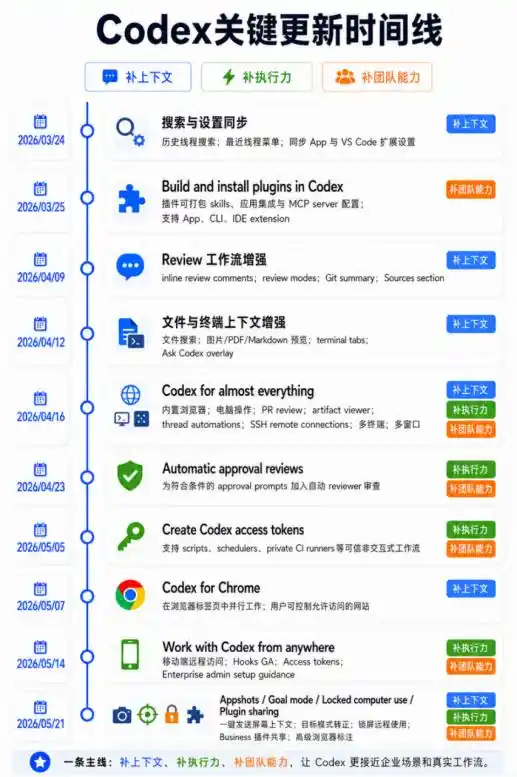
March 24th, Search & Settings Sync.

The Codex App added historical thread search, quick jump to recent threads, and synchronized key settings between the Codex App and VS Code extension. Basically foundational experience optimization: letting users quickly retrieve past tasks and ensuring a more consistent experience between desktop and editor usage.

March 25th, Plugin System Launched.

Codex began supporting plugins. Plugins can package skills, application integrations, and MCP server configurations to reuse workflows, supporting the Codex App, CLI, and IDE extension.

April 9th, Code Review Workflow Enhancement.

The Codex App added collapsible inline review comments, different review modes, Git summaries, and source blocks. Codex started delving deeper into code review and PR collaboration.

April 12th, File & Terminal Context Enhancement.

Codex added file search in the command menu, support for previewing images, PDFs, and Markdown in the sidebar, added a terminal tab for each thread, and supported directly asking Codex about selected text.

April 16th, Codex for almost everything.

This was the first major milestone in the past two months. OpenAI began pushing Codex to become a more comprehensive AI workbench. This wave of updates included a built-in browser, computer operation, thread automation, task sidebar, PR workflows, result previews, SSH remote connections, multi-terminal, multi-window, Intel Mac support, and a batch of new plugins.

April 23rd, Auto-Approve Reviews.

Codex could send eligible approval requests to an auto-review agent for risk assessment first, then display review status and risk level, ultimately leaving the decision to approve or not to the user.

May 5th, Codex Access Tokens Launched.

ChatGPT Enterprise workspace owners and administrators could allow members to create Codex access tokens for use in trusted non-interactive local workflows like scripts, schedulers, and private CI runners. Codex started approaching CI, automation, and enterprise engineering systems.

May 7th, Codex Enters Chrome.

Codex launched a Chrome extension, allowing parallel work in browser tabs without directly taking over the user's browser. Users could also control which websites allow Codex usage. The browser is the entry point for many backend systems, internal tools, and web debugging scenarios. This step brought Codex closer to the real office environment.

May 14th, Codex Supports Phone Control.

OpenAI supported users using Codex from the ChatGPT mobile app, connecting to a Mac running the Codex App. Users could check task progress, approve actions, view code diffs, and test results on their phones. This wave also included Hooks becoming generally available, access tokens, and enterprise admin setup guides. Codex started becoming a work agent that could be monitored remotely.

May 21st, Appshots, Goal Mode, Lock Screen Remote Use, and Plugin Sharing.

This was the second major milestone. Appshots could directly send a screenshot of the current Mac window and available text to Codex; Goal Mode officially launched, allowing users to give Codex a goal and have it work persistently on it for hours or even days; Lock Screen Remote Use allowed Codex to continue operating desktop apps after the Mac was locked, no longer needing to "leave a window open."

Simultaneously, ChatGPT Business began supporting team-shared plugins; the built-in browser's annotation capabilities were further enhanced, allowing direct adjustment of fonts, colors, spacing, and other styles.

The features themselves are important, but the overall update trend is equally noteworthy. Whether it's Appshots or Goal Mode, or the Chrome extension, access tokens, and plugin sharing, they are all filling the basic requirements for entering real workflows: seeing the field, pushing tasks forward, and managing risks.

To see the field, what needs to be complemented is contextual capability.

Real development tasks rarely happen only in code editors. File search, file preview, terminal tabs, built-in browser, browser annotation, Chrome extension, Appshots—essentially, these are all about reducing the user's cost of describing context to the AI.

Previously, you had to tell the AI what the problem was via description or Ctrl+C/V. Now, OpenAI wants Codex to see these things directly.

To push tasks forward, long-running task and remote execution capabilities are crucial.

Goal Mode solves "whether it can keep going." Mobile remote access and lock screen remote use allow tasks to continue even when the user isn't at the computer. Access tokens and Hooks further integrate Codex into enterprise engineering systems like scripts, schedulers, and CI runners.

Managing risks is a matter of enterprise and team management.

For individual developers using tools, the core concern is usability. But enterprise tools involve more complex issues: how to manage permissions, how to distribute plugins, who is using them and how much, how to review risks, whether they can integrate with CI, whether they can be managed uniformly by the team.

Codex has also done a lot of work in this area. The plugin system allows workflows to be packaged and reused; plugin sharing allows teams to distribute tools uniformly; auto-approve reviews are about controlling agent execution risks; access tokens and enterprise admin settings are about integrating Codex into existing enterprise engineering and governance processes.

02

"The Hope of the Whole Village"

Codex's updates have brought it a very impressive user growth rate.

In early March, Codex's weekly active users were around 1.6 million. By May 14th, OpenAI officially mentioned while introducing the mobile version of Codex that over 4 million people use Codex weekly. This means that in about two months, Codex's weekly active user count increased significantly again.

This growth trajectory is inseparable from the underlying model's capabilities. The premise for users being willing to entrust real tasks to Codex more frequently is that it can actually get the job done. Especially after GPT-5.5, Codex's coding, tool use, long-context, and multi-step task capabilities have a better foundation.

But having a model alone isn't enough. The market won't pay just because a model's benchmark improves; it cares more about whether these capabilities can translate into revenue.

This is what OpenAI must clarify before its IPO.

OpenAI holds many cards, but each has its own uncertainties.

ChatGPT is the largest user entry point, proving OpenAI has global users and consumer subscription capabilities. The problem is, the larger the user base, the heavier the inference costs; whether consumer subscriptions can sustain a frontier model company's long-term investments still needs further proof.

API is a fundamental revenue source, selling model capabilities to developers and enterprises. But the API market can easily become a price war, and enterprise clients may not bind themselves to just one model supplier. The more general the model capabilities, the more likely clients are to use multiple models.

ChatGPT Enterprise, Agents, and industry solutions are OpenAI's direct entry into the enterprise market. But these products need time, sales, integration, and industry-specific implementation to truly penetrate enterprise processes.

Looking further ahead, OpenAI also has hardware, data centers, multi-cloud partnerships, and compute infrastructure. These stories have great imaginative potential but are also heavier, more distant, and more capital-intensive. They can support the long-term vision but struggle to immediately explain short-term commercial returns.

In contrast, Codex's commercial value is easier to explain. It targets a very clear group: developers and engineering teams.

This is a group already willing to pay for services. Engineer time is expensive, software project cycles are long, and code maintenance costs are high. Bug fixes, testing, code reviews—each stage has a calculable cost.

Software development itself is also one of the most core production processes for enterprises. Financial companies have risk control and trading systems, retail companies have supply chain and membership systems, healthcare companies have data and compliance systems, media companies have content backends and distribution systems... Even non-tech companies have vast internal tools, data pipelines, automation scripts, and business systems that need maintenance—virtually every company today relies on software systems.

In other words, Codex is cutting into where companies spend money and consume manpower every single day.

In a sense, it's the hope for OpenAI to articulate a compelling IPO narrative. This becomes particularly important as OpenAI prepares to enter the capital markets.

Because in the IPO narrative, OpenAI no longer faces questions like "Does AI have a future?" The truly difficult question to answer is another one: Can a frontier model company find a clear, stable, and profitable enough commercial path beyond massive compute investments?

What's more troublesome is that Anthropic has already taken a step forward on this issue.

03

Anthropic Has Already Taken the Lead

There's another crucial reason Codex must be pushed to the forefront: OpenAI's biggest competitor, Anthropic, has already paved a path on the enterprise side.

Although in terms of revenue scale, OpenAI still leads—The Information reported OpenAI's Q1 2026 revenue at approximately $5.7 billion, higher than Anthropic's $4.8 billion for the same period—the issue now isn't just about revenue size. The real pressure for frontier model companies is whether revenue growth can outpace cost growth.

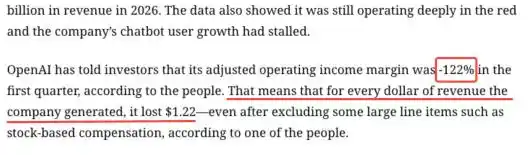
OpenAI's Q1 revenue was high, but its adjusted operating margin was approximately -122%. Calculated on this basis, for every $1 of revenue, adjusted operating costs might be about $2.22, ultimately losing $1.22.
Over the past few years, the outside world has consistently questioned the capital intensity of large model companies: training, inference, GPUs, talent expenses—each is a bottomless pit. The more users, the more calls, the heavier the costs.

The signal recently released by Anthropic has changed the imagination around this issue.

According to The Wall Street Journal, Anthropic expects Q2 2026 revenue to exceed $10.9 billion and is approaching its first quarterly operating profit, estimated at around $559 million.

While this doesn't mean Anthropic has forever escaped the burn problem, it gives the market a very important signal: Frontier model companies don't necessarily have to rely on fundraising to survive forever. As long as the model capabilities are strong enough and the products are close enough to high-value enterprise scenarios, revenue growth can potentially outpace costs.

Anthropic doesn't have a mass-market entry point like ChatGPT, nor does it have as many simultaneous narratives. Its path is narrower and purer: directly enter areas enterprises are willing to pay for, especially high-value scenarios like developers, finance, law, research, data analysis, and internal knowledge work.

Claude Code is the most typical card in this deck. It started as a coveted tool among developers, focusing on programming scenarios. Later, it progressively added long-running tasks, plugins, permissions, team management, and enterprise governance, gradually becoming an important entry point for Anthropic into enterprise workflows. Developers adopt it first, teams follow, eventually turning into enterprise procurement and budgets.

In April 2026, among sample enterprises on the Ramp platform, Anthropic's adoption rate rose to 34.4%, while OpenAI's fell to 32.3%. Although this is only a sample based on enterprise spending on the Ramp platform and not a full-market statistic, this data at least indicates that Anthropic's momentum in enterprise-paid scenarios is strengthening.
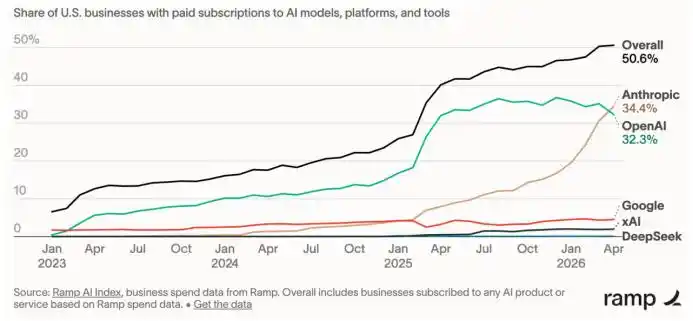
This is precisely where the pressure lies for Codex.

OpenAI's revenue scale still leads, but if it's to enter the capital markets, it can't just talk about user scale or model capabilities. It needs a product closer to enterprise production to prove it can turn AI into stable enterprise revenue.

If Claude Code has proven that developer workflows can become Anthropic's enterprise entry point, then Codex must prove that OpenAI can also walk this path.

Codex lead Tibo Sottiaux recently half-jokingly summarized the company's "master plan": release better, more efficient models, release better products every week, then acquire more compute (and increase time surfing on X).

Better models determine whether Codex can truly work; higher-frequency product updates determine whether Codex can enter real workflows; more compute determines whether all of this can support growing usage.

All of this is very important for the IPO.

In other words, Codex's recent intensive updates aren't just about chasing features; they're also chasing the enterprise-oriented path that Anthropic has already carved out.

ChatGPT has already proven OpenAI has users.

And Codex must prove that OpenAI is a business that can make money.

This article is from WeChat public account "字母AI", author: Yuan Xinyue

Domande pertinenti

QWhat is the main role of Codex in OpenAI's current strategic positioning?

ACodex serves as OpenAI's product with the most easily articulated commercial value, aimed at proving OpenAI can integrate AI into genuine, paid enterprise production workflows, which is crucial for its IPO narrative.

QAccording to the article, what are the three core capabilities Codex's recent updates have focused on enhancing?

AThe updates focus on three key capabilities: 1) Contextual Awareness (seeing the work environment), 2) Long-task and Remote Execution (pushing tasks forward), and 3) Enterprise and Team Management (controlling risk and governance).

QWhy is the enterprise/developer market segment specifically important for Codex's commercial success?

ADevelopers and engineering teams represent a segment already willing to pay for productivity tools. Their time is expensive, and software development is a core, costly production环节 in nearly every modern company, making it a high-value, monetizable market for AI tools.

QHow does the competitive pressure from Anthropic relate to Codex's development?

AAnthropic's Claude Code has demonstrated a viable path to profitability by deeply integrating into enterprise developer workflows. Codex's rapid feature development is, in part, a response to prove OpenAI can also successfully capture this lucrative enterprise market segment.

QWhat key financial challenge for frontier AI companies does the article highlight, and how does Codex address it?

AThe challenge is that revenue growth must outpace the heavy costs of compute, training, and inference. Codex addresses this by targeting a specific, high-value enterprise use case (software development) where businesses are accustomed to paying for efficiency gains, aiming to create a clear and stable revenue stream.

Letture associate

a16z: How Tokenization is Transforming the Nature of Assets in 7 Charts

"Tokenized Assets: How Tokenization Changes the Nature of Assets" by a16z Crypto The market for tokenized assets, excluding stablecoins, has grown from under $3 billion two years ago to over $340 billion today. US Treasury bonds are the primary growth driver, allowing investors to hold yield-bearing assets digitally and enabling more efficient settlement. Other key sectors include private credit (growing fastest), commodities (dominated by gold), and niche financial assets. However, the market remains concentrated in tokenized US Treasuries and gold. A critical insight is that most tokenized assets currently lack "composability." While the total market is large, only a small fraction is actively used within DeFi protocols. For instance, only about 5% of tokenized bonds and a low percentage of tokenized gold are utilized on-chain. In contrast, assets like reinsurance and private credit tokens show much higher on-chain usage rates (84% and 33%, respectively). This highlights a divide: many tokenized assets are merely digital records on a blockchain without enabling new, programmable financial applications. The Pantera Capital Token Native Index indicates over 70% of tokenized assets have minimal on-chain native functionality. Ethereum remains the dominant blockchain for tokenized assets (over $150B), but the ecosystem is diversifying across chains like BNB Chain, Solana, and Stellar, based on factors like cost and compliance. Major institutions forecast massive future growth, with predictions for the tokenized asset market ranging from $2 trillion to over $30 trillion by the early 2030s. However, compared to the global financial system (e.g., ~$140T bonds, multi-trillion dollar gold market), tokenized assets currently represent a tiny fraction (0.01% or less). The conclusion is that while tokenization has begun by digitizing and streamlining settlement for simpler assets, the next phase involves bringing more complex financial instruments on-chain and deeply integrating them into composable, internet-native financial infrastructure.

Odaily星球日报6 min fa

a16z: How Tokenization is Transforming the Nature of Assets in 7 Charts

Odaily星球日报6 min fa

a16z: 7 Charts to Understand How Tokenization Is Changing the Nature of Assets

a16z: 7 Charts on How Tokenization is Transforming the Nature of Assets Tokenized Assets, often referred to as "real-world assets" (RWA), are altering the form, flow, and structure of the financial system. The market recently surpassed $30 billion (excluding stablecoins), driven largely by tokenized U.S. Treasuries. These offer investors digital, yield-bearing assets with efficient settlement. Growth varies significantly by asset class. Asset-backed credit leads in speed, followed by niche financial assets, while venture capital and active strategies took longer to scale. U.S. Treasuries and commodities dominate, holding about two-thirds of the current market share. Within commodities, gold tokenization dominates entirely due to its standardization and historical appeal in crypto. The ecosystem is spread across multiple blockchains. Ethereum holds over half the market, with others like BNB Chain, Solana, and Stellar holding significant shares. However, a key insight is that most tokenized assets currently lack "composability." While the total market is large, only a small fraction (e.g., 5% of tokenized bonds) is used within DeFi protocols. Many tokens are simply digital records of off-chain assets, not natively programmable financial building blocks. In contrast, smaller categories like reinsurance tokens see very high on-chain usage. Looking ahead, forecasts for the tokenized asset market by 2030 range from $2 trillion to over $30 trillion, representing immense potential growth from today's ~$340 billion base. Yet, relative to global markets (e.g., $140T+ in bonds), tokenization's penetration remains minuscule (<0.02%). The current phase focuses on digitizing straightforward assets for efficiency. The next major challenge is bringing more complex financial instruments on-chain and integrating tokenized assets into truly composable, internet-native financial infrastructure.

marsbit1 h fa

a16z: 7 Charts to Understand How Tokenization Is Changing the Nature of Assets

marsbit1 h fa

Trading

Spot
Futures

Articoli Popolari

Cosa è $S$

Comprendere SPERO: Una Panoramica Completa Introduzione a SPERO Mentre il panorama dell'innovazione continua a evolversi, l'emergere delle tecnologie web3 e dei progetti di criptovaluta gioca un ruolo fondamentale nel plasmare il futuro digitale. Un progetto che ha attirato l'attenzione in questo campo dinamico è SPERO, denotato come SPERO,$$s$. Questo articolo mira a raccogliere e presentare informazioni dettagliate su SPERO, per aiutare gli appassionati e gli investitori a comprendere le sue basi, obiettivi e innovazioni nei domini web3 e crypto. Che cos'è SPERO,$$s$? SPERO,$$s$ è un progetto unico all'interno dello spazio crypto che cerca di sfruttare i principi della decentralizzazione e della tecnologia blockchain per creare un ecosistema che promuove l'impegno, l'utilità e l'inclusione finanziaria. Il progetto è progettato per facilitare interazioni peer-to-peer in modi nuovi, fornendo agli utenti soluzioni e servizi finanziari innovativi. Al suo interno, SPERO,$$s$ mira a responsabilizzare gli individui fornendo strumenti e piattaforme che migliorano l'esperienza dell'utente nello spazio delle criptovalute. Questo include la possibilità di metodi di transazione più flessibili, la promozione di iniziative guidate dalla comunità e la creazione di percorsi per opportunità finanziarie attraverso applicazioni decentralizzate (dApps). La visione sottostante di SPERO,$$s$ ruota attorno all'inclusività, cercando di colmare le lacune all'interno della finanza tradizionale mentre sfrutta i vantaggi della tecnologia blockchain. Chi è il Creatore di SPERO,$$s$? L'identità del creatore di SPERO,$$s$ rimane piuttosto oscura, poiché ci sono risorse pubblicamente disponibili limitate che forniscono informazioni dettagliate sul suo fondatore o fondatori. Questa mancanza di trasparenza può derivare dall'impegno del progetto per la decentralizzazione—un ethos che molti progetti web3 condividono, dando priorità ai contributi collettivi rispetto al riconoscimento individuale. Centrando le discussioni attorno alla comunità e ai suoi obiettivi collettivi, SPERO,$$s$ incarna l'essenza dell'empowerment senza mettere in evidenza individui specifici. Pertanto, comprendere l'etica e la missione di SPERO rimane più importante che identificare un creatore singolo. Chi sono gli Investitori di SPERO,$$s$? SPERO,$$s$ è supportato da una varietà di investitori che vanno dai capitalisti di rischio agli investitori angelici dedicati a promuovere l'innovazione nel settore crypto. Il focus di questi investitori generalmente si allinea con la missione di SPERO—dando priorità a progetti che promettono avanzamenti tecnologici sociali, inclusività finanziaria e governance decentralizzata. Queste fondazioni di investitori sono tipicamente interessate a progetti che non solo offrono prodotti innovativi, ma contribuiscono anche positivamente alla comunità blockchain e ai suoi ecosistemi. Il supporto di questi investitori rafforza SPERO,$$s$ come un concorrente degno di nota nel dominio in rapida evoluzione dei progetti crypto. Come Funziona SPERO,$$s$? SPERO,$$s$ impiega un framework multifunzionale che lo distingue dai progetti di criptovaluta convenzionali. Ecco alcune delle caratteristiche chiave che sottolineano la sua unicità e innovazione: Governance Decentralizzata: SPERO,$$s$ integra modelli di governance decentralizzati, responsabilizzando gli utenti a partecipare attivamente ai processi decisionali riguardanti il futuro del progetto. Questo approccio favorisce un senso di proprietà e responsabilità tra i membri della comunità. Utilità del Token: SPERO,$$s$ utilizza il proprio token di criptovaluta, progettato per servire varie funzioni all'interno dell'ecosistema. Questi token abilitano transazioni, premi e la facilitazione dei servizi offerti sulla piattaforma, migliorando l'impegno e l'utilità complessivi. Architettura Stratificata: L'architettura tecnica di SPERO,$$s$ supporta la modularità e la scalabilità, consentendo un'integrazione fluida di funzionalità e applicazioni aggiuntive man mano che il progetto evolve. Questa adattabilità è fondamentale per mantenere la rilevanza nel panorama crypto in continua evoluzione. Coinvolgimento della Comunità: Il progetto enfatizza iniziative guidate dalla comunità, impiegando meccanismi che incentivano la collaborazione e il feedback. Nutrendo una comunità forte, SPERO,$$s$ può affrontare meglio le esigenze degli utenti e adattarsi alle tendenze di mercato. Focus sull'Inclusione: Offrendo basse commissioni di transazione e interfacce user-friendly, SPERO,$$s$ mira ad attrarre una base utenti diversificata, inclusi individui che potrebbero non aver precedentemente interagito nello spazio crypto. Questo impegno per l'inclusione si allinea con la sua missione generale di empowerment attraverso l'accessibilità. Cronologia di SPERO,$$s$ Comprendere la storia di un progetto fornisce preziose intuizioni sulla sua traiettoria di sviluppo e sui traguardi. Di seguito è riportata una cronologia suggerita che mappa eventi significativi nell'evoluzione di SPERO,$$s$: Fase di Concettualizzazione e Ideazione: Le idee iniziali che formano la base di SPERO,$$s$ sono state concepite, allineandosi strettamente con i principi di decentralizzazione e focus sulla comunità all'interno dell'industria blockchain. Lancio del Whitepaper del Progetto: Dopo la fase concettuale, è stato rilasciato un whitepaper completo che dettaglia la visione, gli obiettivi e l'infrastruttura tecnologica di SPERO,$$s$ per suscitare interesse e feedback dalla comunità. Costruzione della Comunità e Prime Interazioni: Sono stati effettuati sforzi attivi di outreach per costruire una comunità di early adopters e potenziali investitori, facilitando discussioni attorno agli obiettivi del progetto e ottenendo supporto. Evento di Generazione del Token: SPERO,$$s$ ha condotto un evento di generazione del token (TGE) per distribuire i propri token nativi ai primi sostenitori e stabilire una liquidità iniziale all'interno dell'ecosistema. Lancio della Prima dApp: La prima applicazione decentralizzata (dApp) associata a SPERO,$$s$ è stata attivata, consentendo agli utenti di interagire con le funzionalità principali della piattaforma. Sviluppo Continuo e Partnership: Aggiornamenti e miglioramenti continui alle offerte del progetto, inclusi partnership strategiche con altri attori nello spazio blockchain, hanno plasmato SPERO,$$s$ in un concorrente competitivo e in evoluzione nel mercato crypto. Conclusione SPERO,$$s$ rappresenta una testimonianza del potenziale del web3 e delle criptovalute di rivoluzionare i sistemi finanziari e responsabilizzare gli individui. Con un impegno per la governance decentralizzata, il coinvolgimento della comunità e funzionalità progettate in modo innovativo, apre la strada verso un panorama finanziario più inclusivo. Come per qualsiasi investimento nello spazio crypto in rapida evoluzione, si incoraggiano potenziali investitori e utenti a ricercare approfonditamente e a impegnarsi in modo riflessivo con gli sviluppi in corso all'interno di SPERO,$$s$. Il progetto mostra lo spirito innovativo dell'industria crypto, invitando a ulteriori esplorazioni delle sue innumerevoli possibilità. Mentre il percorso di SPERO,$$s$ è ancora in fase di sviluppo, i suoi principi fondamentali potrebbero effettivamente influenzare il futuro di come interagiamo con la tecnologia, la finanza e tra di noi in ecosistemi digitali interconnessi.

75 Totale visualizzazioniPubblicato il 2024.12.17Aggiornato il 2024.12.17

Cosa è $S$

Cosa è AGENT S

Agent S: Il Futuro dell'Interazione Autonoma in Web3 Introduzione Nel panorama in continua evoluzione di Web3 e criptovalute, le innovazioni stanno costantemente ridefinendo il modo in cui gli individui interagiscono con le piattaforme digitali. Uno di questi progetti pionieristici, Agent S, promette di rivoluzionare l'interazione uomo-computer attraverso il suo framework agentico aperto. Aprendo la strada a interazioni autonome, Agent S mira a semplificare compiti complessi, offrendo applicazioni trasformative nell'intelligenza artificiale (AI). Questa esplorazione dettagliata approfondirà le complessità del progetto, le sue caratteristiche uniche e le implicazioni per il dominio delle criptovalute. Cos'è Agent S? Agent S si presenta come un innovativo framework agentico aperto, progettato specificamente per affrontare tre sfide fondamentali nell'automazione dei compiti informatici: Acquisizione di Conoscenze Specifiche del Dominio: Il framework apprende in modo intelligente da varie fonti di conoscenza esterne ed esperienze interne. Questo approccio duale gli consente di costruire un ricco repository di conoscenze specifiche del dominio, migliorando le sue prestazioni nell'esecuzione dei compiti. Pianificazione su Lungo Orizzonte di Compiti: Agent S impiega una pianificazione gerarchica potenziata dall'esperienza, un approccio strategico che facilita la suddivisione e l'esecuzione efficiente di compiti complessi. Questa caratteristica migliora significativamente la sua capacità di gestire più sottocompiti in modo efficiente ed efficace. Gestione di Interfacce Dinamiche e Non Uniformi: Il progetto introduce l'Interfaccia Agente-Computer (ACI), una soluzione innovativa che migliora l'interazione tra agenti e utenti. Utilizzando Modelli Linguistici Multimodali di Grandi Dimensioni (MLLM), Agent S può navigare e manipolare senza sforzo diverse interfacce grafiche utente. Attraverso queste caratteristiche pionieristiche, Agent S fornisce un framework robusto che affronta le complessità coinvolte nell'automazione dell'interazione umana con le macchine, preparando il terreno per innumerevoli applicazioni nell'AI e oltre. Chi è il Creatore di Agent S? Sebbene il concetto di Agent S sia fondamentalmente innovativo, informazioni specifiche sul suo creatore rimangono elusive. Il creatore è attualmente sconosciuto, il che evidenzia sia la fase embrionale del progetto sia la scelta strategica di mantenere i membri fondatori sotto anonimato. Indipendentemente dall'anonimato, l'attenzione rimane sulle capacità e sul potenziale del framework. Chi sono gli Investitori di Agent S? Poiché Agent S è relativamente nuovo nell'ecosistema crittografico, informazioni dettagliate riguardanti i suoi investitori e sostenitori finanziari non sono documentate esplicitamente. La mancanza di approfondimenti pubblicamente disponibili sulle fondazioni di investimento o sulle organizzazioni che supportano il progetto solleva interrogativi sulla sua struttura di finanziamento e sulla roadmap di sviluppo. Comprendere il supporto è cruciale per valutare la sostenibilità del progetto e il suo potenziale impatto sul mercato. Come Funziona Agent S? Al centro di Agent S si trova una tecnologia all'avanguardia che gli consente di funzionare efficacemente in contesti diversi. Il suo modello operativo è costruito attorno a diverse caratteristiche chiave: Interazione Uomo-Computer Simile a Quella Umana: Il framework offre una pianificazione AI avanzata, cercando di rendere le interazioni con i computer più intuitive. Mimando il comportamento umano nell'esecuzione dei compiti, promette di elevare le esperienze degli utenti. Memoria Narrativa: Utilizzata per sfruttare esperienze di alto livello, Agent S utilizza la memoria narrativa per tenere traccia delle storie dei compiti, migliorando così i suoi processi decisionali. Memoria Episodica: Questa caratteristica fornisce agli utenti una guida passo-passo, consentendo al framework di offrire supporto contestuale mentre i compiti si sviluppano. Supporto per OpenACI: Con la capacità di funzionare localmente, Agent S consente agli utenti di mantenere il controllo sulle proprie interazioni e flussi di lavoro, allineandosi con l'etica decentralizzata di Web3. Facile Integrazione con API Esterne: La sua versatilità e compatibilità con varie piattaforme AI garantiscono che Agent S possa adattarsi senza problemi agli ecosistemi tecnologici esistenti, rendendolo una scelta attraente per sviluppatori e organizzazioni. Queste funzionalità contribuiscono collettivamente alla posizione unica di Agent S all'interno dello spazio crittografico, poiché automatizza compiti complessi e multi-fase con un intervento umano minimo. Man mano che il progetto evolve, le sue potenziali applicazioni in Web3 potrebbero ridefinire il modo in cui si svolgono le interazioni digitali. Cronologia di Agent S Lo sviluppo e le tappe di Agent S possono essere riassunti in una cronologia che evidenzia i suoi eventi significativi: 27 Settembre 2024: Il concetto di Agent S è stato lanciato in un documento di ricerca completo intitolato “Un Framework Agentico Aperto che Usa i Computer Come un Umano”, mostrando le basi per il progetto. 10 Ottobre 2024: Il documento di ricerca è stato reso pubblicamente disponibile su arXiv, offrendo un'esplorazione approfondita del framework e della sua valutazione delle prestazioni basata sul benchmark OSWorld. 12 Ottobre 2024: È stata rilasciata una presentazione video, fornendo un'idea visiva delle capacità e delle caratteristiche di Agent S, coinvolgendo ulteriormente potenziali utenti e investitori. Questi indicatori nella cronologia non solo illustrano i progressi di Agent S, ma indicano anche il suo impegno per la trasparenza e il coinvolgimento della comunità. Punti Chiave su Agent S Man mano che il framework Agent S continua a evolversi, diversi attributi chiave si distinguono, sottolineando la sua natura innovativa e il potenziale: Framework Innovativo: Progettato per fornire un uso intuitivo dei computer simile all'interazione umana, Agent S porta un approccio nuovo all'automazione dei compiti. Interazione Autonoma: La capacità di interagire autonomamente con i computer attraverso GUI segna un passo avanti verso soluzioni informatiche più intelligenti ed efficienti. Automazione di Compiti Complessi: Con la sua metodologia robusta, può automatizzare compiti complessi e multi-fase, rendendo i processi più veloci e meno soggetti a errori. Miglioramento Continuo: I meccanismi di apprendimento consentono ad Agent S di migliorare dalle esperienze passate, migliorando continuamente le sue prestazioni e la sua efficacia. Versatilità: La sua adattabilità attraverso diversi ambienti operativi come OSWorld e WindowsAgentArena garantisce che possa servire un'ampia gamma di applicazioni. Man mano che Agent S si posiziona nel panorama di Web3 e delle criptovalute, il suo potenziale per migliorare le capacità di interazione e automatizzare i processi segna un significativo avanzamento nelle tecnologie AI. Attraverso il suo framework innovativo, Agent S esemplifica il futuro delle interazioni digitali, promettendo un'esperienza più fluida ed efficiente per gli utenti in vari settori. Conclusione Agent S rappresenta un audace passo avanti nell'unione tra AI e Web3, con la capacità di ridefinire il modo in cui interagiamo con la tecnologia. Sebbene sia ancora nelle sue fasi iniziali, le possibilità per la sua applicazione sono vaste e coinvolgenti. Attraverso il suo framework completo che affronta sfide critiche, Agent S mira a portare le interazioni autonome al centro dell'esperienza digitale. Man mano che ci addentriamo nei regni delle criptovalute e della decentralizzazione, progetti come Agent S giocheranno senza dubbio un ruolo cruciale nel plasmare il futuro della tecnologia e della collaborazione uomo-computer.

521 Totale visualizzazioniPubblicato il 2025.01.14Aggiornato il 2025.01.14

Cosa è AGENT S

Come comprare S

Benvenuto in HTX.com! Abbiamo reso l'acquisto di Sonic (S) semplice e conveniente. Segui la nostra guida passo passo per intraprendere il tuo viaggio nel mondo delle criptovalute.Step 1: Crea il tuo Account HTXUsa la tua email o numero di telefono per registrarti il tuo account gratuito su HTX. Vivi un'esperienza facile e sblocca tutte le funzionalità,Crea il mio accountStep 2: Vai in Acquista crypto e seleziona il tuo metodo di pagamentoCarta di credito/debito: utilizza la tua Visa o Mastercard per acquistare immediatamente SonicS.Bilancio: Usa i fondi dal bilancio del tuo account HTX per fare trading senza problemi.Terze parti: abbiamo aggiunto metodi di pagamento molto utilizzati come Google Pay e Apple Pay per maggiore comodità.P2P: Fai trading direttamente con altri utenti HTX.Over-the-Counter (OTC): Offriamo servizi su misura e tassi di cambio competitivi per i trader.Step 3: Conserva Sonic (S)Dopo aver acquistato Sonic (S), conserva nel tuo account HTX. In alternativa, puoi inviare tramite trasferimento blockchain o scambiare per altre criptovalute.Step 4: Scambia Sonic (S)Scambia facilmente Sonic (S) nel mercato spot di HTX. Accedi al tuo account, seleziona la tua coppia di trading, esegui le tue operazioni e monitora in tempo reale. Offriamo un'esperienza user-friendly sia per chi ha appena iniziato che per i trader più esperti.

935 Totale visualizzazioniPubblicato il 2025.01.15Aggiornato il 2025.03.21

Come comprare S

Discussioni

Benvenuto nella Community HTX. Qui puoi rimanere informato sugli ultimi sviluppi della piattaforma e accedere ad approfondimenti esperti sul mercato. Le opinioni degli utenti sul prezzo di S S sono presentate come di seguito.

活动图片