Web3 August Security Monthly Report: 29 Major Security Incidents, Total Losses Exceeding $68.29 Million

marsbitPubblicato 2026-09-09Pubblicato ultima volta 2026-09-09

Introduzione

Web3 Security Monthly Report for August 2026: Major Incidents and Losses In August 2026, a total of 29 significant Web3 security incidents resulted in losses exceeding $68.29 million. The primary causes were contract vulnerabilities and private key mismanagement. Notable events included: A major private key leak on August 13th led to a loss of approximately $25.6 million in crypto assets like WBTC and LDO from an individual user's wallet. On August 30th, the Cronos-based lending protocol Tectonic suffered an attack exploiting a price oracle manipulation vulnerability, with potential losses initially estimated at $74 million. The Cronos network was paused and transactions were rolled back, but the attacker successfully bridged about $6 million to the Ethereum network before the pause. Other significant incidents involved Harmony ($ONE), which experienced a cross-shard replay attack leading to the unauthorized minting of 40 billion ONE tokens (nominal value over $400M). This was resolved via a state rollback. The fixed-rate lending protocol Term Finance lost around $8.5 million due to a governance attack exploiting low voter participation and the lack of absolute quorum thresholds. Attack analysis identified key vulnerabilities: - **Price Oracle Manipulation (Tectonic, Moonwell):** Attackers artificially inflated the price of illiquid collateral assets to borrow excessive funds. - **Cross-Shard Replay Attack (Harmony):** Exploited a flaw in cross-shard transaction validatio...

Author: Beosin

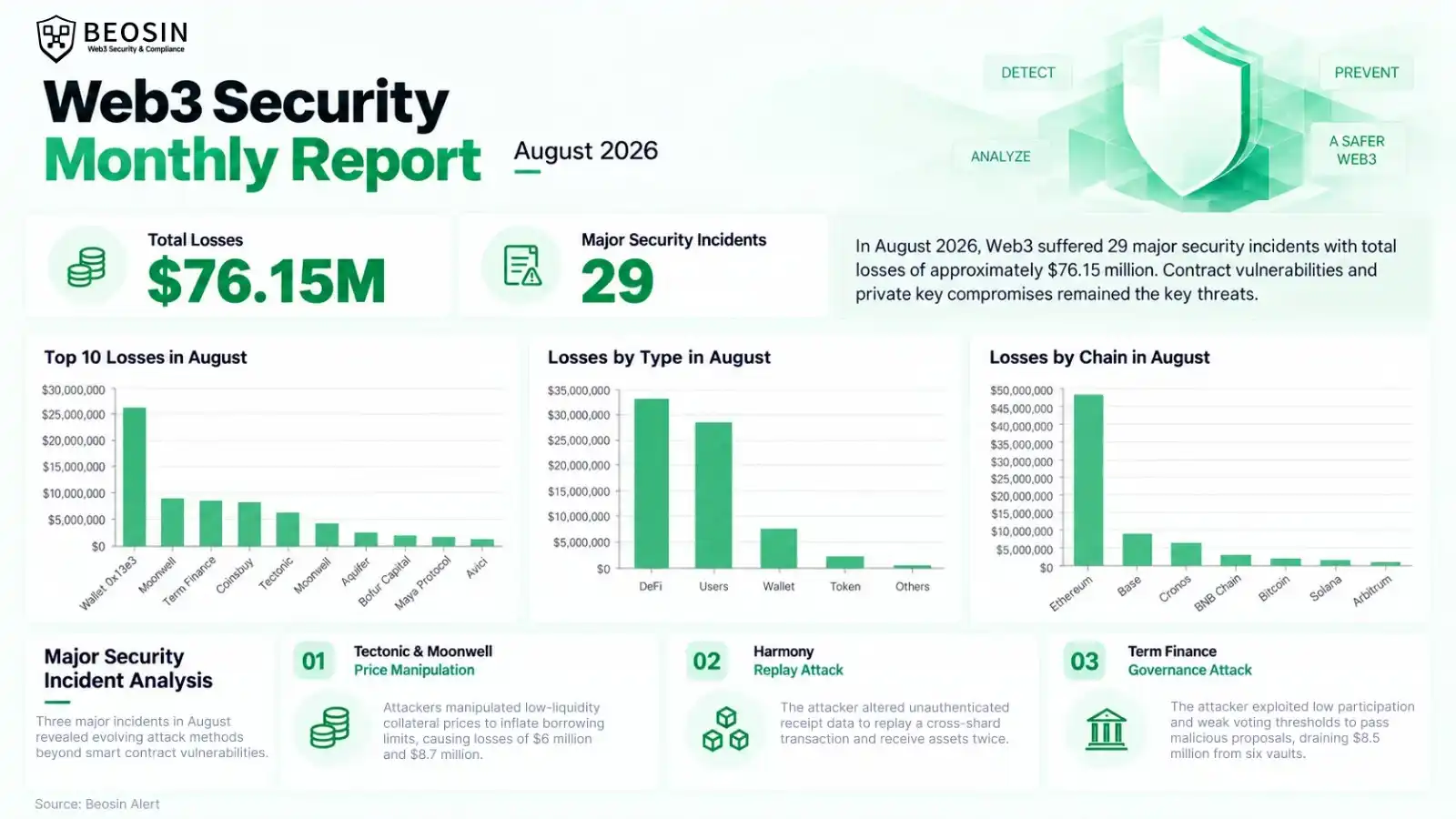
According to monitoring data statistics from the Beosin Alert platform, in August 2026, the total loss amount from various security incidents was approximately $76.15 million, with a total of 『29』 major security incidents. The primary cause was contract vulnerabilities. Among these, there were 18 security incidents due to contract/network vulnerabilities and 2 security incidents involving losses from private key leakage. Smart contract security and private key management remain weak points in Web3 security.
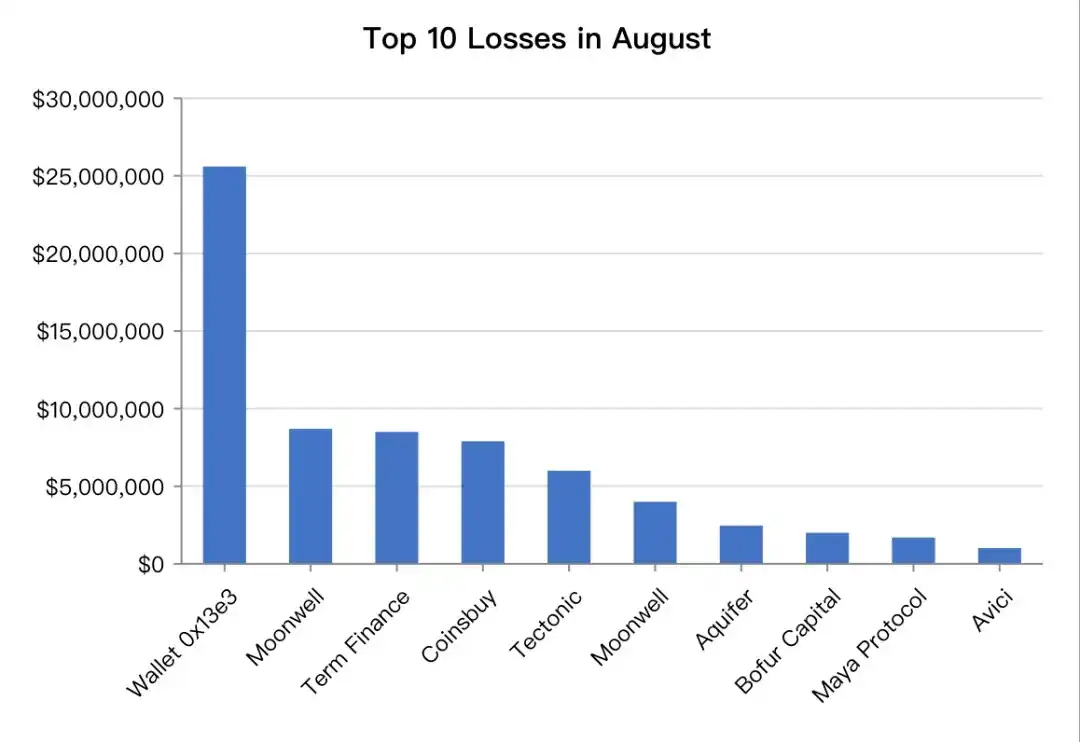
Top 10 Losses in August

On August 13th, the personal user address 0x13e3....179e had crypto assets such as WBTC, cbBTC, LDO, USDS, and CRV stolen due to private key leakage, with a total loss of about $25.6 million. This was the security incident with the largest actual loss. On August 30th, the lending protocol Tectonic on the Cronos network suffered a hacker attack due to a contract vulnerability, with an estimated loss of approximately $74 million. This attack led to the Cronos network taking emergency measures, pausing the network and rolling back transactions. The hacker ultimately transferred about $6 million to the Ethereum network via cross-chain transactions.
Additionally, approximately 40 billion ONE tokens were minted extra on the Harmony public chain due to a vulnerability, with a nominal loss exceeding $4 million. However, this was ultimately resolved by rolling back transactions to clear the state of the counterfeit tokens, so it is not counted as a loss.

Types of Attacked Projects and Loss Situation Across Chains

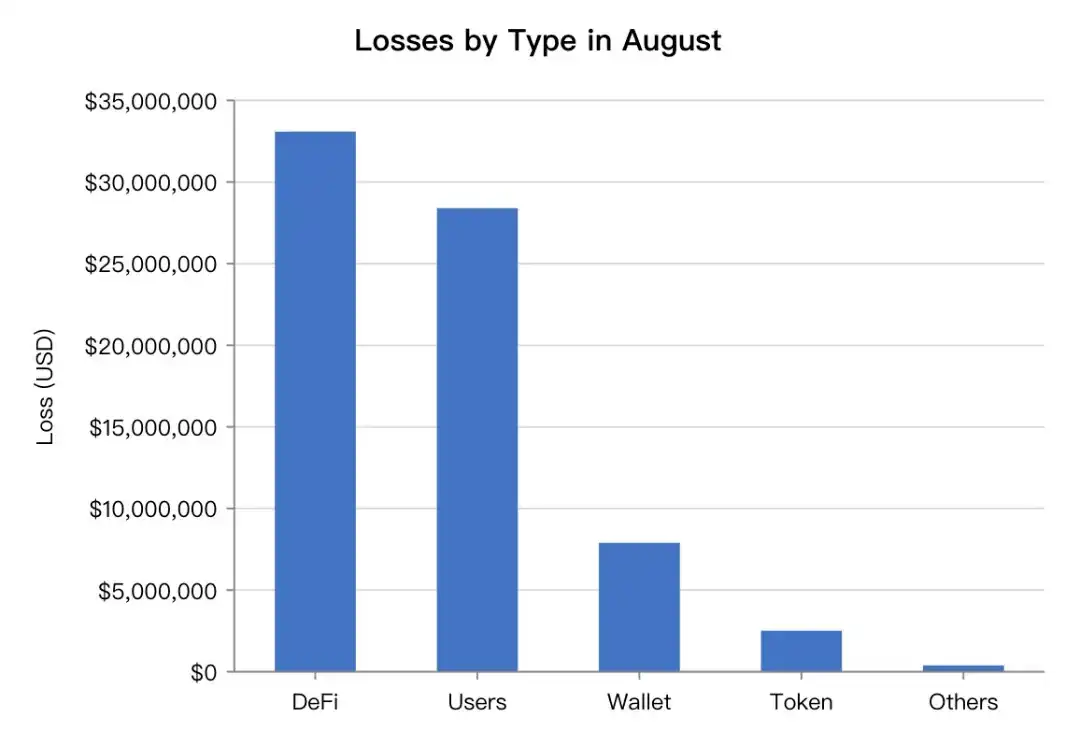
This month, the attacked targets covered various types including public chains, lending protocols, wallet applications, token contracts, cross-chain bridges, and ordinary users. Among them, DeFi projects suffered the largest loss amount, reaching $33.09 million; while losses for personal addresses due to private key leakage or phishing were approximately $28.4 million. Attacks on token contracts were the most frequent, totaling 10 incidents; attacks on DeFi contracts ranked second, with 9 incidents.
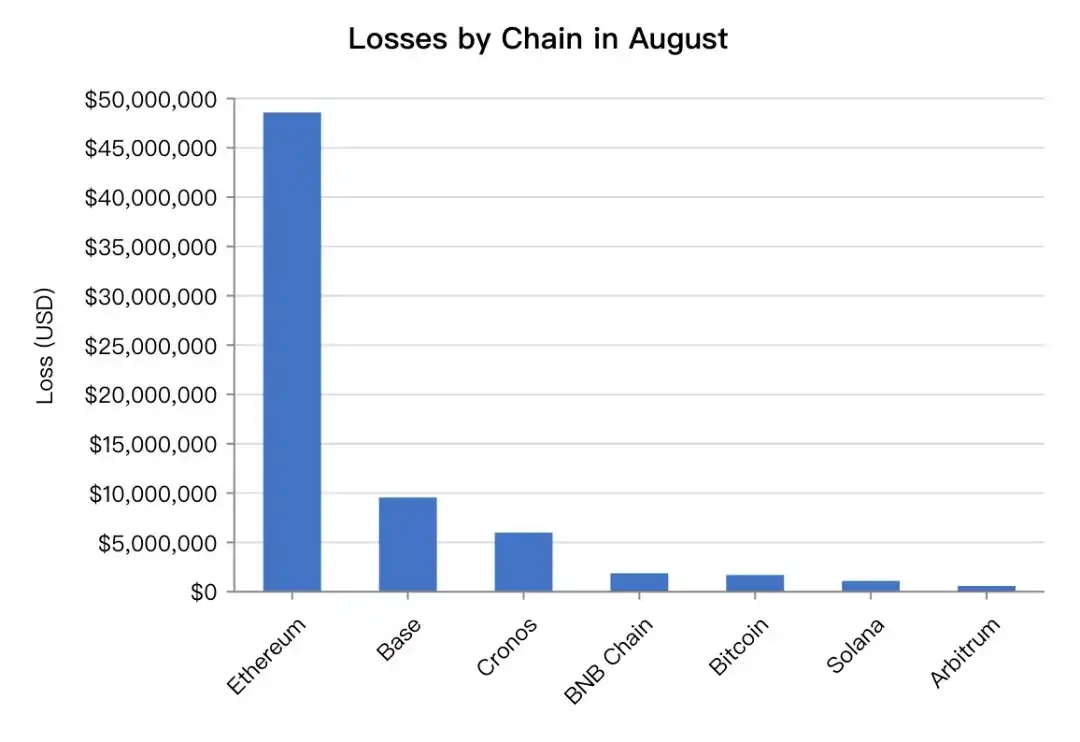
The chain with the highest loss amount in May was Ethereum, with losses exceeding $48.58 million and a total of 15 security incidents. Currently, most DeFi protocols and phishing attacks targeting whales are still mainly on Ethereum. The chain with the second-highest number of security incidents was BNB Chain, but the attack targets were primarily token contracts, resulting in smaller loss amounts. Security incidents also occurred on other public chains such as Cronos, Base, Harmony, Bitcoin, and Solana, showing a multi-chain trend in on-chain attacks.
Analysis of Major Security Incidents

1. Tectonic and Moonwell: Price Manipulation

Tectonic and Moonwell are on-chain lending protocols. The reason for their attacks was the manipulation of prices for certain low-liquidity token collaterals, allowing them to borrow excessive assets based on inflated collateral value to profit. In the Tectonic attack, the attacker inflated the price of the Tectonic protocol's governance token $TONIC by 100 times, obtaining a borrowing capacity of approximately $74 million, and then borrowed assets such as USDT. After the incident, the Cronos network urgently paused block production across the entire chain. Before the pause, the attacker transferred about $6 million to Ethereum via cross-chain. Subsequently, the Cronos network performed a rollback to recover the losses.

Hacker's Ethereum profit address: 0xc404160B79BD8905061a1cAecBeCa2EEab3f72DD and the flow of stolen funds:
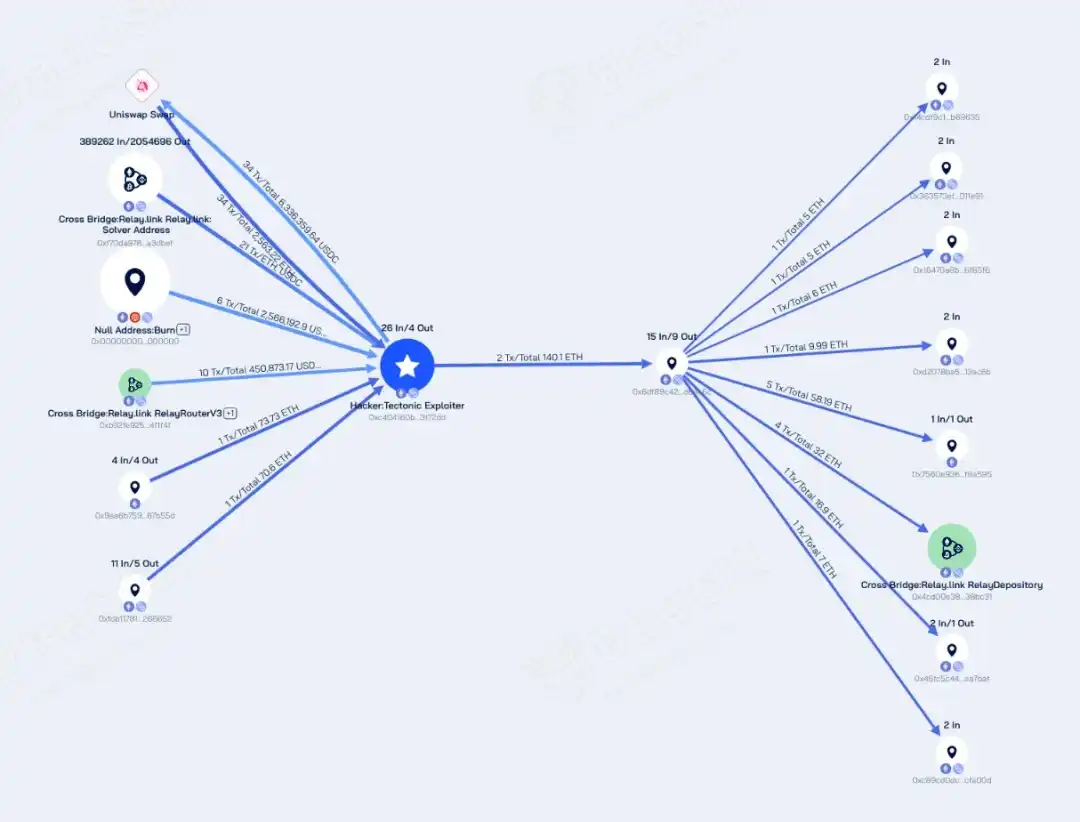
Currently, about 2659 ETH remains stored at 0xc4041, and 140.1 ETH was transferred to 0x6df89c42f0abdfaa2b5b77edcdafbc945ed6ee6c, then further dispersed to multiple newly created addresses.

Moonwell, on the other hand, lost about $8.7 million because the attacker manipulated the price of the illiquid MAMO token to borrow cbBTC:
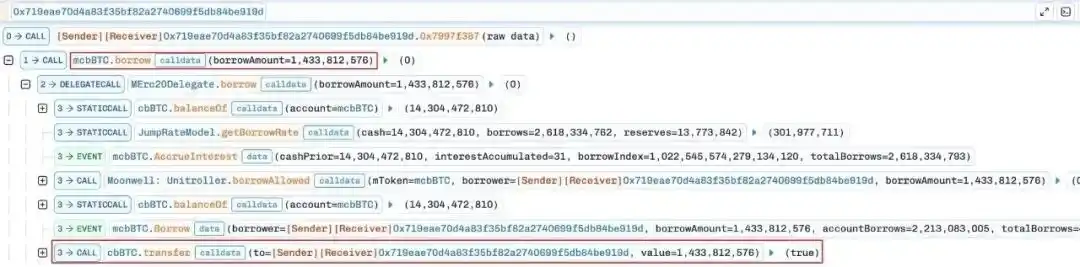
These two attacks were not based on smart contract vulnerabilities but rather because the protocols themselves priced collateral from weak spot liquidity, incorrectly calculating collateral value. To avoid such attacks, protocols can obtain data from multiple oracles and implement additional checks for cases of extreme price fluctuations.

2. Harmony: Replay Attack

Harmony is a shard-supporting Layer 1, operating four shards and transferring assets between them via a receipt-based asynchronous cross-shard mechanism. The source shard generates encrypted receipts for outbound transactions, and the target shard is responsible for verifying that the receipt and its Merkle proof match the signed source block header before recording the transaction, with each receipt usable only once.

The vulnerability in this attack existed in the legacy part of Harmony's sharding system. Previously, Harmony checked whether a shard receipt had been used by examining two fields: CXMerkleProof.ShardID and BlockNum,
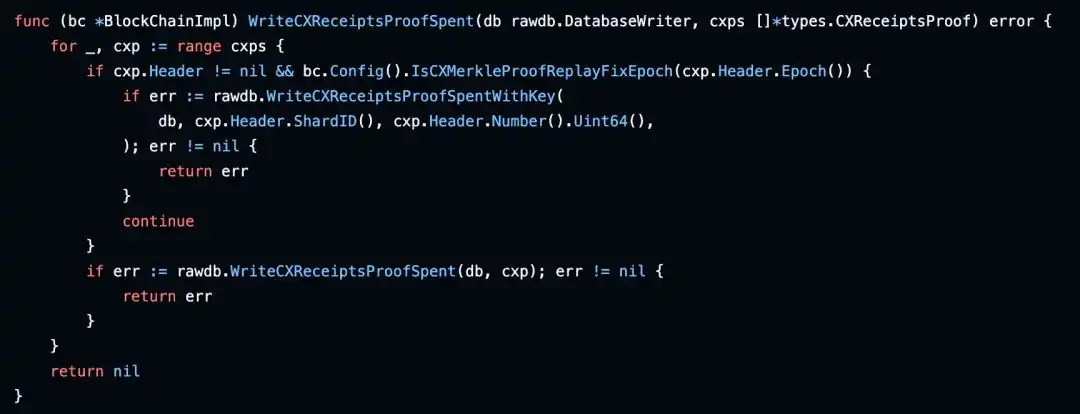
Because these two fields are outside the signed block header, an attacker could modify them without breaking any existing functionality. In this attack, the attacker obtained a cross-shard receipt, modified the ShardID and BlockNum within it, causing the verification program to recognize it as a brand new receipt. The target shard accepted the modified receipt and recorded it again, while the original shard did not deduct the corresponding assets.

This was a very typical replay attack. For any field used as a "one-time use marker," it must be part of the signed header's authenticated portion. When verifying a receipt, the shard ID and block number should be read directly from the verified signed block header, rather than trusting unauthenticated fields within the proof structure.

3. Term Finance: Governance Attack

Term Finance is a DeFi fixed-rate lending protocol, where each Vault is an ERC-4626 Vault based on the Yearn V3 code. Term Finance's vault governance is not approval voting but veto voting. When a curator proposes a parameter change, governance opens a window requiring LP token holders to raise objections. However, there were serious vulnerabilities in the threshold settings for governance voting:

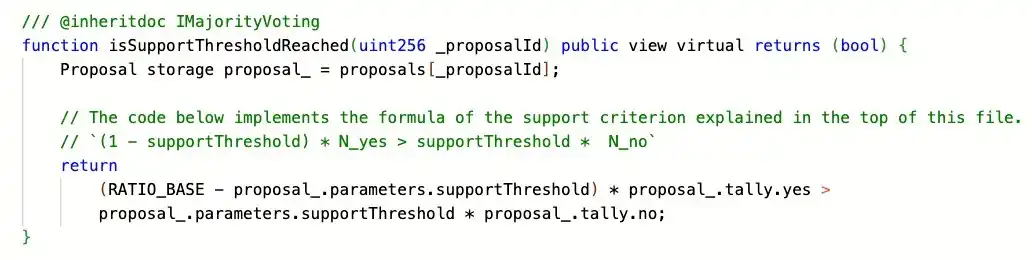
● Lack of absolute vote count or capital floor: The conditions for proposal passage, isSupportThresholdReached() and isMinParticipationReached(), only check relative proportions, not absolute vote counts. This means that as long as a relative majority is met, the proposal can pass, regardless of the total number of voters or total capital behind those votes.
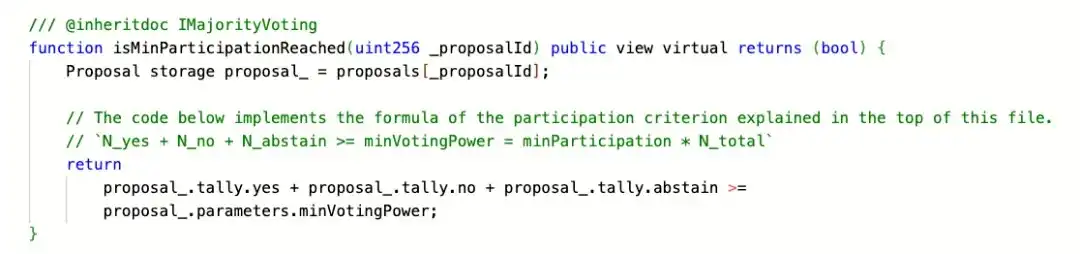
● Extremely low participation: Almost no depositors wrapped their vault shares (tmvETH) into governance tokens (gtmvETH) to participate in voting. This led to an extremely low total supply of governance tokens for the relevant vaults.

The attacker exploited the above design flaws to carry out a governance attack on the vaults at a very low cost:

(1) Acquiring voting power: The attacker exchanged about 0.5 ETH for approximately 0.485 tmvETH vault shares and wrapped them 1:1 into 0.485 gtmvETH governance tokens, obtaining voting rights.

(2) Initiating a malicious proposal: When the attacker created the proposal, the contract recorded the total governance token supply at that time as only 0.535 gtmvETH. This meant the attacker's holding of 0.485 gtmvETH represented 90.66% of the total.

(3) Voting and execution: The attacker cast an approval vote as the sole voter. Since there were no opposing votes, the support rate far exceeded the 50% threshold; meanwhile, their individual voting power also exceeded the minimum participation threshold (minVotingPower) calculated based on the extremely low total supply.

(4) Extracting assets: After the proposal passed, the malicious operation was executed to withdraw assets (WETH) from the vault.

Using the same method, the attacker compromised a total of 6 vaults in Term Finance, causing losses of approximately $8.5 million.

This attack is also a very typical on-chain protocol governance attack. For on-chain governance, project teams should set up the following checkpoints for prevention:

● Set absolute vote count or capital floor: Governance proposals should not rely solely on relative proportions for passage. A hard threshold based on absolute quantities must be set, for example, requiring approval votes to reach a certain amount (e.g., $1 million) or a number of independent addresses.

● Equip timelocks with guardians or cancellation paths: Although governance execution usually has a delay, this only provides some reaction time. Project teams must equip effective guardian mechanisms or proposal cancellation paths for the execution delay period. Once a malicious proposal is detected during the delay period, the guardian can immediately intervene and cancel it.

● Monitor governance participation: Protocols should establish real-time monitoring of governance participation levels for each vault. When an abnormally low total supply of governance tokens or voting participation rate is detected for a particular vault, alerts should be issued promptly, and even automatic protective measures triggered.

Web3 Security Threat Trends

The deepest trend in Web3 security in 2026 is the systematic expansion of the attack surface. Vulnerabilities are emerging simultaneously at the code level, daily operations, and interactive operations. Relying solely on several security audits or tools cannot cover operational security, on-chain governance, or vulnerabilities in business logic. This poses new challenges for Web3 project teams in building security defense systems.

Additionally, attacks targeting DeFi contracts and individual users are frequent. Contract vulnerabilities or permissions can easily be exploited by attackers. Contract developers or operators should review the security of their contracts. For contracts handling core business, multiple rounds of security audits from different parties should be conducted. For individual users, they should regularly use blockchain explorers or permission-revocation tools to check and cancel contract permissions that are no longer in use, stay informed about common and emerging phishing techniques, and enhance security awareness.

Crypto di tendenza

Domande pertinenti

QAccording to the report, what were the two major categories of security incidents in August 2026 and which one caused more incidents?

AThe two major categories were incidents caused by contract/network vulnerabilities and those caused by private key leaks. Incidents caused by contract/network vulnerabilities were more frequent, with 18 events occurring compared to 2 for private key leaks.

QWhich single security event in August resulted in the highest actual financial loss, and what was the primary cause?

AThe single security event with the highest actual loss was the theft from a personal user address (0x13e3....179e) on August 13th, resulting in a loss of approximately $25.6 million. The primary cause was a private key leak.

QWhat was the common root cause of the attacks on the Tectonic and Moonwell protocols, and what is a suggested mitigation?

AThe common root cause was price manipulation of collateral tokens with thin liquidity, which allowed attackers to borrow excess assets. A suggested mitigation is for protocols to use multiple oracles for price data and implement additional checks for extreme price fluctuations.

QDescribe the nature of the attack on the Harmony blockchain and the specific flaw that was exploited.

AThe attack on Harmony was a replay attack. The flaw was that the shard system checked two fields, `CXMerkleProof.ShardID` and `BlockNum`, to see if a cross-shard receipt had been used. However, these fields were outside the signed block header, allowing an attacker to modify them and trick the target shard into processing the same receipt multiple times.

QWhat key vulnerabilities in Term Finance's governance design allowed the attacker to succeed with a very small capital outlay?

AThe key vulnerabilities were: 1) The governance mechanism lacked an absolute quorum or capital threshold, relying only on relative proportions (e.g., >50% support). 2) There was extremely low voter participation, resulting in a very low total supply of governance tokens. This allowed the attacker to gain majority voting power with a minimal investment (about 0.5 ETH) and pass malicious proposals.

Letture associate

DATA Network joins Sui and Walrus to scale the supply chain for AI training data

The DATA Network, which operates the Trace onchain registry for rights-cleared AI training data with over 250 million verifiable receipts, is joining the Sui blockchain ecosystem and adopting Walrus as its default storage layer. This integration addresses a critical need for the next generation of AI models, which require real-world, consented data with clear provenance due to regulatory requirements and legal challenges. The open internet has been largely exhausted as a data source. Trace registers the origin and usage rights of data from contributors—such as personal dashcam footage or medical notes—and handles payments to them, processing over 3 million receipts daily. Sui's object-centric model allows datasets and their licenses to be managed onchain, with fast, parallel transaction processing. Walrus provides efficient, secure storage for large files, ensuring data is only accessible to licensed buyers. By integrating with Walrus, Trace will be able to store an immutable, encrypted copy of the original data file itself, strengthening provenance guarantees. As part of the migration, the DATA Network will be upgraded to run natively as a protocol on Sui, and its independent chain will be retired. The $DATA token will transition to the Sui protocol on a one-to-one basis. Sui Foundation is making a $30 million strategic investment in the DATA Network, becoming its largest institutional stakeholder. Leaders from Mysten Labs (original contributor to Sui), PIP Labs, and DATA Foundation highlighted that the combination provides a comprehensive solution for storing, licensing, and paying for the high-quality, consented data essential for advancing AI, with the scale and integrity proofs the industry demands.

TheNewsCrypto23 min fa

DATA Network joins Sui and Walrus to scale the supply chain for AI training data

TheNewsCrypto23 min fa

ICP Cloud Engine Heats Up: "20% of Revenue Used for Burn", How Far is it From Token Revaluation?

The ICP community is discussing Cloud Engines, a product enabling enterprises to run private subnets on the Internet Computer. It is linked to the "Mission 70" deflationary plan, where node providers allocate 20% of Cloud Engines revenue to buy and burn ICP tokens, aiming to reduce ICP's inflation rate from 9.72% to 2.92%. This narrative connects enterprise adoption to token scarcity and potential price appreciation for ICP, which is down 99.6% from its peak. Cloud Engines functions as a "custom data center," offering businesses dedicated, sovereign infrastructure without vendor lock-in, using the same underlying protocol as the public ICP network. Key selling points include data sovereignty and hardware choice. However, critical features like SEV-encrypted nodes (for enhanced security) and operator-controlled upgrades are still on the roadmap, not yet live. Early adopters include Pakistan's national cloud engine and a UNDP pilot. The "Mission 70" goal relies on two pillars: supply-side reductions (like cutting node rewards) and demand-side increases in token burns from Cloud Engines revenue. While supply-side changes can be enacted via governance, the demand-side depends entirely on market adoption. Current daily burn rates are far below the levels needed to achieve the 26% deflation target attributed to increased burns. Analysts remain cautious, viewing the 20% burn mechanism as a forward-looking narrative. The product is in early access, and significant, scalable enterprise adoption is unproven. Near-term price catalysts are more likely to come from implementable supply-side governance proposals. The Cloud Engines story represents a longer-term bet on ICP capturing a segment of the enterprise cloud market, with token revaluation contingent on the product generating substantial, quantifiable burn data.

marsbit42 min fa

ICP Cloud Engine Heats Up: "20% of Revenue Used for Burn", How Far is it From Token Revaluation?

marsbit42 min fa

Bank of America's Hartnett: Interest Rate Hikes Become the Biggest Positive, Bond-Ending Bubble Logic Is Spreading

In a recent note, Bank of America strategist Michael Hartnett argues that aggressive central bank tightening, including a potential Fed hike in October, could paradoxically be the most bullish near-term catalyst for risk assets. His core thesis is "the bond bubble is bursting." While stocks remain resilient due to strong US data, solid earnings expectations, and robust AI-related capital expenditure plans, bonds are already showing severe stress, with government bonds down 4.4% year-to-date. The logic is that a proactive Fed hike could help anchor runaway long-end yields (the 10-year recently touched 5.36%), preventing a disorderly surge toward 6%. Without such action, the pressure from rising term premiums could continue unabated. The damage from higher rates is already visible in the most rate-sensitive areas: South Korean retail brokers, French government bonds (with the France-Germany spread hitting 140 bps, reminiscent of the 2012 crisis), and CCC-rated credit. Hartnett highlights that the $8 trillion in money market funds is unlikely to flow into equities without a clear shift to monetary easing. Furthermore, the upcoming US midterm elections pose a key risk; a Democratic sweep (currently a 64% probability) could trigger a >10% equity sell-off due to fears of higher taxes and regulation. Near-term strategy involves positioning for a peak in yields (e.g., long 30-year Treasuries) and risk contraction ahead of the elections, while maintaining exposure to commodities and EM assets. Key levels to watch include 10-year yields at 6%, the France-Germany spread at 150 bps, and a Bull & Bear Indicator below 8 for a potential risk rebound.

marsbit46 min fa

Bank of America's Hartnett: Interest Rate Hikes Become the Biggest Positive, Bond-Ending Bubble Logic Is Spreading

marsbit46 min fa

Silicon Valley AI Status: Whoever Has the Compute is the Boss

The Silicon Valley AI Power Crunch: Compute is King Silicon Valley's race for AI dominance has devolved into a desperate scramble for computing power. The situation has become so extreme that even top executives are resorting to unusual measures. Anthropic's CEO Dario Amodei was reportedly turned down by Meta's Mark Zuckerberg when seeking additional GPU resources, leading to a deal where SpaceX acts as a broker, reselling Nvidia GPUs to Anthropic. This venture reportedly generated $2.561 billion in quarterly AI revenue for SpaceX. The shortage is reshaping the industry's dynamics, creating a new "compute economy" where GPU access is the ultimate currency. This scarcity is causing internal strife at major firms and altering competitive landscapes. A high-profile example is Noam Shazeer, a key AI scientist whom Google re-hired for $2.7 billion, only for him to leave for OpenAI reportedly due to insufficient compute resources for his team. Similar frustrations over resource allocation have been cited within Google and DeepMind. For AI startups, the challenge is existential. Cloud providers are now demanding multi-year contracts with large upfront payments, making flexible, on-demand access nearly impossible. This has spurred innovative workarounds, including a new market for "global compute prospecting"—companies scavenging for underutilized server capacity worldwide—and venture capital firms like Y Combinator and Radical Ventures directly acquiring and allocating GPU clusters for their portfolio companies. The root causes are complex: explosive growth in AI model complexity and the shift from simple chatbots to persistent "Agent" systems dramatically increase compute demands. While tech giants are building new data centers, supply cannot keep pace with immediate needs. Rental prices for critical chips like the Nvidia H100 have surged nearly 40% in months. The consequence is a consolidation of power. Compute access is becoming the definitive barrier to entry, significantly strengthening large companies with their own infrastructure and creating a lucrative "picks and shovels" market for those who control the hardware supply. In today's Silicon Valley, compute isn't just a resource—it's the foundation of survival and competitive advantage.

marsbit1 h fa

Silicon Valley AI Status: Whoever Has the Compute is the Boss

marsbit1 h fa

Trading

Spot

Articoli Popolari

Come comprare DATA

Benvenuto in HTX.com! Abbiamo reso l'acquisto di DATA Network (DATA) semplice e conveniente. Segui la nostra guida passo passo per intraprendere il tuo viaggio nel mondo delle criptovalute.Step 1: Crea il tuo Account HTXUsa la tua email o numero di telefono per registrarti il tuo account gratuito su HTX. Vivi un'esperienza facile e sblocca tutte le funzionalità,Crea il mio accountStep 2: Vai in Acquista crypto e seleziona il tuo metodo di pagamentoCarta di credito/debito: utilizza la tua Visa o Mastercard per acquistare immediatamente DATA NetworkDATA.Bilancio: Usa i fondi dal bilancio del tuo account HTX per fare trading senza problemi.Terze parti: abbiamo aggiunto metodi di pagamento molto utilizzati come Google Pay e Apple Pay per maggiore comodità.P2P: Fai trading direttamente con altri utenti HTX.Over-the-Counter (OTC): Offriamo servizi su misura e tassi di cambio competitivi per i trader.Step 3: Conserva DATA Network (DATA)Dopo aver acquistato DATA Network (DATA), conserva nel tuo account HTX. In alternativa, puoi inviare tramite trasferimento blockchain o scambiare per altre criptovalute.Step 4: Scambia DATA Network (DATA)Scambia facilmente DATA Network (DATA) nel mercato spot di HTX. Accedi al tuo account, seleziona la tua coppia di trading, esegui le tue operazioni e monitora in tempo reale. Offriamo un'esperienza user-friendly sia per chi ha appena iniziato che per i trader più esperti.

858 Totale visualizzazioniPubblicato il 2026.07.01Aggiornato il 2026.07.01

Come comprare DATA

Discussioni

Benvenuto nella Community HTX. Qui puoi rimanere informato sugli ultimi sviluppi della piattaforma e accedere ad approfondimenti esperti sul mercato. Le opinioni degli utenti sul prezzo di DATA DATA sono presentate come di seguito.

活动图片