How Did Liquid Network's 4,000 Bitcoins Vanish from the Vault?

marsbitPubblicato 2026-09-15Pubblicato ultima volta 2026-09-15

Introduzione

On September 6th, approximately 4,000 Bitcoins worth $320 million were stolen from the Liquid Network, a Bitcoin sidechain, marking the largest crypto theft of 2026. The breach did not involve stolen private keys, hacked hardware, phishing, or insider collusion. Instead, the attack exploited a critical vulnerability in the network's node software, allowing the attacker to forge L-BTC, the sidechain's asset, and then legitimately redeem it for real Bitcoin. The Liquid Network, operated by a 15-member federation with an 11/15 multi-signature requirement, was designed to be secure. Its use of Confidential Transactions hides transaction amounts. However, a caching flaw in the Elements node software for validating "range proofs" (which confirm amounts are valid without revealing them) was the entry point. The software's cache did not properly tie a validated proof to a specific asset or recipient. Over 14 hours, the attacker submitted 68 identical valid proofs, priming the cache. They then reused the same proof in an invalid context—creating 3,996 L-BTC without any real Bitcoin backing. Since the federation nodes only verified multi-signatures and amounts, not the legitimacy of the L-BTC's origin, the forged assets were approved. A subsequent peg-out request, signed by 11 members, moved nearly 4,000 real Bitcoins off the main chain. The theft was detected due to a node discrepancy, revealing a reserve deficit of over 95%. A fix for the caching bug had been committed to the codeb...

On September 6, approximately 4,000 bitcoins (worth around $320 million at the time) left the Liquid Network's wallet. This is the largest cryptocurrency theft event to date in 2026.

But the most puzzling aspect of this case is not the amount.

No private key was stolen, no HSM (Hardware Security Module) was breached, no one was phished, and there was no insider. The 15 institutions managing this vault all kept their keys perfectly intact in their own safes, and every signature was made by them actively, voluntarily, and according to the rules.

And just like that, the money walked out.

To understand how this happened, we need to spend a few minutes understanding how this vault was designed.

I. A Bitcoin Vault Co-managed by 15 Institutions

The Bitcoin mainnet has a well-known problem: it's slow and expensive. A transaction typically takes about ten minutes to be included in a block, and the fees fluctuate with mining difficulty. This is not sufficient for exchanges or quantitative teams that need to make large, frequent transfers.

Liquid Network is a solution proposed by Blockstream. It is a "sidechain"—think of it as a fast lane next to the Bitcoin mainnet.

The usage is simple: you deposit real bitcoin into a jointly managed vault, and the vault issues you a receipt of equivalent value. This receipt is called L-BTC and can circulate rapidly on this fast lane, handling a transaction per minute. When you want to withdraw the real bitcoin, you return the receipt for cancellation, and the vault gives you the equivalent amount of real coins. The former action is called peg-in, the latter peg-out. In theory, the total amount of L-BTC circulating on-chain should always equal the amount of real bitcoin lying in the vault—this is the so-called 1:1 peg.

The key is who manages this vault. Liquid's answer: it is not entrusted to any single entity, but to a "federation" of 15 known institutions, including multiple exchanges and infrastructure service providers. Each of these 15 nodes holds a key stored in its own dedicated Hardware Security Module (HSM). Any operation to open the vault requires simultaneous signatures from at least 11 of these keys, i.e., an 11/15 multisig.

Simultaneously, these 15 nodes are also responsible for taking turns producing blocks and validating each other. In other words, they are both the custodians of the vault and the bookkeepers of this chain.
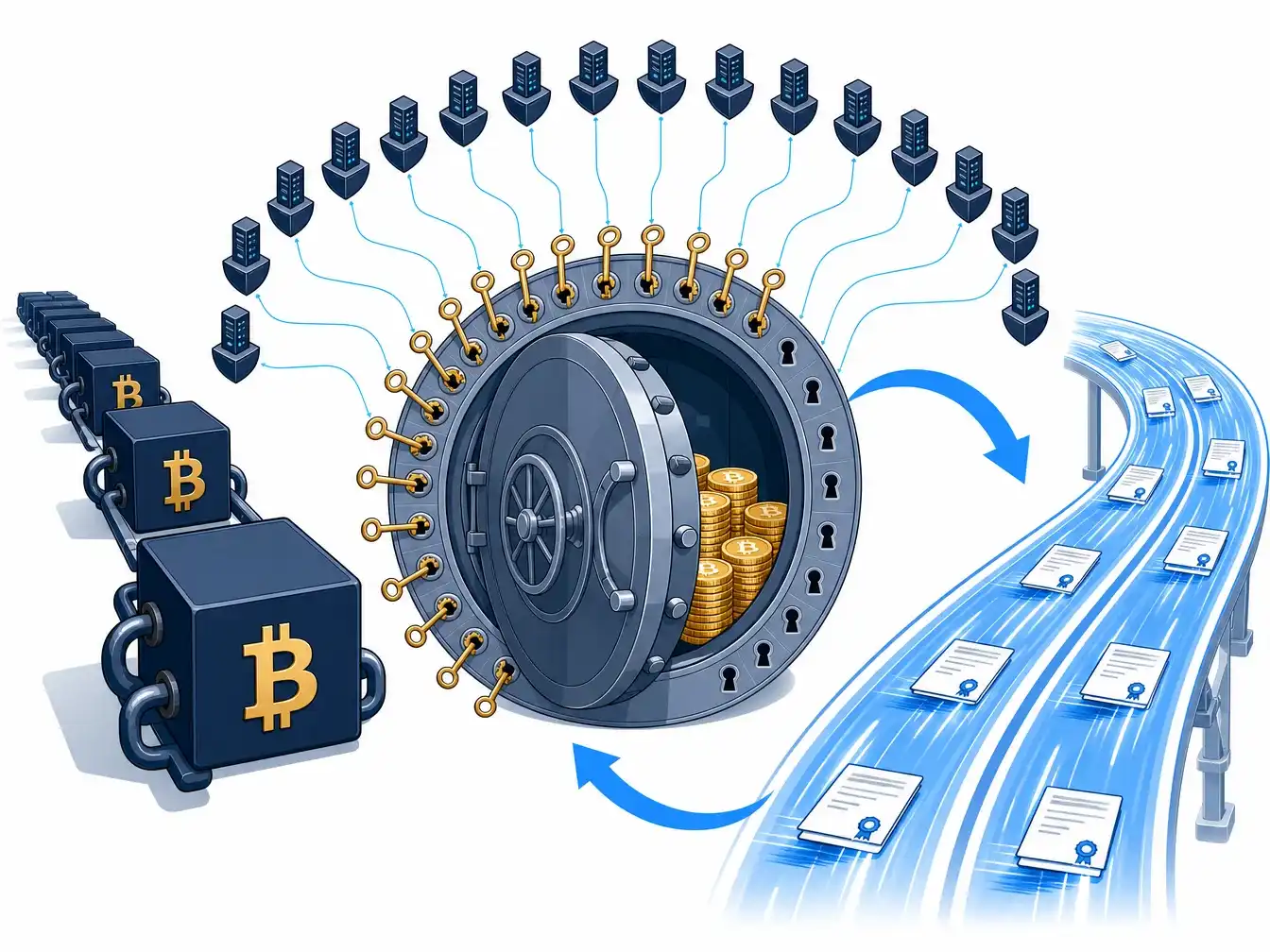
The intention of this design is clear: single-point malfeasance is impossible; you would need to persuade 11 unrelated institutions simultaneously to steal the money. From the perspective of "defending against bad actors," it indeed does a good job.

II. A Private Ledger and "Verifying Money Without Opening the Envelope"

Liquid has another feature: its transaction amounts are kept confidential from the public.

On the Bitcoin mainnet, anyone can see the specific amount of each transfer. This is uncomfortable for institutions—your large-scale position adjustments are watched by the whole world. Liquid solves this with a technology called "Confidential Transactions": amounts are encrypted and hidden, leaving only a mathematical commitment on-chain; outsiders cannot see the specific numbers.

But this immediately introduces a new problem. If the amounts are invisible, how do nodes know that a transaction is not cheating? For example, writing a negative number out of thin air or inflating a number to overflow?

The solution is called "range proof." To use an analogy: put the amount into an opaque envelope, and attach a mathematical proof. This proof allows anyone to be convinced, without opening the envelope, that the number inside falls within a legitimate range. Nodes check these proofs one by one, confirming that the income and expenditure of each transaction balance, but never knowing the specific amount.

This mechanism itself is sound cryptography. The problem lies in its performance optimization.

III. The Vulnerability: A Verifier with Too Good a Memory, but Remembering the Wrong Thing

Verifying range proofs is computationally expensive. To prevent nodes from being overwhelmed, Elements (the open-source node software used by Liquid, a fork of Bitcoin Core) did something any engineer would do: add caching.

A proof that has been verified once is recorded; next time the same one is encountered, it is directly approved without recalculation.

Now the question arises: how to determine if "the encountered proof is the same one"?

Elements' approach was to create an index key using two things: the bytes of the proof itself, plus the encrypted amount commitment.

What was missed? It missed which asset this was, and who this money was to be paid to (the output script).

Using a checkout counter analogy. There is a bill verifier on the counter. Bills it has verified are recorded by serial number; the same serial number is directly approved next time. But when recording the serial number, it only recorded the watermark pattern and denomination of the bill, not which country's currency it was, nor which payee it was meant for. Thus, the same "verified" conclusion could be applied to a completely different, inapplicable scenario.
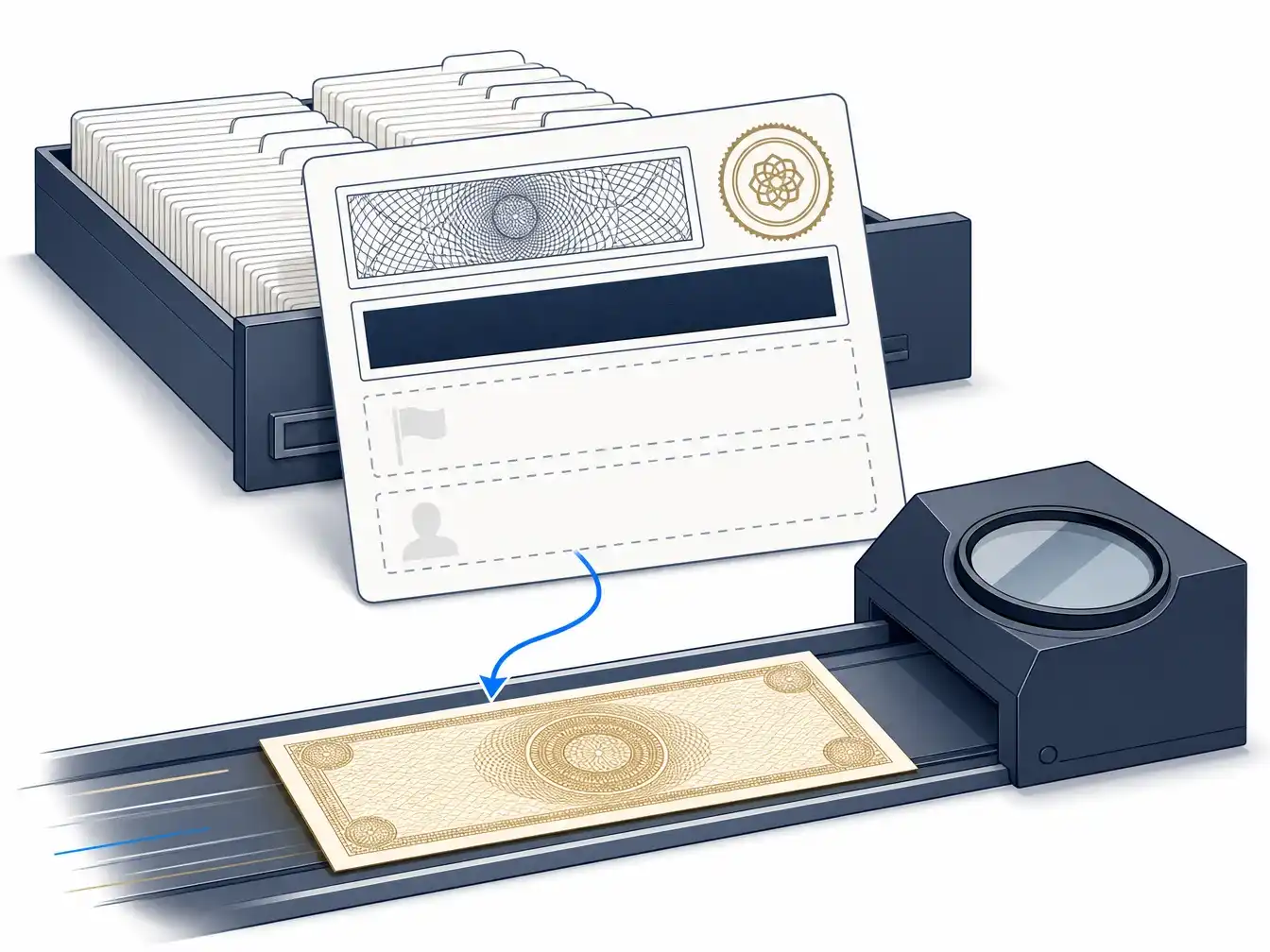
This is exactly what the attacker did, and very patiently. According to researcher analysis, in the approximately 14 hours before taking action, they gradually sent 68 identical range proofs to the chain—feeding these "verified" conclusions into the caches of various nodes, over and over. When the time was ripe, they submitted the same proof again, but placed it in a context where it should have been rejected.

The node checked its cache, found "I've verified this, no problem," and approved it.

Thus, 3,996 L-BTC, unsupported by any real bitcoin, was recorded into the ledger out of thin air.

Since the amounts were already hidden by Confidential Transactions, no observer on-chain could see this extra money.

IV. Those 35 Minutes: Every Step Compliant

At 23:53 Beijing Time on September 6 (15:53:10 UTC), Liquid block 4,050,336 packaged this forged transaction.

Every step that happened next was completely in accordance with the rules. This is the most unsettling part of the whole incident.

These newly minted L-BTC were transferred to SideSwap's wallet (a third-party platform providing peg-out services). Once mixed in, they became indistinguishable from any normal L-BTC. To the ledger, they were real money.

A dozen minutes later, a peg-out request for 4,000 L-BTC was submitted: cancel the receipts and withdraw the real bitcoin.

The 15 nodes began to perform their duties. Their HSMs performed two checks: whether the withdrawal address was on the whitelist, and whether the amount of L-BTC being destroyed matched the amount of bitcoin requested. Both checked out.

It would not, and could not, ask the third question: where did these L-BTC originally come from?

Eleven keys signed as usual. About 35 minutes later, the Bitcoin mainnet confirmed that transaction, and 3,996 real bitcoins left the federation wallet.

It's worth noting that Liquid had an emergency insurance mechanism: if the normal signing path fails, it requires using 2/3 of the backup keys and waiting 56 days to access the funds. This insurance was never triggered—because the attacker never went for the back door; they walked through the front door, and the front door opened for them.

The multisig threshold controls "who can sign"; it cannot answer "whether what is being signed is correct." When the forgery occurs at a layer below the signing—the node software's judgment of what constitutes real money—a higher threshold only serves to sign an erroneous expenditure more neatly.

V. How It Was Discovered

Ironically, this vulnerability caused discrepancies between different nodes: for the same block, some nodes accepted it, while others rejected it—depending on what was previously stored in their respective caches.

Bitcoin Core developer Antoine Poinsot pointed out publicly at the time that the key block was "rejected by mempool but accepted by Blockstream."
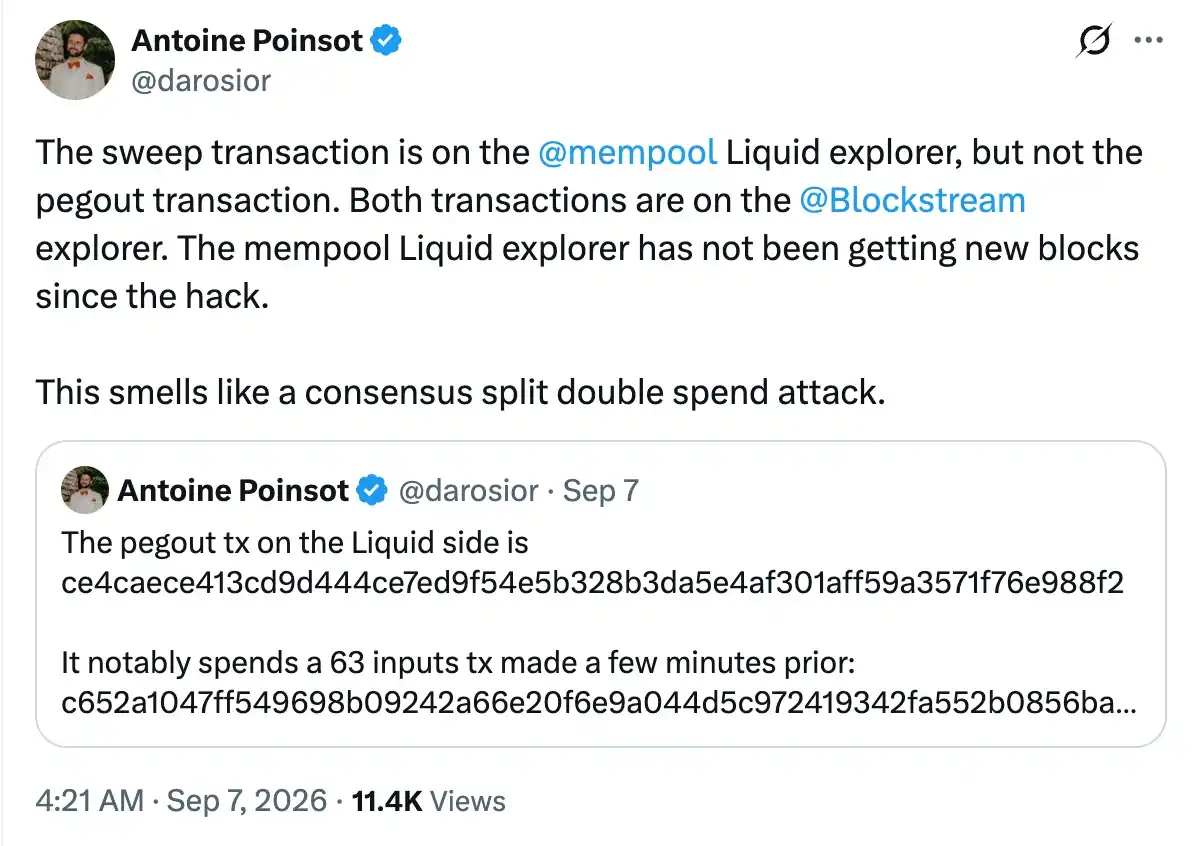
And mempool.space itself is a member of the federation. Its real-time auditing program caught an abnormal withdrawal of -4,019 BTC, while Liquid's official panel did not reflect this loss at the time—two monitoring systems presented different realities.

The subsequent numbers were stark: 4,205 L-BTC were circulating on-chain, while after processing a few subsequent withdrawals, only 197 real bitcoins remained in the federation wallet—a backing rate of less than 5%.

This also reveals the other side of Confidential Transactions: the cost of privacy is verifiability. With amounts hidden, no external party can cross-check in real time the "total receipt amount on the ledger" with the "balance of real coins in the vault." The 1:1 peg degenerates from a fact verifiable by anyone into a statement that needs to be believed. By the time it was proven false, the gap was already $320 million.

VI. More Striking Than the Bug Is the Patch

If the story ended here, it would just be a high-level cryptographic attack. But there is a second half.

The code to fix that caching flaw had already been submitted to the code repository on August 3, with a clear title: bind range proof caching to asset and output script. On September 2, it was merged into the main branch.

At the time of the incident, the federation nodes were running version 23.3.3—released on April 13, which did not contain this fix. Less than three hours after the incident on September 6, this patch was urgently merged into the release branch.

It needs to be clarified that the official has not formally confirmed that this incident was caused by this specific flaw; the above correspondence comes from external researcher analysis. But the timeline itself is sufficient to illustrate a more common problem: a vulnerability being fixed and the fixed code actually running in the production environment are two different things, and there can be a five-month gap between them.

Casa's Head of Security, Jameson Lopp, pointed out another thing: the public commit history of the federation node code repository showed that the last commit was in April 2024—over two years before the incident.
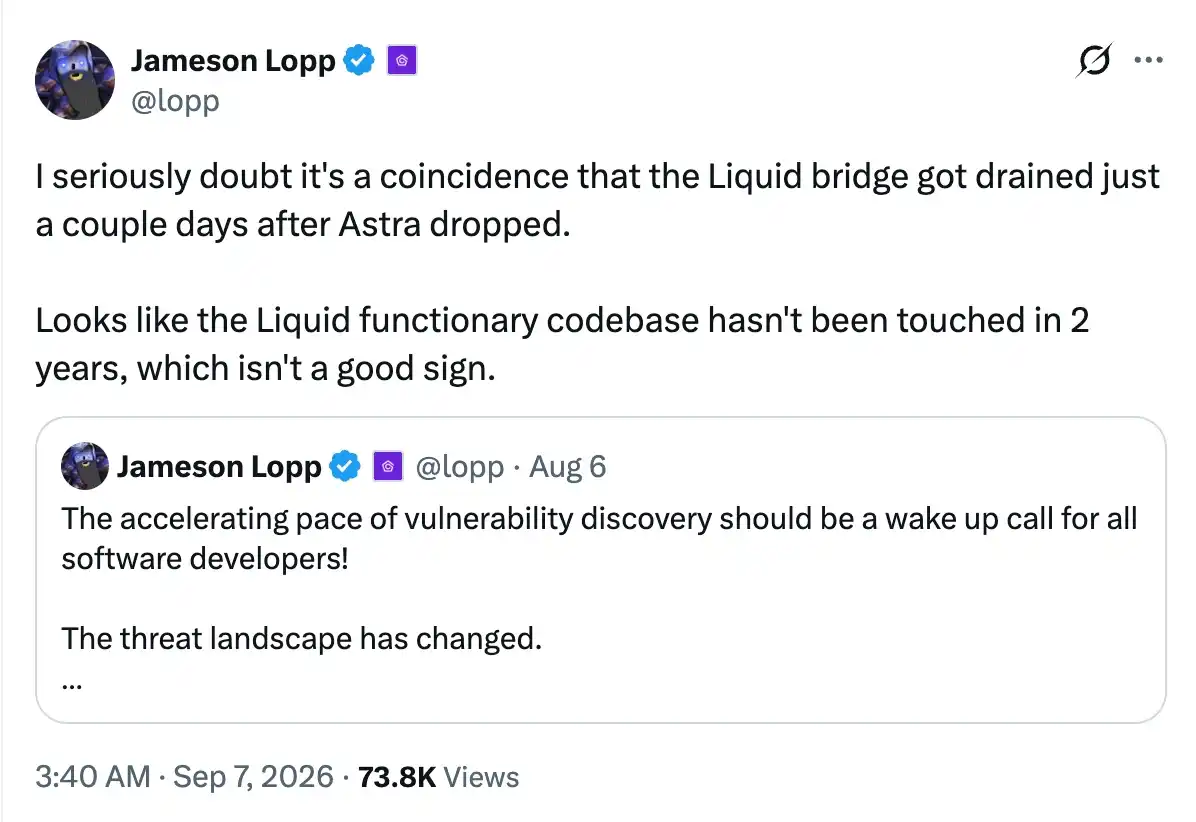
$320 million in assets was entrusted to software that hadn't been seriously maintained for two years. This is not a failure of cryptography; it's a failure of operations.

VII. "We Are White Hats," and Blockstream's Response

That evening, the receiving address sent an OP_RETURN message on-chain:

we are whitehats. contact us on chain.

Negotiations began. On September 7, the other party returned 3,400 bitcoins (approximately $272 million, 85%), keeping 598.5 bitcoins (approximately $47 million) for themselves.

Initially, communication was private, with Blockstream replying using encrypted and PGP-signed messages. But between September 8 and 9, the other party moved the messages to plaintext on the public chain, and the tone changed:

Accusing the other side of negligence—"You only spent $1.5 million (possibly even $0) to protect $5 billion in assets; this is a blatant disregard for security."

Proposing conditions—demanding that Blockstream pay an additional vulnerability bounty equivalent to 10% from its own funds as a precondition for returning the remainder.

And threatening—if refused, to make "all your holders bear a 15% loss for your irresponsibility and stinginess."

At this point, the self-proclaimed "white hat" status became difficult to maintain. Ledger's CTO, Charles Guillemet, was quite direct: a real white hat would disclose the vulnerability before moving the collateralized assets, not after; emptying 95% of the reserves first and then setting terms "resembles extortion more than security research."

Comparing with history also reveals the difference. In cases like Nomad, SafeMoon, and Team Finance, there have been outcomes where "most was returned, and a bounty was kept," but those usually involved a clear bounty arrangement, often around 10%. The peculiarity here is that the 15% was unilaterally taken, and the question of who set the "price" remained unanswered throughout.

Then, Blockstream publicly refused.

In a public statement, Blockstream stated it would not pay a ransom for the return of stolen funds and left no room for ambiguity: taking assets without authorization and refusing to return them is a crime, not responsible vulnerability disclosure, nor white-hat behavior—"this is theft."

The statement acknowledged that good-faith communication had indeed taken place earlier, aiming to recover user funds and protect the broader Bitcoin community, but emphasized that this should not be misinterpreted as accepting the other party's actions or conditions. It also explicitly refused to set a precedent: developers of open-source software created for the benefit of the Bitcoin community should not be forced to pay a ransom that "far exceeds their economic participation."

In response to the threat of "making holders bear a 15% loss," the statement's reply was a declaration of principle—bitcoin is hard money, it cannot be minted costlessly, and Bitcoin will not impose a write-down on users to pay a ransom.

Finally, it presented two paths: return now, and things can still be handled according to white-hat standards; if not returned, Blockstream will use all legal means, collaborating with law enforcement, exchanges, service providers, on-chain forensics experts, and other parties to trace, recover the assets, and identify the responsible parties. And it reminded everyone of a common knowledge in the crypto world: Bitcoin's design is inherently transparent; "transactions do not disappear, and the evidence they leave does not either."

Why this matter is more important than those $47 million. In recent years, "take first, negotiate terms later" has gradually solidified into a semi-standardized playbook: attackers drain the funds, claim to be white hats, keep a self-determined "bounty," and the project accepts to mitigate losses quickly. The essence of this playbook is that the pricing power of a security incident falls into the hands of the attacker—the return ratio, the retention amount, the negotiation pace are all decided by the other party.

What Blockstream refused this time was not so much the money, but this playbook. The price might be that the $47 million cannot be recovered; what is gained is not endorsing the pricing for the next attack. Whether this judgment is correct depends on whether subsequent investigations yield results. But it at least lays out a long-term ambiguity: the victim's willingness to communicate in good faith and the victim's acceptance of conditions are two entirely different things.

Another detail worth noting. Since an AI model, evaluated as "the first capable of independently discovering unknown vulnerabilities," was released just three days before the incident, there was speculation in the community linking the two events—there is still no evidence to support this; treat it as chatter. But interestingly, Blockstream's statement also proactively mentioned AI: "Advances in AI are making the world different, and the Bitcoin community has been working hard to address this threat."

The official did not say that this attack used AI. But the fact that a company that just lost $320 million mentions AI in the threat context of its incident statement itself indicates the industry's judgment: the cost of discovering deep vulnerabilities is decreasing, while the speed of patching and deployment has not kept pace. The patch that lay dormant for five months in this incident is the most concrete footnote to this statement.

VIII. The Current Situation

Liquid resumed block production at 12:26 UTC on September 10, but does not yet package user transactions; peg-in and peg-out remain suspended. The official has outlined a three-phase recovery path—first resume block production, then replay verified transactions, and finally reopen pegging operations after confirming the network state is correct.

After the return of 3,400 bitcoins, the backing rate of L-BTC returned to approximately 86%. Blockstream co-founder Adam Back publicly stated that the 1:1 L-BTC peg will be backed and advised holders not to panic sell on the over-the-counter market.

With Blockstream's public refusal to pay, the remaining 598.5 bitcoins are no longer a negotiation issue but have become an investigation issue—on-chain forensics, exchange cooperation, law enforcement involvement, with timelines measured in months or even years, and outcomes highly uncertain.

This also clarifies the meaning of the promise that "the 1:1 peg will be backed": the shortfall will be borne by Blockstream and the federation's own balance sheets, not by imposing a proportional write-down on token holders. This is precisely the implication of the statement's line, "Bitcoin will not write down users to pay a ransom." For L-BTC holders, this means that, for now, they face a liquidity freeze lasting from days to weeks, not a loss of principal—provided this guarantee of backing is fully executed. This "proviso" should be assessed by the holders themselves, not taken as grounds for optimism on their behalf.

IX. An Expensive Lesson for Institutions

This incident yields several conclusions that don't require you to understand cryptography.

First, "wrapped assets" are not the original assets.

The L-BTC in your hands, various cross-chain BTC, various wrapped tokens—they are not the native assets themselves, but deposit receipts. Their security equals the weakest link among three layers: the issuer's credibility, potential bugs in the node software implementation, and whether the entry/exit channels can distinguish between real and fake. In this case, the problem occurred in the second layer, and the party that accepted the bad money was the third layer—SideSwap did nothing wrong; it simply had no way to distinguish. Most people only look at the first layer when assessing risk.

Second, visibility is more important than invisibility.

Privacy is a genuine need, but when the verifiability of reserves is sacrificed, you lose the ability to detect a problem before it becomes catastrophic. The gap in this case was caught because different nodes accidentally gave different answers, not because of any designed verification mechanism.

Third, your risk includes others' operational rhythms.

A patch lying dormant for five months without being deployed; code that hasn't been touched for two years—these aren't written in any whitepaper, but they determine how safe your money is. When evaluating a protocol, besides reading its design documents, it's also worth looking at its commit history and version release discipline.

Fourth, multisig is necessary, but it defends against bad actors, not bad code.

An 11/15 multisig is a good defense in a key-theft scenario; in a scenario where software mistakes fake money for real money, it is useless. It might even make that erroneous expenditure appear exceptionally proper and legal.

Fifth, "white hat" is a behavioral standard, not an identity one can claim.

The difference lies not in how much is ultimately returned, but in the sequence: disclose first, then collaborate; or drain first, then set a price. Blockstream's choice, even risking the non-recovery of $47 million to publicly refuse payment this time, draws exactly this line for the industry. It may not recover the money, but it at least makes the next attacker uncertain whether claiming to be a white hat will still grant a get-out-of-jail-free card.

As a custody service provider, what alarms us most at Cactus Custody about this incident is not the vulnerability itself, but that it exposed three actions that could have been managed proactively:

  • Asset vetting should not only examine the issuer; the minting logic, redemption channels, and the degree of reserve verifiability must be assessed together. Assets lacking independent verification means should be categorized and limited separately.
  • Any entry confirmation relying on a single data source is fragile. Critical on-chain states are worth cross-verifying using two independent node service providers—the gap in this case was precisely caught because "two nodes gave different answers."
  • Holding user assets in address-isolated accounts and conducting regular reconciliations can limit the blast radius of any single misjudgment to a manageable scope.

In the end, security is not about whose lock is stronger, but about who needs to trust fewer entities.

Crypto di tendenza

Domande pertinenti

QAccording to the article, how were approximately 4,000 bitcoins transferred out of the Liquid Network vault without any keys being stolen or compromised?

AThe transfer exploited a vulnerability in the 'range proof' caching mechanism within the Elements node software. Attackers submitted 68 identical valid range proofs over 14 hours to prime the nodes' caches. Later, they reused the same cached proof in an illegitimate transaction context to mint 3,996 L-BTC without actual bitcoin backing. This fraudulent L-BTC was then used to legitimately peg-out and withdraw the real bitcoin, bypassing the 11/15 multi-signature scheme as all checks appeared normal.

QWhat was the critical flaw in the 'range proof' caching mechanism that enabled the attack on Liquid Network?

AThe flaw was that the cache index key was constructed using only the proof bytes and the encrypted amount commitment. It failed to include the asset type and the output script (recipient). This allowed a previously validated proof to be incorrectly matched and accepted in a completely different and illegitimate transaction context, tricking the node software into approving the creation of fraudulent L-BTC.

QWhat major operational failure, beyond the software vulnerability itself, did the article highlight as contributing to the incident?

AThe article highlighted a severe operational failure: a patch fixing the caching vulnerability had been committed to the code repository on August 3rd and merged on September 2nd. However, at the time of the attack on September 6th, the federation nodes were still running version 23.3.3 from April 13th, which did not contain the fix. Furthermore, the federation node codebase showed no commits for over two years prior to the incident, indicating poor maintenance practices for software securing billions in assets.

QWhy did Blockstream publicly refuse to pay the remaining ~598.5 BTC as demanded by the attackers, and what principle were they defending?

ABlockstream refused to pay to avoid setting a precedent where attackers unilaterally set the price for a security incident by taking funds first and then negotiating. They classified the act as theft, not responsible white-hat disclosure. The principle they defended was that developers of open-source software for the Bitcoin community should not be forced to pay ransoms 'far exceeding their economic participation.' They also emphasized that Bitcoin is hard money and should not be debased (e.g., via user haircuts) to pay ransoms.

QWhat key distinction does the article make between a genuine 'white-hat' security researcher and the attackers in this case?

AThe key distinction is the sequence of actions. Genuine white-hat researchers would disclose the vulnerability to the project and collaborate *before* exploiting it to move funds. In this case, the attackers drained 95% of the reserves first and then opened negotiations, setting their own terms for the return of most funds while unilaterally keeping a portion as a 'bounty.' Security experts like Ledger's CTO labeled this behavior as closer to extortion than responsible security research.

Letture associate

Silicon Valley AI Status: Whoever Has the Compute is the Boss

The Silicon Valley AI Power Crunch: Compute is King Silicon Valley's race for AI dominance has devolved into a desperate scramble for computing power. The situation has become so extreme that even top executives are resorting to unusual measures. Anthropic's CEO Dario Amodei was reportedly turned down by Meta's Mark Zuckerberg when seeking additional GPU resources, leading to a deal where SpaceX acts as a broker, reselling Nvidia GPUs to Anthropic. This venture reportedly generated $2.561 billion in quarterly AI revenue for SpaceX. The shortage is reshaping the industry's dynamics, creating a new "compute economy" where GPU access is the ultimate currency. This scarcity is causing internal strife at major firms and altering competitive landscapes. A high-profile example is Noam Shazeer, a key AI scientist whom Google re-hired for $2.7 billion, only for him to leave for OpenAI reportedly due to insufficient compute resources for his team. Similar frustrations over resource allocation have been cited within Google and DeepMind. For AI startups, the challenge is existential. Cloud providers are now demanding multi-year contracts with large upfront payments, making flexible, on-demand access nearly impossible. This has spurred innovative workarounds, including a new market for "global compute prospecting"—companies scavenging for underutilized server capacity worldwide—and venture capital firms like Y Combinator and Radical Ventures directly acquiring and allocating GPU clusters for their portfolio companies. The root causes are complex: explosive growth in AI model complexity and the shift from simple chatbots to persistent "Agent" systems dramatically increase compute demands. While tech giants are building new data centers, supply cannot keep pace with immediate needs. Rental prices for critical chips like the Nvidia H100 have surged nearly 40% in months. The consequence is a consolidation of power. Compute access is becoming the definitive barrier to entry, significantly strengthening large companies with their own infrastructure and creating a lucrative "picks and shovels" market for those who control the hardware supply. In today's Silicon Valley, compute isn't just a resource—it's the foundation of survival and competitive advantage.

marsbit4 min fa

Silicon Valley AI Status: Whoever Has the Compute is the Boss

marsbit4 min fa

Even Losing Money Requires Waiting in Line, How Far Can PaperTrade's 1000x Leverage Experiment Go?

PaperTrade, a synthetic perpetual contract platform built on HyperEVM, launched on October 10th. Its defining feature is offering up to 1000x leverage and rewarding users with its native token, PAPER, for trading losses or liquidations—a mechanism dubbed "losing money to mine." This sparked initial frenzy, with users queuing to execute trades and generate losses for PAPER rewards. Within 24 hours, nominal trading volume exceeded $678 billion. The platform operates without traditional order books; users trade directly against a shared USDC liquidity pool. Profits are paid from this pool, but if insufficient funds exist, payments queue on a first-in, first-out basis. PAPER has zero initial supply, minted solely from qualifying user losses, and can be staked for a share of protocol revenue. However, controversies emerged quickly. Smaller orders faced longer execution queues compared to larger ones. More critically, PaperTrade's reliance on Hyperliquid's mid-price for asset pricing made it vulnerable to market manipulation. Reports indicated that actors potentially moved prices on Hyperliquid to profit from large, highly leveraged positions on PaperTrade. The team acknowledged this as a known risk, exacerbated by high initial position limits, and has since tightened limits to reduce the attack surface. After the initial surge, open interest and margin deposited have significantly declined. The platform's long-term viability hinges on whether the value and revenue share from PAPER can justify the initial "loss-mining" strategy for users, moving beyond speculative hype to sustainable returns.

marsbit33 min fa

Even Losing Money Requires Waiting in Line, How Far Can PaperTrade's 1000x Leverage Experiment Go?

marsbit33 min fa

XRP Ledger defends emergency patch for unlimited XRP bug

The XRP Ledger (XRPL) development team defended its decision to enact an emergency security patch on September 25, bypassing the network's usual two-week validator voting process. The patch fixed a critical integer overflow bug, present since 2015, which could have been exploited to create unlimited XRP beyond the network's fixed supply. Developers argued that the normal amendment process would have publicly exposed the flaw for weeks, posing a severe security risk. This expedited fix, triggered by a bug bounty report, led to debates about XRPL's decentralization. Critics, including Cyber Capital founder Justin Bons, argued that the coordinated upgrade and temporary withholding of source code demonstrated centralized control, contradicting claims that XRP is not a security. In response, the XRPL Foundation, RippleX, core developers, and validators stated the decision was a collective assessment of the bug's severity, and that no single entity could force the update. Independent validators like XRP Kuwait emphasized that coordination among operators does not equate to loss of independence. The vulnerability report clarified the bug existed in the payment engine and could only be triggered by deliberately constructed offers, with no evidence of exploitation on public networks. The patch version later became officially required through a normal amendment vote with over 80% validator support.

cointelegraph55 min fa

XRP Ledger defends emergency patch for unlimited XRP bug

cointelegraph55 min fa

Trading

Spot

Articoli Popolari

Cosa è BITCOIN

Comprendere HarryPotterObamaSonic10Inu (ERC-20) e la sua posizione nel mondo delle criptovalute Negli ultimi anni, il mercato delle criptovalute ha assistito a un aumento della popolarità delle meme coin, catturando l'interesse non solo dei trader, ma anche di coloro che cercano coinvolgimento comunitario e valore di intrattenimento. Tra questi token unici c'è HarryPotterObamaSonic10Inu (ERC-20), un progetto intrigante che mescola riferimenti culturali nel tessuto delle criptovalute. Questo articolo esplora gli aspetti chiave di HarryPotterObamaSonic10Inu, analizzando i suoi meccanismi, l'etica guidata dalla comunità e il suo coinvolgimento con il panorama crittografico più ampio. Che cos'è HarryPotterObamaSonic10Inu (ERC-20)? Come suggerisce il suo nome, HarryPotterObamaSonic10Inu è una meme coin costruita sulla blockchain di Ethereum, classificata secondo lo standard ERC-20. A differenza delle criptovalute tradizionali che possono enfatizzare l'utilità pratica o il potenziale investimento, questo token prospera grazie al valore di intrattenimento e alla forza della sua comunità. Il progetto mira a creare un ambiente in cui gli utenti coinvolti possono riunirsi, condividere idee e partecipare ad attività ispirate a diversi fenomeni culturali. Una caratteristica notevole di HarryPotterObamaSonic10Inu è la zero tassa sulle transazioni. Questo elemento allettante tende a incoraggiare il trading e il coinvolgimento della comunità, privo di costi aggiuntivi che possono scoraggiare i trader di piccole dimensioni. L'offerta totale della moneta è fissata a un miliardo di token, un numero che segna la sua intenzione di mantenere una circolazione sostanziale all'interno della comunità. Creatore di HarryPotterObamaSonic10Inu (ERC-20) Le origini di HarryPotterObamaSonic10Inu sono avvolte in un certo mistero; i dettagli sul creatore rimangono sconosciuti. Lo sviluppo di questo token non presenta un team identificabile o un piano esplicito, cosa non rara nel settore delle meme coin. Invece, il progetto è emerso organicamente, con il suo progresso fortemente dipendente dall'entusiasmo e dalla partecipazione della sua comunità. Investitori di HarryPotterObamaSonic10Inu (ERC-20) Per quanto riguarda investimenti esterni e finanziamenti, HarryPotterObamaSonic10Inu rimane ambiguo. Il token non elenca alcuna fondazione di investimento conosciuta o un sostegno organizzativo significativo. Invece, la linfa vitale del progetto è la sua comunità di base, che informa la sua crescita e sostenibilità attraverso azioni collettive e coinvolgimento nello spazio crittografico. Come funziona HarryPotterObamaSonic10Inu (ERC-20)? In quanto meme coin, HarryPotterObamaSonic10Inu opera principalmente al di fuori delle strutture tradizionali che governano spesso il valore degli asset. Ci sono diversi aspetti distintivi che definiscono il funzionamento del progetto: Transazioni senza tasse: Senza costi fiscali sulle transazioni, gli utenti possono comprare e vendere liberamente il token senza preoccuparsi di costi nascosti. Coinvolgimento della comunità: Il progetto prospera sull'interazione della comunità, sfruttando le piattaforme social per creare entusiasmo e facilitare il coinvolgimento. Discussioni, condivisione di contenuti e coinvolgimento sono elementi cruciali che aiutano ad espandere la sua portata e a favorire la lealtà tra i sostenitori. Nessuna utilità pratica: Va notato che HarryPotterObamaSonic10Inu non offre un'utilità concreta all'interno dell'ecosistema finanziario. Piuttosto, è classificato come un token principalmente per attività di intrattenimento e comunitarie. Riferimento culturale: Il token incorpora astutamente elementi della cultura pop per attirare interesse, collegandosi a appassionati di meme e seguaci delle criptovalute. HarryPotterObamaSonic10Inu esemplifica come le meme coin operino in modo diverso rispetto ai progetti di criptovalute più tradizionali, entrando nel mercato come costrutti sociali innovativi piuttosto che come asset utilitari. Cronologia di HarryPotterObamaSonic10Inu (ERC-20) La storia di HarryPotterObamaSonic10Inu è segnata da diversi traguardi notevoli: Creazione: Il token è emerso da un meme virale, catturando l'immaginazione di molti appassionati di criptovalute. Le date di creazione specifiche non sono disponibili, sottolineando la sua crescita organica. Inserimento negli scambi: HarryPotterObamaSonic10Inu ha fatto il suo ingresso in vari scambi, consentendo un accesso e un trading più facili da parte della comunità. Iniziative di coinvolgimento della comunità: Attività in corso volte a migliorare l'interazione della comunità, comprese gare, campagne sui social media e generazione di contenuti da parte di fan e sostenitori. Piani di espansione futura: La tabella di marcia del progetto include il lancio di una collezione NFT, merchandising e un sito di eCommerce relativo ai suoi temi culturali, coinvolgendo ulteriormente la comunità e cercando di aggiungere più dimensioni al suo ecosistema. Punti chiave su HarryPotterObamaSonic10Inu (ERC-20) Natura guidata dalla comunità: Il progetto dà priorità al contributo collettivo e alla creatività, garantendo che il coinvolgimento degli utenti sia al centro del suo sviluppo. Classificazione come meme coin: Rappresenta l'epitome delle criptovalute basate sull'intrattenimento, distinguendosi dai veicoli d'investimento tradizionali. Nessuna affiliazione diretta con Bitcoin: Nonostante la somiglianza nel nome del ticker, HarryPotterObamaSonic10Inu è distintivo e non ha alcuna relazione con Bitcoin o altre criptovalute consolidate. Focus sulla collaborazione: HarryPotterObamaSonic10Inu è progettato per creare uno spazio per la collaborazione e la condivisione di storie tra i suoi detentori, fornendo un canale per la creatività e il legame comunitario. Prospettive future: L'ambizione di espandersi oltre il suo presupposto iniziale verso NFT e merchandising delinea un percorso per il progetto per potenzialmente entrare in strade più mainstream all'interno della cultura digitale. Poiché le meme coin continuano a catturare l'immaginazione della comunità crittografica, HarryPotterObamaSonic10Inu (ERC-20) si distingue per i suoi legami culturali e il suo approccio centrato sulla comunità. Anche se potrebbe non adattarsi al modello tipico di un token orientato all'utilità, la sua essenza risiede nella gioia e nella camaraderia coltivate tra i suoi sostenitori, evidenziando la natura in evoluzione delle criptovalute in un'epoca sempre più digitale. Con la continuazione dello sviluppo del progetto, sarà importante osservare come le dinamiche della comunità influenzano la sua traiettoria nel panorama in continuo cambiamento della tecnologia blockchain.

2.7k Totale visualizzazioniPubblicato il 2024.04.01Aggiornato il 2024.12.03

Cosa è BITCOIN

Come comprare BTC

Benvenuto in HTX.com! Abbiamo reso l'acquisto di Bitcoin (BTC) semplice e conveniente. Segui la nostra guida passo passo per intraprendere il tuo viaggio nel mondo delle criptovalute.Step 1: Crea il tuo Account HTXUsa la tua email o numero di telefono per registrarti il tuo account gratuito su HTX. Vivi un'esperienza facile e sblocca tutte le funzionalità,Crea il mio accountStep 2: Vai in Acquista crypto e seleziona il tuo metodo di pagamentoCarta di credito/debito: utilizza la tua Visa o Mastercard per acquistare immediatamente BitcoinBTC.Bilancio: Usa i fondi dal bilancio del tuo account HTX per fare trading senza problemi.Terze parti: abbiamo aggiunto metodi di pagamento molto utilizzati come Google Pay e Apple Pay per maggiore comodità.P2P: Fai trading direttamente con altri utenti HTX.Over-the-Counter (OTC): Offriamo servizi su misura e tassi di cambio competitivi per i trader.Step 3: Conserva Bitcoin (BTC)Dopo aver acquistato Bitcoin (BTC), conserva nel tuo account HTX. In alternativa, puoi inviare tramite trasferimento blockchain o scambiare per altre criptovalute.Step 4: Scambia Bitcoin (BTC)Scambia facilmente Bitcoin (BTC) nel mercato spot di HTX. Accedi al tuo account, seleziona la tua coppia di trading, esegui le tue operazioni e monitora in tempo reale. Offriamo un'esperienza user-friendly sia per chi ha appena iniziato che per i trader più esperti.

5.3k Totale visualizzazioniPubblicato il 2024.12.12Aggiornato il 2026.06.02

Come comprare BTC

Cosa è $BITCOIN

ORO DIGITALE ($BITCOIN): Un'Analisi Completa Introduzione all'ORO DIGITALE ($BITCOIN) L'ORO DIGITALE ($BITCOIN) è un progetto basato su blockchain che opera sulla rete Solana, con l'obiettivo di combinare le caratteristiche dei metalli preziosi tradizionali con l'innovazione delle tecnologie decentralizzate. Sebbene condivida un nome con Bitcoin, spesso definito “oro digitale” a causa della sua percezione come riserva di valore, l'ORO DIGITALE è un token separato progettato per creare un ecosistema unico all'interno del panorama Web3. Il suo obiettivo è posizionarsi come un asset digitale alternativo valido, anche se i dettagli riguardanti le sue applicazioni e funzionalità sono ancora in fase di sviluppo. Cos'è l'ORO DIGITALE ($BITCOIN)? L'ORO DIGITALE ($BITCOIN) è un token di criptovaluta esplicitamente progettato per l'uso sulla blockchain di Solana. A differenza di Bitcoin, che fornisce un ruolo di stoccaggio di valore ampiamente riconosciuto, questo token sembra concentrarsi su applicazioni e caratteristiche più ampie. Aspetti notevoli includono: Infrastruttura Blockchain: Il token è costruito sulla blockchain di Solana, nota per la sua capacità di gestire transazioni ad alta velocità e a basso costo. Dinamiche di Offerta: L'ORO DIGITALE ha un'offerta massima fissata a 100 quadrilioni di token (100P $BITCOIN), sebbene i dettagli riguardanti la sua offerta circolante siano attualmente non divulgati. Utilità: Sebbene le funzionalità precise non siano esplicitamente delineate, ci sono indicazioni che il token potrebbe essere utilizzato per varie applicazioni, potenzialmente coinvolgendo applicazioni decentralizzate (dApp) o strategie di tokenizzazione degli asset. Chi è il Creatore dell'ORO DIGITALE ($BITCOIN)? Attualmente, l'identità dei creatori e del team di sviluppo dietro l'ORO DIGITALE ($BITCOIN) rimane sconosciuta. Questa situazione è tipica tra molti progetti innovativi nel settore blockchain, in particolare quelli allineati con la finanza decentralizzata e i fenomeni delle meme coin. Sebbene tale anonimato possa favorire una cultura guidata dalla comunità, intensifica le preoccupazioni riguardo alla governance e alla responsabilità. Chi sono gli Investitori dell'ORO DIGITALE ($BITCOIN)? Le informazioni disponibili indicano che l'ORO DIGITALE ($BITCOIN) non ha alcun sostenitore istituzionale noto o investimenti di venture capital prominenti. Il progetto sembra operare su un modello peer-to-peer incentrato sul supporto e sull'adozione della comunità piuttosto che su percorsi di finanziamento tradizionali. La sua attività e liquidità si trovano principalmente su exchange decentralizzati (DEX), come PumpSwap, piuttosto che su piattaforme di trading centralizzate consolidate, evidenziando ulteriormente il suo approccio di base. Come Funziona l'ORO DIGITALE ($BITCOIN) Le meccaniche operative dell'ORO DIGITALE ($BITCOIN) possono essere elaborate in base al suo design blockchain e alle caratteristiche della rete: Meccanismo di Consenso: Sfruttando il proof-of-history (PoH) unico di Solana combinato con un modello di proof-of-stake (PoS), il progetto garantisce una validazione efficiente delle transazioni contribuendo all'alta performance della rete. Tokenomics: Sebbene meccanismi deflazionistici specifici non siano stati dettagliati ampiamente, l'ampia offerta massima di token implica che potrebbe soddisfare microtransazioni o casi d'uso di nicchia che devono ancora essere definiti. Interoperabilità: Esiste il potenziale per l'integrazione con l'ecosistema più ampio di Solana, inclusi vari piattaforme di finanza decentralizzata (DeFi). Tuttavia, i dettagli riguardanti integrazioni specifiche rimangono non specificati. Cronologia degli Eventi Chiave Ecco una cronologia che evidenzia traguardi significativi riguardanti l'ORO DIGITALE ($BITCOIN): 2023: Il dispiegamento iniziale del token avviene sulla blockchain di Solana, contrassegnato dal suo indirizzo di contratto. 2024: L'ORO DIGITALE guadagna visibilità poiché diventa disponibile per il trading su exchange decentralizzati come PumpSwap, consentendo agli utenti di scambiarlo contro SOL. 2025: Il progetto assiste a un'attività di trading sporadica e a un potenziale interesse per impegni guidati dalla comunità, sebbene non siano state documentate partnership significative o avanzamenti tecnici fino ad ora. Analisi Critica Punti di Forza Scalabilità: L'infrastruttura sottostante di Solana supporta alti volumi di transazioni, il che potrebbe migliorare l'utilità di $BITCOIN in vari scenari di transazione. Accessibilità: Il potenziale basso prezzo di trading per token potrebbe attrarre investitori al dettaglio, facilitando una partecipazione più ampia grazie a opportunità di proprietà frazionata. Rischi Mancanza di Trasparenza: L'assenza di sostenitori, sviluppatori o di un processo di audit pubblicamente noti potrebbe generare scetticismo riguardo alla sostenibilità e all'affidabilità del progetto. Volatilità del Mercato: L'attività di trading è fortemente dipendente dal comportamento speculativo, il che può comportare una significativa volatilità dei prezzi e incertezze per gli investitori. Conclusione L'ORO DIGITALE ($BITCOIN) emerge come un progetto intrigante ma ambiguo all'interno dell'evolvente ecosistema di Solana. Sebbene tenti di sfruttare la narrativa dell'“oro digitale”, la sua partenza dal ruolo consolidato di Bitcoin come riserva di valore sottolinea la necessità di una chiara differenziazione della sua utilità e struttura di governance. L'accettazione e l'adozione future dipenderanno probabilmente dall'affrontare l'attuale opacità e dalla definizione più esplicita delle sue strategie operative ed economiche. Nota: Questo rapporto comprende informazioni sintetizzate disponibili a ottobre 2023, e potrebbero essersi verificati sviluppi oltre il periodo di ricerca.

746 Totale visualizzazioniPubblicato il 2025.05.13Aggiornato il 2025.05.13

Cosa è $BITCOIN

Discussioni

Benvenuto nella Community HTX. Qui puoi rimanere informato sugli ultimi sviluppi della piattaforma e accedere ad approfondimenti esperti sul mercato. Le opinioni degli utenti sul prezzo di BTC BTC sono presentate come di seguito.

活动图片