Franklin Templeton Explores SEC Exemptions for Tokenized Funds

cryptonews.ruPublished on 2026-10-10Last updated on 2026-10-10

Abstract

Franklin Templeton has engaged with the SEC regarding regulatory questions about trading tokenized money market funds and ETFs via on-chain liquidity pools. The firm's agenda addressed its digital asset business and the potential need for regulatory exemptions for innovation. Specifically, it inquired whether investors could exchange blockchain-based fund shares for tokenized NMS securities on a blockchain platform and if service providers could charge fees for such transactions. The core legal issue involves exemptions from Investment Company Act rules—particularly Section 22(d) and Rule 22c-1—which govern the pricing of fund share sales and redemptions. These rules typically mandate sales at the published offering price and require transactions at the next calculated net asset value. The firm seeks clarity on whether exemptions are necessary for its proposed blockchain trading model.

Trading tokenized money market funds and exchange-traded funds (ETFs) through blockchain liquidity pools raises regulatory questions that Franklin Templeton (NYSE: BEN) brought to the attention of U.S. Securities and Exchange Commission (SEC) staff on October 9. This global investment manager reported preliminary assets under management (AUM) of $1.79 trillion as of September 30. Its proposed agenda covered its digital assets business and its perspective on the agency's innovation exemption.

Regarding money market funds, the proposed agenda examined whether investors can exchange blockchain-based fund shares for tokenized shares of National Market System (NMS) securities via a blockchain platform trading pair. The company also inquired whether providers supplying assets for such trades could charge a servicing fee. NMS securities include exchange-listed stocks and ETF shares subject to national trade reporting rules.

The legal question pertains to rules governing the price at which investors buy and sell a fund's redeemable shares. Section 22(d) of the Investment Company Act of 1940 generally requires sales to be made at the price stated in the fund's prospectus. Rule 22c-1 generally requires trades to occur at the next computed net asset value per share after the order is received. This value reflects the fund's assets minus liabilities, divided by the number of shares outstanding. The agenda asks whether exemptions from these rules are necessary for the proposed trading pairs and provider fees.


Related Questions

QWhat is the main regulatory issue that Franklin Templeton raised with the SEC regarding tokenized funds?

AThe main regulatory issue is whether tokenized money market and ETF shares traded on a blockchain can be exchanged for traditional National Market System (NMS) securities through a blockchain trading pair, and whether service fees can be charged for such transactions, potentially requiring exemptions from Sections 22(d) and Rule 22c-1 of the Investment Company Act of 1940.

QWhat specific regulations under the Investment Company Act of 1940 did Franklin Templeton's agenda inquire about for potential exemptions?

AThe agenda inquired about potential exemptions from Section 22(d) and Rule 22c-1 of the Investment Company Act of 1940. Section 22(d) generally requires fund share sales at the public offering price stated in the prospectus, and Rule 22c-1 generally requires transactions to occur at the next calculated net asset value (NAV) after the order is received.

QWhat was Franklin Templeton's preliminary assets under management (AUM) as of September 30, as mentioned in the article?

AFranklin Templeton reported a preliminary assets under management (AUM) figure of $1.79 trillion as of September 30.

QWhat are National Market System (NMS) securities, according to the article?

AAccording to the article, National Market System (NMS) securities include exchange-listed stocks and ETF shares that are subject to national trade reporting rules.

QWhat is the 'Innovation Hub exemption' mentioned in the context of Franklin Templeton's discussion with the SEC?

AThe 'Innovation Hub exemption' refers to a provision by the SEC that Franklin Templeton's agenda covered. It represents the firm's perspective on seeking potential regulatory exceptions or no-action relief to facilitate innovative activities, such as trading tokenized funds on a blockchain, within the SEC's framework for engaging with new financial technologies.

Related Reads

Anthropic's Strongest Model 4 Revealed for the First Time: RSI Soars at 2x Speed

Anthropic's unreleased "Model 4," reportedly trained between September and October, has surfaced via a third-party METR evaluation, scoring 178.6 on Anthropic's internal Aggregate Evaluation Capability Index (AECI)—outpacing public models Opus 5.5 (174.5) and Mythos 5.1 (172.5). Model 4 passed all 15 benchmarks at above 50% accuracy, a first compared with Opus 4.6 nine months earlier; removing three flawed benchmarks would push its score to 179.7. METR's 11-week investigation of internal data concludes Anthropic's model improvement has roughly doubled, with an inflection point in October 2025: AECI growth accelerated from about 15 points per year to 29 points per year (1.9x), meaning one year now covers what previously took two. Notably, METR estimates about 80% of this acceleration stems from AI assisting its own R&D rather than increased training compute, researcher headcount, or inference scaling—Claude is effectively helping build a stronger Claude. Internal employee surveys report self-assessed productivity gains rising from 1.3–1.4x in spring 2025 to about 5x by June and roughly 12x by October with Model 4, as researchers shift from using Claude as autocomplete to orchestrating many parallel agents, cutting idea-to-experiment time by up to 80%. METR researcher Ryan Greenblatt calls the report a signal pointing toward ASI within one to two years. Roughly 100 pages were submitted to Anthropic, but much of the most sensitive evidence—including a table forecasting future model capability scores—was redacted in the public version. METR sees no obvious bottleneck in algorithms, compute, or data over the next 12 months, and no brake in sight.

marsbit7m ago

Anthropic's Strongest Model 4 Revealed for the First Time: RSI Soars at 2x Speed

marsbit7m ago

US 401(k) proposal leaves door open to altcoins, but hurdles remain

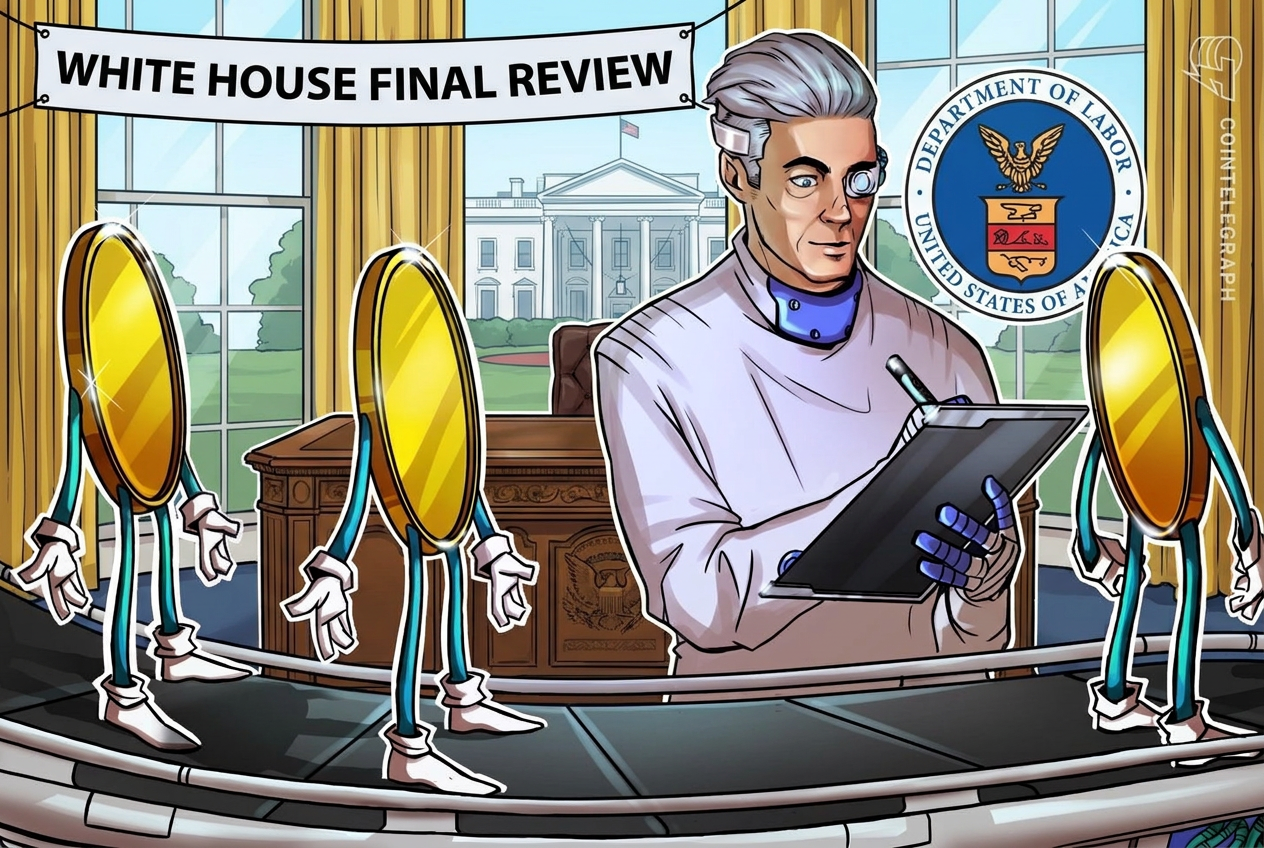
A proposed US Labor Department rule could allow smaller cryptocurrencies (altcoins) in 401(k) retirement plans, but experts say they face more hurdles than Bitcoin and Ether. The rule, now under White House final review, aims to ease offering alternative investments like crypto while giving employers and plan managers more legal protection. It doesn't specify which digital assets qualify or set a minimum market cap, but directs plan managers to weigh six factors: performance, fees, liquidity, valuation, benchmarks and complexity. Experts expect Bitcoin and Ether to be offered first given their established markets and investment products. Teresa Goody Guillén of Bellementis PLLC said altcoins aren't automatically excluded, but plan managers must show their choices are prudent, noting "big doesn't mean suitable, and small doesn't mean disqualified." Bernardo Brites of Trace Finance said most tokens fail on track record or benchmark, and the practical test is whether a plan committee can document a reliable daily price from a regulated wrapper. ETFs and managed funds will likely precede direct crypto holdings, fitting existing custody and recordkeeping systems. Brites expects some crypto options by 2027, ETFs at larger employers later that year, and wider availability by 2028, noting the rule changes legal risk, not infrastructure. Legal uncertainty remains: the proposal offers some lawsuit protection but doesn't prevent suits, and future administrations could reverse the rule, potentially making employers hesitant.

cointelegraph4h ago

US 401(k) proposal leaves door open to altcoins, but hurdles remain

cointelegraph4h ago

Russia finalizes crypto trading rules ahead of Nov. 17 rollout

Russia’s central bank has finalized rules allowing exchanges to offer Bitcoin, Ether and Tether USDt to retail investors starting Nov. 17. Non-qualified investors can buy up to 300,000 rubles (about $3,700) in crypto annually through each intermediary, including brokers, asset managers and crypto exchange providers. Qualified investors face no purchase limits, but all investors must pass a mandatory test before trading. The directive builds on legislation signed by President Vladimir Putin on Aug. 4 establishing a regulated crypto market under central bank oversight. On Aug. 11, the Bank of Russia published draft regulations identifying BTC, ETH and USDT as eligible for public trading based on market capitalization, average daily trading volume and at least five years of price history on foreign exchanges. The law took effect Sept. 1, and the Bank of Russia later authorized Sberbank, the country’s largest bank, to offer crypto exchange services in October. Moscow Exchange, Russia’s largest securities exchange and a publicly traded company, is preparing to launch crypto trading on Dec. 1, initially offering the three cryptocurrencies through pilot transactions. While expanding regulated access, Russia is also tightening restrictions outside those channels. Direct peer-to-peer crypto trading will be prohibited starting July 1, 2027, transfers from regulated digital accounts to self-custody wallets are already banned, and cryptocurrency cannot be used to pay for goods and services.

cointelegraph5h ago

Russia finalizes crypto trading rules ahead of Nov. 17 rollout

cointelegraph5h ago

Trading

Spot
活动图片