Odds of CLARITY Act passing fall to 16% after key Democrats reject GOP's 'final' offer

cryptonews.ruPublished on 2026-09-15Last updated on 2026-09-15

Abstract

The odds of the CLARITY Act passing this year fell sharply to 16% on Polymarket after key Senate Democrats rejected the "final" Republican proposal on cryptocurrency market regulation. Initially, traders had raised the odds to 35% on a revised GOP offer with expanded ethics provisions, but confidence waned as Democrats raised objections. Senator Mark Warner called the revised ethics language "far from sufficient," and Democrats began preparing a counter-proposal. Republicans need 60 votes to advance the bill, and a failed procedural vote on Tuesday could stall the legislation, which aims to divide oversight between the SEC and CFTC. Key Democrats, including Senators Raphael Warnock and Ruben Gallego, remained unconvinced, arguing the ethics provisions did not adequately address corruption risks. Senator Cynthia Lummis countered that Democrats had "nothing more to offer," as President Trump had agreed to significant ethics terms. Further opposition came from a coalition of 18 state attorneys general, the Indian Gaming Association—which seeks protections for tribal gaming laws—and banking groups arguing the text leaves loopholes for stablecoin rewards. Crypto industry advocates, like the Blockchain Association's Kristin Smith, urged passage for clear rules and consumer protection.

According to Polymarket, the odds of the CLARITY Act passing this year plunged again on Monday after a spike the previous day: key Democrats in the Senate reportedly said the Republican Party's final offer on the cryptocurrency bill did not convince them.

Polymarket traders initially took the recently revised Republican offer with enhanced ethics provisions as a positive signal, raising the odds to 35%. However, as doubts about the revised text grew, their confidence waned, and on Monday, the odds fell back to 16%.

U.S. Senator Mark Warner, one of the Democrats involved in the negotiations, reportedly stated that the revised ethics provision was "far from sufficient," and negotiating Democrats began preparing a counter-offer on Monday.

Republicans need 60 votes to advance the bill, and failure on Tuesday could stall the legislation, which would define how the U.S. Securities and Exchange Commission and the Commodity Futures Trading Commission divide oversight of the U.S. cryptocurrency market.

Key Democrats remain unconvinced by ethics proposal

Brendan Pedersen from Punchbowl News reported that Senator Raphael Warnock stated: Democrats should not advance legislation that does not address opportunities for corruption happening "in real-time."

Pedersen reported that Senator Ruben Gallego stated: the latest ethics proposal "falls short," and that he plans to work on a counter-proposal. Separately, Pedersen reported that staff of Senator Elizabeth Warren on the Senate Banking Committee circulated talking points stating that the proposed enforcement mechanism by state attorneys general could be overridden by White House ethics officials.

Later, Democrats sent their counter-offer to Republican negotiators, Politico reported, citing three people familiar with the situation.

Not all Democrats oppose advancing the bill for a floor vote. Senator Kirsten Gillibrand privately urged colleagues to support the procedural motion, Politico reported.

Republican Senator Cynthia Lummis stated that President Donald Trump had agreed to two substantial ethics provisions and that Democrats have "nothing more to offer."

The resistance adds to opposition from a coalition of 18 state attorneys general and heightens uncertainty about whether Republicans can gather the votes needed to advance the bill.

Banking and tribal groups challenge latest text

The National Indian Gaming Association, an organization representing tribal gaming interests, called on member tribes to pressure senators to vote against the bill, stating that the proposed DeFi changes do not address Native American concerns about prediction markets.

The association called for the inclusion of explicit language affirming that federal commodity legislation does not supersede tribal or state gaming laws, including the Indian Gaming Regulatory Act.

Related: Revised CLARITY Act Targets 'Non-Decentralized' DeFi Operators

Eight banking trade groups also stated that the revised text does not close loopholes allowing the payment of rewards on stablecoins that function similarly to deposit interest. According to the groups, the proposed regulatory "circuit breaker" only activates after significant deposit outflows from community banks have already occurred.

Crypto industry representatives have urged senators to advance the bill. In a statement released Monday, Blockchain Association CEO Summer Mersinger stated that the industry had made significant concessions to help build bipartisan support and called on every senator to vote for the bill.

She argued that the bill would establish clear rules, protect consumers, and deter illegal activity, while also preventing the offshoring of crypto jobs, developers, and innovation.

Magazine: Why are the biggest AI companies suddenly calling to slow down?

end-content

Related Questions

QWhat happened to the odds of the CLARITY Act passing according to Polymarket after key Democrats rejected the Republican proposal?

AThe odds of the CLARITY Act passing this year, according to Polymarket, dropped sharply again to 16% after key Democrats in the Senate stated that the Republican party's final proposal for the cryptocurrency bill did not convince them.

QWhy are key Democrats reportedly not convinced by the latest Republican proposal for the CLARITY Act?

AKey Democrats, like Senator Mark Warner, stated that the revised ethics provision in the proposal was 'far from sufficient'. Other concerns included that it didn't eliminate opportunities for real-time corruption and left an enforcement mechanism that could be overruled by White House ethics officials.

QWhat is a major procedural hurdle the CLARITY Act must overcome in the Senate?

AThe Republicans need 60 votes to advance the bill. A failure on Tuesday (referenced in the article) could stall the legislation.

QWhich two groups raised concerns about the revised text of the CLARITY Act, and what were their main objections?

A1. The Indian Gaming Association objected, stating the proposed DeFi changes did not address Native American concerns about prediction markets and called for language protecting tribal and state gambling laws. 2. Eight banking trade groups argued the text failed to close loopholes allowing stablecoin rewards that function like deposit interest, and that a proposed regulatory 'circuit breaker' would activate too late.

QWhat is the main argument made by the Blockchain Association's CEO in favor of advancing the CLARITY Act?

ASummer Mersinger argued that the industry made significant concessions to build bipartisan support, and that the bill would establish clear rules, protect consumers, deter illicit activity, and prevent the offshoring of crypto jobs, developers, and innovation.

Related Reads

Changing Gas Metering Could Break Smart Contracts? Ethereum Urgently Halts Hoodi Fork to Investigate Eight Major Security Risks

Ethereum core developers have paused the Hoodi testnet upgrade after security auditors found that two upcoming Gas improvement proposals could invalidate long-standing assumptions underpinning many deployed smart contracts. The proposals, EIP-8037 and EIP-8038, part of the Glamsterdam upgrade, aim to reprice state storage by decoupling state creation from state access and setting dynamic weights for certain opcodes, in order to curb unchecked growth of Ethereum's state data. However, this overhaul disrupts static Gas constants that developers have relied on as fixed system parameters. ChainSecurity identified eight invariant risks. Many contracts and off-chain infrastructure depend on hardcoded Gas limits, for example to prevent reentrancy or bound execution scope; higher costs could cause cross-contract calls to run out of Gas and revert. Other risks lie in error-handling logic that relies on precise prediction of inner execution costs, and in proxy contracts that forward Gas based on fixed ratios, potentially distorting execution paths or locking funds in incomplete state-machine branches. To avoid systemic compatibility failures and cascading disruptions across multisig wallets, bridges, and lending protocols, developers agreed at an ACD meeting not to hard-fork Hoodi until the affected contracts are fully mapped and compatibility guidance is issued. Because much logic lives off-chain in proprietary routing, settlement scripts, and liquidation bots, the Ethereum Foundation acknowledged it cannot audit the entire ecosystem alone. It has published a public repository detailing the eight affected invariants, sample problem code, and prompt templates for audit and scanning tools, so teams can check their own logic. Findings will be reviewed at next week's ACD meeting, when Hoodi activation conditions will be reassessed.

marsbit1h ago

Changing Gas Metering Could Break Smart Contracts? Ethereum Urgently Halts Hoodi Fork to Investigate Eight Major Security Risks

marsbit1h ago

What Exactly Drives the Value of Layer 1?

This analysis by Marc Arjoon, CFA, examines what actually drives Layer 1 valuation through time-series regression on major L1 assets. Short-term, all L1 price movements remain dominated by Bitcoin beta. Over longer horizons, Ethereum's market cap has fully decoupled from its own protocol revenue—a deliberate policy outcome of Dencun and higher gas limits rather than a demand collapse—with its 2025 rally driven instead by spot ETF and corporate treasury demand. Solana, by contrast, shows revenue and market cap moving in tandem, both rising ~15x since January 2023 and peaking the same week. Active addresses and DEX volumes show weak weekly correlations and large divergences despite long-cycle drift. Testing Metcalfe's Law, the fitted elasticity of market cap to active addresses is only 0.56 for Ethereum and 0.62 for Solana and BNB—closer to the square root of addresses than the square. None of six valuation multiples reliably mean-reverts; Mcap/REV is the only one that predicts positive 13-week returns from low valuation quantiles on Ethereum and TRON. No L1 has Bitcoin's deep holder base: only 4% of Solana and 10% of Ethereum supply has been dormant over three years versus 42% for Bitcoin. Ethereum's pricing anchors to peer capital share—59% of L1 market cap, 70% of DeFi TVL, 75% of tokenized RWA—rather than on-chain activity, where it holds just 5% of active addresses. Across chains, market cap rank correlates strongly with TVL (Spearman 0.87) and stablecoin supply (0.63) but weakly with transactions (0.17). The core conclusion: L1s are valued less as fee-generating businesses and more as monetary assets competing for capital settlement and liquidity share.

marsbit1h ago

What Exactly Drives the Value of Layer 1?

marsbit1h ago

From 85% to 9%: The Dramatic Shift in Korean Exchange Listing Logic—Tokens Are Safer, but Is the Business Harder?

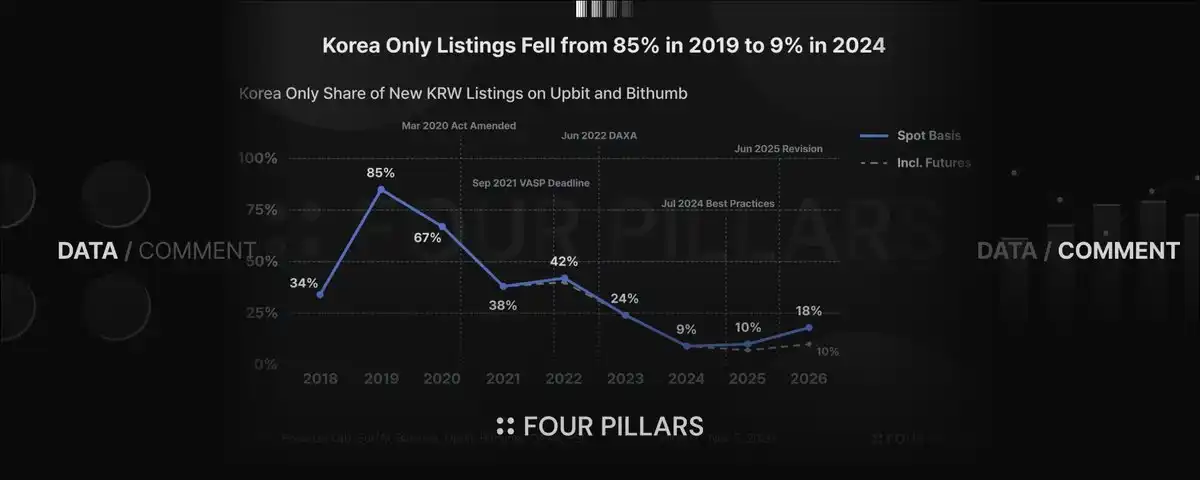
South Korea’s KRW crypto exchanges have fundamentally changed their listing logic. According to Bonanza Lab data across Upbit, Bithumb, Coinone, Korbit, and Gopax, the share of Korea-only token listings fell from 85% in 2019 to 9% in 2024, with a slight rebound to 18% in 2026 that drops back to about 10% when excluding assets first traded on overseas futures markets. The shift began with the 2021 Specific Financial Information Act, which required real-name bank accounts and traditional-finance-level AML compliance, and was reinforced by DAXA’s unified listing review guidelines effective July 2024, under which assets with two or more years of trading history on compliant overseas exchanges can automatically satisfy baseline disclosure and whitepaper requirements. Despite the collapse in local-first listings, total listings have grown: Upbit and Bithumb added 43 KRW-market tokens in 2022, 116 in 2023, 125 in 2024, and 238 in 2025. Listing timing remains cyclical—in the 2025 bitcoin high, 111 assets (47%) were brought to Korea within 30 days of overseas listing, while in 2026 mature assets with over a year of overseas trading became the mainstay (52 assets, 31%), including older tokens such as CRV and RSR. The consequences are clear. The share of assets hit by investment warnings or delisting within two years fell from 24% for the 2020 cohort to 10% for 2024. Among 2020–2024 listings, 44 of 148 Korea-only tokens (30%) faced warnings or delisting within two years, versus only 26 of 279 overseas-first tokens (9%). Overseas seasoning also reduces post-listing drawdowns: assets listed in Korea within 30 days of overseas launch saw a median 30-day price decline of 39%, compared with just 7% for assets with over a year of overseas trading history. The trade-off is revenue. Heavily traded overseas assets generate limited first-day speculative volume, and since Korean exchanges rely overwhelmingly on spot trading fees, weaker listing-day surges can hurt earnings. A renewed bull market could temporarily revive listings of newly launched overseas assets, but exchanges cannot build a durable, cycle-resistant business on listing structure alone. Their core challenge is to create new trading demand and diversify revenue beyond listing-driven fees.

marsbit1h ago

From 85% to 9%: The Dramatic Shift in Korean Exchange Listing Logic—Tokens Are Safer, but Is the Business Harder?

marsbit1h ago

Didn't We Agree on Decoupling? BTC Fell Along With US Stocks Again

Bitcoin's "decoupling" from tech stocks proved short-lived. On Nov 4, the Dow rose 3% and BTC rebounded to $81K; just 24 hours later, a massive AI-driven selloff sent Nasdaq down 5.5% and BTC back to $75.2K. The trigger had nothing to do with crypto: after Democrats won Congress, markets feared slower data-center buildout, and chip stocks cratered (Nvidia -9.26%, AMD -17.26%, semiconductor ETF -12%, worst since March 2020). All 11 S&P sectors fell. BTC followed: it dropped about 5.5% to $76K, with over $1B liquidated in 24 hours—nearly 90% longs, about 210,000 traders forced out. The transmission path was simple: tech panic → institutions sell BTC ETFs → ETF outflows trigger on-chain leverage liquidations → accelerated decline. From Oct 30 to Nov 5, BTC ETFs saw roughly $1.5B in net outflows. The decoupling narrative keeps flipping. In February, Grayscale's Zach Pandl said BTC was highly correlated with high-growth tech software stocks. By August, the same analyst said BTC's correlation with gold had risen above 50% while its correlation with Nasdaq 100 fell from over 60% to about 33%—prompting talk that BTC was finally shifting toward gold. Two months later, K33 Research found BTC-Nasdaq synchronicity rising again. On Nov 5, Nasdaq fell ~6.5%, BTC ~5.5%, while gold rose 0.9%—BTC tracked Nasdaq, not gold. This isn't new. In early 2022, Kaiko found BTC-Nasdaq correlation at its highest since July 2020, while BTC-gold correlation was negative—the first data-driven blow to the "digital gold" thesis. In April 2025's tariff shock, BTC briefly decoupled, rising 13% while Nasdaq was flat, but correlation soon returned. Nov 5 mirrored April 2025: two shocks of similar magnitude; BTC withstood the first but not the second. Different institutions use different windows—Grayscale looks at 90 days, K33 at two-week returns—so conclusions change with the window. Correlation isn't a fixed conclusion; it keeps flipping. Notably, BTC and gold are both among 2025's worst performers. Charlie Bilello's Oct 23 ranking of 21 assets showed BTC down 7.3% and gold down 7.5%—the two worst—while short-term Treasuries rose 2.9% and commodities 52.5%. By Nov 5, BTC's year-to-date loss widened to about 13%. Bilello noted that since 2011, no year had seen BTC and gold both at the bottom. Gold itself fell about 27% from its January high near $5,600 to about $4,095, hit by war-driven inflation, higher yields, a stronger dollar, and leveraged selling. Yet in March, during the Iran war, BTC didn't follow stocks down—Grayscale's April report was titled "Resilience in War," noting equities, bonds, and precious metals all fell while crypto rose slightly, aided by Strategy's purchase of ~44,400 BTC. Same year: BTC held up in March but fell with tech in November. "Digital gold" is less a fixed property than a switching state. Pandl framed it honestly in February: "Is BTC a store-of-value asset like gold, or a growth asset like tech stocks? Short answer: we think it's both." The risk-asset side is visible—post-ETF institutional inflows make BTC trade like a high-beta tech stock. The store-of-value side needs a longer view: since 2011, BTC's average annual return is 120.6% versus gold's 6.3%. Even JPMorgan now includes BTC in long-term capital market assumptions, projecting 10% annualized returns over the next decade (above US large caps' 7.5%), though it flags 55% volatility and unstable correlations and excludes BTC from main portfolio models. Pandl added: "If BTC succeeds as a monetary asset long term, its price behavior may eventually look more like gold." Note the "if"—BTC is only 17 years old. Three indicators to watch: whether BTC-Nasdaq 100 90-day correlation stays above 0.5; whether spot ETFs see net outflows for more than a week; and whether BTC follows or decouples from tech in the next big move. At 17, BTC hasn't yet grown into itself.

marsbit1h ago

Didn't We Agree on Decoupling? BTC Fell Along With US Stocks Again

marsbit1h ago

After the US Midterm Elections, South Koreans Are in Complete Panic

After the U.S. midterm elections, a "blue wave" swept Congress and key AI-data-center states, triggering a global selloff in AI and semiconductor stocks. While most markets absorbed the shock without emergency action, South Korea reacted with alarming urgency: the deputy prime minister and finance chief convened an emergency market meeting, the financial services commissioner and a Bank of Korea deputy governor attended, and authorities announced a three-month exemption from the 140% credit-financing collateral requirement for brokerages, while the exchange triggered a Sidecar circuit breaker to halt programmatic selling. The panic is rooted in structure. In the month before the crash, Korean retail investors—the famous "ant army"—piled into Samsung Electronics and SK Hynix, often using borrowed money and single-stock leveraged ETFs, which regulators had already been tightening since July as leverage grew dangerously large. Retail investors hold roughly 60% of these leveraged products, and earlier declines had already wiped out 41% of their assets. Beneath them, the National Pension Service, the world's third-largest sovereign wealth fund, was heavily concentrated in the same chip stocks and rode them down from June's peak, losing about $137 billion. Korea's stock market is also a amplifier of social mood and a political risk, and the won is not a safe-haven currency: risk-off outflows hit the currency, import-dependent inflation rises, and a stock-FX-inflation "triple kill" becomes lethal. Foreign investors hold nearly 38-39% of market capitalization and over 46-50% of Samsung and SK Hynix, and have been massive net sellers—about $131 billion withdrawn this year, the most in Asia. Ultimately, the U.S. election was only the match; Korea's dependence on semiconductors is the fuel. Chips are now approaching 47% of exports, and semiconductor-related production contributed about half of Q3 GDP growth. With demand tied to U.S. AI capital spending, Korea catches a heavy cold whenever America sneezes—so its response is less market rescue than firefighting.

marsbit1h ago

After the US Midterm Elections, South Koreans Are in Complete Panic

marsbit1h ago

Trading

Spot
活动图片