Original Title: Meta parts ways with Virtue AI
Original Author: Ashley Gold
Compiled by: Machine Heart
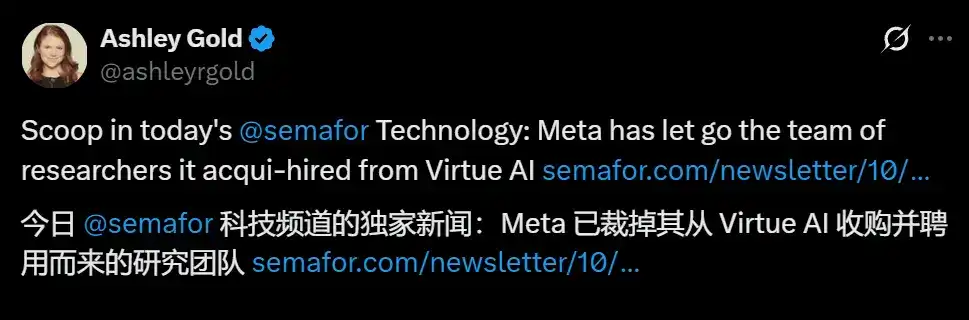
Recruited in June, rumors of parting ways emerge in October?
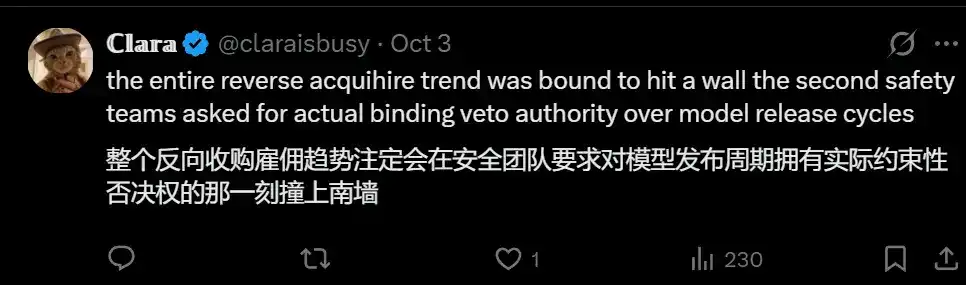
UC Berkeley computer science professor Dawn Song's Virtue AI team appears to have run into issues with its collaboration with Meta, reportedly due to "clashing work styles."
Dawn Song enjoys a high reputation in both academia and industry. She is one of the most influential scholars in the global fields of computer security and AI security. The paper she proposed in 2005 on "Dynamic Taint Analysis" is a classic in the field of computer security.
In AMiner's rankings, she is the most globally cited scholar in computer security. Her lab at Berkeley is known as the "Whampoa Military Academy" of the computer security field.
Besides being a professor, Dawn Song is also the founder of Oasis Labs and Virtue AI. According to Virtue AI's website, their work includes simulating attacks, identifying AI vulnerabilities, and providing runtime protection and implementing security and governance rules. In simpler terms, they both perform "security check-ups" for AI and install "guardrails" during operation.
In June of this year, Dawn Song announced on social media that she was joining Meta's Superintelligence Labs. According to media reports at the time, the move also included Virtue AI's other two founders, Bo Li and Sanmi Koyejo, as well as more team members. In other words, this recruitment involved Meta bringing in an independent team rather than acquiring the entire company.
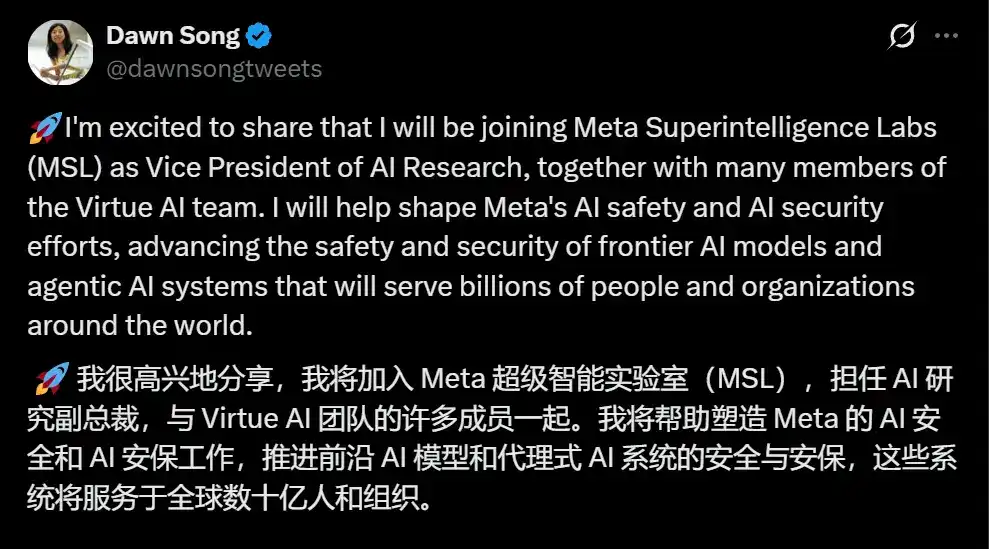
For the Virtue AI talent team, joining Meta made sense because they were already performing AI security testing, red teaming, and post-deployment protection for clients. However, a startup has limited scenarios and resources. By entering Meta, they could directly deploy these capabilities into products with billions of users, evolving from "security tools" to the security infrastructure of a large platform.
Meanwhile, Meta needed them because it is aggressively pushing AI Agents and superintelligence. The further it goes, the more it fears model misbehavior, data leaks, and being led astray by malicious instructions. Hence, the urgent need to find a top-tier team that understands research and has hands-on security implementation experience to provide a safety net for AI security, reliability, and governance.
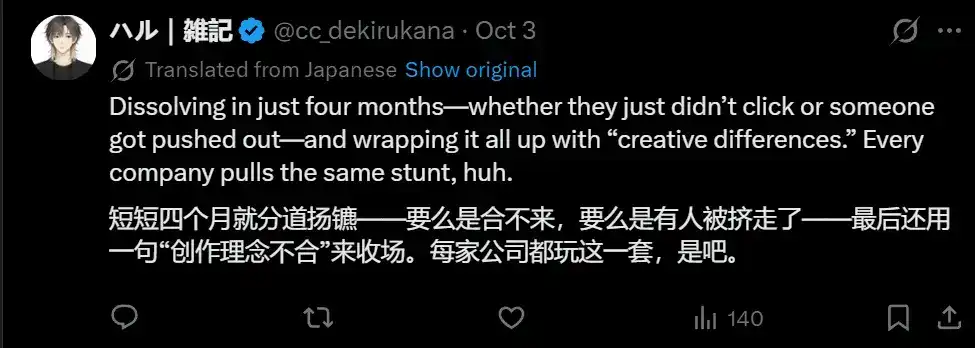
All of this seemed very reasonable. However, the media outlet Semafor recently wrote in an article, "Meta spokesperson Andy Stone told Semafor that the company is cutting a group of employees who were hired from AI security startup Virtue AI, having joined only four months ago in June."
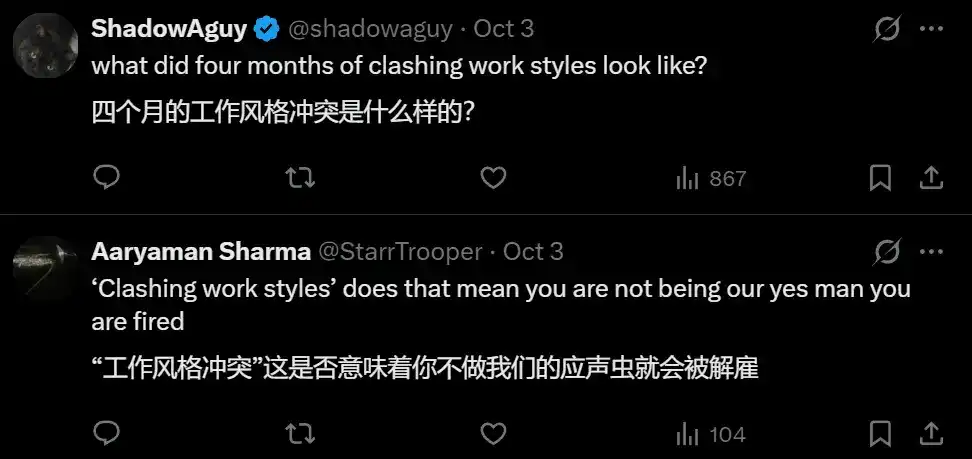
Why did it reach this point so quickly? Meta's explanation is "clashing work styles," stating the collaboration did not develop as expected. Meta also said the Superintelligence Labs will continue to focus on AI safety, alignment, and frontier risks. Of course, this is just the company's side of the story, and specific disagreements were not disclosed.

Additionally, the report did not confirm whether Dawn Song and others had all left, and the team had not responded by the time the article was published.
However, the real questions left by this collaboration change are still worth discussing. The core issue is: after bringing in excellent researchers, how do you enable them to function effectively within the organization?
A 2019 MIT Sloan study found that in the first year after a company acquisition, 33% of acquired employees chose to leave, compared to 12% of regular hires with similar skills and experience. Although these percentages tend to converge over time, within the three-year window studied, acquired employees were 15% more likely to leave than new hires.
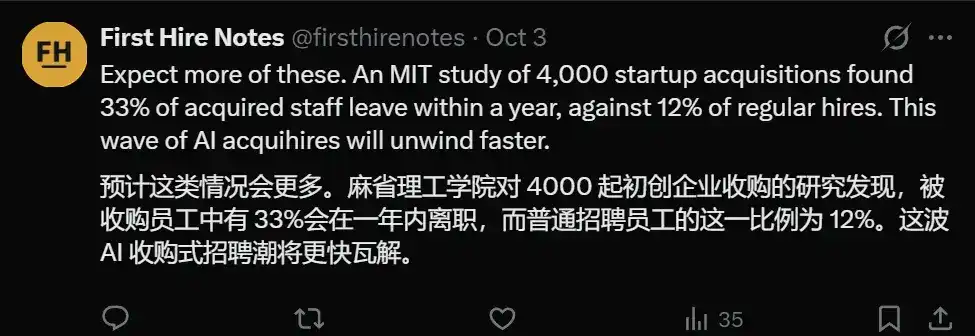
The article argues that the high turnover rate among acquired employees is primarily due to "organizational misfit." These individuals initially joined a startup for the entrepreneurial atmosphere, autonomy, flexibility, and risk-taking environment. However, after being acquired by a large company, they often face more bureaucratic processes and formal corporate culture, which directly conflicts with their preferences. Moreover, ordinary acquired employees typically cannot choose the buyer and are not involved in post-acquisition organizational adjustments. This "lack of choice" further exacerbates discomfort. Coupled with their inherent preference for building things from scratch, they are more likely to leave, even to start competing companies.
Returning to Meta's incident, the explanation of "clashing work styles" is clearly unconvincing to many. As for the deeper disagreements between the two sides, we still need to wait for an explanation from Virtue AI.