The wave of Physical AI is surging.
Looking around, most Physical AI companies focus on how to free embodied robots from remote controls; however, a company in Guangzhou has already enabled AI to take over more than 260,000 energy devices in energy station rooms.
What does take over mean?
It means at 3 a.m., when the sterilization equipment in a pharmaceutical factory starts up, AI in the energy station room monitors the gauges, replacing the two workers originally needed for overnight duty to stabilize the air pressure. It means that before the terminal cooling load in an electronics factory rises, AI has already calculated and adjusted the curve, arranging chillers, water pumps, and cooling towers into the most power-efficient parameter formation. It means AI scrutinizes dozens of columns and tens of thousands of lines of energy consumption data, intelligently identifying various points of waste like leaks and drips, and then issues rectification work orders.
A common name emerges behind all this—Mogu IOT. Touzijie learned that Mogu IOT recently completed its Series C (C1, C2) financing, with a cumulative financing scale of nearly 200 million yuan. Yunhui Capital and other existing shareholders continued to invest.
At a time when the AI sector generally faces challenges in commercial validation, this round of financing is regarded by the market as the most substantial capital vote for the “Physical AI Commercial Closed-loop”: the people who understand the company best have once again chosen to invest heavily.
Behind the Old Shareholders' Additional Investment: A Decade, Three-Stage Iteration
This is undoubtedly a financing event of landmark significance.
In the current context where AI companies generally “increase revenue without increasing profit” and capital shifts from “investing in concepts” to “investing in implementation,” this financing round sends two clear signals:
First, the commercial closed-loop of Physical AI has been validated—serving over 6,000 enterprises, cumulatively saving over 3.6 billion kilowatt-hours of electricity, and unlocking nearly 20% energy-saving potential. “AI moving from the digital world to the physical world” is no longer a slogan, but an auditable electricity bill;
Second, insiders are bullish—multiple existing shareholders continue to invest. They have witnessed the company’s most difficult phase when R&D expenses were high but scaling was challenging, understanding the company’s true quality better than any external due diligence report. The continued heavy investment by old shareholders and the high renewal rate from existing customers are trust votes carrying more weight than the financing amount itself.
Of course, investing is about betting on people. Looking at the resume of Mogu IOT’s founder, Shen Guohui, the first half is filled with the words “not sexy.”

Born in 1982, he studied mathematics, was admitted to graduate school for Management Science and Engineering, researching operations optimization for water conservancy and power projects—dry, but practical. After graduating with a master’s degree in 2006, he joined a large factory, becoming Deputy General Manager of the Refrigerator and Washing Machine Division in three years, and later was responsible for implementing the group’s smart home construction.
During his ten years at the factory, he realized a truth: while household appliances costing a few hundred or thousand yuan could be made smart, once large-scale equipment costing hundreds of thousands or millions per unit on the production floor is made intelligent, the value scale is incomparable.
In 2016, Shen Guohui decided to start a business and founded Mogu IOT. The first three years were spent on even more “boring” tasks—device connectivity: IoT gateways, energy device communication protocols, and data applications. Others found it tough, but he called it digging a well, “The logic of digging a well is to choose a direction and keep digging down. When you hit the underground river, everything becomes connected.”
Looking back at the decade of entrepreneurship, Mogu IOT’s iterative evolution can be clearly divided into three stages: the first three years were the “Device Connectivity Period,” the second three years opened up the “Industrial SaaS” business for the equipment industry chain; the third three years encountered the surging wave of ChatGPT in 2022. The team realized that large models would become “knowledge workers,” and subsequently initiated the development of the Lingzhi AI Multi-source Vertical Model.
Li Xing, a partner at Yunhui Capital, who witnessed Mogu IOT’s rise along the way, is also deeply impressed. In his view, the management of Mogu IOT accurately grasped the development patterns of the industrial internet years ago, established a bottom-up development path, chose the universal scenario of auxiliary energy supply, and adopted a market strategy targeting FSU (Factory, Supplier, User) customers simultaneously. Practice has proven this to be correct. With the advent of the artificial intelligence era, the correct development strategy mentioned above allows Mogu IOT to go with the flow, leveraging its unique global advantage in auxiliary energy big data to rapidly develop vertical industrial large models and agents, forming unique competitive advantages and business barriers. With this advantage, the company can smoothly lead and enter domestic and international markets, participating in both domestic and international circulation, becoming one of the recognized leading enterprises in industrial and energy artificial intelligence.
“The correctness of the strategic direction choice highlights the wisdom of Mogu IOT’s management team. The swift grasp of the opportunities in the era of large models proves the management’s alertness, flexibility, and decisiveness. Such a team and company deserve long-term and continuous additional investment,” Li Xing commented.
Why Energy Efficiency AI?
Why focus on Energy Efficiency AI?
This starts with Mogu IOT’s unique dichotomy: from an energy perspective, all energy-consuming entities can be divided into the energy supply side (supply end) and the production side (consumption end).
The logic behind this is self-evident—the production side is too “picky”: the production logic of pharmaceuticals and automobile manufacturing is completely different, with strong product and process attributes; the energy supply side, however, is very “uniform”: air compressors, chillers, water pumps, fans—the core indicators are the same worldwide, with strong cross-industry versatility, covering massive scenarios like factories, data centers, commercial complexes, and campuses.
As Shen Guohui puts it, “Naturally, it’s easier to be the ‘top scholar’ in one specific field than to master all three hundred and sixty trades.”
More importantly, comprehensive energy systems typically account for 30%-60% of a company’s total electricity consumption, making them the most universalized and standardized entry point for Physical AI implementation—even a rough calculation shows an annual energy-saving value space as high as 240 billion yuan. And philosophically, while AI is becoming the biggest driver of new energy consumption, it also brings unprecedented energy-saving potential.
Shen Guohui sees a key trend: from the coal era to the new energy era, every energy revolution is accompanied by a control revolution. The control revolution of the coal era was the centrifugal governor; this time, the name of the control revolution is Physical AI.
As is well known, the essential characteristic of Physical AI is not whether it has limbs or can move, but whether it can complete the physical closed-loop of “perception-decision-execution.” Currently, the AI sector is mixed with genuine and fake players. Many vendors fly the flag of Physical AI but are merely putting a layer of generic large model conversational interface on traditional PLC automation systems. Regarding this, Shen Guohui vividly gave two “inspection” standards to distinguish the genuine from the fake:
First, whether there is an AI visualization interface. Similar to the SR interface of autonomous driving, it can identify in real-time that there are cars, people, traffic cones nearby, and actually control the steering wheel, throttle, and brakes—data corresponds one-to-one with execution. Fake Physical AI may have a flashy interface, but data and execution are disconnected.
Second, whether the vertical model has completed the national internet information office registration. “It must withstand the verification of national-level auditing institutions. This is the most basic and mandatory requirement for doing Physical AI.”
There are many AIs that can write PPTs, but few AIs dare to control energy equipment. Undoubtedly, Energy Efficiency Physical AI is a long-term project. The real competition is not just about how strong the model capability is, but about high-quality data in professional fields, the generalization capability of the model, and safety control capability. It’s about achieving “experience feedback” through Agents, converting each real-world feedback into the next round of model capability improvement.
The Data Barrier That Money Can't Buy
In the era of Physical AI, the scarcest resource is not models, but “dark data”—those real operational data that flow only between devices and sensors, never extensively recorded by the internet. They can be vectorized, encoded, and compressed into latent space, becoming latent variables for models to understand the physical world.
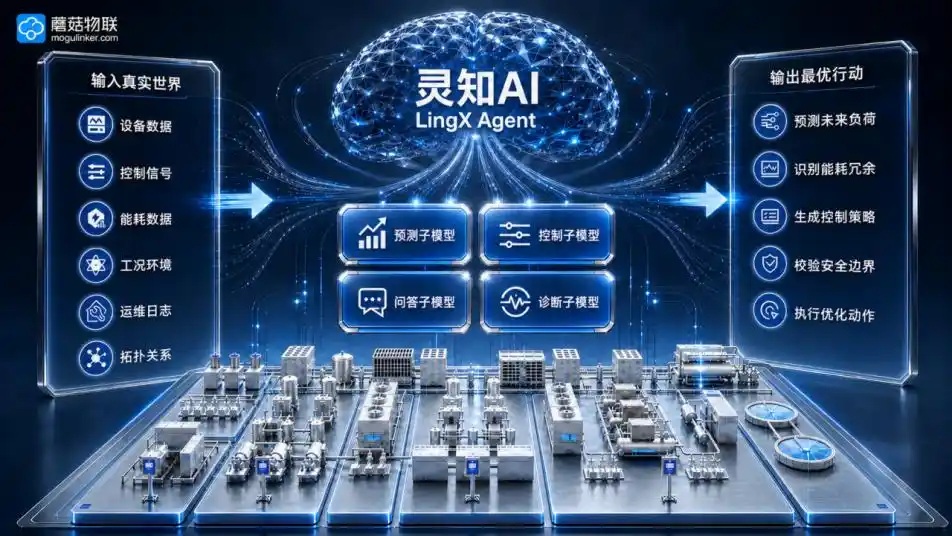
The reason Lingzhi AI positions itself as a “multi-source vertical model” lies in the three types of data it “feeds” on: text, time series, and graphics. Behind this is a multimodal database for the energy field: 30+ types of equipment, 8 data dimensions, 260,000 cloud-based real-time energy devices—the data flywheel spins, and the Matthew effect grows stronger.
This “well,” Mogu IOT started digging ten years ago. “When we were doing Industrial SaaS early on, we insisted on public cloud deployment, while some peers opted for private deployment, only seeking short-term revenue,” Shen Guohui said. “And the result? Their data is scattered in the hands of various customers. Now, even if they want to buy it with money, they can't get it.”
Undoubtedly, some barriers cannot be bought with money, and “dark data” is precisely such a thing.
Beyond that, for Physical AI to truly take root in energy control, safety compliance and risk controllability are equally core capabilities. To this end, Lingzhi AI has built a unique three-layer fusion architecture: the first layer is the expression fusion layer; the second is the prediction fusion layer; the key is the third decision-execution fusion layer—an independent safety constraint mechanism is set up. Only after completing rule checks, boundary verification, etc., does it output the final actionable device control commands, cutting off the possibility of runaway operations.
Building on the Lingzhi AI model, Mogu IOT self-developed the LingX Agent, adding two industrial-grade control differentiation modules: one is the Safety and Reliability Gating (rule checking, simulation trial runs, device interlock protection, boundary verification, etc.); the other is the Data Support Framework (standardized access for heterogeneous data, time-series databases, data lakes and semantic indexing, etc.).
“Others are teaching AI to talk; we are teaching AI to work,” Shen Guohui emphasized. “But for AI to work, it must be 100% safe, verifiable, and traceable.”
Hardcore Commercialization Achievements: 3.6 Billion kWh and 6,000 Enterprises
Commercialization is the soul-searching question for every AI enterprise.
Shen Guohui mentioned a pattern summarized by an industry expert: the industry generally follows the development path of Project (project-based) → Product (productization) → Platform (platformization). A large number of AI companies are stuck in the Project stage, trapped in the dilemma of “increasing revenue without increasing profit.”
He pointedly noted that energy control AI faces two layers of standardization difficulties: product standardization and delivery standardization, with delivery being the true watershed that creates gaps. Many companies can output standardized products, but the delivery and debugging phase still heavily relies on personalized, experienced senior engineers. Changing the person delivering leads to a different outcome.
Mogu IOT’s approach is to build a cloud-edge-device integrated product system: cloud-side “data layer + Lingzhi AI/LingX + application layer,” edge-side “edge intelligent server ensuring low-latency real-time control,” device-side “IoT gateways, inspection robots responsible for perception and execution.”
How does it make money? Currently, Mogu IOT has two charging models: product-based charging “initial installation fee + annual operation and maintenance fee,” and service-based charging “energy-saving effect sharing or AI hosting.” Relying on the cloud-edge-device integrated standard product system, Mogu IOT has taken the lead in running a commercial closed-loop: serving over 6,000 enterprises, cumulatively saving over 3.6 billion kWh of electricity, and unlocking nearly 20% additional energy-saving potential compared to non-AI energy-saving methods—very few in the entire AI sector can present such a report card in the field of energy control.
And the continuous evolution of AI means the value of energy control AI lies not only in energy saving but also in unattended operation.
This immense value is also recognized by investors. Zhu Bin, Partner at Yuanhe Origin Capital, stated that Mogu IOT is a representative Physical AI company in the energy control field, having built an industrial physical intelligence closed-loop of “perception-decision-execution.” “Thanks to the massive real-time physical data accumulated from air compressor stations, refrigeration stations, and other energy equipment during the IoT era, coupled with the widespread application of the Lingzhi vertical large model on the client side, Physical AI entering new quality productivity has never been so concrete, and the measurable value created for customers is more trustworthy.”
Shen Guohui can’t help but recall a vivid implementation scene—that was at 3 a.m., when the equipment sterilization operation started at the Huarun Sanjiu pharmaceutical factory, with two employees on duty overnight. After Mogu IOT completed the unattended operation transformation, only AI was present in the station room in the early morning, solving the problem of overnight shifts at once and improving employee well-being.
From the pilot of the air compressor station at the Shenzhen Guanlan base to achieving over 15% energy saving rate in the refrigeration station, after two rounds of verification, Huarun Sanjiu decided to purchase a group-level energy AI management platform and replicate it in batches to national bases like Zaozhuang and Chenzhou. This story was written into Huarun Sanjiu’s ESG report and also into the SASAC’s compilation of state-owned enterprise reform cases.
It is reported that Mogu IOT will also explore a charging model similar to Token-based API calls in the future. “As customers’ recognition of the value of unattended operation increases, the acceptance of this charging model will become higher and higher.”
Why Did Japan's Mitsubishi Choose Chinese AI, Embarking on a Global Expedition
Currently, a consensus is gradually forming in the venture capital circle: going global is the second growth curve for AI companies and also the biggest testing ground.
Talking about this point, Shen Guohui’s judgment is straightforward: domestic customers’ willingness to pay is relatively weak; in developed markets like Japan, Europe, and the US, enterprises are more willing to pay a premium for AI. Serving the Southeast Asian market cannot be considered true global expansion; essentially, it’s equivalent to doing the domestic market.
In July this year, Mogu IOT reached a key milestone—forming a strategic partnership with RYODEN, a core listed company under the Mitsubishi Group. The two parties will collaborate around Physical AI control in the energy efficiency field, involving both technology and market aspects. This is the first joint development cooperation between a Chinese AI tech company and a global leading automation giant on Physical AI control technology in the energy efficiency field. Clearly, this cooperation is of landmark significance.
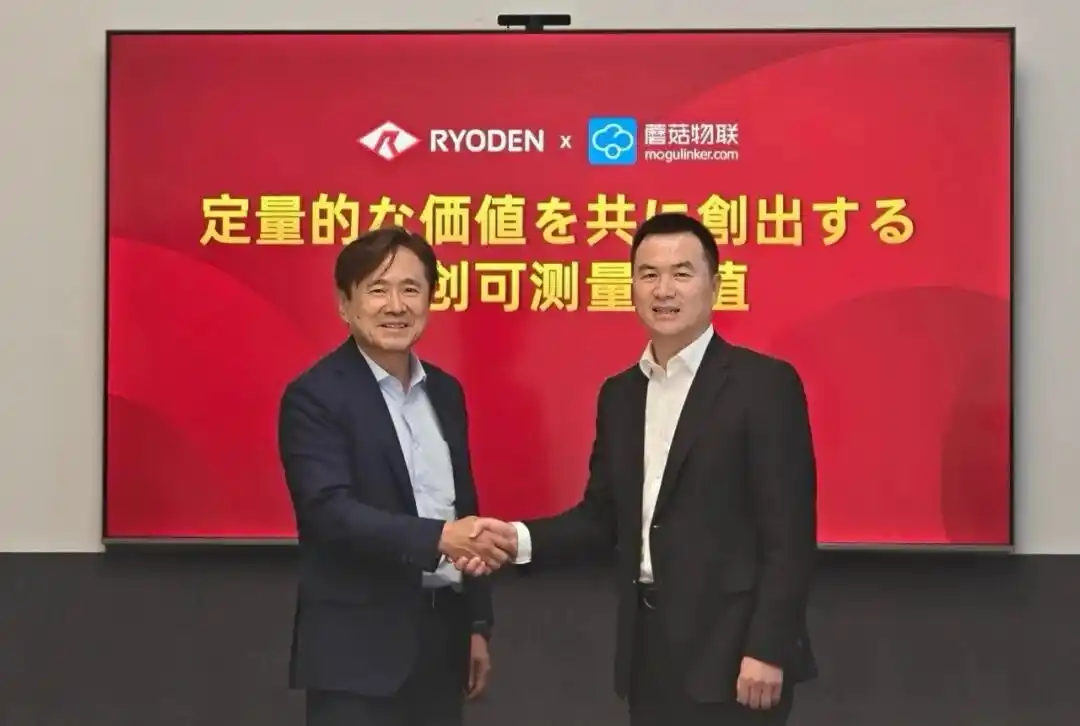
As a century-old automation giant, Mitsubishi conducted multiple rounds of comparative screening among Chinese and American tech companies, conducted in-depth on-site verification of implementation cases, and finally selected Mogu IOT. Shen Guohui’s interpretation is very down-to-earth: “Because our AI model is the most solid, our data foundation is the strongest, and we have the most cases—Mogu serves 130 among the Fortune 500.”
Facing the entry of giants like Siemens into energy management AI, he is even more unworried: “No matter how big the giant is, to do Energy Efficiency AI, they also need data and must complete the accumulation of device communication protocols and on-site know-how—the dirty and hard work we’ve been through, they can’t skip any of it.”
Time is the longest moat. Shen Guohui has calculated a time account: achieving full-category device communication protocol connectivity is a “well” Mogu dug for ten years, and even if a big company invests ten times the manpower, they might not be faster. He believes the best strategy for big companies is, like Mitsubishi, to choose cooperation over competition. “We can each play to our strengths, like assembling Lego blocks, piecing together a complete picture of industrial AI.”
Looking back on the decade-long entrepreneurial journey, Shen Guohui summarizes it in twelve words—Respect common sense, respect the rules, and iterate continuously. In his view, the most important gene for an enterprise is iteration. “There is no such thing as a perpetually successful enterprise, only enterprises of the era.”
“If we look 5-10 years further ahead, I can already see that in the factories of the future, the production side will be taken over by embodied intelligence robots; the energy side will be taken over by Mogu IOT’s Lingzhi AI and Agents.”
In his words, the next decade has already quietly begun.
This article is from the WeChat public account “Touzijie” (ID: pedaily2012), author: Liu Bo