Claude's Latest Model to be Released Tomorrow, Anthropic Turns Model Launches into an IPO Language

marsbitPubblicato 2026-06-09Pubblicato ultima volta 2026-06-09

Introduzione

Anthropic is positioning itself for an IPO, transitioning from a "safe AI lab" to a company speaking the language of public markets. Recent signals include a near-trillion-dollar valuation, confidential S-1 filing, high revenue run-rate, and rumors of the upcoming Claude 5 model. The market is eagerly trading on the Claude 5 (or "Fable 5") rumors, seeing the potential release as a key piece of Anthropic's IPO narrative—proof of its continued innovation. However, public investors will look beyond raw model capability to scrutinize sustainable revenue, cost structure, and profitability. A differentiator for Anthropic is its work on advanced, controlled models like Mythos and Project Glasswing, focused on high-value security tasks. This supports a premium enterprise and safety story but also brings heightened regulatory and dual-use risk disclosure pressures for its IPO. Ultimately, the S-1 filing, not model rumors, will reveal the substance. The market will judge Anthropic based on concrete metrics: revenue quality, customer concentration, cost control, and whether it can be framed as a scalable AI software platform versus a capital-intensive infrastructure player.

TL;DR

The recent market inclusion of Anthropic in the same trading chart is not an isolated event but a set of signals: a nearly one-trillion-dollar post-money valuation, confidential S-1 filing, rapidly growing revenue run-rate, and rumors surrounding Claude 5.

For investors, the meaning of these signals is straightforward. AI frontier labs are no longer proving themselves solely with papers, model rankings, and product reputation. They are starting to explain how much they are worth in a language the public market can understand. Model capabilities, enterprise adoption, revenue quality, compute costs, and risk disclosure are all being placed into a single pricing framework.

There is currently no official announcement, product page, or model card from Anthropic confirming Claude Fable 5. Statements about it sharing an underlying architecture with Mythos, adding safety guardrails, and improving long-context and complex task capabilities should still be considered rumors or market expectations. What's truly worth discussing is not what Fable 5 has already proven, but why an unconfirmed new model is being incorporated into Anthropic's IPO narrative ahead of time.

Anthropic Enters IPO Preparation Phase

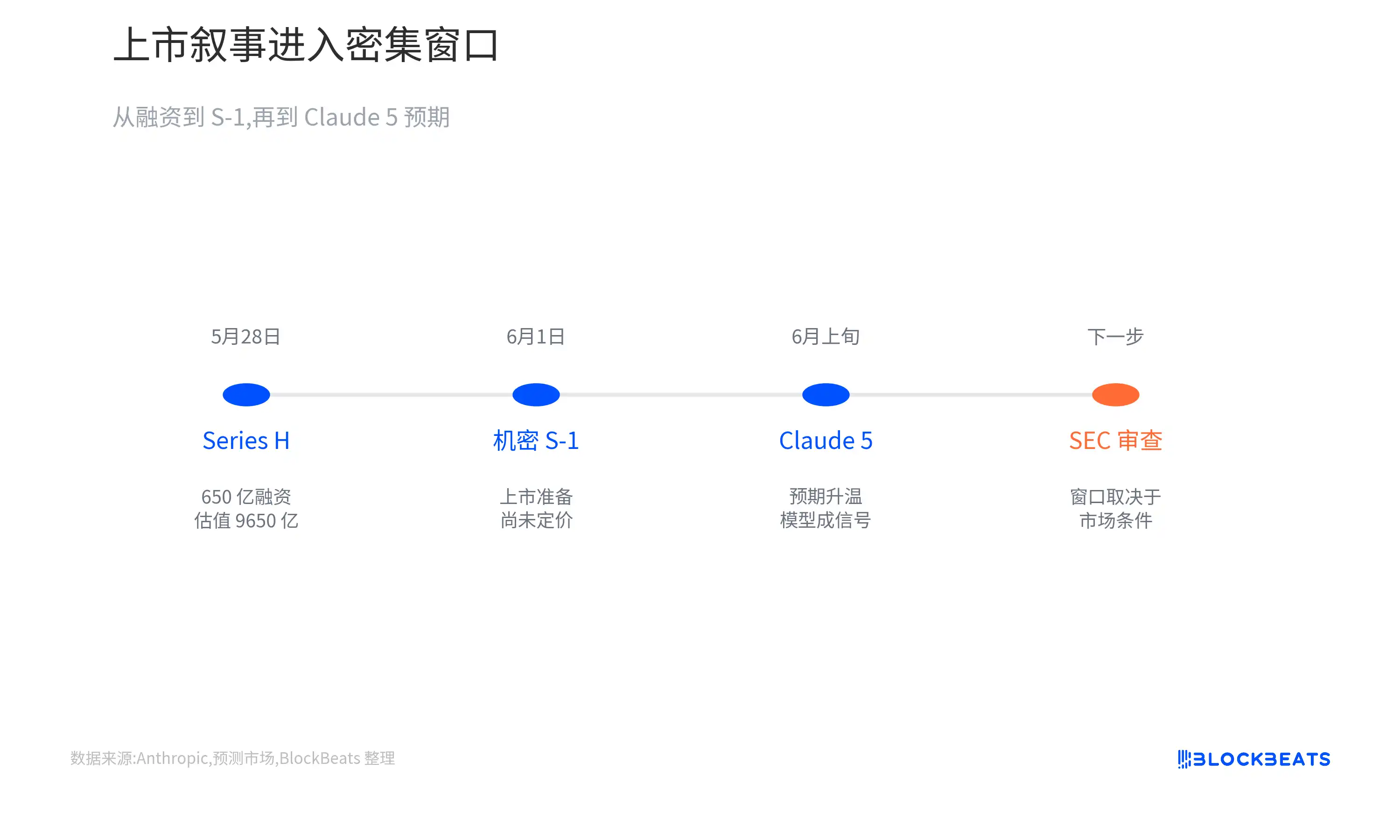
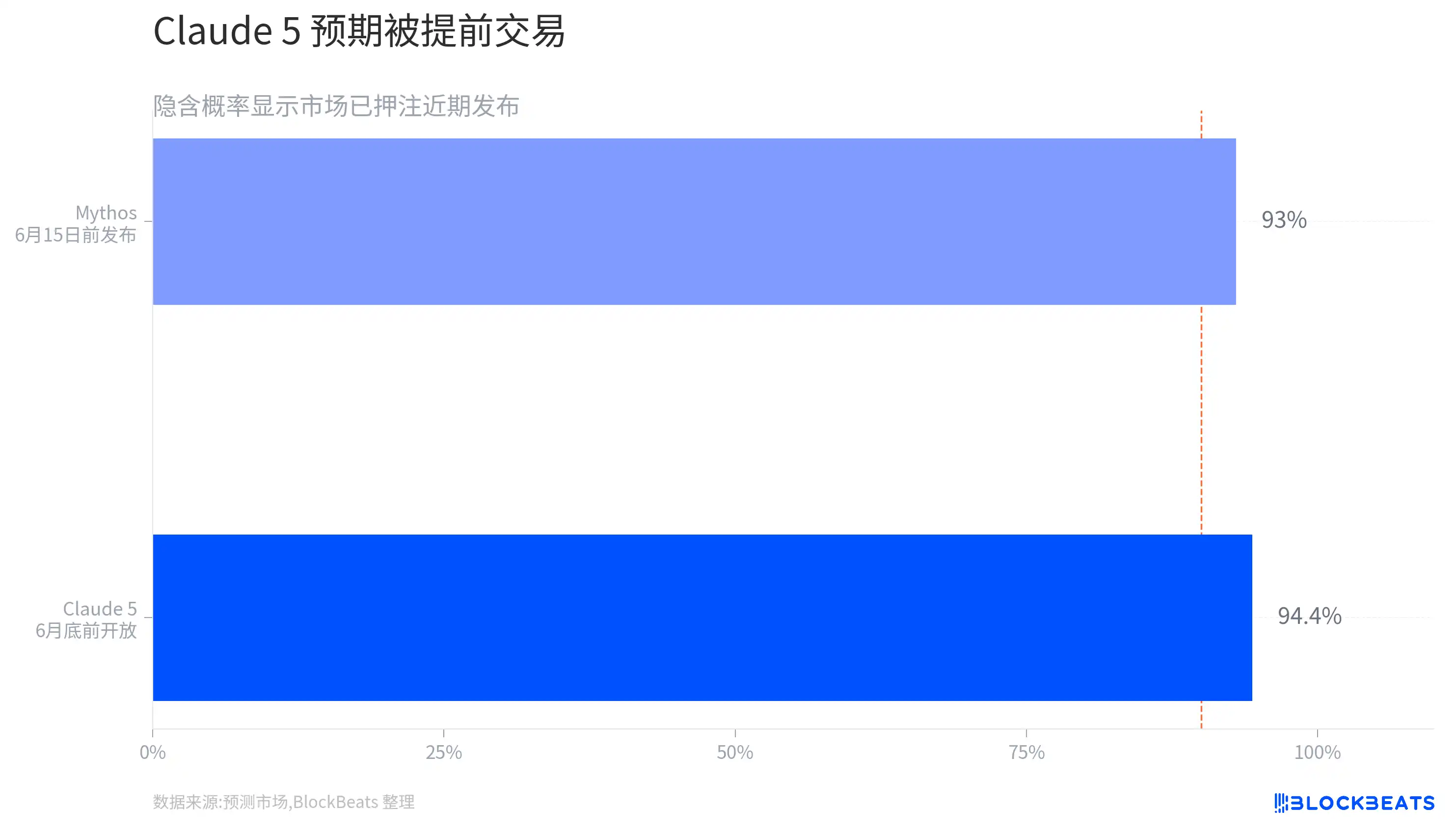
Anthropic's timeline is dense enough. On May 28, the company announced the completion of a $650 billion Series H financing, with a post-money valuation reaching $9.65 trillion, and stated that its run-rate revenue had exceeded $470 billion earlier that month. On June 1, Anthropic further confirmed it had confidentially filed a draft Form S-1 with the SEC for a planned IPO. The number of shares to be offered and the price range have not been determined, and the listing remains subject to SEC review, market conditions, and other factors.
This changes Anthropic's position in the market. It is no longer just the "safe model company" alongside OpenAI but an ultra-large AI platform candidate preparing for the public market. The private market can pay for future imagination, and the public market will also pay for the future, but it demands that companies break down that imagination into more verifiable metrics.

These metrics include whether revenue sources are stable, customers are concentrated, compute costs are controllable, model leadership is sustainable, and regulatory risks are disclosable and manageable. For frontier model companies, this transition is harder than for traditional software companies.

When traditional SaaS companies go public, investors typically look at ARR, net retention rate, gross margin, sales efficiency, and customer structure. Frontier model companies also need to answer these questions but additionally face training and inference costs, model iteration speed, safety incidents, cloud provider dependency, and chip cycles. The stronger the model, the greater the revenue potential, but also the heavier the cost and regulatory variables.

This is also what makes Anthropic special at this moment. Its high valuation cannot be supported solely by "Claude is smarter." It needs a more complete story: sustained progress in model capabilities, enterprise customers willing to pay, a sufficiently large revenue run-rate, a safety positioning that unlocks high-value scenarios, and an available capital market window. The amplification of the Claude 5 rumors is precisely because it appears to be the next piece of the puzzle in this story.
Fable 5 Rumors Being Traded in Advance

If Anthropic were simply releasing a new model in a routine manner, the market likely wouldn't be this excited. The amplification of the Claude 5 rumors is precisely because it coincides with a critical IPO juncture. Financing, valuation, S-1 filing, layered with heavyweight model leaks perfectly form a narrative the capital market loves to hear: the company proves with concrete action just before its IPO that it remains firmly at the forefront of capability iteration.

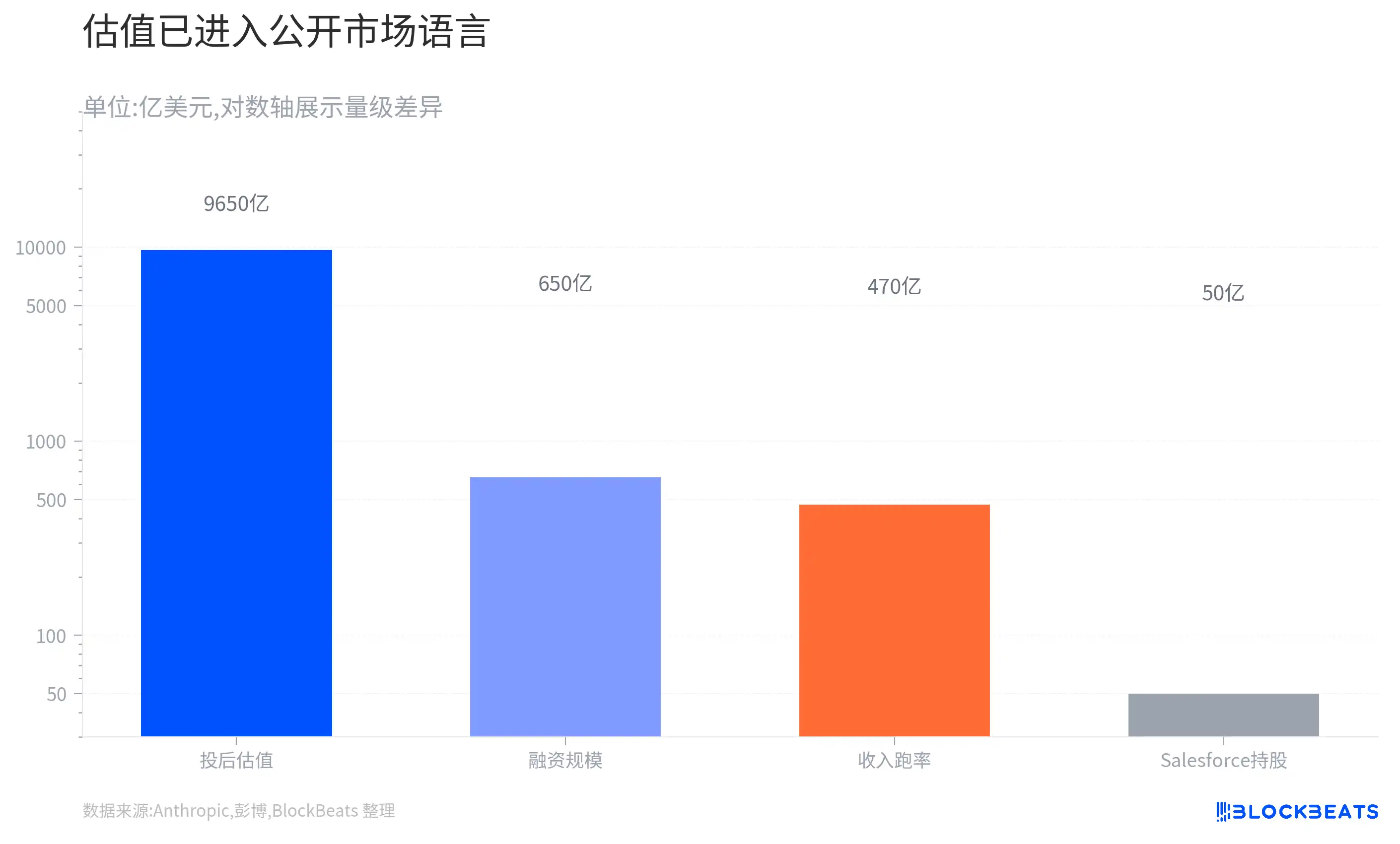
Prediction markets have already opened betting on "whether Claude 5 will be publicly available by June 30, 2026." The current market price reflects the traders' implied probability. While public information cannot yet fully confirm the specific timeline previously circulated, it's clear: the prediction market is already pricing a near-term release of Claude 5, and the price is not low.

This expectation carries inherent information. The market directly translates "product cadence" into "valuation narrative": if Anthropic can indeed consistently roll out stronger models, its nearly trillion-dollar post-money valuation with a high revenue run-rate will be interpreted as a natural outcome of rapid platform capability expansion; conversely, if the model cadence noticeably slows, then the near-trillion valuation would have to rely more heavily on the quality and certainty of existing revenue to sustain itself.

This trading method is not unfamiliar. Consumer internet companies emphasize user growth and retention before IPO, cloud companies highlight large customers and net expansion rates, chip companies talk about orders and capacity. AI model companies don't yet have a fully mature public market template, so model releases themselves become a visible signal. It is both a product update and a capability showcase, impacting developers and enterprise clients while also shaping investor imagination about the next phase of revenue growth.

But the impact of a model release on valuation is not linear. A stronger model can bring higher API call volumes, larger enterprise contracts, and stronger customer stickiness, but also potentially higher inference costs, more complex safety reviews, and heavier infrastructure investment. The public market ultimately won't just ask "Is it the strongest?" but also "How much compute is consumed per dollar earned?" "Can gross margins improve?" "Will safety boundaries limit commercialization speed?"

Mythos Provides Imagination, But Also Brings Disclosure Pressure

The more differentiated part of Anthropic's current narrative is not "another chatbot model," but the controlled frontier capabilities represented by Mythos and Project Glasswing.

According to official Anthropic disclosures, Claude Mythos Preview is a general, unreleased frontier model that will not be made broadly available. Project Glasswing is oriented towards defensive security work, where collaborative partners gain controlled access for use in critical software security, zero-day vulnerability discovery and remediation, among other scenarios. Anthropic also disclosed that the project has already discovered a significant number of zero-day vulnerabilities and committed to up to $1 billion in usage credits and $4 million in open-source security donations.
This provides Anthropic with a valuation story different from that of a regular consumer chatbot. It can position itself as a foundational model supplier entering complex tasks, high-value enterprise workflows, and safety-critical scenarios. For the public market, this is easier to map to large customer budgets than "users like to chat," and it's also easier to explain why enterprises are willing to pay a premium for more reliable, safer models.

If there is indeed a technical link between a future Fable 5 and Mythos, with the former offering stricter guardrails to a broader user base, it would create a narrative path in theory: the most frontier capabilities are first validated in a controlled environment, then partially productized in a safer form. This path aligns with Anthropic's long-emphasized safety positioning and fits the demand of enterprise clients for controlled AI.

But the same dynamic pushes Anthropic towards greater regulatory pressure. Cybersecurity capabilities have a dual-use (civilian-military) nature. Models that can find and fix vulnerabilities could also be misused in attack chains. Mythos's controlled release already indicates such capabilities cannot simply be fully released. If future, more general models are interpreted by the market as "trickled-down Mythos capabilities," the company must more clearly explain safety guardrails, access restrictions, misuse monitoring, and liability boundaries.

These contents will enter the S-1 risk disclosures. Public market investors won't only care about how powerful the model is, but also whether that power brings additional regulatory costs, national security reviews, reputational risks, and potential liabilities. For an AI company with a post-money valuation nearing one trillion dollars, a major safety incident could be more than just a product mishap; it could be a systemic variable affecting the listing timeline and valuation multiples.

What's Next is the S-1, Not New Rumors

For Anthropic, what is most likely overestimated by the market right now is not model capability, but the relationship between model capability and valuation.

Discussions about Fable 5, Claude 5, and even Mythos can indeed boost market sentiment. A stronger model means higher customer attention, stronger developer interest, and means Anthropic can continue to maintain its presence in the frontier model competition. But these factors are essentially growth expectations. They can explain why the market is willing to trade the future in advance, but they are insufficient alone to prove that the nearly trillion-dollar valuation has been validated by reality.

Once truly in the public market, investor concerns will quickly become specific. How much of that over $470 billion revenue run-rate can ultimately convert into sustainable, auditable revenue? Is enterprise customer growth coming from long-term deployments or pilot phases? What proportion of revenue comes from top customers? What roles do strategic partners and cloud channels like Amazon and Alphabet play? More importantly, while model inference volumes grow rapidly, can training and inference costs be continuously reduced to support margin improvement?

These metrics ultimately determine not just the growth rate, but how the market defines Anthropic.
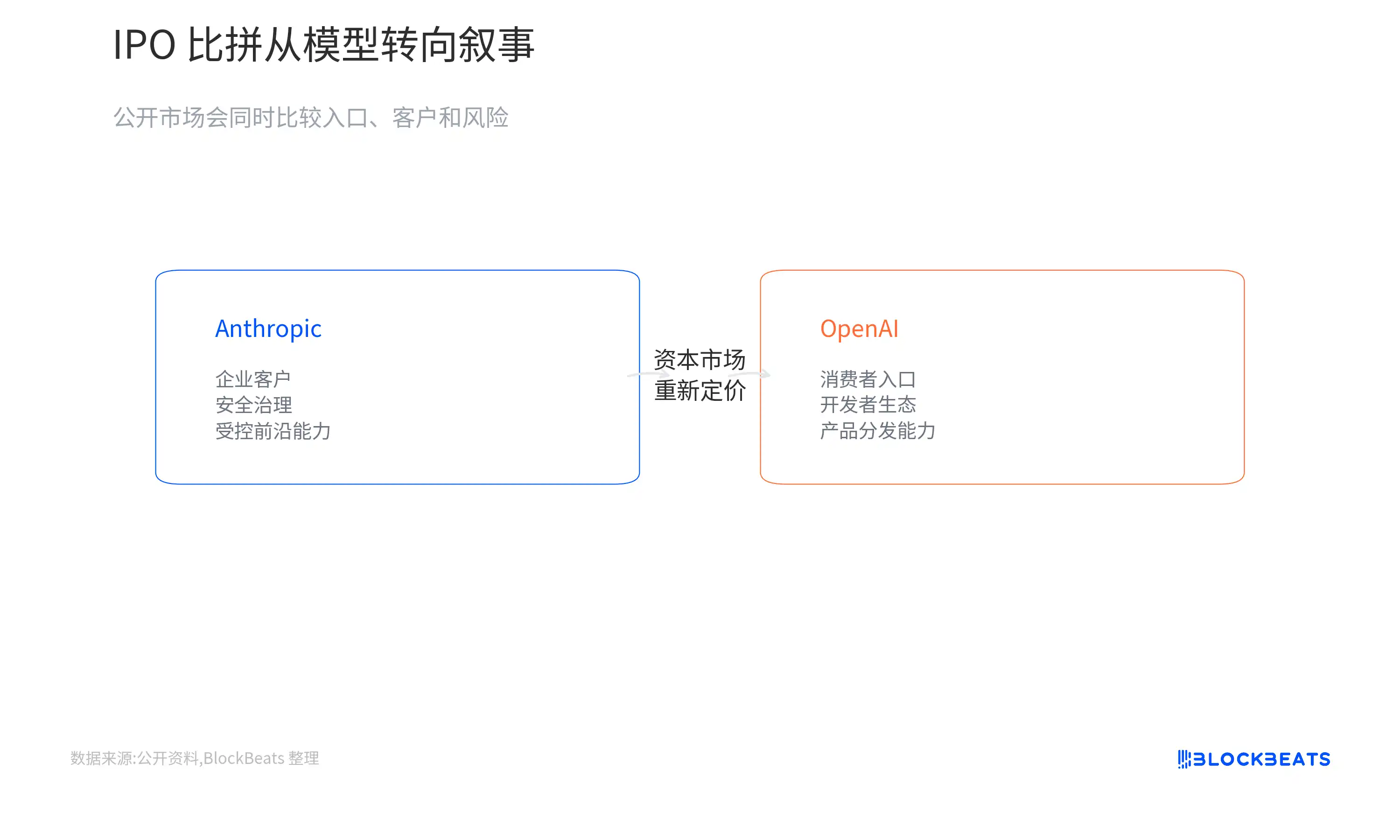
If the company can persistently lower unit costs, increase customer stickiness, and build a broader software ecosystem around its models, then investors are more willing to view it as the next-generation AI software platform. If revenue growth is consistently accompanied by massive compute investment and expanding capital expenditures, then the market is more likely to categorize it as a high-growth, high-consumption AI infrastructure company. Both narratives can support high valuations, but they correspond to different valuation multiples and risk tolerances.

OpenAI's presence will make this comparison more apparent, but the two don't necessarily constitute a simple zero-sum competition. OpenAI possesses stronger consumer touchpoints and ecosystem influence, while Anthropic has built a more distinct enterprise, safety, and governance narrative. What the future public market will truly compare might not be who releases a certain model first, but who can more stably convert model capabilities into revenue growth and explain the future to investors with lower uncertainty.


Domande pertinenti

QAccording to the article, what is the new 'language' that Anthropic is starting to speak when communicating its value?

AThe article states that Anthropic is beginning to communicate its value using the 'language' understood by the public market. This involves framing its worth through measurable financial indicators like model capabilities, enterprise adoption, revenue quality, computing costs, and risk disclosures, moving beyond just research papers and product reputation.

QWhat specific event marked Anthropic's official entry into the IPO preparation stage, as detailed in the text?

AAnthropic officially entered the IPO preparation stage on June 1, when it confirmed it had confidentially submitted a draft Form S-1 to the SEC, with the actual IPO contingent on regulatory review and market conditions.

QWhy does the article suggest the Claude 5 (Fable 5) rumors are being amplified by the market at this specific time?

AThe article suggests the Claude 5 rumors are being amplified because they coincide perfectly with Anthropic's key IPO milestones. The timing creates a compelling narrative for investors: the company is demonstrating it remains at the forefront of AI capability just before going public, thereby validating its high valuation and growth story.

QWhat differentiated valuation story does the 'Mythos' model and Project Glasswing provide for Anthropic, according to the analysis?

AMythos and Project Glasswing provide Anthropic with a differentiated valuation story focused on controlled, high-value enterprise and security-critical applications. This positions Anthropic not just as a consumer chatbot provider, but as a supplier of foundational models for complex tasks, high-value enterprise workflows, and cybersecurity (like zero-day vulnerability discovery), which is easier to map to large enterprise budgets and justifies premium pricing for safer, more reliable models.

QWhat does the article identify as the more critical factor for public market investors to assess about Anthropic's future, beyond just new model releases?

ABeyond new model releases, the article identifies the more critical factor for public market investors as understanding how Anthropic's model capabilities translate into sustainable, verifiable financial performance. Key concerns include the sustainability and auditability of its $47B+ revenue run-rate, customer concentration, the role of strategic partners, and most importantly, whether training and inference costs can decrease to support improved profit margins, which will define the company as either a next-gen AI software platform or a high-growth, high-burn infrastructure company.

Letture associate

Apple's Desired On-Device AI Sees a Dark Horse Emerge: The First Cognitive Model is Born, 4B Matches GPT-5.4

A Chinese company, Tomorrow's Journey (Nextie), has introduced what it is calling the industry's first "cognitive model" for edge devices. Named New Journey Alpha, this 4-billion-parameter model reportedly matches the performance of trillion-parameter giants like GPT-5.4 in group intelligence tasks such as debate and collective decision-making. The development follows Andrej Karpathy's vision of stripping vast factual knowledge from large language models to retain only a smaller "cognitive core" capable of reasoning, planning, and knowing its own limits. This approach directly addresses the soaring computational costs and token expenses hindering AI's widespread deployment, as highlighted by incidents like Amazon shutting down an internal AI tool due to prohibitive costs. Trained via reinforcement learning on a corpus of academic papers from 1800-2020 to enhance generalization, the model enables three key advancements: 1) Improved decision quality in multi-agent systems, 2) Drastically reduced compute costs, allowing for cost-effective cloud or on-device (e.g., MacBook) deployment, and 3) The feasibility of "proactive" AI agents that act autonomously without user prompts, unlocking new commercial possibilities beyond today's reactive models. Built by the former Microsoft Xiaoice team—known for creating a 3.6B model that outperformed a 65B Llama model—the company is now focusing on the multi-agent systems sector, a field gaining significant investor interest. The model's economic impact is profound; by achieving high-level performance with minimal parameters, it fundamentally alters the cost structure of AI services, challenging the prevailing model of ever-larger parameter counts.

marsbit1 h fa

Apple's Desired On-Device AI Sees a Dark Horse Emerge: The First Cognitive Model is Born, 4B Matches GPT-5.4

marsbit1 h fa

OpenAI's 'Blueprint for the Future': Making AI Beneficial for Every Person on the Planet

A new transformative technology emerges every few generations. OpenAI draws a parallel with the advent of electricity in the 1920s, which initially brought convenience but ultimately enabled unprecedented progress in medicine, engineering, and living standards by empowering people to create new possibilities. AI is poised to recreate this phenomenon. Its true significance lies not in the technology itself, but in what people can achieve with it—from understanding a medical bill or starting a business to aiding scientific discovery. OpenAI believes AI should be universally accessible, allowing everyone to use it according to their own needs. This future, however, is not guaranteed. While transformative tech can centralize power, OpenAI's philosophy is that AI must serve humanity, augmenting human capabilities and broadly distributing its benefits. The company's first commitment is to build AI for human service, aiming to empower the many rather than concentrate power in a few. Safety, alignment with human intent, and oversight are paramount. OpenAI is optimistic about AI's potential to expand human welfare but remains clear-eyed about risks. The goal is to help people achieve more, not to replace them. Full automation is not the desired future; human judgment, values, and direction will become even more critical. OpenAI outlines three core goals: 1. Build automated AI researchers to accelerate and increasingly automate the research process itself, maintaining close human collaboration. The internal projection is that by March 2028, a significant portion of their research will be conducted by AI systems working alongside human researchers. 2. Accelerate economic development by advancing science, boosting productivity, and fostering growth, while ensuring the fruits are widely shared. 3. Provide a personal AGI for everyone on Earth, allowing individuals to benefit from this transformative technology in their own way. The company is entering its third phase, moving from foundational AGI research (Phase 1) to product deployment and learning from real-world use (Phase 2). The current challenge is making advanced AI abundant, affordable, safe, practical, and usable for all individuals and organizations. OpenAI concludes that a widely distributed power structure leads to a more resilient, adaptable, and free society. A positive AI future should not be controlled by a handful of entities but built, benefited from, and owned by many. If realized correctly, AI can become a cornerstone for enhancing global productivity, creativity, scientific advancement, and economic opportunity, fulfilling the mission to ensure AGI benefits all of humanity.

marsbit2 h fa

OpenAI's 'Blueprint for the Future': Making AI Beneficial for Every Person on the Planet

marsbit2 h fa

Arthur Hayes' New Article: AI Bubble Nears Bursting, Crypto Market Faces Short-Term Pressure

In a new essay, Arthur Hayes argues that the AI market bubble is approaching a rupture, which will place significant short-term pressure on crypto assets. He identifies rising oil prices, a trio of massive tech IPOs (SpaceX, Anthropic, OpenAI), and potential anti-AI political rhetoric from Trump as the three key catalysts for a correction. Hayes posits that the prolonged blockage of the Strait of Hormuz will drive energy prices higher, increasing operational costs for data centers and squeezing AI company profits. Simultaneously, the market may struggle to absorb the upcoming wave of multi-trillion dollar tech IPOs. Furthermore, with high inflation hurting his election chances, Trump could pivot to attacking the AI sector with proposals for heavy taxation and regulation to win over voters, spooking the market. Hayes notes that nearly all new dollar liquidity since 2022 has flowed into the AI sector, leaving little for Bitcoin, explaining its recent underperformance. He believes an AI stock crash would trigger a broad risk-off sentiment and credit contraction, dragging down crypto in the near term. Consequently, his fund, Maelstrom, has sold all AI-related stocks and non-core cryptocurrencies, retaining only Bitcoin and Ethereum while building positions in traditional energy stocks. He anticipates Bitcoin will bottom and resume its bull run only after the AI bubble pops and a new monetary easing cycle begins.

marsbit2 h fa

Arthur Hayes' New Article: AI Bubble Nears Bursting, Crypto Market Faces Short-Term Pressure

marsbit2 h fa

Trading

Spot
Futures

Articoli Popolari

Cosa è $S$

Comprendere SPERO: Una Panoramica Completa Introduzione a SPERO Mentre il panorama dell'innovazione continua a evolversi, l'emergere delle tecnologie web3 e dei progetti di criptovaluta gioca un ruolo fondamentale nel plasmare il futuro digitale. Un progetto che ha attirato l'attenzione in questo campo dinamico è SPERO, denotato come SPERO,$$s$. Questo articolo mira a raccogliere e presentare informazioni dettagliate su SPERO, per aiutare gli appassionati e gli investitori a comprendere le sue basi, obiettivi e innovazioni nei domini web3 e crypto. Che cos'è SPERO,$$s$? SPERO,$$s$ è un progetto unico all'interno dello spazio crypto che cerca di sfruttare i principi della decentralizzazione e della tecnologia blockchain per creare un ecosistema che promuove l'impegno, l'utilità e l'inclusione finanziaria. Il progetto è progettato per facilitare interazioni peer-to-peer in modi nuovi, fornendo agli utenti soluzioni e servizi finanziari innovativi. Al suo interno, SPERO,$$s$ mira a responsabilizzare gli individui fornendo strumenti e piattaforme che migliorano l'esperienza dell'utente nello spazio delle criptovalute. Questo include la possibilità di metodi di transazione più flessibili, la promozione di iniziative guidate dalla comunità e la creazione di percorsi per opportunità finanziarie attraverso applicazioni decentralizzate (dApps). La visione sottostante di SPERO,$$s$ ruota attorno all'inclusività, cercando di colmare le lacune all'interno della finanza tradizionale mentre sfrutta i vantaggi della tecnologia blockchain. Chi è il Creatore di SPERO,$$s$? L'identità del creatore di SPERO,$$s$ rimane piuttosto oscura, poiché ci sono risorse pubblicamente disponibili limitate che forniscono informazioni dettagliate sul suo fondatore o fondatori. Questa mancanza di trasparenza può derivare dall'impegno del progetto per la decentralizzazione—un ethos che molti progetti web3 condividono, dando priorità ai contributi collettivi rispetto al riconoscimento individuale. Centrando le discussioni attorno alla comunità e ai suoi obiettivi collettivi, SPERO,$$s$ incarna l'essenza dell'empowerment senza mettere in evidenza individui specifici. Pertanto, comprendere l'etica e la missione di SPERO rimane più importante che identificare un creatore singolo. Chi sono gli Investitori di SPERO,$$s$? SPERO,$$s$ è supportato da una varietà di investitori che vanno dai capitalisti di rischio agli investitori angelici dedicati a promuovere l'innovazione nel settore crypto. Il focus di questi investitori generalmente si allinea con la missione di SPERO—dando priorità a progetti che promettono avanzamenti tecnologici sociali, inclusività finanziaria e governance decentralizzata. Queste fondazioni di investitori sono tipicamente interessate a progetti che non solo offrono prodotti innovativi, ma contribuiscono anche positivamente alla comunità blockchain e ai suoi ecosistemi. Il supporto di questi investitori rafforza SPERO,$$s$ come un concorrente degno di nota nel dominio in rapida evoluzione dei progetti crypto. Come Funziona SPERO,$$s$? SPERO,$$s$ impiega un framework multifunzionale che lo distingue dai progetti di criptovaluta convenzionali. Ecco alcune delle caratteristiche chiave che sottolineano la sua unicità e innovazione: Governance Decentralizzata: SPERO,$$s$ integra modelli di governance decentralizzati, responsabilizzando gli utenti a partecipare attivamente ai processi decisionali riguardanti il futuro del progetto. Questo approccio favorisce un senso di proprietà e responsabilità tra i membri della comunità. Utilità del Token: SPERO,$$s$ utilizza il proprio token di criptovaluta, progettato per servire varie funzioni all'interno dell'ecosistema. Questi token abilitano transazioni, premi e la facilitazione dei servizi offerti sulla piattaforma, migliorando l'impegno e l'utilità complessivi. Architettura Stratificata: L'architettura tecnica di SPERO,$$s$ supporta la modularità e la scalabilità, consentendo un'integrazione fluida di funzionalità e applicazioni aggiuntive man mano che il progetto evolve. Questa adattabilità è fondamentale per mantenere la rilevanza nel panorama crypto in continua evoluzione. Coinvolgimento della Comunità: Il progetto enfatizza iniziative guidate dalla comunità, impiegando meccanismi che incentivano la collaborazione e il feedback. Nutrendo una comunità forte, SPERO,$$s$ può affrontare meglio le esigenze degli utenti e adattarsi alle tendenze di mercato. Focus sull'Inclusione: Offrendo basse commissioni di transazione e interfacce user-friendly, SPERO,$$s$ mira ad attrarre una base utenti diversificata, inclusi individui che potrebbero non aver precedentemente interagito nello spazio crypto. Questo impegno per l'inclusione si allinea con la sua missione generale di empowerment attraverso l'accessibilità. Cronologia di SPERO,$$s$ Comprendere la storia di un progetto fornisce preziose intuizioni sulla sua traiettoria di sviluppo e sui traguardi. Di seguito è riportata una cronologia suggerita che mappa eventi significativi nell'evoluzione di SPERO,$$s$: Fase di Concettualizzazione e Ideazione: Le idee iniziali che formano la base di SPERO,$$s$ sono state concepite, allineandosi strettamente con i principi di decentralizzazione e focus sulla comunità all'interno dell'industria blockchain. Lancio del Whitepaper del Progetto: Dopo la fase concettuale, è stato rilasciato un whitepaper completo che dettaglia la visione, gli obiettivi e l'infrastruttura tecnologica di SPERO,$$s$ per suscitare interesse e feedback dalla comunità. Costruzione della Comunità e Prime Interazioni: Sono stati effettuati sforzi attivi di outreach per costruire una comunità di early adopters e potenziali investitori, facilitando discussioni attorno agli obiettivi del progetto e ottenendo supporto. Evento di Generazione del Token: SPERO,$$s$ ha condotto un evento di generazione del token (TGE) per distribuire i propri token nativi ai primi sostenitori e stabilire una liquidità iniziale all'interno dell'ecosistema. Lancio della Prima dApp: La prima applicazione decentralizzata (dApp) associata a SPERO,$$s$ è stata attivata, consentendo agli utenti di interagire con le funzionalità principali della piattaforma. Sviluppo Continuo e Partnership: Aggiornamenti e miglioramenti continui alle offerte del progetto, inclusi partnership strategiche con altri attori nello spazio blockchain, hanno plasmato SPERO,$$s$ in un concorrente competitivo e in evoluzione nel mercato crypto. Conclusione SPERO,$$s$ rappresenta una testimonianza del potenziale del web3 e delle criptovalute di rivoluzionare i sistemi finanziari e responsabilizzare gli individui. Con un impegno per la governance decentralizzata, il coinvolgimento della comunità e funzionalità progettate in modo innovativo, apre la strada verso un panorama finanziario più inclusivo. Come per qualsiasi investimento nello spazio crypto in rapida evoluzione, si incoraggiano potenziali investitori e utenti a ricercare approfonditamente e a impegnarsi in modo riflessivo con gli sviluppi in corso all'interno di SPERO,$$s$. Il progetto mostra lo spirito innovativo dell'industria crypto, invitando a ulteriori esplorazioni delle sue innumerevoli possibilità. Mentre il percorso di SPERO,$$s$ è ancora in fase di sviluppo, i suoi principi fondamentali potrebbero effettivamente influenzare il futuro di come interagiamo con la tecnologia, la finanza e tra di noi in ecosistemi digitali interconnessi.

75 Totale visualizzazioniPubblicato il 2024.12.17Aggiornato il 2024.12.17

Cosa è $S$

Cosa è AGENT S

Agent S: Il Futuro dell'Interazione Autonoma in Web3 Introduzione Nel panorama in continua evoluzione di Web3 e criptovalute, le innovazioni stanno costantemente ridefinendo il modo in cui gli individui interagiscono con le piattaforme digitali. Uno di questi progetti pionieristici, Agent S, promette di rivoluzionare l'interazione uomo-computer attraverso il suo framework agentico aperto. Aprendo la strada a interazioni autonome, Agent S mira a semplificare compiti complessi, offrendo applicazioni trasformative nell'intelligenza artificiale (AI). Questa esplorazione dettagliata approfondirà le complessità del progetto, le sue caratteristiche uniche e le implicazioni per il dominio delle criptovalute. Cos'è Agent S? Agent S si presenta come un innovativo framework agentico aperto, progettato specificamente per affrontare tre sfide fondamentali nell'automazione dei compiti informatici: Acquisizione di Conoscenze Specifiche del Dominio: Il framework apprende in modo intelligente da varie fonti di conoscenza esterne ed esperienze interne. Questo approccio duale gli consente di costruire un ricco repository di conoscenze specifiche del dominio, migliorando le sue prestazioni nell'esecuzione dei compiti. Pianificazione su Lungo Orizzonte di Compiti: Agent S impiega una pianificazione gerarchica potenziata dall'esperienza, un approccio strategico che facilita la suddivisione e l'esecuzione efficiente di compiti complessi. Questa caratteristica migliora significativamente la sua capacità di gestire più sottocompiti in modo efficiente ed efficace. Gestione di Interfacce Dinamiche e Non Uniformi: Il progetto introduce l'Interfaccia Agente-Computer (ACI), una soluzione innovativa che migliora l'interazione tra agenti e utenti. Utilizzando Modelli Linguistici Multimodali di Grandi Dimensioni (MLLM), Agent S può navigare e manipolare senza sforzo diverse interfacce grafiche utente. Attraverso queste caratteristiche pionieristiche, Agent S fornisce un framework robusto che affronta le complessità coinvolte nell'automazione dell'interazione umana con le macchine, preparando il terreno per innumerevoli applicazioni nell'AI e oltre. Chi è il Creatore di Agent S? Sebbene il concetto di Agent S sia fondamentalmente innovativo, informazioni specifiche sul suo creatore rimangono elusive. Il creatore è attualmente sconosciuto, il che evidenzia sia la fase embrionale del progetto sia la scelta strategica di mantenere i membri fondatori sotto anonimato. Indipendentemente dall'anonimato, l'attenzione rimane sulle capacità e sul potenziale del framework. Chi sono gli Investitori di Agent S? Poiché Agent S è relativamente nuovo nell'ecosistema crittografico, informazioni dettagliate riguardanti i suoi investitori e sostenitori finanziari non sono documentate esplicitamente. La mancanza di approfondimenti pubblicamente disponibili sulle fondazioni di investimento o sulle organizzazioni che supportano il progetto solleva interrogativi sulla sua struttura di finanziamento e sulla roadmap di sviluppo. Comprendere il supporto è cruciale per valutare la sostenibilità del progetto e il suo potenziale impatto sul mercato. Come Funziona Agent S? Al centro di Agent S si trova una tecnologia all'avanguardia che gli consente di funzionare efficacemente in contesti diversi. Il suo modello operativo è costruito attorno a diverse caratteristiche chiave: Interazione Uomo-Computer Simile a Quella Umana: Il framework offre una pianificazione AI avanzata, cercando di rendere le interazioni con i computer più intuitive. Mimando il comportamento umano nell'esecuzione dei compiti, promette di elevare le esperienze degli utenti. Memoria Narrativa: Utilizzata per sfruttare esperienze di alto livello, Agent S utilizza la memoria narrativa per tenere traccia delle storie dei compiti, migliorando così i suoi processi decisionali. Memoria Episodica: Questa caratteristica fornisce agli utenti una guida passo-passo, consentendo al framework di offrire supporto contestuale mentre i compiti si sviluppano. Supporto per OpenACI: Con la capacità di funzionare localmente, Agent S consente agli utenti di mantenere il controllo sulle proprie interazioni e flussi di lavoro, allineandosi con l'etica decentralizzata di Web3. Facile Integrazione con API Esterne: La sua versatilità e compatibilità con varie piattaforme AI garantiscono che Agent S possa adattarsi senza problemi agli ecosistemi tecnologici esistenti, rendendolo una scelta attraente per sviluppatori e organizzazioni. Queste funzionalità contribuiscono collettivamente alla posizione unica di Agent S all'interno dello spazio crittografico, poiché automatizza compiti complessi e multi-fase con un intervento umano minimo. Man mano che il progetto evolve, le sue potenziali applicazioni in Web3 potrebbero ridefinire il modo in cui si svolgono le interazioni digitali. Cronologia di Agent S Lo sviluppo e le tappe di Agent S possono essere riassunti in una cronologia che evidenzia i suoi eventi significativi: 27 Settembre 2024: Il concetto di Agent S è stato lanciato in un documento di ricerca completo intitolato “Un Framework Agentico Aperto che Usa i Computer Come un Umano”, mostrando le basi per il progetto. 10 Ottobre 2024: Il documento di ricerca è stato reso pubblicamente disponibile su arXiv, offrendo un'esplorazione approfondita del framework e della sua valutazione delle prestazioni basata sul benchmark OSWorld. 12 Ottobre 2024: È stata rilasciata una presentazione video, fornendo un'idea visiva delle capacità e delle caratteristiche di Agent S, coinvolgendo ulteriormente potenziali utenti e investitori. Questi indicatori nella cronologia non solo illustrano i progressi di Agent S, ma indicano anche il suo impegno per la trasparenza e il coinvolgimento della comunità. Punti Chiave su Agent S Man mano che il framework Agent S continua a evolversi, diversi attributi chiave si distinguono, sottolineando la sua natura innovativa e il potenziale: Framework Innovativo: Progettato per fornire un uso intuitivo dei computer simile all'interazione umana, Agent S porta un approccio nuovo all'automazione dei compiti. Interazione Autonoma: La capacità di interagire autonomamente con i computer attraverso GUI segna un passo avanti verso soluzioni informatiche più intelligenti ed efficienti. Automazione di Compiti Complessi: Con la sua metodologia robusta, può automatizzare compiti complessi e multi-fase, rendendo i processi più veloci e meno soggetti a errori. Miglioramento Continuo: I meccanismi di apprendimento consentono ad Agent S di migliorare dalle esperienze passate, migliorando continuamente le sue prestazioni e la sua efficacia. Versatilità: La sua adattabilità attraverso diversi ambienti operativi come OSWorld e WindowsAgentArena garantisce che possa servire un'ampia gamma di applicazioni. Man mano che Agent S si posiziona nel panorama di Web3 e delle criptovalute, il suo potenziale per migliorare le capacità di interazione e automatizzare i processi segna un significativo avanzamento nelle tecnologie AI. Attraverso il suo framework innovativo, Agent S esemplifica il futuro delle interazioni digitali, promettendo un'esperienza più fluida ed efficiente per gli utenti in vari settori. Conclusione Agent S rappresenta un audace passo avanti nell'unione tra AI e Web3, con la capacità di ridefinire il modo in cui interagiamo con la tecnologia. Sebbene sia ancora nelle sue fasi iniziali, le possibilità per la sua applicazione sono vaste e coinvolgenti. Attraverso il suo framework completo che affronta sfide critiche, Agent S mira a portare le interazioni autonome al centro dell'esperienza digitale. Man mano che ci addentriamo nei regni delle criptovalute e della decentralizzazione, progetti come Agent S giocheranno senza dubbio un ruolo cruciale nel plasmare il futuro della tecnologia e della collaborazione uomo-computer.

537 Totale visualizzazioniPubblicato il 2025.01.14Aggiornato il 2025.01.14

Cosa è AGENT S

Come comprare S

Benvenuto in HTX.com! Abbiamo reso l'acquisto di Sonic (S) semplice e conveniente. Segui la nostra guida passo passo per intraprendere il tuo viaggio nel mondo delle criptovalute.Step 1: Crea il tuo Account HTXUsa la tua email o numero di telefono per registrarti il tuo account gratuito su HTX. Vivi un'esperienza facile e sblocca tutte le funzionalità,Crea il mio accountStep 2: Vai in Acquista crypto e seleziona il tuo metodo di pagamentoCarta di credito/debito: utilizza la tua Visa o Mastercard per acquistare immediatamente SonicS.Bilancio: Usa i fondi dal bilancio del tuo account HTX per fare trading senza problemi.Terze parti: abbiamo aggiunto metodi di pagamento molto utilizzati come Google Pay e Apple Pay per maggiore comodità.P2P: Fai trading direttamente con altri utenti HTX.Over-the-Counter (OTC): Offriamo servizi su misura e tassi di cambio competitivi per i trader.Step 3: Conserva Sonic (S)Dopo aver acquistato Sonic (S), conserva nel tuo account HTX. In alternativa, puoi inviare tramite trasferimento blockchain o scambiare per altre criptovalute.Step 4: Scambia Sonic (S)Scambia facilmente Sonic (S) nel mercato spot di HTX. Accedi al tuo account, seleziona la tua coppia di trading, esegui le tue operazioni e monitora in tempo reale. Offriamo un'esperienza user-friendly sia per chi ha appena iniziato che per i trader più esperti.

1.1k Totale visualizzazioniPubblicato il 2025.01.15Aggiornato il 2026.06.02

Come comprare S

Discussioni

Benvenuto nella Community HTX. Qui puoi rimanere informato sugli ultimi sviluppi della piattaforma e accedere ad approfondimenti esperti sul mercato. Le opinioni degli utenti sul prezzo di S S sono presentate come di seguito.

活动图片