Hacken Found Critical Risk in Managing $91 Billion USDT

cryptonews.ruPublished on 2026-09-07Last updated on 2026-09-07

Abstract

Hacken has identified a critical risk in the management of approximately 91.3 billion USDT on the TRON network. According to their assessment, the contract governing these funds is controlled by a multi-signature setup where compromising just two keys could allow an attacker to seize control. This would enable the malicious actor to change the contract owner, mint new USDT, freeze addresses, alter fees, and modify other administrative parameters. The contract lacks built-in delays, cancellation windows, or robust rollback mechanisms. Hacken clarified there is no evidence of key compromise or any past incident. They also noted that Tether uses the same six keys across Ethereum, Avalanche, and Celo networks, meaning a breach in one could potentially affect others. Furthermore, the USDT smart contracts do not perform automatic reserve checks or have a minting limit; tokens can be created solely based on signatory approval without on-chain confirmation of bank deposits. In related news, Bluechip upgraded Tether's corporate rating from D to C, partly based on a KPMG US audit and a new SMIDGE methodology assessment that included Hacken's technical review. The cybersecurity score for USDT was 3.3 out of 10. Hacken has not yet completed a comparable assessment for USDC.

Approximately 91.3 billion $USDT on the TRON network are managed by a contract, control over which can be obtained by compromising two signature keys, writes CoinDesk citing a Hacken assessment.

Roughly half of the stablecoin's market supply is tied to a contract without built-in delays, cancellation windows, or a reliable rollback mechanism, the experts noted.

This does not refer to user wallets. The risk is related to the administrative multi-signature that manages the $USDT contract itself. Through it, tokens can be issued, addresses can be frozen, and the contract owner can be reassigned.

Seher Saylik, smart contract auditor at Hacken, stated that after compromising two keys, an attacker could change the owner to a controlled address and deprive Tether of access to management. In such a scenario, they would also gain the ability to issue new $USDT, stop or resume transfers, introduce fees, and change other administrative parameters.

Hacken emphasized that it did not find signs of key compromise or an incident that has already occurred. The company also noted that Tether uses the same six keys on Ethereum, Avalanche, and Celo — meaning that compromising part of the infrastructure in one network could potentially affect other deployments of the stablecoin.

Separately, the auditors pointed out that the $USDT smart contracts lack automatic reserve checks and an issuance limit: if signers approve a transaction, the contract will create any volume of tokens without on-chain confirmation of a bank deposit.

Against this backdrop, Bluechip upgraded Tether's corporate rating from D to C. The basis was an audit by KPMG US: according to its results, Tether International's reserves as of December 31, 2025, exceeded liabilities by $6.8 billion. This is the first assessment using the SMIDGE methodology, which combines analysis of reserves, corporate governance, and technical risks with the participation of Hacken. The cybersecurity assessment for $USDT was 3.3 out of 10.

Hacken has not yet completed a comparable assessment for USDC, so experts do not consider Bluechip's B+ rating for this stablecoin to be a direct technical comparison with $USDT.
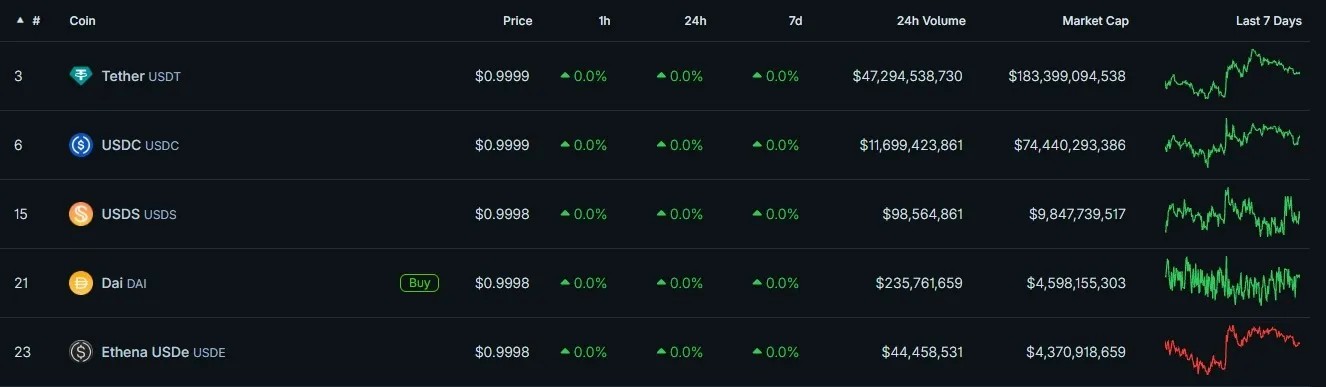
Source: CoinGecko.

Recall that the Bank for International Settlements believes stablecoins do not provide the key properties of money and do not appear to be a reliable means of payment for the entire economy.

end-content

Related Questions

QWhat critical vulnerability did Hacken find in the management of 91 billion USDT on the TRON network?

AHacken found that the contract managing approximately 91.3 billion USDT on the TRON network could be controlled if two signing keys are compromised. This administrative multi-signature contract allows for actions like issuing tokens, freezing addresses, and reassigning contract ownership.

QWhat would an attacker gain control over after compromising the two keys, according to Hacken's Seher Saylyk?

AAfter compromising two keys, an attacker could change the contract owner to a controlled address, removing Tether's access to management. The attacker would also gain the ability to issue new USDT, stop or resume transfers, impose fees, and change other administrative parameters.

QWhat significant limitations did Hacken identify in the USDT smart contracts regarding issuance and reserves?

AHacken identified that the USDT smart contracts lack an automatic reserve check and a hard limit on issuance. If signers approve a transaction, the contract can mint any amount of tokens without on-chain confirmation of a corresponding bank deposit.

QWhy did Bluechip upgrade Tether's corporate rating, and what was the new rating?

ABluechip upgraded Tether's corporate rating from D to C based on a KPMG US audit. This audit concluded that Tether International's reserves exceeded its liabilities by $6.8 billion as of December 31, 2025. The evaluation used the new SMIDGE methodology.

QWhat cybersecurity score did USDT receive in the SMIDGE evaluation conducted with Hacken, and what was a key risk factor mentioned?

AUSDT received a cybersecurity score of 3.3 out of 10 in the SMIDGE evaluation. A key risk factor mentioned was that Tether uses the same set of six keys for its USDT contracts on Ethereum, Avalanche, and Celo, meaning a compromise in one network could potentially affect deployments on others.

Related Reads

Luxor CEO warns of AI ‘dark forest’ following Bitcoin miner hijack

Luxor, a Bitcoin mining services provider, suffered a cyberattack over the weekend in which attackers compromised its Commander mining-management platform and redirected customers' computing power to another mining pool. CEO Nick Hansen said the attack came through a "sophisticated AI-enabled vector" and warned that AI-enabled attacks on businesses, especially in crypto, are becoming more frequent and harder to defend against as models improve and more attackers enter the arena. He said Luxor paused most feature work to harden its cybersecurity and acquired GPUs to run unrestricted open-weight AI models, urging similar services to do the same, calling it "your only defense in this new AI-powered dark forest." Initial reports suggested about 64,000 mining machines representing 13 exahashes per second were redirected to the OCEAN mining pool on Saturday, though Luxor did not confirm those figures, saying just over a dozen customer accounts using Commander were affected. Luxor said it patched Commander within two hours, began restoring affected machines to their original pool settings, and pledged to fully compensate customers and publish a post-mortem. The issue was isolated to Commander, with other services including Luxor Pool and LuxOS unaffected. Initial reports suggested attackers received no mining rewards, but a Bitcoin address identified by CoreX as linked to the incident later received two OCEAN payouts totaling about 0.162 BTC, worth roughly $10,500. Hansen's warning follows other reported AI-assisted intrusions targeting crypto businesses, including India's cybersecurity agency warning that a group called Crafty Falcon used AI-powered tools to attack financial companies and crypto exchanges, Chainalysis disclosing an attacker used "offensive agentic techniques" to access its systems, and Anthropic reporting that multiple groups had developed "automated exploit foundries" with AI to accelerate vulnerability research and exploit design.

cointelegraph19m ago

Luxor CEO warns of AI ‘dark forest’ following Bitcoin miner hijack

cointelegraph19m ago

Systemic Risk Breaks Through Multiple Supports, BTC and HYPE Temporarily Flat and Observing | Guest Analyst

BTC closed the week around $74,900, effectively breaking below its 52-week moving average (~$76,100) with a 13.98% weekly loss, ending the bull-bear transition and returning the market to bearish territory. A systemic risk event drove a high-volume selloff through multiple supports, including the rising trendline (~$72,000), the 0.5 Fibonacci retracement ($72,610), and the proprietary "Trend Ribbon" zone ($72,510–73,120). On the weekly chart, a five-leg corrective structure (0-1 through 4-5) has formed since the October 2025 high of $126,200, with a descending central zone between roughly $82,850 and $60,000. Two paths are outlined: either the decline ends near $57,820–60,000 and the market ranges, or a new low forms—though momentum models suggest limited downside due to large-scale bottom divergence. On the daily chart, the proprietary "Reversal Monitoring System" has issued its fourth signal (yellow background, depth index -18 to -18.8), with the prior three signals showing roughly a 70% success rate. Key BTC support levels are $60,000–62,000, $57,820, and $54,500; resistance sits at $67,300–69,000, $72,500–73,000, and $75,500–76,000. Both mid-term and short-term strategies remain in cash. HYPE fell 8.61% weekly with 27.92% amplitude, touching $60 before closing at $68.11, just above its long-term rising trendline—the last line of defense. A long lower shadow signals buying support but does not confirm stabilization; a retest of $60 is possible. HYPE resistance is $71, $74–75, and $82.5; support is $68, $60, and $50–52. The key focus is whether the long-term trendline holds; the short-term stance is to stay in cash.

marsbit43m ago

Systemic Risk Breaks Through Multiple Supports, BTC and HYPE Temporarily Flat and Observing | Guest Analyst

marsbit43m ago

Systemic Risk Breaks Through Multiple Supports, BTC and HYPE Temporarily in Cash and Observing | Guest Analyst

Bitcoin's weekly close near $74,900 fell just below the 52-week moving average (~$76,100), ending an eight-week run above it. A systemic risk event drove a high-volume bearish candle through multiple supports (ascending trendline ~$72,000, 0.5 Fibonacci retracement at $72,610, and the "Trend Ribbon" zone of $72,510–73,120), followed by three days of sharp decline. The weekly candle dropped 13.98%, invalidating the bull-bear transition and returning the market to a bear phase. HYPE fell 8.61% for the week with 27.92% volatility, touching $60 before closing at $68.11, holding just above its long-term ascending trendline. On the weekly chart, a five-leg corrective structure (0-1 through 4-5) has formed since the October 2025 high of $126,200, with a descending central zone between ~$82,850 and ~$60,000. Two scenarios are outlined: either the decline ends near $57,820–60,000 (failed breakout, range-bound), or a new low forms with significant bottom divergence, limiting downside. The proprietary "Daily Turning Point Monitoring System" has issued its fourth signal (yellow background, depth index -18 to -18.8) near $62,000, after three prior validated turning points with roughly 70% success. Key levels: resistance at $67,300–69,000, $72,500–73,000, and $75,500–76,000; support at $60,000–62,000, $57,820, and $54,500. The recommended strategy is to stay in cash for both medium- and short-term positions until direction is confirmed. For HYPE, the long-term trendline near $68 is the last defense; a weekly close below it would end the rally from the January low of $20.14. Resistance sits at $71, $74–75, and $82.5; support at $68, $60, and $50–52. The stance is also to remain flat and watch whether the trendline holds.

Odaily星球日报53m ago

Systemic Risk Breaks Through Multiple Supports, BTC and HYPE Temporarily in Cash and Observing | Guest Analyst

Odaily星球日报53m ago

Trading

Spot
活动图片