Bitcoin ETFs shed $90M as BTC sits 32% below year-old ATH

cointelegraphPublished on 2026-10-06Last updated on 2026-10-06

Abstract

U.S. spot Bitcoin ETFs experienced net outflows of $89.9 million on Monday, reversing a two-day inflow streak as Bitcoin's price fell below $86,000. This pullback occurred just before the anniversary of Bitcoin's all-time high of $126,080 from October 6, 2025. At the time of reporting, Bitcoin was trading at $85,559, approximately 32% below its record. Since that peak, cumulative net inflows into U.S. spot Bitcoin ETFs have declined by 5.8%, from about $61.3 billion to $57.7 billion. U.S. spot Ether ETFs also saw roughly $51 million in net outflows on Monday, marking their fifth consecutive day of losses with a total outflow of $206 million over that period. Other altcoin ETF flows were mixed: Solana and Zcash funds recorded outflows of $9.3 million and $3.6 million respectively, while XRP ETFs saw no net flows.

US spot Bitcoin exchange-traded funds (ETFs) shed $89.9 million on Monday, reversing two days of inflows as Bitcoin slipped below $86,000.

Bitcoin ETFs attracted around $293 million over the previous two October trading sessions before Monday’s reversal, with total trading volume reaching $2.18 billion, according to SoSoValue data.

The pullback came a day before the first anniversary of Bitcoin’s $126,080 all-time high on Oct. 6, 2025, with BTC trading at $85,559 at the time of publication, or roughly 32% below its record, according to CoinGecko.
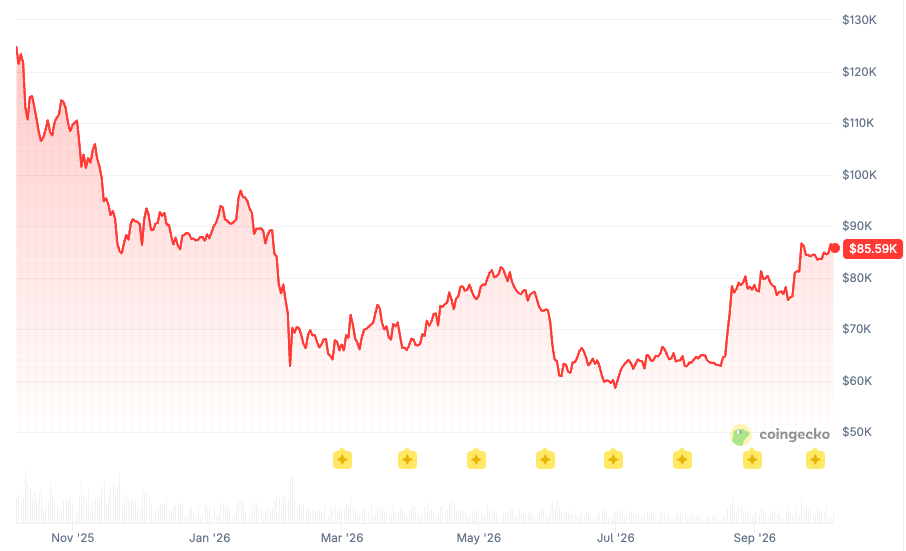
Bitcoin (BTC) price chart over the past year. Source: CoinGecko

Since then, cumulative net inflows into US spot Bitcoin ETFs have fallen 5.8%, from around $61.3 billion to $57.7 billion as of Monday, according to SoSoValue.

US spot Ether (ETH) ETFs also recorded roughly $51 million in net outflows on Monday, extending their losing streak to five consecutive trading days. The funds lost a combined $206 million throughout the streak, with cumulative net inflows standing at $13.8 billion.

Other altcoin ETFs posted mixed results on Monday. Solana (SOL) and Zcash (ZEC) funds recorded net outflows of $9.3 million and $3.6 million, respectively, while XRP ETFs saw no net flows after posting $3.3 million in outflows on Friday.

Related: Bitcoin ETFs notch third inflow week as Ether ETFs shed $138M

Trending Cryptos

Related Questions

QHow much did US spot Bitcoin ETFs shed on Monday, and what was the trend reversal mentioned?

AUS spot Bitcoin ETFs shed $89.9 million on Monday. This reversed a trend of two days of inflows.

QWhat is Bitcoin's price at the time of publication and how does it compare to its all-time high?

AAt the time of publication, Bitcoin was trading at $85,559. This is roughly 32% below its all-time high of $126,080 reached on Oct. 6, 2025.

QWhat has been the change in cumulative net inflows into US spot Bitcoin ETFs since the all-time high?

ASince the all-time high, cumulative net inflows into US spot Bitcoin ETFs have fallen 5.8%, from around $61.3 billion to $57.7 billion as of Monday.

QWhat was the performance of US spot Ether (ETH) ETFs on Monday and what is their current losing streak?

AUS spot Ether (ETH) ETFs recorded roughly $51 million in net outflows on Monday. This extends their losing streak to five consecutive trading days, during which they lost a combined $206 million.

QWhich altcoin ETFs mentioned in the article saw net outflows on Monday, and what were the amounts?

AOn Monday, Solana (SOL) ETFs saw net outflows of $9.3 million, and Zcash (ZEC) ETFs saw net outflows of $3.6 million. XRP ETFs saw no net flows on Monday.

Related Reads

Metals Crash! Gold, Silver, and Copper Fall Together

Global metals markets sold off sharply on Wednesday, November 18, with industrial metals and precious metals falling together. COMEX copper and LME copper dropped nearly 6%, COMEX gold fell over 3%, and silver fell over 5%. LME three-month copper settled down about 5.7% at $12,471/ton, a seven-month low, while zinc, tin, aluminum and nickel also declined. Spot gold fell below $3,730/oz, its lowest since September 2025, and silver touched $44/oz. The selloff was driven by rising Federal Reserve rate-hike expectations and growing doubts over AI infrastructure investment and global industrial demand. Hawkish comments from Fed officials Waller, Barr and Daly, along with the October FOMC minutes, reinforced expectations of further tightening, with markets pricing a 92% chance of a 25bp December hike. A stronger dollar and higher Treasury yields raised the opportunity cost of holding non-yielding gold. Copper's decline was tied to cooling AI sentiment: Nvidia shares fell 2-3%, and investor Stanley Druckenmiller turned bearish on copper. Mercuria's Nicholas Snowdon said copper demand now resembles a recession environment rather than growth. Weak Chinese industrial data added pressure, though record-high Chinese import copper premiums and low inventories remained supportive. Market chatter also linked the selloff to fund repositioning ahead of a potentially record-breaking Anthropic IPO, with investors selling risk assets including crypto, precious metals and copper to raise capital. Trend-following and quant strategies amplified the decline as key technical levels broke. Goldman data showed low activity, with hedge funds 56% short and long-only funds net sellers. Looking ahead, near-term direction depends on Fed policy expectations and Chinese demand. Gold's $3,800 level is key; copper needs Chinese spot demand and AI capex clarity. Longer term, AI data centers, grid expansion and electrification still underpin copper demand, while central bank gold buying supports bullion.

marsbit5m ago

Metals Crash! Gold, Silver, and Copper Fall Together

marsbit5m ago

Price Hasn't Moved Yet, But Market Makers Are Already Frantically Pulling Orders: How a New Metric Can Warn of Imminent Violent Market Swings

In traditional crypto derivatives and spot analysis, traders often rely on static order book depth and bid-ask spreads to gauge liquidity. However, high-frequency quote cancellations and re-quoting by market makers mean static snapshots frequently mask genuine liquidity crises and sharp price swings. To address this blind spot, Glassnode has introduced a new high-frequency metric called "Book Churn," which quantifies how often order book price levels are updated and rewritten within a given time window. Two order books with identical static depth and spreads can differ several-fold—or even tenfold—in rewrite frequency, and snapshots cannot distinguish between them. The metric captures microsecond-level market maker behavior: when market makers feel confident, quotes tend to rest quietly; when they sense risk, they cancel and re-quote at extraordinary speed. Raw counts are massive—a typical 10-minute BTC perpetual window contains roughly 607,000 level changes, surging into the millions during extreme volatility. To ensure comparability across market cycles, raw counts are log-transformed and standardized into a Z-Score using each asset's trailing 60-day mean and standard deviation. A Z-Score above 2 means the current rewrite frequency exceeds over 95% of recent history; above 3 signals extreme liquidity restructuring. Backtesting since 2020 on BTCUSDT and ETHUSDT perpetuals shows a pronounced right-tail distribution rather than a symmetric normal one. High-churn episodes typically consist of 2–5 consecutive elevated slices, with BTC and ETH peaks highly synchronized during macro shocks, reflecting coordinated risk contraction across market makers' cross-asset arbitrage systems. Most importantly, when Book Churn scores reach 2 or above, the predictive win rate for realized volatility exceeding the historical baseline in the next hour holds steady at 65%–72%—significantly beating the 50% random baseline at a 95% confidence interval. This confirms that market makers' high-frequency rewriting behavior is not merely a backward-looking record but a valuable forward-looking warning signal within market microstructure.

marsbit40m ago

Price Hasn't Moved Yet, But Market Makers Are Already Frantically Pulling Orders: How a New Metric Can Warn of Imminent Violent Market Swings

marsbit40m ago

Trading

Spot

Hot Articles

What is $BITCOIN

DIGITAL GOLD ($BITCOIN): A Comprehensive Analysis Introduction to DIGITAL GOLD ($BITCOIN) DIGITAL GOLD ($BITCOIN) is a blockchain-based project operating on the Solana network, which aims to combine the characteristics of traditional precious metals with the innovation of decentralized technologies. While it shares a name with Bitcoin, often referred to as “digital gold” due to its perception as a store of value, DIGITAL GOLD is a separate token designed to create a unique ecosystem within the Web3 landscape. Its goal is to position itself as a viable alternative digital asset, although specifics regarding its applications and functionalities are still developing. What is DIGITAL GOLD ($BITCOIN)? DIGITAL GOLD ($BITCOIN) is a cryptocurrency token explicitly designed for use on the Solana blockchain. In contrast to Bitcoin, which provides a widely recognized value storage role, this token appears to focus on broader applications and characteristics. Notable aspects include: Blockchain Infrastructure: The token is built on the Solana blockchain, known for its capacity to handle high-speed and low-cost transactions. Supply Dynamics: DIGITAL GOLD has a maximum supply capped at 100 quadrillion tokens (100P $BITCOIN), although details regarding its circulating supply are currently undisclosed. Utility: While precise functionalities are not explicitly outlined, there are indications that the token could be utilized for various applications, potentially involving decentralized applications (dApps) or asset tokenization strategies. Who is the Creator of DIGITAL GOLD ($BITCOIN)? At present, the identity of the creators and development team behind DIGITAL GOLD ($BITCOIN) remains unknown. This situation is typical among many innovative projects within the blockchain space, particularly those aligning with decentralized finance and meme coin phenomena. While such anonymity may foster a community-driven culture, it intensifies concerns about governance and accountability. Who are the Investors of DIGITAL GOLD ($BITCOIN)? The available information indicates that DIGITAL GOLD ($BITCOIN) does not have any known institutional backers or prominent venture capital investments. The project seems to operate on a peer-to-peer model focused on community support and adoption rather than traditional funding routes. Its activity and liquidity are primarily situated on decentralized exchanges (DEXs), such as PumpSwap, rather than established centralized trading platforms, further highlighting its grassroots approach. How DIGITAL GOLD ($BITCOIN) Works The operational mechanics of DIGITAL GOLD ($BITCOIN) can be elaborated on based on its blockchain design and network attributes: Consensus Mechanism: By leveraging Solana’s unique proof-of-history (PoH) combined with a proof-of-stake (PoS) model, the project ensures efficient transaction validation contributing to the network's high performance. Tokenomics: While specific deflationary mechanisms have not been extensively detailed, the vast maximum token supply implies that it may cater to microtransactions or niche use cases that are still to be defined. Interoperability: There exists the potential for integration with Solana’s broader ecosystem, including various decentralized finance (DeFi) platforms. However, the details regarding specific integrations remain unspecified. Timeline of Key Events Here is a timeline that highlights significant milestones concerning DIGITAL GOLD ($BITCOIN): 2023: The initial deployment of the token occurs on the Solana blockchain, marked by its contract address. 2024: DIGITAL GOLD gains visibility as it becomes available for trading on decentralized exchanges like PumpSwap, allowing users to trade it against SOL. 2025: The project witnesses sporadic trading activity and potential interest in community-led engagements, although no noteworthy partnerships or technical advancements have been documented as of yet. Critical Analysis Strengths Scalability: The underlying Solana infrastructure supports high transaction volumes, which could enhance the utility of $BITCOIN in various transaction scenarios. Accessibility: The potential low trading price per token could attract retail investors, facilitating wider participation due to fractional ownership opportunities. Risks Lack of Transparency: The absence of publicly known backers, developers, or an audit process may yield skepticism regarding the project's sustainability and trustworthiness. Market Volatility: The trading activity is heavily reliant on speculative behavior, which can result in significant price volatility and uncertainty for investors. Conclusion DIGITAL GOLD ($BITCOIN) emerges as an intriguing yet ambiguous project within the rapidly evolving Solana ecosystem. While it attempts to leverage the “digital gold” narrative, its departure from Bitcoin's established role as a store of value underscores the need for a clearer differentiation of its intended utility and governance structure. Future acceptance and adoption will likely depend on addressing the current opacity and defining its operational and economic strategies more explicitly. Note: This report encompasses synthesised information available as of October 2023, and developments may have transpired beyond the research period.

5.6k Total ViewsPublished 2025.05.14Updated 2025.05.14

What is $BITCOIN

Discussions

Welcome to the HTX Community. Here, you can stay informed about the latest platform developments and gain access to professional market insights. Users' opinions on the price of BTC (BTC) are presented below.

活动图片