Story Protocol:重塑 IP 管理的区块链新星

深潮Pubblicato 2024-09-09Pubblicato ultima volta 2024-09-09

Story Protocol 通过区块链革新 IP 管理,让创作者轻松保护和授权作品。

撰文:dt

编辑:Lisa

近来的行情除了币圈大盘市场走势持续低迷之外,链上迷因也同样熄火,相较于去年同一时期可为冷清许多,唯有少数几个未发币的项目得到玩家的注目,其中近来宣布由著名风投 a16z 领投 80M 巨额融资的 Story Protocol 是最受市场重视的。

本周的 CryptoSnap Dr.DODO 就带大家来了解下 Story Protocol 是什么!

Source: https://x.com/StoryProtocol/status/1815429614208250134/photo/1

融资与背景

要介绍 Story Protocol 便不得不提其强大的背景,近日 Story Protocol 的开发商 Programmable IP (PIP) Labs 宣布完成 8000 万美元 B 轮融资。这轮融资由著名风险投资公司 a16z Crypto 领投,Polychain Capital 等参投,值得注意的是天使投资人阵容同样强大,包括 Stability AI 高级副总裁兼董事会成员 Scott Trowbridge、K11 创始人兼亿万富翁 Adrian Cheng 以及数字艺术收藏家 Cozomo de' Medici 等。这轮融资紧随去年 5400 万美元的 A 轮之后,使 PIP Labs 的总融资额达到惊人的 1.4 亿美元,公司估值已达 22.5 亿美元。

而 Story Protocol 项目方的背景同样大有来头,PIP Lab 执行长兼创始人 SY (Seung Yoon) Lee 拥有丰富的创业经验和行业洞察,他曾创立移动讲故事平台 Radish 并被韩国通讯软件巨头 Kakao 以 4.4 亿美元收购,接着担任 Kakao 的全球战略官,负责其全球投资和并购活动,还同时是韩国最大区块链基金 Hashed 的风险合伙人。

核心技术:重新定义 IP 管理的区块链解决方案

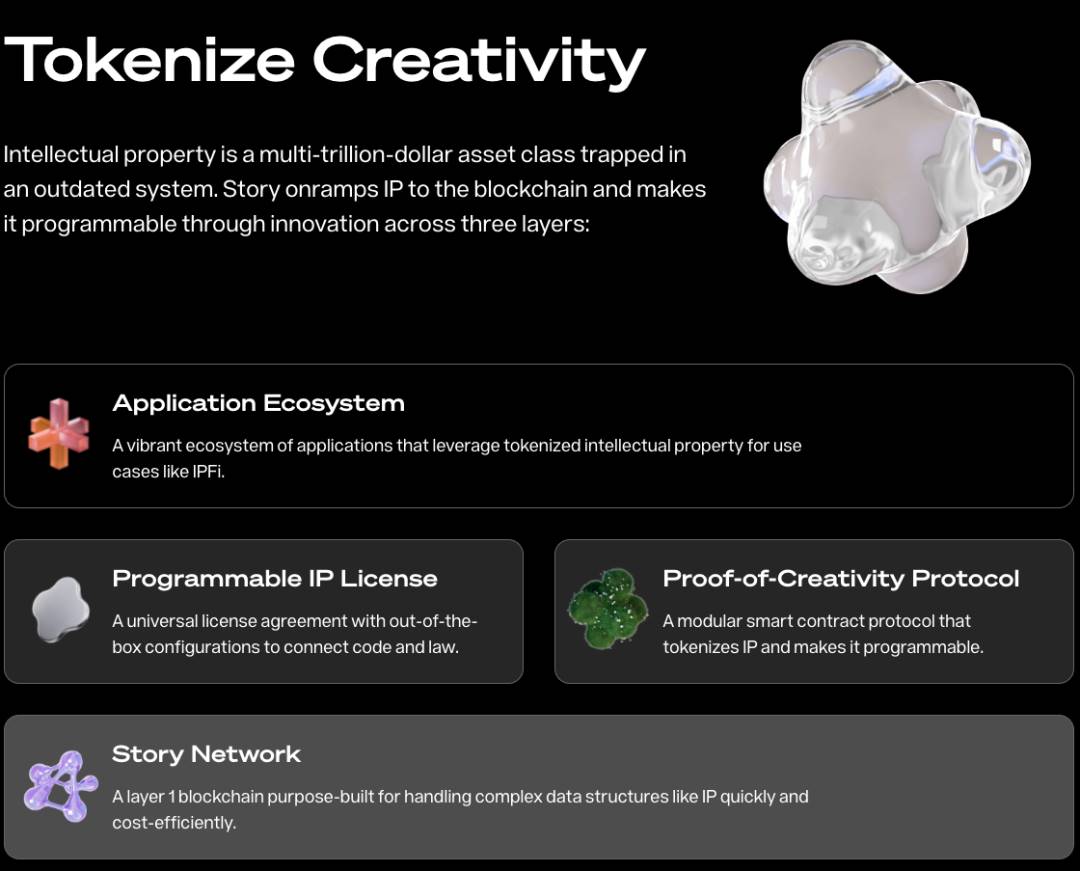
Story Protocol 的核心目标是通过区块链技术彻底改变 IP 管理方式,使创意 IP 的法律体系更加高效、透明和易于操作。它的核心由三个关键组件构成:

  1. Story Network ( 专门为 IP 管理构建的第 1 层区块链 )

  2. 创意证明协议 ( 允许创作者将 IP 注册为「IP 资产」的智能合约系统 )

  3. 可编程 IP 许可证 (PIL,连接链上 IP 与现实世界法律合同的桥梁 )

Story Protocol 选择建立自己的区块链而不是在现有区块链上运行,主要基于以下考虑:首先 IP 管理涉及复杂的关系网络,需要高效的图数据处理能力,现有区块链在处理大规模、复杂的 IP 关系时存在性能瓶颈。通过建立自己的 L1,Story Protocol 可以在底层进行优化,提高 IP 图的遍历和存储效率。

其次,Story Protocol 的目标是成为全球 IP 的结算层,实现跨链的 IP 可组合性,拥有专门的 L1 可以为所有注册的 IP 提供一个统一的中心。

Source: https://learn.story.foundation/

生态系统运作:创新的 IP 管理与保护机制

在 Story Protocol 的生态系统中,创作者可以将其 IP 注册为 IP 资产,并设定使用条款。其他创作者可以直接在链上查看这些条款,如果同意,可以立即获得授权并开始创作。当衍生作品产生收入时,智能合约会自动按照预设条款分配版税,整个过程透明、高效,无需中间人介入。

举个具体例子来理解 Story Protocol 的运作方式。想象一位名叫 Alice 的动画师创作了一个可爱的卡通角色。在传统模式下,如果另一位艺术家 Bob 想要使用这个角色创作一部短片,他需要联系 Alice,可能还需要聘请律师起草复杂的授权协议。这个过程可能耗时数周甚至数月。而在 Story Protocol 的生态系统中,Alice 可以将她的卡通角色注册为 IP 资产,并设定使用条款,比如允许非商业用途的免费使用,或者商业用途需要支付 5% 的版税。Bob 可以直接在链上查看这些条款,如果同意他可以立即获得授权并开始创作。当 Bob 的短片开始产生收入时,智能合约会自动将 5% 的版税分配给 Alice,整个过程相较于传统形式效率高出许多。

Story Protocol 还设计了链上争议机制来应对 IP 侵权问题。如果有人未经授权使用他人的 IP,社区成员可以在链上提出争议。如果争议成立,该内容将被标记,无法进行后续的授权或收益。此外,通过 PIL 与现实世界法律体系的对接,创作者始终保留寻求法律追溯的权利。
Source: https://learn.story.foundation/

愿景与展望:构建全球 IP 生态系统的未来

Story Protocol 的愿景是创建一个全球性的 IP 仓库和交易系统,让创作者能够自下而上地构建叙事宇宙。它还计划允许大型内容平台如 Netflix、TikTok 运行验证器节点,直接在链上传输 IP 数据,创造一个更加公平和透明的内容生态系统。

Story Protocol 现状

目前 Story Protocol 主网尚未上线,但测试网已经可以先行体验了。有兴趣的小伙伴可以于小狐狸钱包添加测试网,去领取水龙头代币($IP),并自行注册自己的 IP 资产,接着可以于交易市场 Colormp 交易资产,或是在 PiperX 上为资产添加流动性, Layer3 等任务平台上也有关于 Story Protocol 的任务可以参加体验。

笔者观点

Story Protocol 算是近期来笔者看过最有意思的项目之一,与现阶段各种强调高性能、高吞吐的网络不同,Story Protocol 的 L1 公链有非常明确的功能性以及具体地提出现在 IP 授权的低效率形式如何透过区块链来解决痛点。从上一周期的 NFT 到这一周期的 Memecoin 热潮,就能看出 IP 是一个多么有价值的产品。

随着数字创意产业的不断发展,IP 管理的重要性日益凸显。Story Protocol 的创新方案可能成为连接创意、技术和法律的重要桥梁,为全球创意产业的发展注入新的活力,虽然道路还很长,但 Story Protocol 的创新理念无疑为知识产权管理的未来指明了一个充满希望的方向。


Letture associate

a16z: 7 Charts to Understand How Tokenization Is Changing the Nature of Assets

a16z: 7 Charts on How Tokenization is Transforming the Nature of Assets Tokenized Assets, often referred to as "real-world assets" (RWA), are altering the form, flow, and structure of the financial system. The market recently surpassed $30 billion (excluding stablecoins), driven largely by tokenized U.S. Treasuries. These offer investors digital, yield-bearing assets with efficient settlement. Growth varies significantly by asset class. Asset-backed credit leads in speed, followed by niche financial assets, while venture capital and active strategies took longer to scale. U.S. Treasuries and commodities dominate, holding about two-thirds of the current market share. Within commodities, gold tokenization dominates entirely due to its standardization and historical appeal in crypto. The ecosystem is spread across multiple blockchains. Ethereum holds over half the market, with others like BNB Chain, Solana, and Stellar holding significant shares. However, a key insight is that most tokenized assets currently lack "composability." While the total market is large, only a small fraction (e.g., 5% of tokenized bonds) is used within DeFi protocols. Many tokens are simply digital records of off-chain assets, not natively programmable financial building blocks. In contrast, smaller categories like reinsurance tokens see very high on-chain usage. Looking ahead, forecasts for the tokenized asset market by 2030 range from $2 trillion to over $30 trillion, representing immense potential growth from today's ~$340 billion base. Yet, relative to global markets (e.g., $140T+ in bonds), tokenization's penetration remains minuscule (<0.02%). The current phase focuses on digitizing straightforward assets for efficiency. The next major challenge is bringing more complex financial instruments on-chain and integrating tokenized assets into truly composable, internet-native financial infrastructure.

marsbit28 min fa

a16z: 7 Charts to Understand How Tokenization Is Changing the Nature of Assets

marsbit28 min fa

Under the squeeze between giants Tether and Circle, how can foreign exchange stablecoins break through?

In the face of dominance by Tether (USDT) and Circle (USDC), new entrants in the stablecoin space face significant challenges competing directly, especially in the foreign exchange (FX) market. A more viable and efficient path forward is the adoption of synthetic foreign exchange (Forex) built atop existing USD stablecoin rails. The rise of stablecoin neo-banks represents the next major growth area for mass crypto adoption, with FX becoming a core component. However, replicating the vast liquidity, distribution channels, and network effects of USDT/USDC is extremely difficult for new FX stablecoin issuers. The total market cap of all FX stablecoins is a fraction (roughly 1/700th) of USD stablecoins, leading to issues like poor liquidity, peg instability, limited acceptance, and complex compliance hurdles. Instead of issuing spot FX stablecoins, the article advocates for a model inspired by traditional finance's non-deliverable forwards (NDFs). Users would continue to hold underlying USDT/USDC, while their account balances are displayed and economically settled in their preferred local currency through MtM (Mark-to-Market) NDF structures. This approach leverages the deep liquidity and infrastructure of USD stablecoins while providing synthetic forex exposure. Key advantages include strong peg stability via oracles, retained access to USD stablecoin yields and liquidity, high capital efficiency, and easy scalability to new currencies. Primary use cases for this on-chain NDF forex include: 1. Neo-banks, custodians, and wallets offering multi-currency accounts to attract international users and increase deposits. 2. Forex carry trade strategies, potentially offering more stable and scalable yields compared to crypto-native products like Ethena. 3. Global corporate payments, allowing businesses to receive payments in local currencies while hedging forex risk on-chain, similar to services offered by Stripe in traditional finance. This synthetic forex model presents a pragmatic solution to overcome the network effects of incumbents and unlock the next wave of stablecoin utility for global consumers and businesses.

marsbit4 h fa

Under the squeeze between giants Tether and Circle, how can foreign exchange stablecoins break through?

marsbit4 h fa

Trading

Spot
Futures
活动图片