16 Days, He Turned 'The Little Prince' into a 3D Game Using Opus 5.5, Now You Can Explore the Planets from the Book

marsbitPublished on 2026-10-16Last updated on 2026-10-16

Abstract

In just 16 days, developer Sac created a playable 3D narrative game titled "The Little Prince: Across the Stars" based on the classic book. Using a combination of AI tools—primarily Opus 5.5, 3D model generator Tripo, and software Blender—he transformed the story's planets into explorable 3D environments. The game allows players to step into and navigate scenes from the tale, such as the desert, cloudscapes, and the little prince's home. The project demonstrates how solo creators can leverage modern AI and 3D tools to rapidly prototype interactive experiences. Sac's process involved generating assets, integrating movement and camera controls, and scripting interactive story sequences. The current demo, accessible via a dedicated website with multi-language support, has already garnered player feedback, including bug reports which help refine the experience. Sac plans to open-source the full project and share a detailed development breakdown. This case highlights the potential for individual developers to bring imaginative worlds to life by breaking down complex game development into manageable steps with the aid of generative AI tools.

He spent 16 days turning 'The Little Prince' into a playable 3D narrative game.

On October 13th, developer Sac announced his creation on X.
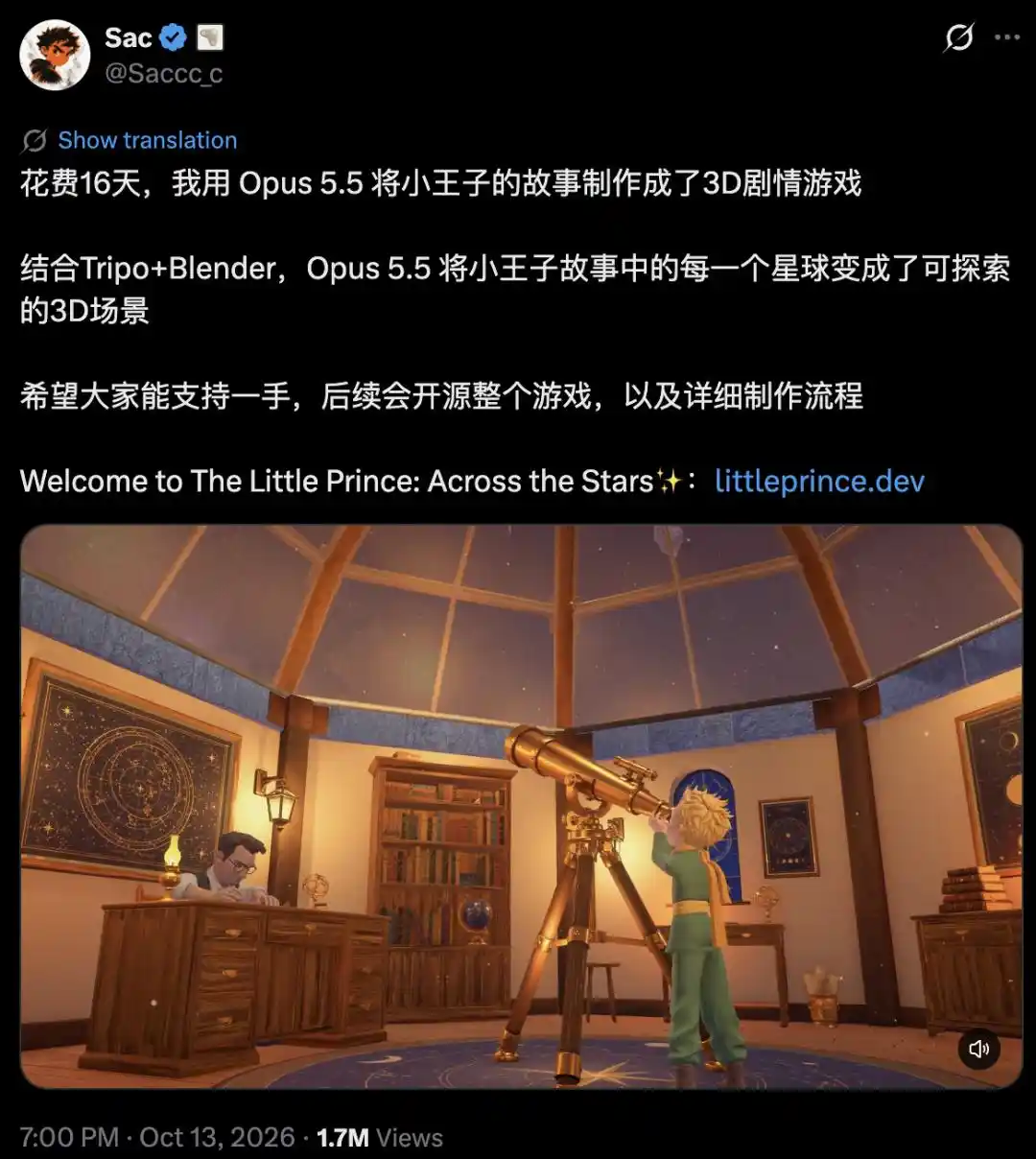
According to Sac, he used Opus 5.5, combined with the 3D model generation tool Tripo and 3D production software Blender, to transform every planet from the story into explorable 3D scenes.

The game is named 'The Little Prince: Across the Stars' and already has an independent website portal.
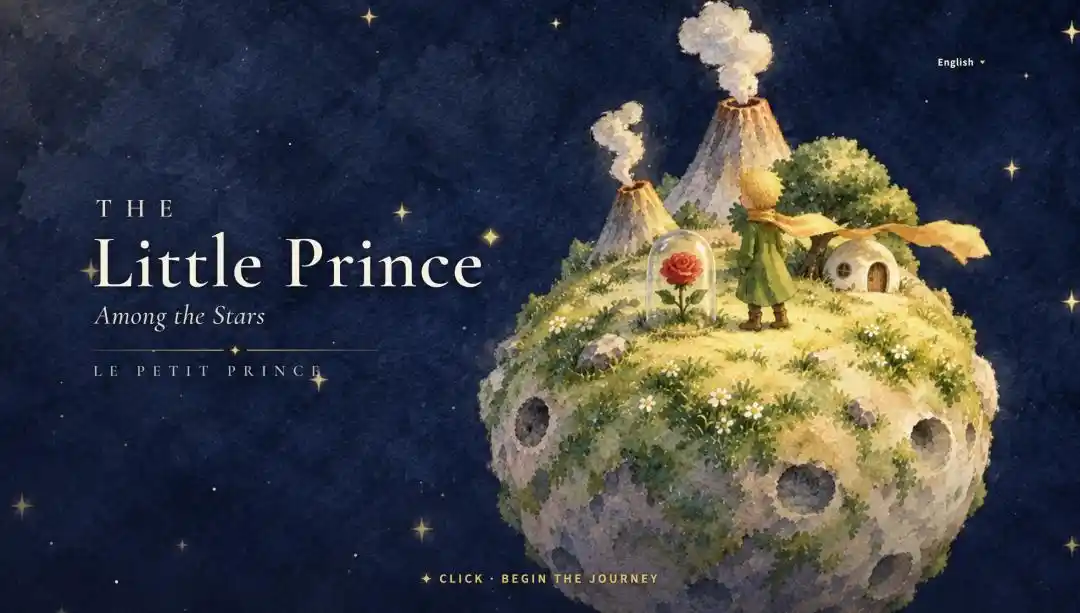
For fans of the book, just the ability to personally walk into those places once imagined in their minds is enough to be exciting.

The Little Prince's Planet, Now Open for Exploration

First, let's look at the demo shared by the creator.

The blond Little Prince stands among grass and rocks, with a sea of clouds spreading out in the distance.
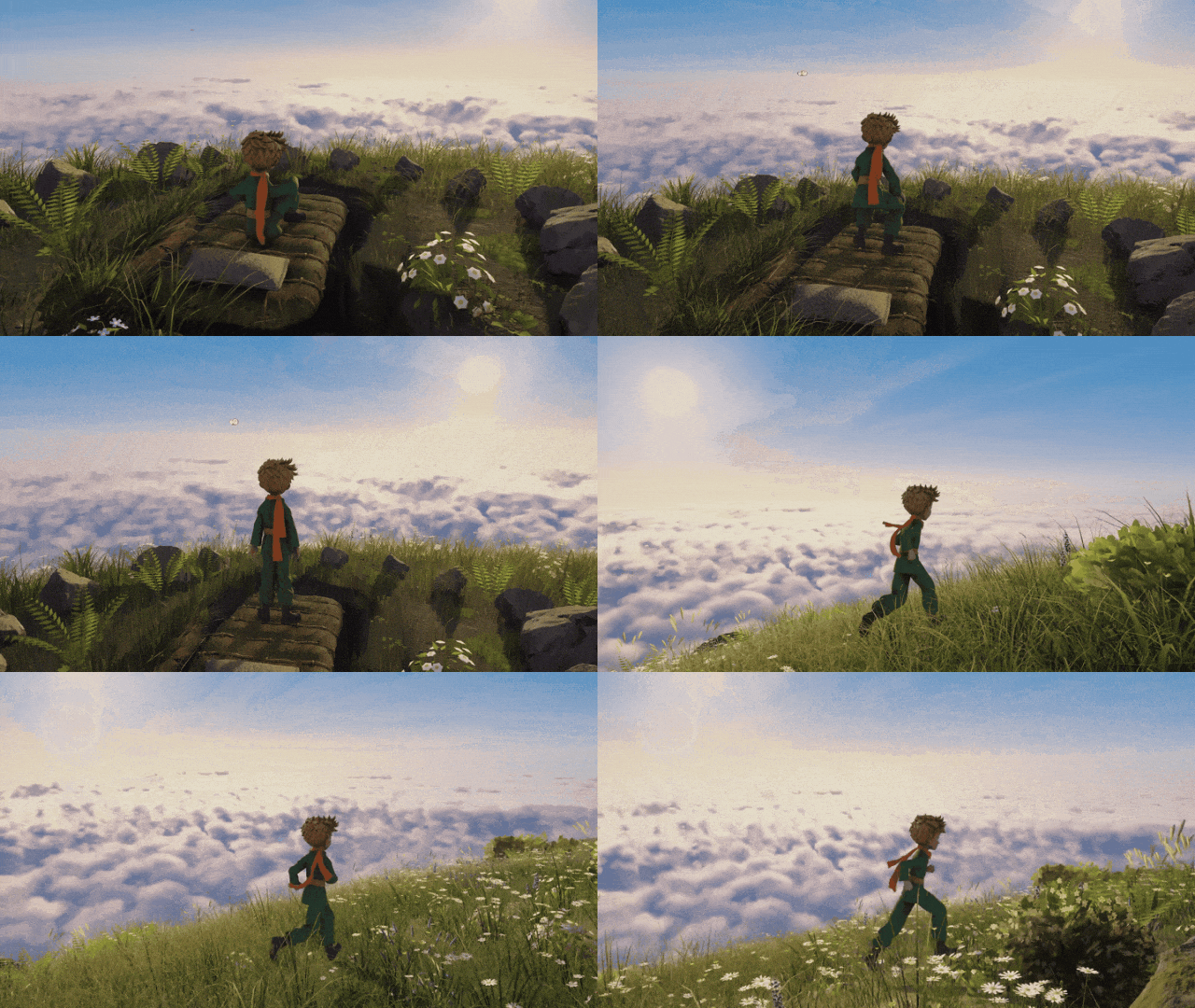
The camera moves indoors, revealing a wooden ceiling, a map hanging on the wall, and bookshelves lining the sides.
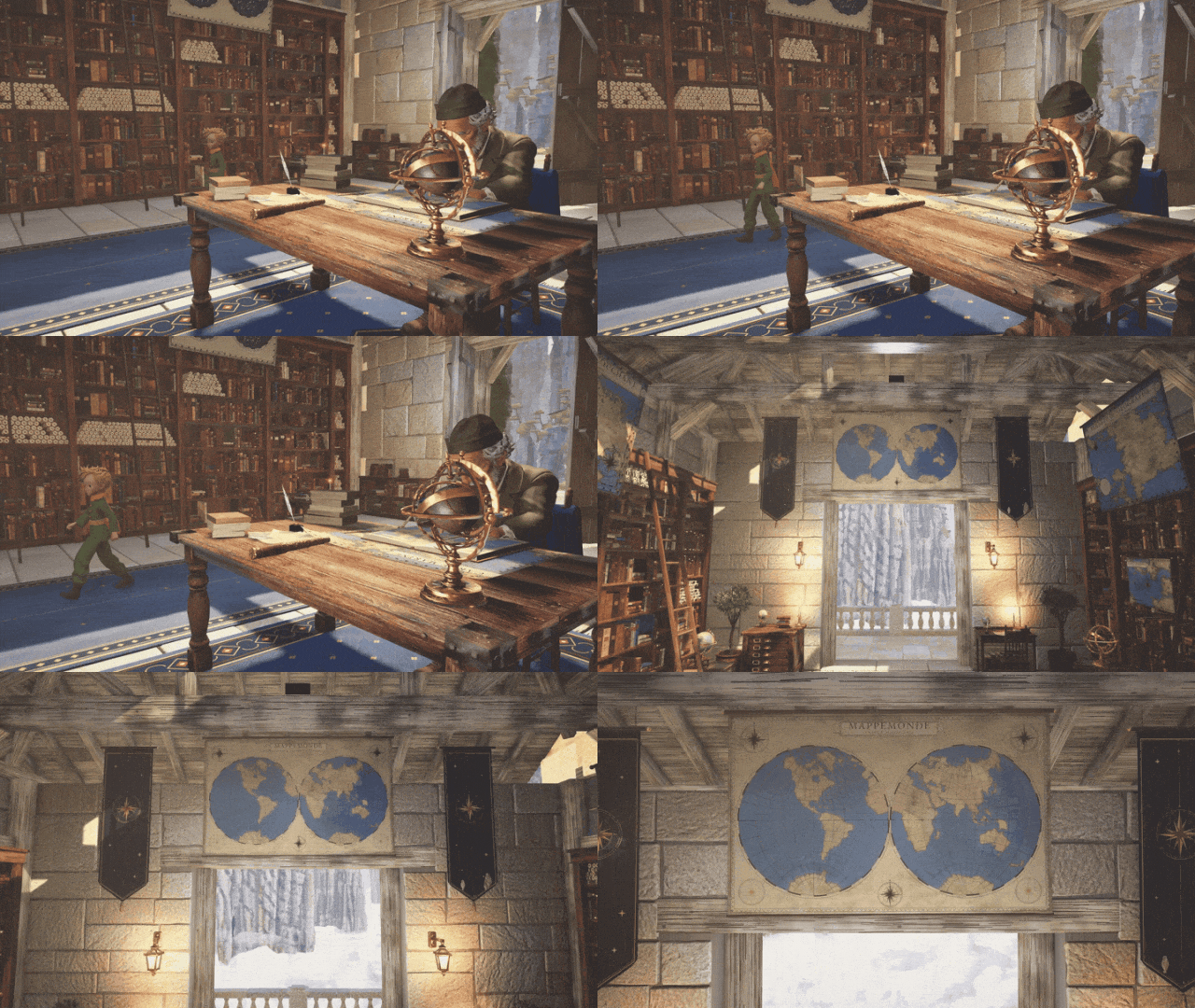
In another sequence, the Little Prince runs on sandy ground, his shadow moving with his footsteps.

From the sea of clouds to the room, and then to the desert, the characters and environments from the book now have concrete form, lighting, and space.

For those who have read 'The Little Prince,' this adaptation easily sparks curiosity:

What does that fairy-tale world remembered from the pages look like when transformed into a game?

When reading, we follow the text to paint that world in our minds.

In the game, we can become the Little Prince and explore within the 3D scenes: where to go, where to stop, which corner to examine first—all are up to us.

A familiar story thus gains a new, personally engaging way to be experienced.

However, after building these scenes, there's an even more interesting challenge:

How to turn the book's memorable plots into interactive experiences that move players?

A single action, an encounter, or even lingering a bit longer in a certain place could all influence how the game tells its story.

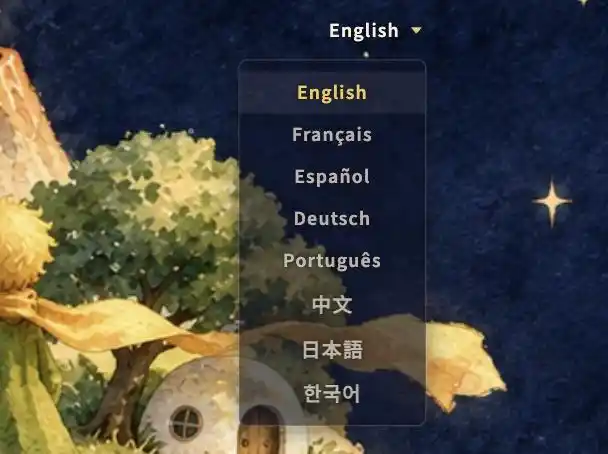
The official website currently lists 8 language options, including Chinese, English, and Japanese, providing an entry point for readers of different languages to approach and explore this world.
One Person Making a Game, Supported by Multiple Tools

The most intriguing question is: How did he make this 3D game in 16 days?

Turning a story into a 3D game requires far more than just getting characters and scenes on screen:

Characters need to move, and the camera needs to follow;

Characters must trigger storylines when reaching specific locations;

The game must provide appropriate feedback when a player completes an action...

The tool combination Sac explicitly named is Opus 5.5, Tripo, and Blender.

Among them, Tripo can generate 3D models from text or images, helping creators transform ideas for characters, objects, etc., into 3D assets.

Blender is a suite of 3D production software used for modeling, texturing, animation, and rendering. Generated models can be imported for further adjustment and production.

By combining Opus 5.5 with these tools, Sac ultimately created this publicly accessible game project.

Furthermore, game production has another easily overlooked difficulty: after separately creating characters, scenes, actions, and storylines, they must all work together seamlessly for the game to run smoothly.

A character might look beautiful alone, but appear out of scale or stylistically mismatched when placed in a scene. An animation might look natural in isolation, but feel awkward to players when combined with a follow camera.

These problems only become apparent after running the build, requiring repeated discovery and adjustment.

A complete game also takes shape step by step through solving these specific problems.

The biggest inspiration this case offers individual creators is:

With the help of large models and 3D tools, one person can also gradually turn an idea into an experienceable work.

First, set up a scene, get characters moving inside, then connect more scenes and plotlines.

By breaking down the massive production task into small goals, testing, and adjusting along the way, the work can gradually take shape.

Players Have Already Started Watering Flowers, and Have Started Reporting Bugs

Soon after the release, Sac received feedback from players.

X user @0xLuo expressed amazement after trying it, finding it hard to imagine such a polished 3D game was made in just 16 days.

However, he also discovered a minor bug: after completing the flower-watering task, the forward/backward directions for the W and S keys and the left/right directions for the A and D keys were reversed, though he wasn't sure of the exact trigger conditions.

Once players get their hands on it, issues not found during development can surface. Different exploration paths, key operations, and task sequences can all expose new bugs.

More importantly, while the visuals might attract clicks, whether the gameplay and story can retain players is up to them to decide.

The website also notes that the current version requires a browser supporting WebGPU graphics technology. If you want to try it, you need to ensure your browsing environment meets the requirements.

After the game's public release, adapting it to different devices and browsers to allow more people to play smoothly is also work the creator needs to continue.

After Open-Sourcing, the 16-Day Process Becomes Even More Worth Seeing

Sac mentioned in the original post that he plans to open-source the entire game later and publish detailed production documentation.

For others who also want to try making 3D games, these materials might provide actionable steps to reference:

How to build planets, adjust character models, connect character actions to the plot, and troubleshoot bugs.

If he can also explain which steps required repeated trial and error, which details needed his own judgment, and publicly share tool costs and time spent on each stage, newcomers could more clearly estimate the time, effort, and funds they themselves need to invest.

The exciting aspect of this project is that one person, with the help of AI and 3D tools, turned a familiar fairy tale into a game that others can enter and personally experience.

If the open-source plans proceed smoothly, the experience accumulated over these 16 days could potentially help even more creators take their first step.

Some might want to create a planet, others to recreate a small town, and some to turn a story they've been writing for a long time into a world they can walk into.

If it were you, what kind of game would you most want to make using AI?

References:

https://x.com/Saccc_c/status/2109962425512734739

https://littleprince.dev/

This article is from the WeChat public account "新智元" (ID: AI_era), author: ASI启示录

Related Questions

QWhat is the main achievement of the developer named Sac?

ASac created a 3D narrative game based on 'The Little Prince' in just 16 days.

QWhat is the name of the game developed by Sac?

AThe game is named 'The Little Prince: Across the Stars'.

QWhat were the primary tools Sac used to develop the game?

ASac primarily used Opus 5.5, the 3D model generation tool Tripo, and the 3D software Blender.

QWhat are some challenges mentioned in turning a story into an interactive 3D game?

AChallenges include ensuring character movement, camera following, triggering plot at specific locations, providing player feedback, and coordinating different assets like characters, scenes, and actions to work smoothly together.

QWhat did Sac announce regarding the future of this project?

ASac announced plans to open-source the entire game and share a detailed production process.

Related Reads

GPT-6.1 Sol Participates in Live Brain Surgery! Three Rounds of Localization, Each More Accurate Than the Last

Exin Therapeutics CEO Gabriel Ocana-Santero reported an experiment in which GPT-6.1 Sol participated in three rounds of real mouse brain surgery positioning. The task involved locating Bregma and Lambda, two key skull landmarks used to calibrate stereotaxic coordinates for accurate targeting of brain regions. After each round, a professional surgeon corrected the model's positioning results, and the model retained its images, measurements, and expert corrections for reference in subsequent rounds. By the third round, GPT-6.1 Sol reduced landmark search time from 169 to 86 seconds, required corrections from four to two, and cut positioning error from 0.6 mm to 0.3 mm. Ocana-Santero described this as in-context learning from real-world experience. The team did not disclose how the experience records are integrated into the model or whether underlying weights are updated, so it cannot be described as autonomous training or parameter-level self-evolution. The sample is only three operations, far from proving stable surgical capability, but it demonstrates AI accumulating experience from real observations and expert feedback. This follows earlier Exin work in which AI selected gene therapy vectors, chose injection targets and coordinates, and controlled a stereotaxic device in a mouse experiment, with a licensed veterinarian supervising and safety limits in place. In a further experiment, Claude Sonnet 5, GPT-6.1 Sol, and Grok 4.7 chose different brain regions and treatment strategies for the same scientific goal, suggesting models may reason toward different experimental paths.

marsbit2h ago

GPT-6.1 Sol Participates in Live Brain Surgery! Three Rounds of Localization, Each More Accurate Than the Last

marsbit2h ago

From Drones to Nuclear Reactors: What Has Paradigm Invested in Since Leaving the Crypto World?

Paradigm, a venture capital firm known for crypto investments like Coinbase and Uniswap, is rapidly expanding into hard tech. In November, it co-led a $1.5 billion funding round for Zipline, a US drone delivery company now valued at $21.5 billion—nearly triple its valuation from January. Zipline, founded in 2014, began delivering medical supplies in Rwanda and now operates a large-scale automated logistics network, having completed 150 million miles of commercial autonomous flights. Walmart plans to add 300 new delivery sites, and Uber aims to scale their partnership to one million daily orders by 2029. Paradigm's broader portfolio now spans AI, robotics, manufacturing, semiconductors, space defense, and nuclear energy. Investments include open-source AI lab Nous Research, math-reasoning AI firm Harmonic, AI data company Idler, and GPU platform Andromeda. It also backs SendCutSend (metal parts manufacturing), Fab2 (compact semiconductor factories), True Anomaly (space defense), and Antares (micro nuclear reactors). In July, Paradigm launched a $12 billion new fund for frontier tech. This shift reflects a broader VC trend toward AI and physical technology, as crypto's path to sustained commercial revenue remains uncertain. Paradigm's bets focus on companies solving concrete industrial problems with existing markets, aiming to build a hard-tech network that transcends crypto cycles.

marsbit2h ago

From Drones to Nuclear Reactors: What Has Paradigm Invested in Since Leaving the Crypto World?

marsbit2h ago

Nomura: "Blue Wave" Hits US Data Centers, China's AI Benefits Instead

Nomura argues that the Democratic "blue wave" in the US midterms could paradoxically benefit China's AI economy. Democratic victories in key data-center states will likely tighten regulation, shift grid upgrade costs onto developers, and lengthen approval timelines, slowing US data-center expansion. Market reaction was sharp: the Nasdaq fell 5.5% in a single day, the SOX dropped nearly 15% over two days, Nvidia fell about 12%, and Micron about 24%. Because US cloud giants had been hoarding global GPU, HBM, and advanced logic chip capacity—driving black-market premiums of 200–300% at Asian logistics hubs—a US capex slowdown could collapse those speculative premiums, letting Chinese AI firms, cloud providers, and research institutions obtain GPUs, HBM modules, and advanced packaging materials more cheaply through intermediary trade hubs. China is also building a state-led national AI data-center network, with roughly RMB 2 trillion planned under the 15th Five-Year Plan to integrate regional computing by 2028, supported by low-cost renewable power in western hubs under the "East Data, West Computing" program. Morgan Stanley, meanwhile, does not see the blue wave as a real easing of US-China tensions; it expects strategic competition to persist but sees greater policy predictability. It prefers China's "self-sufficiency" AI trade—supported by both supply and demand under national policy priorities—over export chains tied to global AI capex. It also notes more balanced opportunities in Chinese equities, with valuations near historic lows.

marsbit2h ago

Nomura: "Blue Wave" Hits US Data Centers, China's AI Benefits Instead

marsbit2h ago

After GPT-6, Embodied Large Models Are Trapped in Their Own Territory! Next Year's Self-Research Budget Is Probably Up in the Air

The article discusses how the release of GPT-6 Astra (and the imminent GPT-6.2 Astra) has disrupted the embodied AI/robotics industry. General-purpose large models are now encroaching on capabilities that embodied AI companies previously developed in-house—such as in-context learning, out-of-distribution generalization, error correction, and open-vocabulary manipulation—often without task-specific post-training. On benchmarks like RoboDojo, teams combining general models with robot-use-agent techniques saw scores jump from 20–30 to 50–60, prompting many to question whether self-developing embodied foundation models still makes sense. Some companies have begun cutting algorithm roles. However, the article notes GPT-6 Astra still struggles with complex physical contact, force control, object deformation, and high-precision manipulation, and its cloud API inference latency is high (though this is not seen as a fundamental barrier). Experts argue that general models' current weaknesses shouldn't be treated as durable moats for embodied companies, since OpenAI is already hiring robotics talent and future models may absorb more robot operation data. The core argument is economic: embodied companies' opportunity lies not in building smarter models but in delivering better economic value. Stable, standardized industrial tasks may be better served by lightweight, specialized models or rule-based strategies, while open-ended tasks (e.g., home service robots) may benefit from general models. Ultimately, companies need to re-prioritize their R&D directions—leveraging general models for language understanding and task planning while focusing in-house efforts on physical interaction, embodiment-specific control, real-world adaptation, and deployment efficiency. The article concludes that the industry is moving past the demo-and-burn-investment stage, and the elimination round among the "hundred robot wars" has begun.

marsbit2h ago

After GPT-6, Embodied Large Models Are Trapped in Their Own Territory! Next Year's Self-Research Budget Is Probably Up in the Air

marsbit2h ago

Trading

Spot
活动图片