
SUI(SUI Network)
01/05 23:00
Sui Closes in on 6,000 TPS as Inscriptions Surge
As 2023 drew to a close, users flooded numerous smart contract platforms with inscription-related transactions, inadvertently serving as stress tests for various networks. Amidst congestion and fee spikes on many platforms, Sui stood out by achieving impressive transactions per second (TPS) without slowdowns or a spike in gas fees.
Initially used in Bitcoin, inscriptions offer a method for recording arbitrary data onchain without the use of smart contracts. This method utilizes the witness field within Bitcoin transactions, requiring minimal fees and permanently associating the data with a distinct Bitcoin coin unit. As Bitcoin doesn't incorporate smart contracts, inscriptions bring a fresh utility to the blockchain. Consequently, individuals began inscribing tokens, including NFTs, onto the Bitcoin blockchain.
Inscriptions and smart contract platforms
As inscriptions took off on Bitcoin, developers adapted them to the Ethereum Virtual Machine (EVM) by storing inscription data within EVM transaction calldata fields. EVM calldata serves as an optional, read-only, and cost-effective data field for EVM transactions, primarily utilized for smart contract inputs and rollup data on Ethereum. By defining specific interaction formats, inscriptions enable the recording and management of arbitrary data onchain. Similar to Bitcoin, inscriptions on smart contract platforms are typically used to inscribe token and NFT metadata onchain.
Inscriptions offer a cost-effective method of storing token balances and NFT metadata directly onchain due to their significantly lower gas requirements compared to typical transactions involving smart contract interactions. However, these inscriptions rely on offchain indexers, a serious drawback. Users anticipate these indexers to follow identical rule sets, yet unlike smart contract interactions, there's no enforced adherence to these rules by the virtual machine itself.
The appeal of inscriptions lies in their ability to create and exchange tokens without burdensome smart contract gas fees, which can be substantial on most blockchains. Consequently, inscription usage surged across most smart contract platforms. As transactions remain relatively inexpensive, users vying for sought-after inscriptions often resort to submitting transactions in very quick succession. However, the overwhelming influx of transactions during the recent inscription frenzy strained the infrastructure of many blockchain networks, leading to failed transactions, spikes in gas fees, and even network downtime. Essentially, the inscription craze inadvertently acted as a grassroots stress-test.
Sui’s inscription performance
Although the inscription fervor extended to Sui, it was not borne by necessity nor efficiency. Sui uses objects as its basic storage unit, and objects offer enormous flexibility for data. Objects on Sui fundamentally allow dynamic fields, which can include the kind of data typically encoded in an inscription. Similarly, gas fees are not prohibitive on Sui, making it unnecessary to find a means of bypassing them, as inscriptions were used on other networks.
However, the novelty of inscriptions brought this new concept to Sui, and developers found that Sui’s object model enables inscriptions seamlessly. There are various methods to create inscriptions on Sui, including ways that leverage Sui’s transaction fast path. Presently, most inscriptions on Sui rely on shared objects and must pass through consensus, offering a unique method to gauge Sui’s throughput in production.
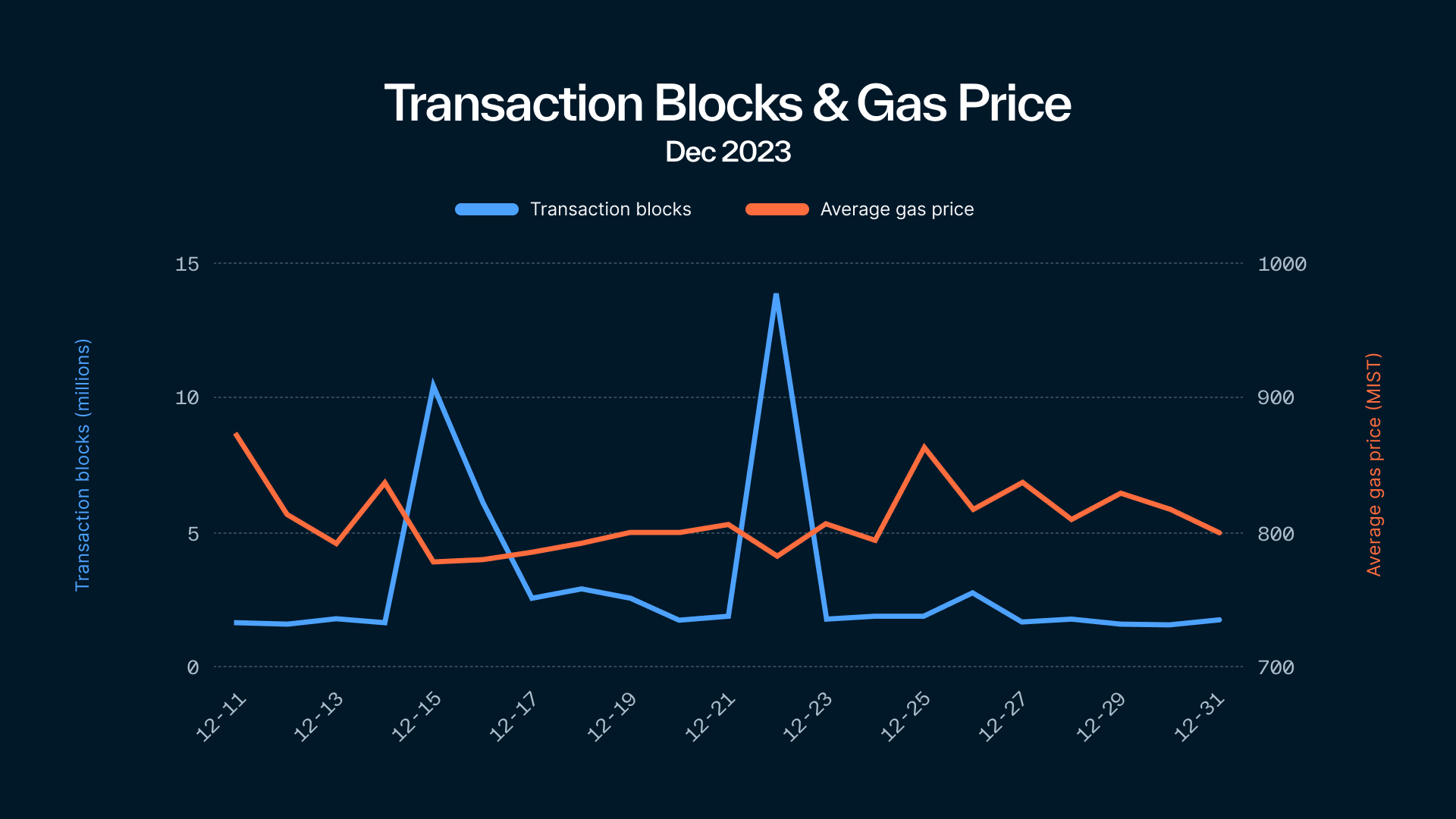
During a surge in inscription-driven activity, Sui encountered two days of exceptionally high transactions, surpassing 10 million transaction blocks processed each day, with a peak of over 13.8 million transaction blocks processed on December 22, 2023. In fact, despite the heightened demand, the average gas price decreased, showcasing the network's stability and the efficiency of Sui’s gas pricing mechanism. Demonstrating remarkable resilience, Sui achieved a peak TPS of nearly 6,000, underscoring its impressive network throughput capabilities.
Built for the future
Although Sui's architecture obviates the need for inscriptions, similar use cases frequently arise in the blockchain industry. Built as the most cutting edge compute environment, Sui's inherent flexibility and support of developer expression lets it support any need or desire. The expectation of onchain storage and a tokenomics model designed around consistently low gas fees lets Sui easily adapt to new ideas in the blockchain world. As more developers discover the power of Sui and Move, the possibilities are endless.
Tutti i commenti0RecentePopolare