Zcash gets a Washington lobbyist to push crypto policy

cointelegraphPublished on 2026-10-09Last updated on 2026-10-09

Abstract

A Zcash advocacy group, Pretty Good Policy for Zcash (PGPZ), has registered to lobby in Washington, D.C., aiming to shape U.S. digital asset policy. Effective October 1, PGPZ lists its executive director as its sole lobbyist and will focus on issues including the Digital Asset Market Clarity Act and digital asset tax proposals. The group, launched in June and evolving from an earlier Electric Coin Co. initiative, seeks to ensure Zcash is understood and represented in policy discussions that will determine the future of privacy-preserving cryptocurrencies. It was recently funded with a $750,000 grant from the Zcash Community Grants program.

A Zcash-focused advocacy group has filed to lobby in Washington, stepping up the privacy-oriented cryptocurrency ecosystem’s efforts to shape US policy on digital assets.

Pretty Good Policy for Zcash (PGPZ) filed a lobbying registration effective on Oct. 1, naming executive director Divij Pandya as its sole lobbyist. The registration lists the Digital Asset Market Clarity Act and two digital asset tax proposals as among its current and anticipated lobbying issues.

PGPZ was launched in June this year, growing out of Pretty Good Policy for Crypto, which was launched in 2022 by Electric Coin Co. The initiative hosted Washington policy roundtables and organized a congressional briefing on encryption technologies in 2023.

PGPZ founder and chief policy and regulatory officer of ZODL, Paul Brigner, said the goal is to “make sure Zcash has serious, organized, and credible policy engagement in Washington.”

“Policymakers are making decisions that will affect whether privacy-preserving digital cash can exist, be used lawfully, and serve the public interest. PGPZ is about ensuring Zcash is understood, represented, and defended in those conversations,” he said.

In August, the Zcash Community Grants approved a $750,000 grant to fund PGPZ’s first year of work.

Related: Zcash targets November of NU7 mainnet upgrade with 25-second blocks

Related Questions

QWhat is the primary goal of the newly registered lobbying group PGPZ for Zcash?

AThe primary goal of PGPZ is to ensure Zcash has serious, organized, and credible policy engagement in Washington, D.C., to make sure it is understood, represented, and defended in policy conversations that will affect the existence and lawful use of privacy-preserving digital cash.

QWho is named as the sole lobbyist for Pretty Good Policy for Zcash (PGPZ) in its registration?

AThe sole lobbyist named in PGPZ's registration is its executive director, Divij Pandya.

QWhich specific legislative issues are listed as current or anticipated lobbying focuses for PGPZ?

APGPZ lists the Digital Asset Market Clarity Act and two digital asset tax proposals as among its current and anticipated lobbying issues.

QHow was PGPZ funded for its first year of work, and what was the amount?

APGPZ's first year of work is funded by a $750,000 grant approved by the Zcash Community Grants in August.

QFrom which previous initiative did the Zcash-focused PGPZ advocacy group evolve?

APGPZ evolved from the earlier initiative called Pretty Good Policy for Crypto, which was launched in 2022 by Electric Coin Co.

Related Reads

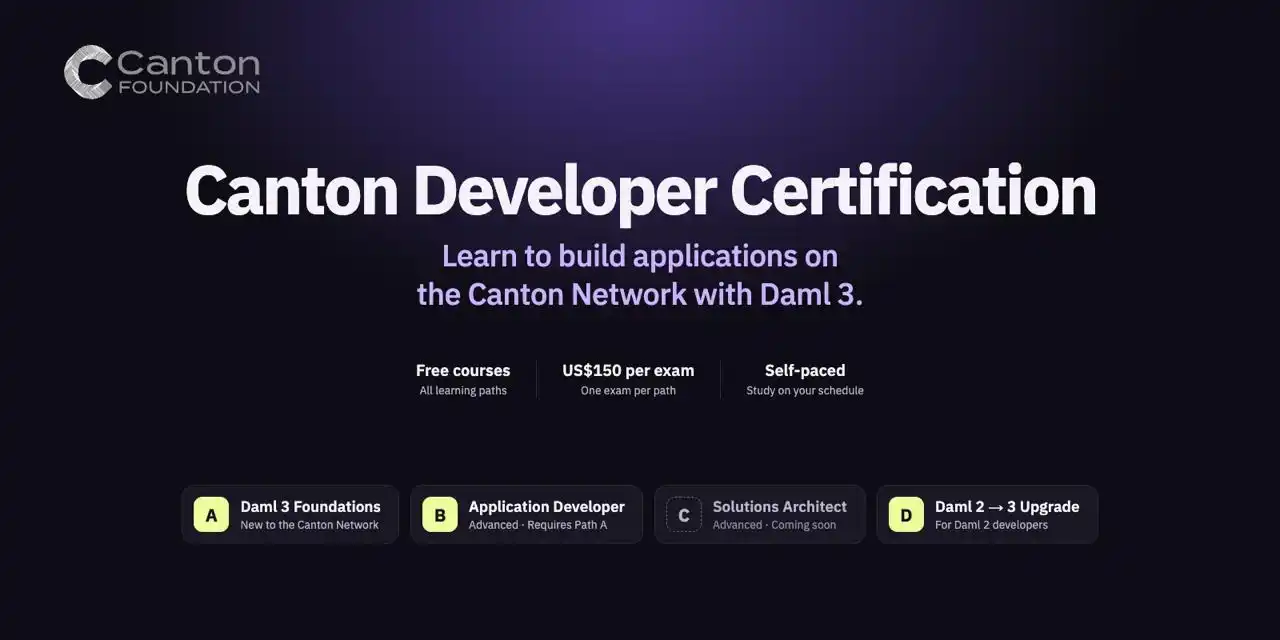
Canton Foundation Launches Official Daml 3 Certification, Expanding Developer Access and Establishing Institutional Finance Standards

Canton Foundation has launched the Canton Developer Certification, an official certification program for Daml 3, the smart contract language of the Canton Network. Combining a self-paced course with a certification exam, it offers developers worldwide a structured path to building applications for regulated financial markets. Canton Network is a public, permissionless blockchain designed for regulated finance, with over $6 trillion in on-chain assets processed by its supported applications. Daml is built to manage who may act on a contract and who may access its terms; the certification validates practical mastery of these authorization and privacy principles, establishing a recognized standard intended to strengthen institutional confidence in applications built on the network. The program is based on Daml 3 and Canton 3.x, the current technology underlying the network, letting newcomers start on the latest stack, helping production engineers deepen expertise, enabling institutional architects to design and integrate Canton deployments, and allowing existing Daml 2 developers to migrate their skills and codebases to Daml 3, unifying the community on a single, current platform. For ecosystem partners—financial institutions, application providers, system integrators, and validators—the certification provides a common technical foundation and a consistent way to assess developers' understanding of authorization and privacy requirements. Canton Foundation COO Amanda Martin said financial institutions need confidence that the applications they rely on are built by developers who understand regulated market requirements, and that the program both opens opportunities for developers globally and establishes a shared professional standard, building a stronger foundation for Canton's future growth by bringing the community together on Daml 3. The certification is now live at certification.canton.foundation; the course is self-paced and free to all developers, and the exam costs $150 per attempt. Canton Foundation is an independent nonprofit responsible for the governance and long-term development of Canton Network's shared infrastructure, supporting transparent and decentralized governance, ecosystem coordination, and broad participation by Global Synchronizer operators and network stakeholders, while working with financial institutions, technology providers, developers, and other participants to support the network's continued global growth and adoption.

marsbit11m ago

Canton Foundation Launches Official Daml 3 Certification, Expanding Developer Access and Establishing Institutional Finance Standards

marsbit11m ago

Nvidia Faces Independent Investigation, Bernstein Maintains $400 Target Price

Nvidia's board has launched an independent investigation following reports about CEO Jensen Huang's contacts with Megaspeed executive Alice Huang, though it says there is no reason to believe U.S. national security or company secrets were compromised. Three Republican House committee chairs have requested Huang attend a closed-door briefing on November 18 to explain the contacts and Nvidia's internal procedures for countering foreign intelligence activities, and Democratic Senator Chris Coons said Congress will investigate. Some reports suggested Alice Huang may have influenced Huang's lobbying to ease chip export restrictions to China, a claim Bernstein doubts, noting Huang has long publicly pushed to expand sales in China and that revenue from mainland China and Hong Kong has fallen sharply since export controls. Only H20 and limited H200 chips were approved for China sales, well behind Nvidia's most advanced products, and Bernstein sees limited room for recovery as Chinese customers prioritize domestic alternatives. Regulatory pressure may persist, with hawkish lawmakers potentially revisiting export limits. Bernstein maintains an Outperform rating and a $400 target price, about 114% above the November 6 close of $186.64, citing data center demand and earnings growth. It projects adjusted EPS of $4.77 for FY2026, $9.20 for FY2027 and $15.80 for FY2028. The target is based on average FY2028-2029 non-GAAP EPS of $19.04 at about 21x. Bernstein also flags Huang's succession as a key risk, given his central role and roughly 60 direct reports.

marsbit21m ago

Nvidia Faces Independent Investigation, Bernstein Maintains $400 Target Price

marsbit21m ago

Two Blocks Hit in 7 Hours: Two Retail Miners Take on the Entire Network's Hashrate and Walk Away with $476,000

Two individual solo miners using home mining rigs hit two Bitcoin blocks within seven hours on November 7, earning a combined $476,000. One miner using a Canaan AvalonQ home miner with roughly 80–87 TH/s earned about $239,000; the other earned roughly $237,000. A CKPool solo platform took about 2% (0.0629 BTC) as a service fee, with the rest going directly to the miners' wallets. Given current network difficulty of about 148.4 trillion, such a rig would normally need over a century to find a block, making the win a luck value of over 10,000%. This is part of a broader trend: in 2026 so far, solo miners have found 36 blocks, nearly one lucky winner per week. Earlier examples include a 6.5 TH/s Avalon Nano 3S worth a few hundred dollars earning $250,000 on October 27, another Nano 3S earning $232,000 on May 30, and a $150 Bitaxe Gamma earning $200,000 on July 10. Home solo mining is often called "plug-in lottery": a 1.2 TH/s mini miner has about a 1-in-16,000 annual chance of winning, far better than Powerball's 1-in-292 million, but rigs cost thousands of dollars and electricity runs $400–$1,100 monthly, with zero income until a block is found. Each viral win serves as free advertising for the industry. Rig manufacturers sell the dream of "maybe I'll win too"; solo pool platforms collect a steady ~2% fee from any winner; and the Bitcoin network preserves its "anyone can participate" narrative despite mining being dominated by large farms. The people paying for it all are ordinary buyers who purchase miners and pay electricity bills hoping for a life-changing jackpot.

marsbit37m ago

Two Blocks Hit in 7 Hours: Two Retail Miners Take on the Entire Network's Hashrate and Walk Away with $476,000

marsbit37m ago

NYSE Picks Avalanche, Why AVAX May Not Capture the Settlement Flow

On November 9, Ava Labs announced that a tokenized securities trading platform affiliated with the NYSE had selected Avalanche to provide core ledger technology for its clearing firm. The platform is a regulated alternative trading system (ATS) designed for 24/7 trading, clearing, and settlement, pending regulatory approval. The Wall Street Journal reported a stronger version: the NYSE would "exclusively" use Avalanche to settle tokenized stocks, with matching still handled by existing technology and a Q4 launch target—though Ava Labs' announcement gave no launch date and did not name the clearing firm. Markets traded the headline first, with AVAX rising roughly 8–11% to near $9 intraday. But the announcement places Avalanche at the clearing-ledger layer, not the main board on a public chain—a distinction that determines whether AVAX captures narrative or verifiable demand. Matching (who trades with whom at what price) stays on the NYSE's Pillar engine; settlement (how cash and securities transfer) goes to the blockchain ledger. Ava Labs said it provides core ledger tech for the clearing firm of the NYSE-affiliated ATS, without disclosing the firm's identity, contract value, or timeline. Tokenized stocks involve three layers: issuance, matching, and settlement. NYSE digital issuance head Dennis Lee said the platform will support stocks listed across multiple chains, but the settlement ledger must be fast, reliable, permissioned, and cost-predictable. Issuance can be multi-chain; settlement converges on one controlled system. The "exclusive" label refers to the settlement ledger, not the whole value chain. ICE previously said the platform combines Pillar with blockchain post-trade systems supporting multi-chain settlement and custody. Ava Labs CBO John Nahas said the NYSE will run a custom Avalanche-based chain tailored to regulatory needs, not use the public Avalanche chain—two very different things. A permissioned chain lets the exchange control access, node deployment, and fee pricing. Founder Emin Gün Sirer cited round-the-clock atomic settlement, predictable performance and cost, and regulatory control. This explains why AVAX's price reaction outpaced fundamental certainty: brand association arrived first, while fee capture remains undisclosed—whether the custom chain uses AVAX for pricing, staking, or fees was not answered. Charles Schwab's same-day addition of AVAX to retail trading offers a competing explanation for the gains. Three unresolved variables determine the significance: regulatory approval (no public status), the clearing firm's identity (unnamed legal entity), and token economics. AVAX's economic link is distant—a custom chain does not equal public-chain lockup or AVAX becoming a settlement asset. Issuer willingness also matters; the NYSE recently expanded transfer agents for issuer-sponsored tokenized securities to six, with Broadridge handling on-chain voting and governance, but whether tokenized equities enter this ATS depends on liquidity, compliance costs, and shareholder communication. Until the platform launches and the clearing firm appears, vendor selection is a necessary step, not realized demand.

marsbit41m ago

NYSE Picks Avalanche, Why AVAX May Not Capture the Settlement Flow

marsbit41m ago

Ethereum Foundation and Vitalik Taken to Court: A Cancer Patient's Dismissal and a "Seppuku Pledge"

In November 2026, a civil complaint filed in a Colorado federal court named the Ethereum Foundation and Vitalik Buterin as defendants. The plaintiff, Kayleen Fulton, former head of EF's Protocol Support team, alleges she was fired after being diagnosed with ovarian cancer, and that the real reason was her leading opposition to the controversial "EF Mandate" document and its "Source Seppuku License." The complaint describes a timeline in which Fulton received her highest performance rating and a 21.9% raise in September 2025, before the 38-page Mandate was published in March 2026, featuring Milady-style imagery and a clause demanding signers "voluntarily exit" if they violated its principles—wording invoking seppuku, published roughly a year after a colleague's suicide. Seventy-nine employees reportedly voted to remove the clause, and Buterin allegedly promised major revisions that never came; the Mandate was instead recorded permanently on-chain. Fulton was diagnosed with cancer on March 19; the next day, co-executive director Bastian Aue issued an ultimatum requiring all staff to sign a loyalty oath to the Mandate or be treated as having resigned. Fulton disclosed her diagnosis on March 24 and, with Trent Van Epps, drafted a letter signed by 53 protocol cluster members refusing to sign under duress while stating they had not resigned. Both Fulton and Van Epps were fired on April 6 without stated reasons. The complaint's most damaging element is a recorded May 1 call in which Buterin allegedly said he was considering what behavior patterns EF should reward—implying protesters should not receive positive outcomes. Buterin is accused of aiding and abetting discrimination and retaliation. The complaint raises 11 claims, including ADA and FMLA violations, Colorado anti-discrimination provisions, illegal confidentiality clauses, wrongful termination, and intentional infliction of emotional distress. Fulton signed a separation agreement on April 9 under severe psychological pressure and threat of losing health insurance, then revoked it on April 17. She seeks a jury trial, back pay, expected wages, punitive damages, $5,000 statutory penalties per violation, and attorney fees. The case unfolds amid massive EF turmoil: about 20% of staff (roughly 54 people) were cut, protocol cluster leaders Tim Beiko and Barnabé Monnot resigned, Alex Stokes took extended leave, co-executive director Tomasz Stańczak departed, and Fulton's former team was dissolved in July 2026. Buterin publicly framed the changes as becoming a "smaller ship" focused on CROPS. The lawsuit tests whether traditional labor protections apply to a Swiss foundation using employer-of-record arrangements while claiming to be "not an employer," and raises broader governance concerns for the crypto industry.

marsbit41m ago

Ethereum Foundation and Vitalik Taken to Court: A Cancer Patient's Dismissal and a "Seppuku Pledge"

marsbit41m ago

Trading

Spot
活动图片