Author: Wall Street CN
The US Treasury's latest primary dealer survey did not release a clear signal that long-term Treasury auction sizes are about to be reduced, disappointing investors betting that the government would act to push down long-term interest rates. As a result, Treasury prices fell and yields rose overall.
This survey was part of the Treasury's preparations for the quarterly refunding plan to be announced on November 4. The market had originally hoped to find clues in the questionnaire about whether US Treasury Secretary Bessent might adjust long-term Treasury issuance sizes, especially the recently much-discussed possibility of reducing or even stopping 20-year Treasury issuance. But the Treasury only asked broadly what auction size adjustments should be considered in the future, without clearly hinting that a reduction in long-term bond supply was imminent.
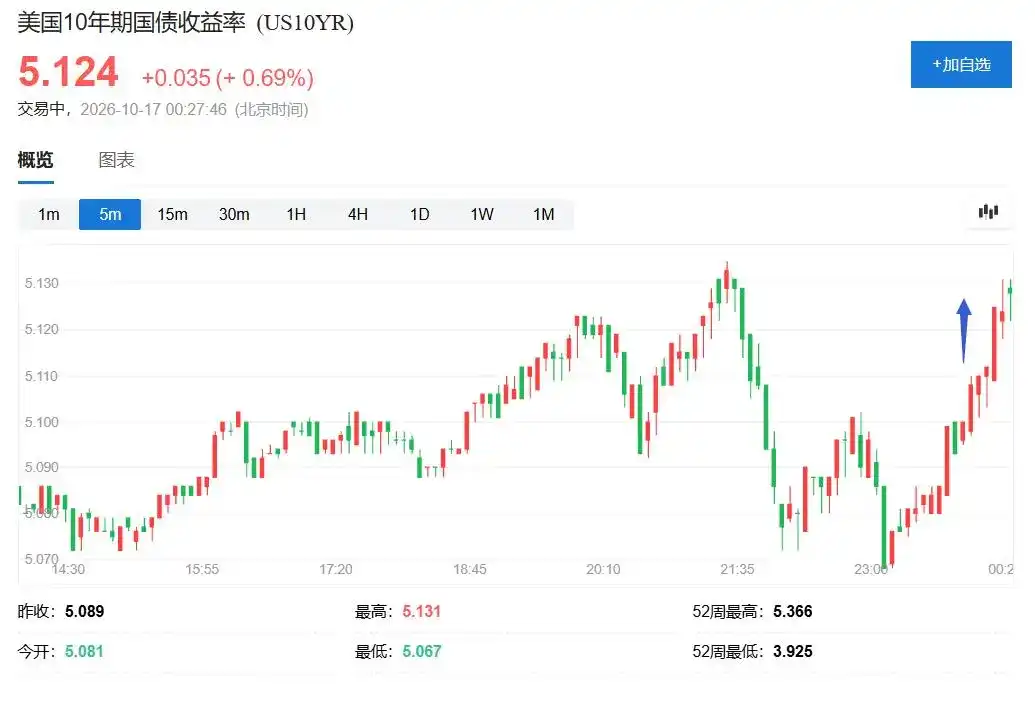
During Friday midday US stock market hours on the 16th, after details of the Treasury survey were published, US Treasury yields rose across the board. The benchmark 10-year US Treasury yield climbed back above 5.12%, approaching the intraday high of 5.1315% refreshed before the US stock market open, with the intraday increase widening again to 6.5 basis points; the 20-year Treasury yield rose 5.4 basis points intraday, the 30-year Treasury yield's intraday increase widened again to about 5 basis points, and the 2-year Treasury yield erased its intraday decline and turned higher.
At the same time, oil prices had already accelerated higher shortly before the survey was released, also putting upward pressure on Treasury yields. Therefore, the rise in yields on Friday reflected both the market's disappointment that the Treasury did not release a supply-cut signal and the impact of changes in energy prices.
What the Treasury Asked, and What the Market Was Waiting For
The Treasury solicited opinions from primary dealers this time, focusing on what adjustments to Treasury auction sizes should be considered in the future given structural changes in investor demand and the possibility that medium-term demand expectations may continue to evolve.
Such surveys are routine preparation for the Treasury's quarterly refunding decisions, aimed at understanding major dealers' judgments on government financing needs, investor demand, and market functioning, so as to provide reference for subsequently determining Treasury issuance sizes and structure. The survey itself is not an issuance plan, nor does it mean the Treasury has already decided to adjust issuance sizes for any maturity.
According to reports, the questionnaire also covered several debt management issues:
-
Long-term Treasury buyback program: The Treasury asked whether expanding the scale of long-term Treasury buybacks has improved market liquidity and trading functioning; how larger-scale buybacks affect dealers' ability to take on customer buy and sell orders, and customers' willingness to participate directly or indirectly in buybacks.
-
How to further improve buyback efficiency: The Treasury sought dealers' views on what other adjustments could be made to the buyback program.
-
Timing of Treasury bill and floating-rate note issuance: The Treasury asked whether the current practice of avoiding issuance of Treasury bills and floating-rate notes on Federal Open Market Committee (FOMC) meeting days should be adjusted.
-
Economic and financing outlook: Dealers also needed to provide forecasts for the economy, fiscal policy, monetary policy, and the Treasury's financing needs over the next several fiscal years.
What truly disappointed the market was that the Treasury did not direct its questions explicitly toward reducing long-term Treasury supply. Some investors had originally expected the Treasury to use this questionnaire to more clearly hint that it was considering reducing long-term bond auction sizes, or even stopping 20-year Treasury issuance, in response to the Trump administration's efforts to lower financing costs.
Blake Gwinn, head of US rates strategy at RBC Capital Markets, said that if the Treasury wanted to use the questionnaire to send a signal or influence yields, it could have asked more direct questions. He believed the survey conveyed no substantive signal; given that some investors expected major adjustments, such as stopping 20-year Treasury issuance, the result may disappoint the market.
20-Year Treasury Becomes the Focus as Wall Street Bets on Treasury Adjusting Issuance Structure
The market's particular sensitivity to the survey is related to the recent high levels of long-term US Treasury yields. With the US fiscal deficit persisting and interest expenses on existing debt increasing, government financing needs continue to rise, and pressure from long-term Treasury supply has become one of the core issues investors focus on.
Bloomberg said some Wall Street institutions had previously bet that the Treasury might ease long-term bond supply pressure by adjusting its issuance structure. Market discussion was especially concentrated on 20-year Treasuries: whether the Treasury would reduce their issuance size or even completely cancel issuance at that maturity.
From a financing mechanism perspective, the Treasury needs to meet the government's overall borrowing needs, but that does not mean it must issue bonds at each maturity in fixed proportions. If demand for short-term financing instruments and market absorption capacity allow, the Treasury could in theory increase short-term debt issuance and reduce supply pressure on the long-term bond market. However, adjusting the maturity structure would also change the government's future refinancing arrangements and cannot simply be understood as reducing total borrowing needs.
Molly Brooks, US rates strategist at TD Securities, said the Treasury's questions were still too broad and did not explicitly ask whether to reduce long-term bond supply, so the market was disappointed. She expects that adjustments to long-term Treasury auction sizes may not come until February 2027 at the earliest.
This judgment means that the optimistic scenario previously bet on by some investors - that the Treasury would announce cuts to long-term issuance in its November quarterly refunding plan, or even cancel 20-year Treasury issuance - may not materialize soon. The questionnaire did not provide a clear supply-cut signal, nor does it mean such adjustments have been ruled out.
However, Citigroup strategists stuck to their forecast that the US Treasury will reduce long-term bond issuance in its November quarterly refunding announcement, expecting 20-year and 30-year US Treasury auction sizes to each be cut by $3 billion. They pointed out that the relevant questions in the survey questionnaire indicate Treasury officials are considering taking this step.
Citigroup's report said that since the last refunding announcement, long-term Treasuries have seen significant selling, and in several long-bond buyback operations after the US Treasury announced an increase in the buyback ceiling, market performance was relatively weak. These factors will prompt the Treasury to shift long-bond issuance toward short-term debt.
Disappointment Over Issuance Signal Plus Rising Oil Prices Weigh on Long-End Yields
In addition to the Treasury survey, rising oil prices also increased upward pressure on US Treasury yields. Higher energy prices may rekindle market concerns about inflation and affect investors' judgments on the Federal Reserve's future rate path. For longer-dated Treasuries, inflation expectations, future short-term rates, and the term premium investors demand all affect yield pricing.
This also explains why the market reaction was concentrated in long-term Treasuries. Long-term Treasury prices are especially sensitive to changes in supply expectations: if the market had originally expected the Treasury to reduce long-term bond issuance, once such a signal is absent, investors may reassess the long-term bond supply they need to hold and the return they require for bearing interest rate risk.
But Friday's rise in yields cannot be attributed entirely to the Treasury survey. Oil price changes were also cited in reports as a driving factor, while the survey result merely dashed the market's previous expectations for policy adjustment and did not directly prove that future long-term Treasury issuance sizes will definitely remain unchanged.
November 4 Refunding Announcement Becomes the Next Observation Point
The Treasury will release its next quarterly refunding plan on November 4, when the market will be able to further assess the government's specific considerations regarding borrowing needs, issuance sizes across different maturities, and buyback arrangements.
The US government faces persistent fiscal deficits, and interest expenses on existing debt are also rising, forcing the Treasury to weigh financing costs, market demand, and debt maturity structure. Reducing long-term bond supply to push down long-end yields is one possible path the market is watching, but it is not without constraints.
Before the formal announcement is published, the dealer survey provides consultation on market views, not a policy commitment. Friday's decline in long-end Treasuries and the renewed rise in yields reflect that the market had originally expected the Treasury to release a more positive supply-cut signal, but did not obtain sufficiently clear evidence from this questionnaire. Next, investors will continue to watch whether the Treasury will adjust long-term Treasury issuance arrangements in its November refunding plan and whether related measures can truly ease supply pressure in long-term Treasuries.