A while ago, OpenAI released a batch of 722 mathematical paper manuscripts on GitHub at once. These manuscripts are grouped into 372 result "families," spanning 17 mathematical fields, all produced by an internal model that has not yet been released and has no public name—its performance far surpasses that of GPT-6 Astra.
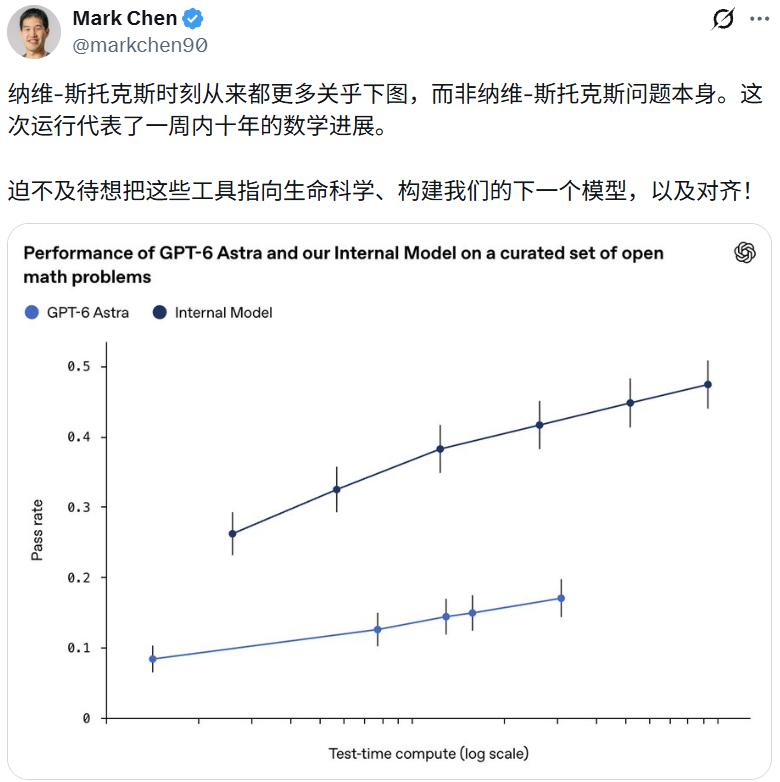
A tweet from OpenAI's Chief Research Officer, Mark Chen
Of course, the mathematics community still has significant controversy regarding the quality of these results and the manner of their disclosure, but one point is becoming hard to deny: The speed at which AI produces research results is beginning to be measured in "hundreds."
Almost simultaneously, in the latest episode of the podcast "The Information Bottleneck," a veteran deep learning researcher said something that made many in the research community uneasy: "After finishing this project and getting some pretty interesting results, I suddenly realized: wow, my job will probably be replaced within five years."
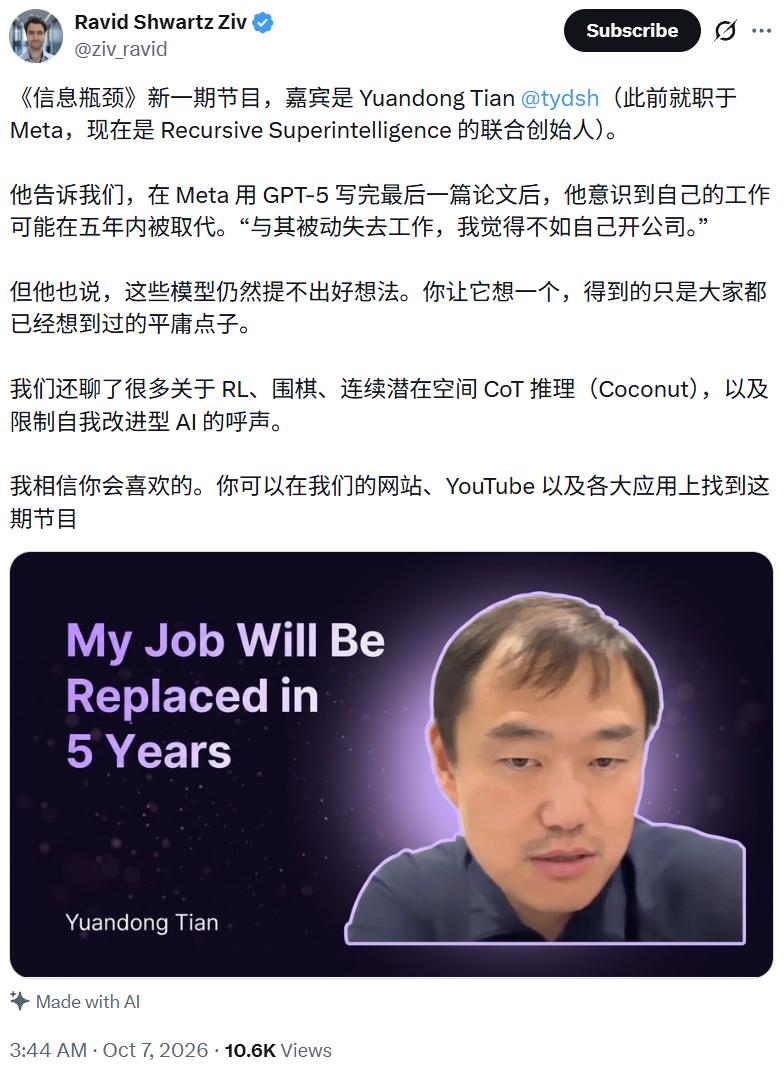
Podcast address: https://www.the-information-bottleneck.com/p/yuandong-tian-on-recursive-self-improvement-600
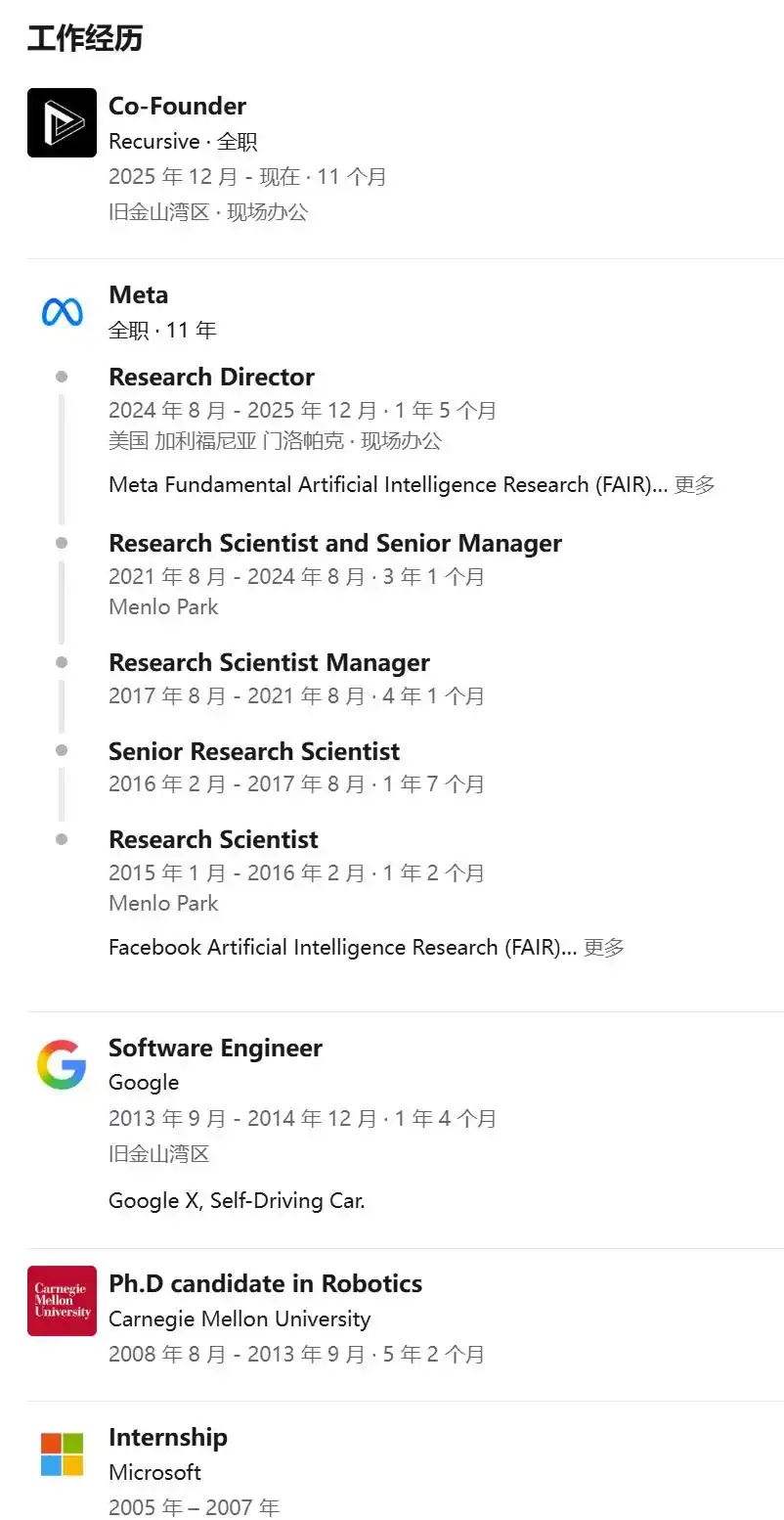
The speaker was Tian Yuandong. He spent nearly a decade at Meta FAIR, working on Go AI, reinforcement learning, neural network interpretability, and is also one of the authors of the Coconut (Continuous Latent Space Chain of Thought) paper.
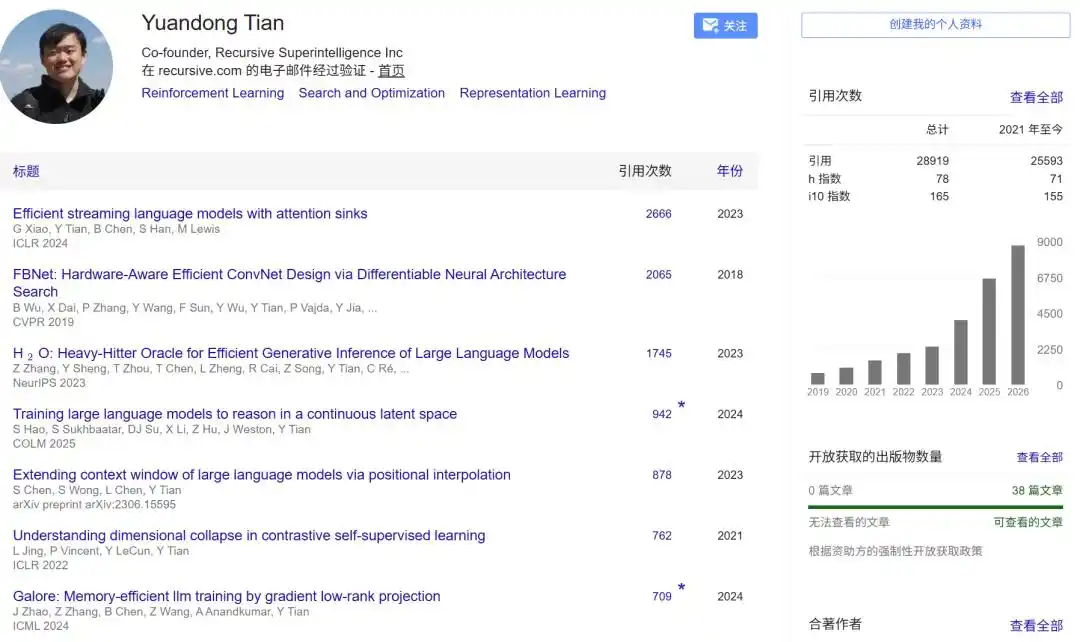
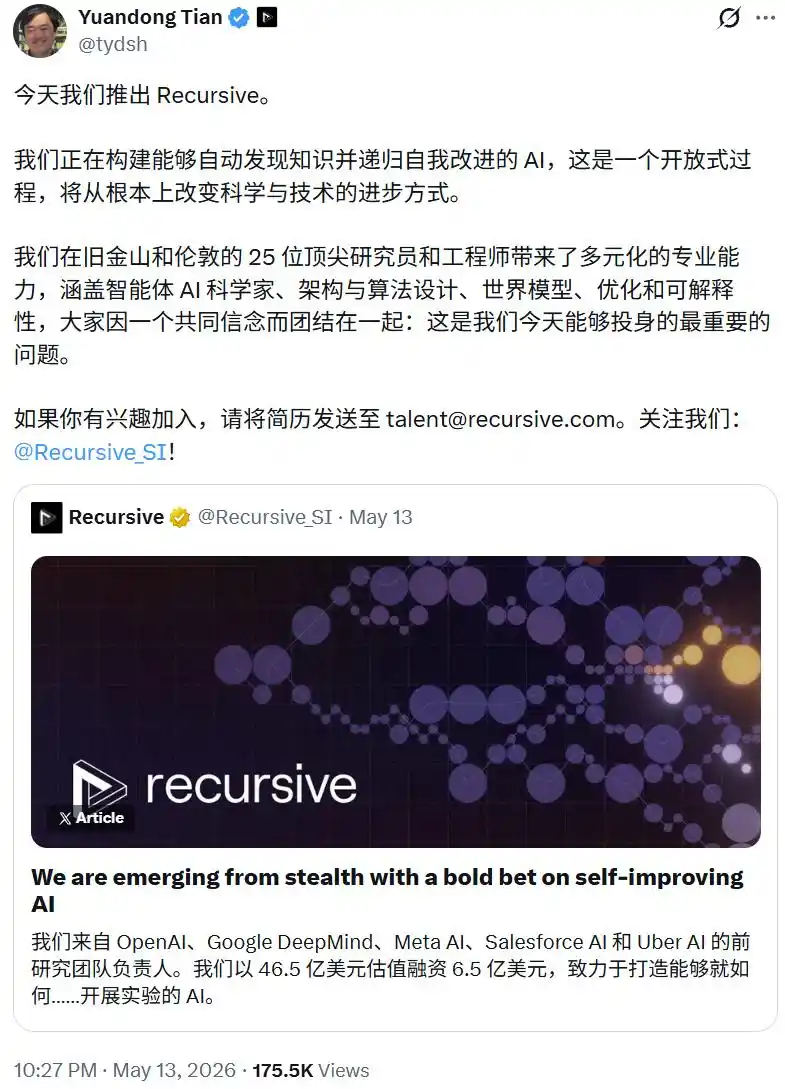
Today, he is a co-founder of Recursive Superintelligence. In May of this year, the company came out of stealth mode, announcing it had raised over $650 million at a valuation of $4.65 billion, led by GV and Greycroft, with participation from NVIDIA and AMD.
In this podcast episode hosted by Ravid Shwartz-Ziv, Tian explained why he started the company: "Instead of passively losing my job, I might as well proactively start a company moving in this direction." However, he also tempered some of the AI hype on the show. "If you ask the model to come up with ideas on its own, it will give you very mediocre ideas, basically things everyone knows, not interesting directions."
In the nearly hour-long conversation, Tian discussed topics ranging from the AlexNet debates during his time at CMU to Go AI, from "action spaces" to latent space reasoning, and finally landed on recursive self-improvement, new architectures, and open source. Below is a summary of that discussion.
The Argument in Smith Hall: Was AlexNet Just a Fluke?
Tian Yuandong came to the United States in 2008 to pursue his PhD at Carnegie Mellon University's Robotics Institute. Back then, machine learning was far from its current status. "Many people at the time didn't think machine learning was a viable path. They'd say it wasn't reliable because it overfits and it's unclear what's happening inside."
His doctoral research focused on non-convex optimization problems in computer vision, such as correcting image distortions caused by water refraction. He used a hierarchical optimization method and proved that even for non-convex problems, given enough data, one could still prove a degree of optimality. "The combination of data-driven methods and optimization was interesting; I'm still quite proud of that work."
In 2012, AlexNet burst onto the scene. Tian emailed Alex Krizhevsky to get the code and experimented with it himself. He quickly realized that the hierarchical processing of convolutional networks was essentially the same idea as the hierarchical optimization in his own thesis. "It might have been what I was always pursuing, just in a different form."
But the atmosphere at CMU at the time wasn't friendly. "People came to the office every day and argued fiercely in Smith Hall about whether AlexNet's results were just a fluke or a real breakthrough. Most said it was a fluke because it didn't make sense."
Upon graduating in 2013, Tian received offers from several institutions interested in deep learning but ultimately chose the Google self-driving car team, partly for its reputation and partly due to a friend's referral. However, during his year and three months there, he didn't get to work on deep learning because the team operated more like a startup, needing mature solutions for practical problems rather than scientific exploration. So he moved to FAIR, calling it "one of the best choices I made at the time."
Two People, One GPU: Tian Yuandong's Go AI Story
At FAIR, Tian's first project was Go AI. In 2015, his team created DarkForest, which defeated top amateur players online using convolutional networks. A few months later, AlphaGo defeated a professional player in early 2016.
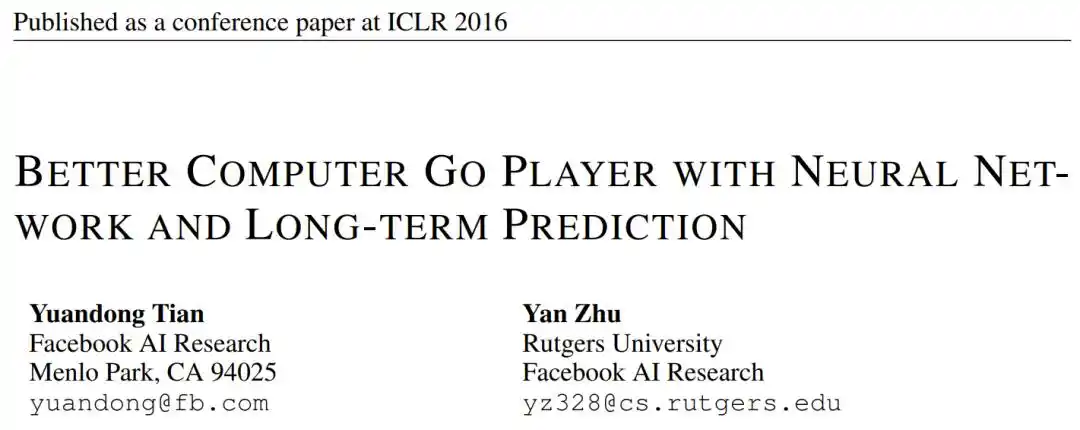
Reflecting on this "coincidence," Tian believed AlphaGo had two things his project lacked:
- A value network (DarkForest only had a policy network);
- He himself had almost no background in reinforcement learning. "I basically learned as I went, like doing reinforcement learning on myself." This experience led him to shift much of his subsequent research to reinforcement learning.
When asked if AlphaGo was surprising, his answer was interesting: the method itself wasn't shocking because convolutional networks could capture the board patterns humans rely on when playing Go. "The truly surprising thing was that it could actually defeat professional players."
In 2018, the team replicated AlphaZero (the approach of self-play from scratch without human games) and made some efficiency improvements, resulting in OpenGo. In an official match against the Korean Baduk Association, this AI, using just a single V100 GPU, won all games against four professional players. "I think that was probably the first time someone defeated professional players using a single GPU."

There was a small anecdote before the match. The team asked professional and semi-professional player friends to evaluate OpenGo's strength. Their response was that they could understand the opening, but after that, it became completely incomprehensible; they could only say, "It looks strong, but I don't know if it's really strong." So Tian decided: let's directly play a match with real professional players.
Action Space Is More Important Than the Algorithm
Discussing reinforcement learning from that era, Tian believes many methods are still undervalued today. For example, distributional reinforcement learning, which uses the distribution of rewards rather than a single scalar to adjust the model; and different modeling approaches like Q-learning. "But nowadays, most of the time we use policy gradient. It's a very different era."
He is also optimistic about gradient-free optimization methods and believes large models offer them new possibilities: "Large models now have a better high-level understanding of the system and the objective function to be optimized. This high-level understanding is much more useful than local gradient information." In situations where gradients fluctuate wildly and local optima are everywhere, gradients can lead one into dead ends, while gradient-free methods inherently include exploration—"something gradient methods never do."
Around 2018-2019, Tian began applying reinforcement learning to real-world problems, reaching a rather surprising conclusion: "What's really important isn't the algorithm, but the design of the action space and state space."
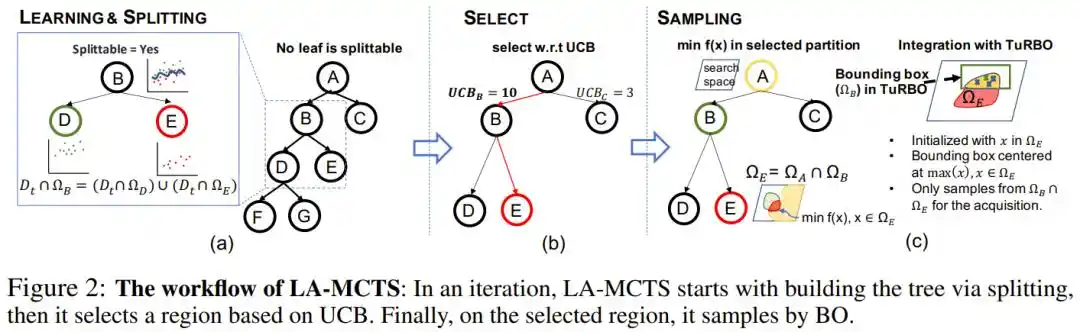
He used neural architecture search (NAS) as an example. Humans know network depth is crucial, but the AI doesn't. If the AI starts by searching for details like the kernel size of the first convolutional layer, all branches perform similarly, and the value function provides no useful signal. It can only dig deeper layer by layer, causing the search space to explode exponentially. "At that point, no algorithm will help." Conversely, if the action space can be reorganized so the AI first "realizes" depth is important, a stark contrast emerges between deep and shallow networks, revealing the direction after just a few rollouts. Based on this, the team proposed Latent Action Monte Carlo Tree Search (LA-MCTS), with the core idea being to automatically find an action space that maximizes the distinguishability of search subspaces.
Coconut: "I Never Use Language When I Think"
The co-host mentioned Tian's involvement in the Coconut paper, which involves having models reason in a continuous latent space rather than token space. Tian said this idea stemmed from observing himself: "I never use language when I think. I can clearly feel that when thinking, I use a different part of my brain, and then I have to translate the thoughts into language to communicate smoothly with others."
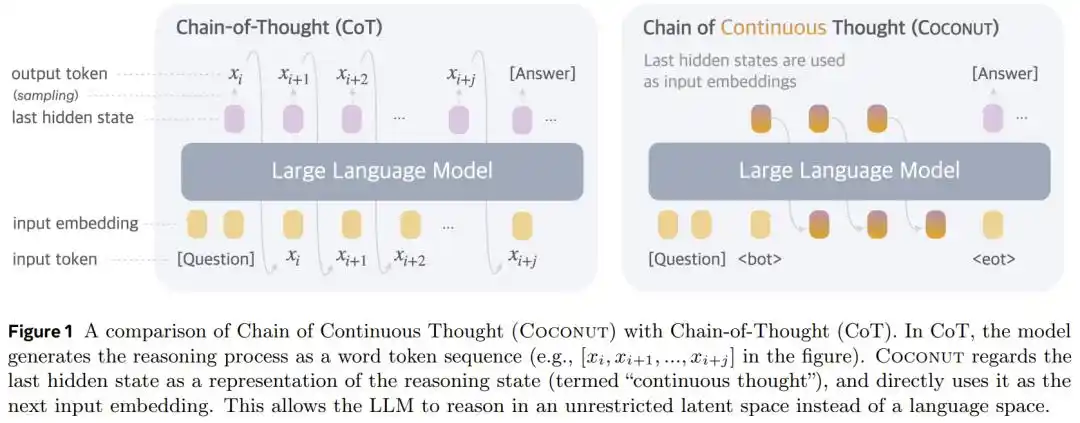
Starting from this intuition, the team performed theoretical derivations, finding that latent representations could be superpositions of multiple ideas. Using this for reasoning might offer significant advantages in problems like graph traversal. "Maybe not exponential, but at least a certain advantage."
So why haven't frontier models adopted continuous chain-of-thought? Tian gave two reasons.
- Data: Vast amounts of human thought processes are recorded in language form, but such data doesn't exist for latent spaces.
- Latent representations might be highly personal. "Everyone uses their own latent representations to some extent." Large models learn much less efficiently than humans, so language becomes the default substitute.
Ravid Shwartz-Ziv asked if this was similar to the regularization challenge faced by self-supervised methods like JEPA. Tian agreed and pushed the issue deeper: gradient descent itself might be stuck in a kind of "meta-level local optimum." There might be excellent representations that the current training paradigm simply cannot learn. "We don't know the boundary yet."
In his view, this is precisely the significance of interpretability research—"like the difference between alchemy and chemistry." It's just that models today are so powerful that everyone is chasing results, and there aren't enough people or time dedicated to this direction.
After Co-authoring My Last Paper with GPT-5
Discussing transitioning to the era of large models, Tian believes that the neural network training dynamics analysis he has continuously worked on since 2018 remains methodologically applicable to large models; there hasn't been a rupture. The real shock is empirical: researchers used to propose hypotheses, conduct experiments, and draw conclusions—a process not fundamentally different from one or two hundred years ago. But as models grow more powerful and can generate ideas themselves, "researchers may be forced to think at a meta-level rather than spending time proposing individual concrete hypotheses."
Simultaneously, engineering capability has been significantly elevated in importance. Many good works in the large model era are "half research, half engineering." With the emergence of capable AI programming agents, the situation changed again: experienced researchers could have agents quickly implement ideas and pinpoint key issues. "Suddenly, they possess superpowers to explore truly deep things."
The turning point was his last paper at Meta—where he was also the sole author. This paper studied the neural network grokking phenomenon, where a network first memorizes and then suddenly learns to generalize at a certain point in training.
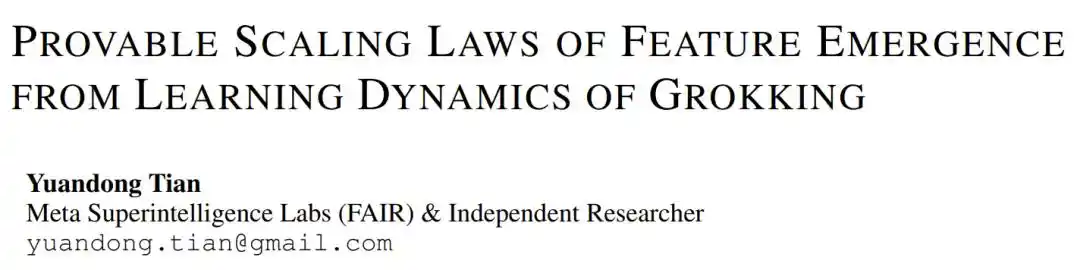
Throughout the process, he treated GPT-5 as a collaborator: asking it questions, assigning it "homework," having it prove theorems, check if theorems held, and brainstorming together.
The result was an efficiency increase of about 6 to 10 times, "and that's a conservative estimate because I was still writing code myself." Today, code and implementation can also be delegated to powerful agents, making the process even faster.
Hence the opening quote. Tian frankly admitted that researchers usually don't want to become co-founders at small companies because they have to worry about many non-research matters. "But I feel now is a phase transition. If I do nothing, I might become irrelevant in the future."
The co-host jokingly responded that his way of coping was to learn hands-on skills, lamenting, "I'm not very good with my hands."
AI Still Can't Generate Good Ideas
However, Tian doesn't believe humans can bow out yet. "I don't think current models can produce excellent results without any human intervention." Even in that paper co-authored with GPT-5, the high-level direction came from him, not from the model generating ideas on its own.
Humans still need to be responsible for:
- Initiating – deciding what problems are worth pursuing
- Validating – judging whether the solutions AI provides are reliable
Ravid Shwartz-Ziv mentioned that recent works on letting agents autonomously perform post-training or tackle Kaggle competitions often expose issues like narrow idea spaces and overfitting to metrics. Tian believes this is partly temporary: models are asked to handle details but lack context; given more background, they might propose more interesting ideas than hyperparameter tuning.
But he also admitted that adding context is just a "temporary fix." Current models are good at repetitive work because internet data is full of such content. For models to truly think outside the box, new architectures are needed that allow them to capture new signals quickly with very little data. "To move from conventional repetitive work to the next level, we need a big leap."
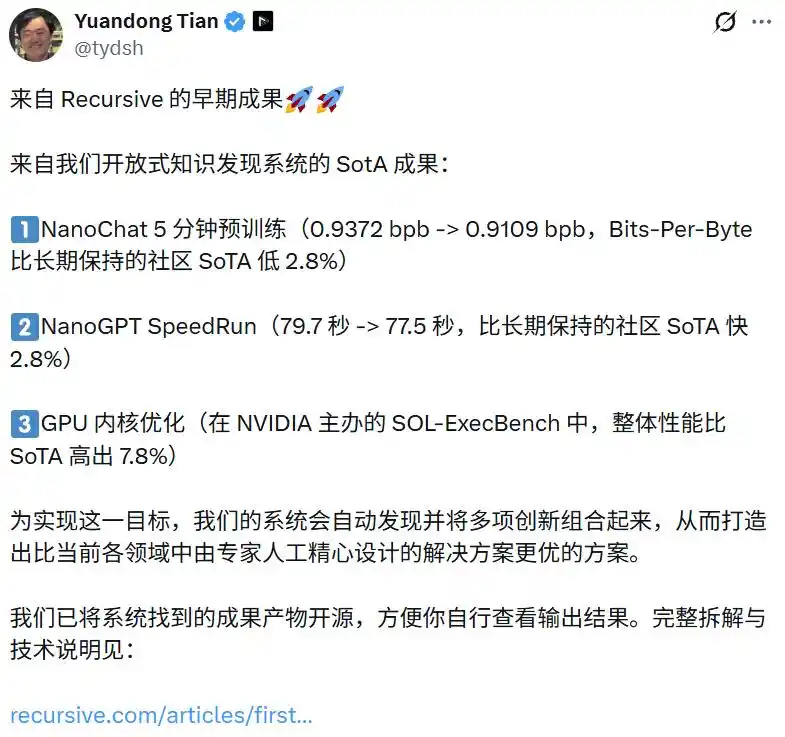
Within the research loop of "proposing ideas, writing code, running experiments, analyzing results," he thinks the hardest part to automate is idea generation. When asked about Recursive's achievement on the NanoGPT Speedrun—reducing training time from 79.7 seconds to 77.5 seconds—whether it was a genuine discovery or just efficient search of known techniques, Tian's answer was "both." For example, the approach of incorporating bigram information into attention can be found in similar ideas in DeepSeek, Gemma 3, and even the STEM paper he co-authored at Meta. But how to use different embedding tables at different layers and combine these ideas involved new creativity.
Why Do New Architectures Always "Fail" at Scale?
Several companies have proposed alternatives to the Transformer architecture that show promise in small-scale experiments but consistently fail to scale to large models. Tian's explanation is inductive bias: at small scale, data is insufficient, so introducing additional structural assumptions naturally yields benefits. When data increases, the best approach is often to let the model find patterns itself. He cited the example of ViT: at the ImageNet data scale, ViT was inferior to convolutional networks, but when data reached hundreds of millions of images, Transformer overtook.
So, how should new architectures be validated?
Tian believes it's essential to start small, but the key is understanding what's happening inside the network. "We need to know there's some insight within that can scale to larger sizes, giving us confidence." Otherwise, blindly following scaling laws means one can never prove that what works at small scale works at large scale. "The only outcome would be that the company with the most compute wins."
The longer-term goal in his mind is to achieve learning efficiency comparable to humans. The human brain, with just 20-30 watts of power and minimal data, can understand things rapidly. The robotics field today emphasizes the need for massive data, which in his view is just a requirement of the current paradigm. "Look at embodied creatures like cats and dogs. They don't need that much data, and their processors are rough, yet they survive in complex worlds. There must be new algorithms there." And reinforcement learning with self-improvement might be the fastest path there.
Limit Self-Improvement? "The Boundary Is Too Blurry"
At the end of the episode, the host asked about a hot topic in AI safety: calls to restrict the latest models and coordinate industry efforts on recursive self-improvement.
Tian's answer was direct: "Honestly, I think it's very difficult to stop people from doing this." In his view, the boundary itself is blurry: discussing new ideas with a programming agent and having it iterate is a form of self-improvement; co-authoring a paper with someone is also self-improvement. Coupled with increasingly powerful open-source models, does using them for research count as self-improvement? How should it be regulated?
He clearly stated that Recursive will open-source its research findings. The company's previous blog post already open-sourced the entire kernel and training scheme, allowing external scrutiny and further development. He is more concerned about another scenario: "The worst-case scenario is a small elite controlling the world's strongest models, making everyone else pay a high premium to use them."
He is quite optimistic about open-source models catching up to closed-source ones. Using Kimi as an example, he believes it's already quite usable, though its reasoning process might be slightly longer. In his view, a programming agent doesn't need to be an "AI Newton" or "AI Einstein" personally writing code for you; once the model crosses a certain usability threshold, it's enough.
Frontier labs have already crossed that line, and open-source models are crossing it too. "Once crossed, it will become commoditized, and everyone will use their preferred model."
It's been fourteen years since that argument in Smith Hall about whether AlexNet was a "fluke." The deep learning that was once doubted is now writing papers, modifying code, and breaking records on its own. Tian Yuandong chose to stand at the forefront of this wave. In his words, the real question ahead is: "How do we use all these models to do better, bigger things?"
This article is from the WeChat public account "Almost Human" (ID: almosthuman2014), edited by Panda.