The Shadow Banking Battle of Stablecoins: Tether Enters Private Credit with a $3 Billion War Chest

marsbitPublished on 2026-09-10Last updated on 2026-09-10

Abstract

Titled "The 'Shadow Banking' Battle of Stablecoins: Tether Enters Private Credit with a $3 Billion Giant Fund," this article details Tether's strategic expansion beyond crypto. Having built immense profits from issuing USDT and investing reserves in U.S. Treasuries, Tether is now targeting the private credit market. Through a new partnership with London-based asset manager Fasanara Capital, it has launched "StableFund," a perpetual fund aiming for up to $3 billion to provide credit to SMEs and consumer lenders across 60+ countries. The move represents a shift from earning risk-free spreads to seeking higher yields in private credit, a sector with a massive global funding gap. Crucially, Tether leverages USDT as a settlement rail, offering borrowers instant, low-cost digital dollar loans instead of slow traditional wire transfers. Fasanara handles underwriting and risk management for these short-duration, asset-backed loans, while Tether provides the capital and infrastructure. This venture positions USDT as a tool for real-world economic activity, not just crypto trading. However, it also ventures Tether deeper into the regulated realm of credit risk. While StableFund is structured as an off-balance-sheet entity to isolate potential losses from Tether's core reserves, the company already holds over $13.45 billion in secured loans on its balance sheet. The article raises concerns that Tether is effectively becoming a large, unregulated "shadow bank," operating without tradit...

Author: Deep Tide TechFlow

After becoming the world's most profitable and cash-rich "atypical financial institution" by issuing USDT, Tether has finally taken the most critical step from the virtual to the real economy.

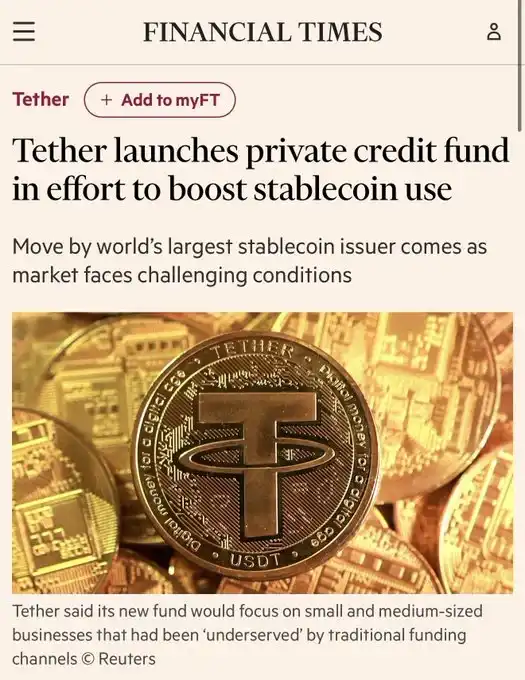
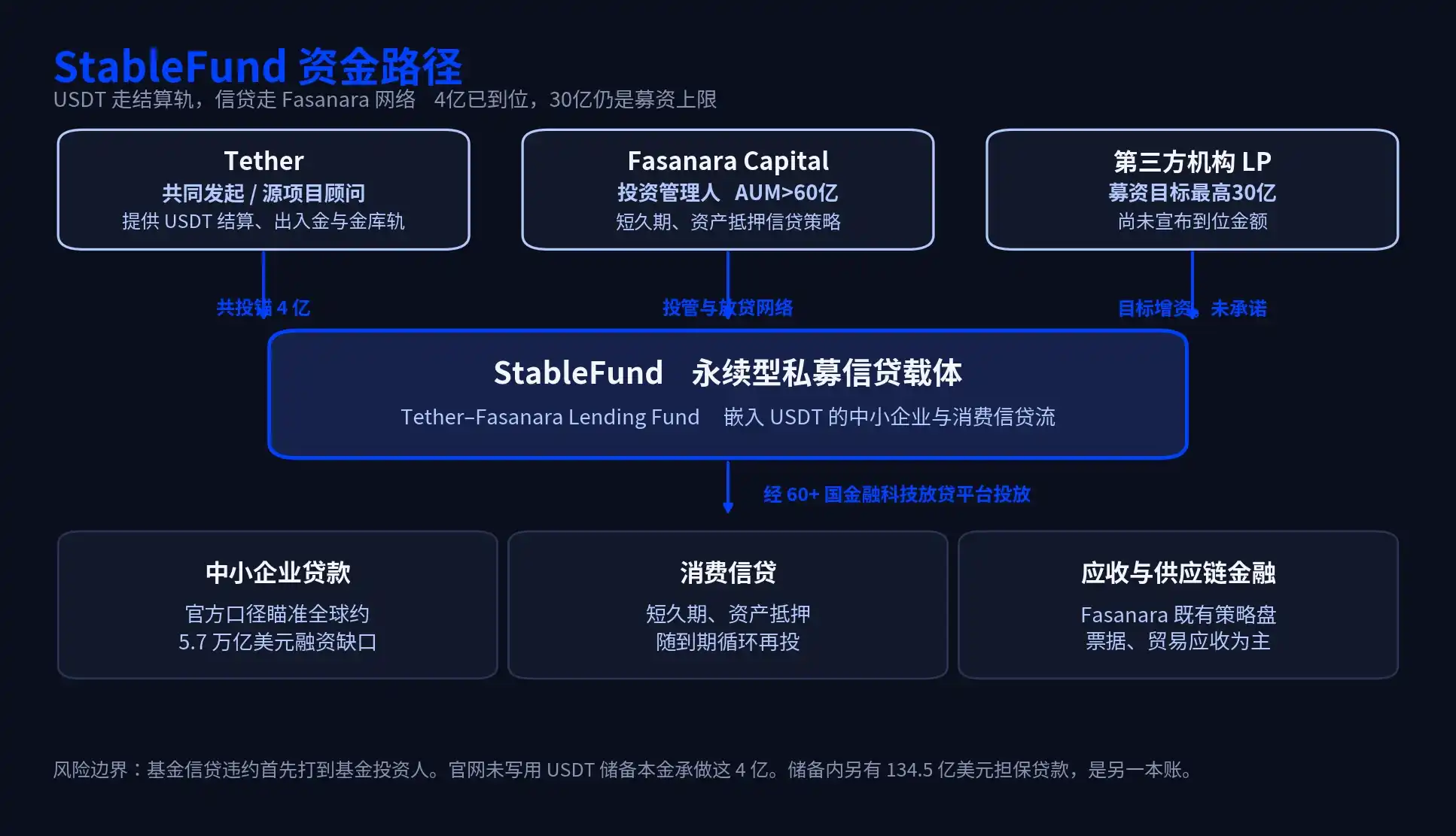
On September 9, Tether, in collaboration with London-based alternative asset manager Fasanara Capital, launched the StableFund, an evergreen private credit fund with a target size of up to $3 billion. The two parties contributed an initial $400 million in co-investment capital as the anchor, officially opening fundraising to external institutions.

This time, Tether is no longer targeting liquidity on crypto exchanges, but rather lending to physical small and medium-sized enterprises (SMEs) and consumer credit distributed across over 60 countries. While Silicon Valley is still debating the real-world use cases of cryptocurrencies, Tether, flush with massive US Treasury interest income, has quietly transformed into the most ambitious "on-chain shadow bank" in traditional finance.
Capital Flywheel: From Risk-Free Spread to a "Poacher" on Wall Street

Over the past two years, Tether's business logic has been remarkably simple: on one hand, meeting the demand for interest-free stablecoin issuance, and on the other, pouring its hundreds of billions in reserves into risk-free US Treasury assets.

This "money-printing machine" model, profiting from the interest spread, allowed Tether to easily record approximately $1.5 billion in operating profit in Q2 of this year.

However, as the global macroeconomic cycle of interest rate cuts approaches, the golden window for enjoying risk-free spreads is narrowing. Tether's enormous profit reserves must find the next reservoir capable of absorbing massive capital and offering higher potential returns.

Private Credit became the best landing point.

Against the backdrop of traditional Western banks contracting their balance sheets and a global SME financing gap reaching $5.7 trillion, Wall Street giants like Blackstone and Apollo have long deployed significant resources here. But unlike traditional Wall Street institutions, Tether wields a weapon for a dimensional strike: it not only provides capital but also the "road."

In this $3 billion venture, the funding pipeline has been completely restructured. Borrowers no longer receive wire transfer dollars that require multiple correspondent banks, take days to clear, and incur high fees. Instead, they receive USDT, settling in seconds.

Using USDT to Bypass the Traditional Banking Lending Track

Within this new vehicle named StableFund, the roles of Tether and Fasanara are clearly delineated, following a typical "storefront-backend" model.

London-based Fasanara plays the role of the "underwriter" and "risk controller." This specialized asset manager, overseeing over $6 billion in assets, has already established a lending network on fintech platforms across more than 60 countries. They are responsible for precisely channeling funds into short-duration, asset-backed SME and consumer credit strategies.

Tether, meanwhile, plays the most central role: the source of capital and the settlement rail. Tether CEO Paolo Ardoino maintains a sober and restrained view on this: Tether will not engage in direct debt collection but will provide the stablecoin infrastructure that enables cross-border lending to function.

At this point, the narrative of USDT undergoes a fundamental shift. It is no longer merely a "trading pair" used by crypto players to hedge volatility but has become a lending pipeline directly inserted into the real economies of emerging markets. Tether is transforming the liquidity once confined to crypto casinos into a dollar alternative that improves the financing efficiency of global physical businesses.
On-Balance-Sheet and Off-Balance-Sheet Gameplay: The Deep Waters of Shadow Banking Risk Control

Venturing into real-economy credit means Tether has officially stepped into the minefield of risk control that traditional banks fear most:

If borrowers can't repay, who bears the loss first?

According to the current structure, the newly established StableFund is an off-balance-sheet fund. Theoretically, its credit default losses will be contained within the fund's net asset value and its Limited Partners (LPs), thus isolated from the 1:1 redemption reserves backing USDT.

But scrutiny from the outside world never ceases. Because on Tether's own balance sheet, credit business is already a behemoth. As of Q2 this year, Tether's reserve assets still contain a staggering $13.45 billion in Secured Loans. In comparison, the initial $400 million anchor capital for the new fund is just a drop in the bucket for testing the waters.

What truly gives Wall Street and regulators pause is this: when a stablecoin giant lacking extreme transparency in audits holds tens of billions in on-balance-sheet secured loans while also starting to lend to micro, small, and medium-sized entities off-balance-sheet through fintech platforms in 60 countries, it has, in effect, become a super shadow bank that circumvents all capital adequacy constraints.

Before this $3 billion target is fully raised, StableFund is merely a reconnaissance mission. But once Tether, leveraging its extremely low cost of capital and the settlement advantages of USDT, truly carves out a niche in the global private credit market, any widespread cross-border collection failures or collateral depreciation could escalate into a stress test for the entire crypto liquidity foundation.

When that time comes, this "unlicensed global central bank" operating outside of regulation will undoubtedly face the harshest scrutiny from Washington.

Related Questions

QWhat is the key strategic move announced by Tether, and who is their partner?

ATether has announced a key strategic move into the private credit sector by launching the StableFund, a perpetual private credit fund with a target size of up to $3 billion. Their partner in this venture is the London-based alternative asset management firm, Fasanara Capital.

QHow does the StableFund plan to use USDT differently from its traditional role in crypto exchanges?

AThe StableFund plans to use USDT not just as a trading pair for speculation but as a core settlement rail for lending. It will provide borrowers in over 60 countries with near-instant, USDT-denominated loans for small and medium-sized enterprises and consumer credit, aiming to improve cross-border lending efficiency.

QWhat are the primary roles of Tether and Fasanara Capital within the StableFund partnership?

AWithin the StableFund partnership, Fasanara Capital acts as the 'underwriter' and 'risk controller,' leveraging its global fintech lending network to source and manage credit strategies. Tether serves as the 'capital source and settlement rail,' providing the foundational USDT liquidity and infrastructure for the lending operations.

QWhat major risk does the article highlight regarding Tether's expansion into private credit?

AThe article highlights the significant risk of Tether effectively operating as a 'super shadow bank' outside traditional banking regulations. Its entry into private credit, both on and off its balance sheet, exposes it to the complexities of global credit risk, loan defaults, and collateral depreciation, which could pressure the stability of the broader crypto liquidity system it underpins.

QWhat financial pressure is prompting Tether to seek new investment avenues like private credit?

ATether is seeking new investment avenues like private credit because the 'golden window' for earning easy profits from the interest rate spread between its non-interest-bearing stablecoin liabilities and risk-free U.S. Treasury assets is narrowing. With a global macro interest rate cutting cycle approaching, Tether needs to deploy its massive profit reserves into higher-yielding, capital-intensive assets.

Related Reads

When Will the Chip Stock 'Capitulation-Style Selling' End? BofA: Perhaps in Early 2027, Stock Price Pullbacks Typically Lead Fundamental Inflection Points by 6-9 Months

The SOX semiconductor index has fallen 38% (from 14,634 to 9,011) since its June 22, 2026 peak, over 136 days—exceeding the average historical peak-to-trough decline of 32% but less than half the average 253-day duration of past downturns (2011, 2015, 2018, 2022). BofA analyst Vivek Arya expects this "indiscriminate selling," driven by AI capex slowdown fears, to end around early 2027. Historically, SOX declines lead actual semiconductor sales declines by 6–9 months, implying real EPS cuts may emerge from Q1 2027, with capex reductions reflected in H2 2027—though stocks may already price in much of the bad news. SOX currently trades at 13.7x forward P/E versus 17.7x for the S&P 500 (a 22% discount, down from a 15% premium at the AI peak), leaving roughly 12% downside to the historical trough valuation of ~12x. US cloud capex runs at ~$300B/quarter (~$1.2T annualized) versus $1.555T consensus for 2027—about 23% below expectations if spending holds steady, equating to ~30 GW of compute deployment versus BofA's 40+ GW base case. A 20% capex cut would pressure AI semiconductor revenue by 20%+ and EPS by 35–40%. BofA outlines three scenarios: base case ( ~10% downside, bottoming Q1 2027, favor segment leaders), bear case (pressure into mid-2027, favor EDA, high-FCF analog, low-AI-exposure names), and bull case (favor memory, optics, quantum, CPUs). Potential stabilizers include policy clarity in Q1 2027, buybacks (Lam $25B, Nvidia, Micron starting Dec 9), and slower capex extending the upcycle.

marsbit16m ago

When Will the Chip Stock 'Capitulation-Style Selling' End? BofA: Perhaps in Early 2027, Stock Price Pullbacks Typically Lead Fundamental Inflection Points by 6-9 Months

marsbit16m ago

TSMC: October Revenue Up 60%, with Month-over-Month Growth Still Accelerating

TSMC reported October consolidated revenue of NT$586.89 billion, up 59.7% year-over-year and 14.7% month-over-month, signaling accelerating momentum. Converted to RMB, that is about RMB 119.4 billion, with cumulative revenue for the first ten months reaching NT$4.49 trillion, up 43.3% year-over-year. The near-60% growth came on top of an already high base, while the sequential acceleration confirms strengthening demand rather than a slowdown. The report arrived at a delicate moment. The Philadelphia Semiconductor Index had plunged 12.25% over two sessions, its worst single-day drop since March 2020, as political changes in the U.S. prompted new governors in Texas and Ohio to pause approvals for new data center projects. Markets pessimistically priced in a halt across the AI data center supply chain. Sentiment rebounded sharply on November 9, with the semiconductor index jumping 6.86%, and Taiwan's weighted index surging 1,960.06 points, its second-largest single-day gain on record, supported by government stabilization funds and short-selling restrictions. TSMC stands apart from other AI assets. As the only foundry capable of mass-producing 3nm and 2nm chips, it holds about 90% of the global AI chip foundry market, with advanced-node capacity booked through 2028. Its diversified revenue mix—68% high-performance computing, 21% smartphones, 4% automotive and 4% IoT—provides a buffer, allowing it to reallocate capacity to flagship phone chips, automotive computing, and edge AI if data center approvals slow. October's results validate management's guidance of roughly 44% full-year dollar revenue growth and capital spending of US$60-64 billion. Expansion continues, with 2nm ramping and Arizona's second fab moved up to Q3 2027; Goldman Sachs raised its 12-month target price to NT$3,300. Google's expanded eighth-generation TPU lineup adds further demand, with TSMC and other Taiwanese suppliers in the ecosystem. TSMC's ADR trades at about 24x trailing earnings, low relative to its growth. Risks include a prolonged U.S. data center approval freeze and geopolitical or oil-price shocks. In A-shares, domestic substitution names such as SMIC and NAURA remain driven by rising localization rather than Texas approvals.

marsbit17m ago

TSMC: October Revenue Up 60%, with Month-over-Month Growth Still Accelerating

marsbit17m ago

Trading

Spot
活动图片