The Decisive Significance of Next Week's US CPI: Will the Fed Hold Off on Rate Hikes in October?

marsbitPublished on 2026-10-10Last updated on 2026-10-10

Abstract

The upcoming US CPI data for September, to be released on October 14, is crucial for the Federal Reserve's policy decision at its October meeting. Key forecasts from Barclays and Morgan Stanley suggest headline inflation will accelerate, primarily driven by a sharp rise in energy prices, notably gasoline. However, core CPI, which excludes volatile food and energy costs, is expected to show a slight deceleration in its monthly growth rate. This moderation is largely attributed to a smaller increase in wireless communication service prices compared to August. While the energy-driven surge in headline CPI presents an upside risk, the marginal easing in underlying price pressures is seen as supporting the case for the Fed to keep interest rates unchanged in October. Market expectations and analyst views have largely shifted the potential for another 25 basis point hike to the December meeting, contingent on further data confirming the inflation trajectory. The report also highlights the need to monitor variables such as airline fare trends, housing inflation stability, and the impact of recent smartphone price adjustments on the overall inflation outlook. The CPI data will also inform the Fed's preferred inflation gauge, the core PCE index, which is projected to remain around 3% year-over-year.

Written by: Zhang Yaqi, Wall Street Insights

Energy prices are once again driving the inflation trend, but the pressure from core inflation is easing marginally, providing support for the Fed to hold rates steady.

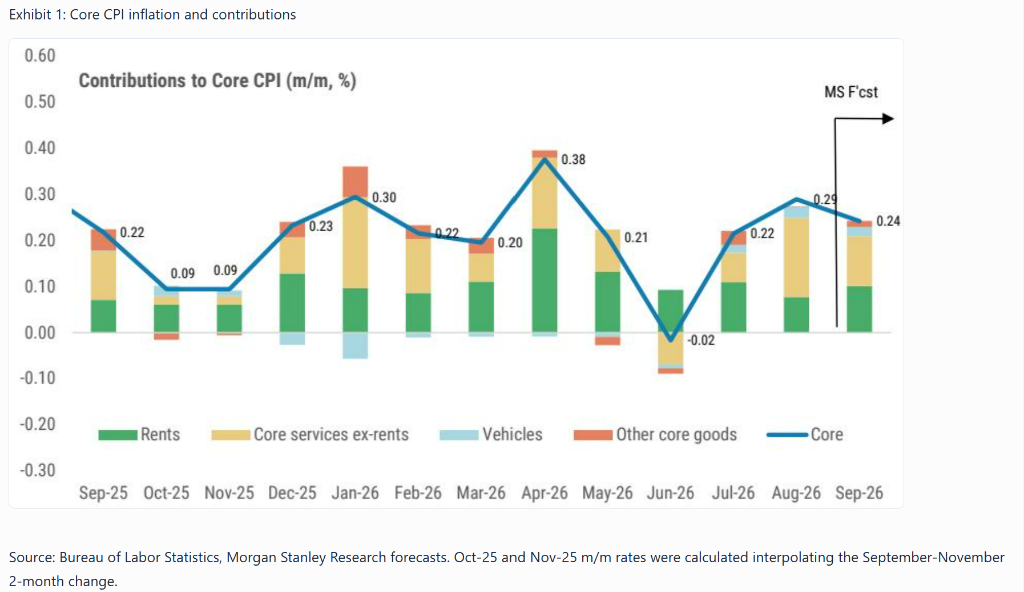
The U.S. Bureau of Labor Statistics will release the September CPI data on October 14 (next Wednesday). According to market news, Barclays and Morgan Stanley predict that the headline CPI in September will accelerate due to a significant increase in gasoline prices. However, the month-over-month increase in core CPI is expected to be slightly smaller than August's figure, primarily due to a partial pullback in wireless communication service price increases. Both institutions forecast a month-over-month core CPI increase of 0.24%, lower than August's 0.29%.

This data will directly influence the Fed's decision at its October meeting. Barclays research believes that, although recent inflation risks remain skewed to the upside, Fed officials are likely to keep interest rates unchanged in October, continuing to observe subsequent data and pushing a potential 25-basis-point hike to December.
The Fed's recently released September meeting minutes showed that "most" officials expect one more rate hike this year but hinted there's no rush in October. Fed Governor Waller stated that rate hikes need not occur at consecutive policy meetings, and officials can be flexible with timing based on economic data. The market has already postponed rate hike expectations from October to December. Goldman Sachs believes a December hike is more likely, but the probability that the FOMC ultimately judges further tightening unnecessary is also quite substantial.

Energy Drives Headline Inflation, Top-Line Data Jumps

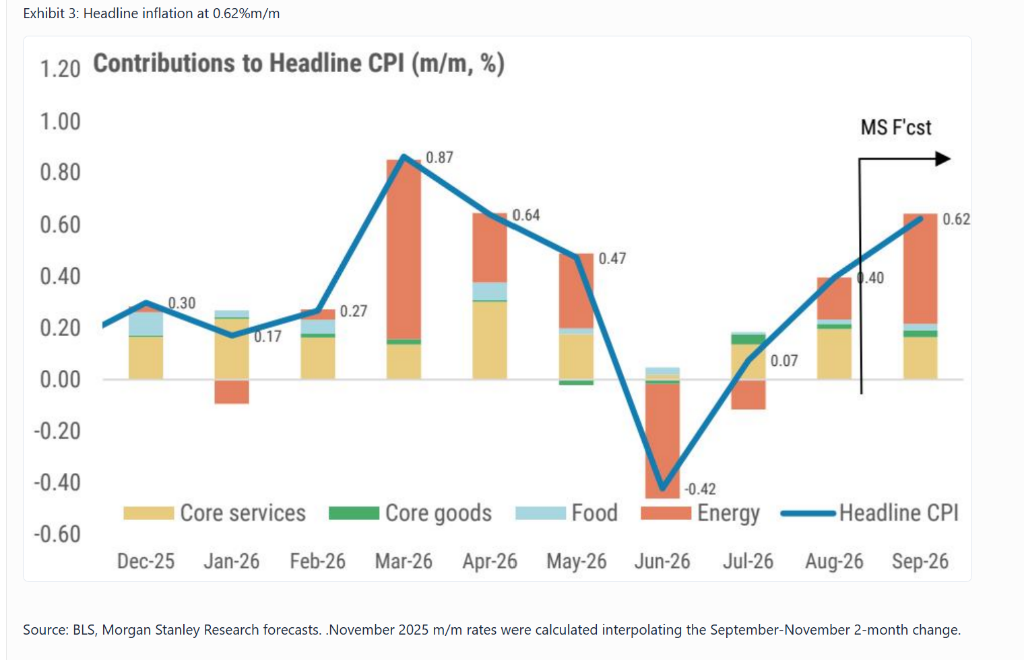
Barclays forecasts that the headline CPI in September will rise 0.58% month-over-month (seasonally adjusted), with the year-over-year rate climbing to 3.7%, up about 0.3 percentage points from August's 3.4%, though still below the recent peak of 4.2% seen in May. Morgan Stanley's forecast is slightly higher, with a year-over-year increase of 3.69% and a month-over-month increase of 0.62%.

Energy is the core driver of this headline inflation jump. According to Barclays' forecast, the energy component's month-over-month increase is as high as 5.05%, with gasoline prices surging 9.23% month-over-month, representing a 34.8% year-over-year increase; heating oil is even higher at 38.8% year-over-year.

Morgan Stanley notes that the ongoing tensions in the Middle East are an important factor pushing up oil prices and will further transmit to airfares and transportation costs. Barclays' research team also warned in a previous report that rising diesel prices are gradually being passed through to U.S. consumers.
Core Inflation Slows Slightly, Wireless Communication Pullback is Main Reason

While headline inflation rises, core CPI pressure has eased slightly. Barclays forecasts a 0.24% month-over-month increase in core CPI for September, year-over-year at 2.5%; Morgan Stanley's forecast is consistent, also at 0.24%, both down 5 basis points from August's 0.29%.

The primary force behind the core inflation slowdown comes from the "Education and Communication" component. In August, wireless communication service prices jumped unusually, contributing about 0.1 percentage points to core CPI that month. Barclays expects that Verizon's latest price increase, combined with AT&T's planned price hike being more moderate, will still exert upward pressure on inflation from this component in September, but the force will be significantly less than last month.

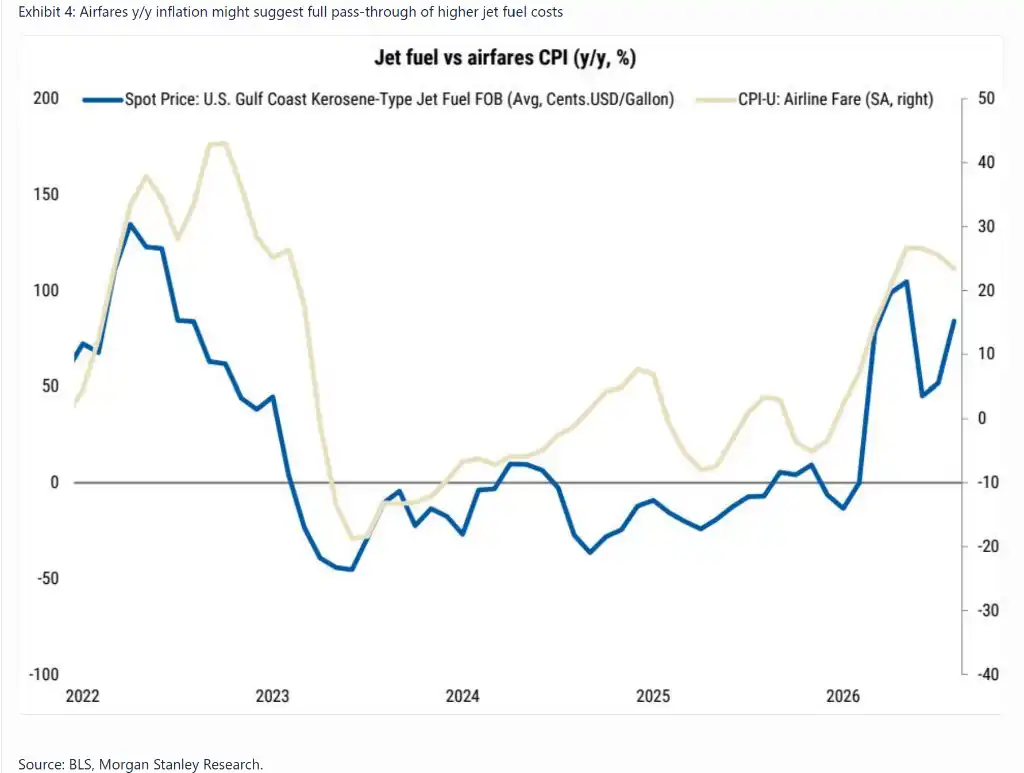
Meanwhile, airfares and medical service prices remain supporting factors for core inflation. Morgan Stanley points out that airfares already rose 23% year-over-year in August and are still forecast to increase 1.8% month-over-month in September; Barclays predicts a 2.6% month-over-month increase in airfares. Morgan Stanley adds that jet fuel prices are up nearly 90% year-over-year, and fuel accounts for about 20% to 30% of airline operating costs. By this measure, airlines' pass-through of fuel cost increases to prices may be nearing completion. Additionally, after weakening in August, Morgan Stanley forecasts medical services will rebound 0.55% month-over-month in September.
Regarding core goods, Barclays and Morgan Stanley forecast month-over-month increases in the range of 0.13% to 0.14%, essentially flat with August, with new and used car prices strengthening slightly.

Shelter Inflation Stabilizes, Insurance Drag Persists

The shelter component continues its steady trend. Barclays forecasts that Owners' Equivalent Rent (OER) will rise 0.24% month-over-month in September, and primary residence rent will increase 0.23%; Morgan Stanley predicts OER and primary residence rent at 0.25% and 0.20%, respectively. Morgan Stanley notes that since May this year, shelter inflation has averaged about 0.24% per month, slightly below the long-term pre-pandemic trend of 0.26%, and expects it to fluctuate near this level in the near term.

Auto insurance continues to be a drag on core inflation. Morgan Stanley forecasts that auto insurance premiums will decline 0.20% month-over-month in September and expects the negative growth trend to continue into 2027, mainly because improved profitability for insurers is prompting them to compete for market share through price reductions.

Regarding hotel prices, which rebounded strongly in August after two consecutive months of unusual weakness, Morgan Stanley predicts they will return to flat (0% month-over-month) in September.

PCE Inflation Forecast: Expected to Remain Near 3%

The CPI data also provides guidance for the Fed's preferred PCE inflation measure. Barclays forecasts core PCE inflation for September at 0.22% month-over-month, year-over-year around 3.0%; Morgan Stanley's forecast is slightly higher at 0.23% month-over-month.

Barclays researchers Pooja Sriram, Marc Giannoni, Jonathan Millar, and Colin Johanson point out there is some uncertainty in the PCE price for financial services, especially with the Bureau of Economic Analysis (BEA) adopting a new method to estimate the price of portfolio management services. Required data on nominal expenditures and hours worked may not be available timely, adding to forecasting difficulty. The team stated they will further revise their forecast after next week's CPI and PPI data release.

Fed Path: Hold Steady in October, 25 bps Hike in December

Regarding the policy path, Barclays maintains its baseline forecast: the Fed will hike rates by 25 basis points in December. The institution notes that due to base effect drag, the six-month and twelve-month medium-to-long-term inflation measures favored by Chair Warsh are unlikely to improve significantly within this year, but the outlook for 2027 will markedly improve.

Recent remarks from Fed officials show that uncertainty around the distribution of inflation outcomes may support further tightening from a risk management perspective, but Barclays expects policymakers to choose to wait and watch in October, awaiting more data for verification.

It is worth noting that Morgan Stanley reminds us that several key variables in this report need close tracking: First, Apple increased prices for some older iPhone models by 10% to 14% when releasing new iPhones on September 9. However, as smartphones account for only about 0.2% of the CPI basket, and sampling in some areas is bi-monthly, the direct impact is expected to be no more than 1 to 1.4 basis points. Second, whether there is further room for airfare increases is nearing its ceiling. Third, whether shelter inflation can maintain its current stable pace.


Related Questions

QAccording to the article, what is the expected trend for the US Core CPI in September and what is the primary reason?

AAccording to forecasts by Barclays and Morgan Stanley cited in the article, the Core CPI for September is expected to show a slightly slower pace of increase, with a projected month-on-month rise of 0.24%, down from 0.29% in August. The primary reason for this slight deceleration is a partial reversal in the sharp increase seen in wireless communication service prices from the previous month.

QWhy is the overall headline CPI for September expected to rise significantly, and what is the main contributing factor?

AThe overall headline CPI for September is expected to jump significantly, with forecasts pointing to a month-on-month increase of around 0.58-0.62%. The main contributing factor is a sharp rise in energy prices, particularly gasoline, which is predicted to have surged approximately 9.23% month-on-month and 34.8% year-on-year, driven in part by geopolitical tensions in the Middle East.

QBased on the analysis from the article, what is the likely outcome of the Federal Reserve's October FOMC meeting regarding interest rates?

AThe article states that analysts, including those from Barclays, believe the Federal Reserve is very likely to keep interest rates unchanged in October. They are expected to adopt a wait-and-see approach, gathering more data before potentially implementing a final 25-basis-point rate hike in December, as the core inflationary pressures show signs of marginal easing.

QWhat are the key variables that Morgan Stanley identifies as requiring close monitoring in the upcoming CPI report, according to the article?

AAccording to the article, Morgan Stanley highlights three key variables to watch: 1) The impact of Apple's price hikes on older iPhone models (though the direct effect on CPI is estimated to be minimal). 2) Whether the upward momentum in airfares is nearing its limit. 3) Whether housing inflation can maintain its recent stable pace.

QHow is the housing component of inflation expected to perform in September, and what is the forecast for auto insurance prices?

AThe housing component is expected to continue its stable trend. Forecasts indicate that Owners' Equivalent Rent (OER) and primary rent will see modest month-on-month increases around 0.20-0.25%. Conversely, auto insurance prices are predicted to decline by around 0.20% month-on-month in September, with expectations for this negative trend to persist due to improved insurer profitability and competitive pricing.

Related Reads

Former OpenAI Researcher Changes His Tune: Super AI Researcher Could Arrive as Early as Next Year

Former OpenAI researcher Daniel Kokotajlo and the AI Futures Project have revised their timelines, now predicting superhuman AI researchers (SARs) could arrive as early as 2027 rather than 2029. The key driver is a METR assessment of Anthropic, which found that since October 2025, the benchmark score growth rate of Anthropic's internal models reached about 1.9x the previous pace (95% CI: 1.5–2.8x) — roughly two years' worth of progress in one year. METR estimates that by October 2026, about 80% of the extra acceleration may come from AI itself, though this is a subjective guess with high uncertainty. AI is already helping researchers write experiment code, run tests, and try out more ideas. Using METR's estimates, the team calculated that by early November 2026, AI-driven acceleration alone could push overall model progress to 1.7x the historical rate — a speed that, in the original AI 2027 scenario, wouldn't be reached until around April 2027, about five months later. Notably, METR says most of the evidence underpinning its core conclusions was redacted from the public report at Anthropic's request, to avoid helping competitors; only the benchmark curves are publicly verifiable. Depending on the method used, SAR arrival estimates range from February 2027 to mid-2028. If acceleration compounds across model generations, superintelligence could arrive sooner than expected.

marsbit13m ago

Former OpenAI Researcher Changes His Tune: Super AI Researcher Could Arrive as Early as Next Year

marsbit13m ago

Aave V3.8 Officially Launches: Covering 15 Public Chains, $15.2 Billion Liquidity Pool, Introducing Low-Gas-Cost Reentrancy Protection

Aave has launched V3.8 across 15 active V3 markets, following approval by the Aave DAO and development by Aave Labs. According to DeFiLlama, Aave's total value locked exceeds $16.4 billion, with active V3 markets holding over $15.23 billion. The upgrade was deployed via AIP #541, completing a 22-day governance process that began with a forum proposal on October 21 and a Snapshot vote on October 27. V3.8 covers active instances on Ethereum (Core and Lido), Plasma, Avalanche, BNB Chain, Monad, Base, and Arbitrum, along with Mantle, X Layer, Polygon, Linea, Optimism, Gnosis, MegaETH, and Celo. Legacy markets that were frozen with zero caps were deliberately skipped. The release introduces kernel-level reentrancy protection for external callback operations on liquidity pools. Traditionally, preventing cross-function reentrancy requires writing a lock flag before state changes, but after EIP-3529 capped SSTORE refunds at 20%, maintaining persistent locks in high-frequency lending pools became gas-intensive. V3.8 instead uses EIP-1153 transient storage, where TSTORE and TLOAD cost only 100 gas per read or write and automatically clear at transaction end, providing reentrancy hardening at minimal cost. Aave Labs addressed developer concerns that the lock might block liquidation composability within flash loan callbacks. The flashLoan and flashLoanSimple entry points only check the lock status without setting it, creating asymmetric isolation: users can still compose liquidations, deposits, or repayments inside a flash loan callback, but attempts to initiate a flash loan from within a regular pool operation callback are rejected and reverted. Security verification included Certora formal verification and independent external audits before the AIP vote. The new contract code is published in the official Aave V3 repository under the Business Source License. Developers also noted that downstream integrators reading view functions such as account health factors or reserve data during callbacks should account for intermediate ledger states and ensure peripheral risk controls remain compatible.

marsbit14m ago

Aave V3.8 Officially Launches: Covering 15 Public Chains, $15.2 Billion Liquidity Pool, Introducing Low-Gas-Cost Reentrancy Protection

marsbit14m ago

Trading

Spot
活动图片