Goldman Sachs Research Report Analysis: Sandisk NBM Locks in 80% Gross Margin, Target Price Sees 26% Upside

marsbitPublished on 2026-09-10Last updated on 2026-09-10

Abstract

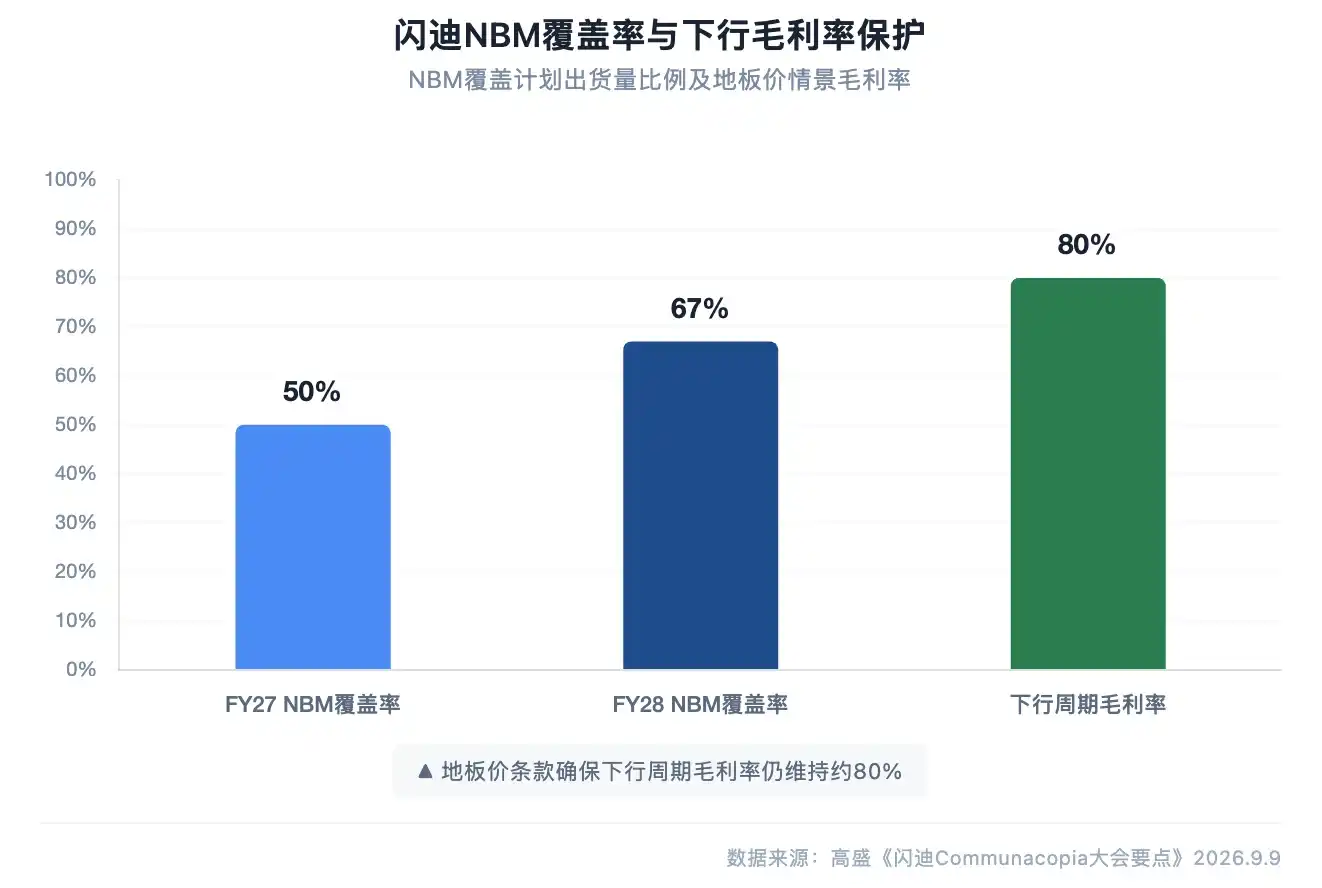
Goldman Sachs report analysis: Sandisk's NBM contracts are expected to secure an 80% gross margin floor, with a target price implying 26% upside. At the Communacopia conference, Sandisk revealed that its long-term NAND Business Model (NBM) agreements cover 50% of planned FY27 and 67% of FY28 shipments. Crucially, these contracts contain floor-price clauses designed to protect approximately 80% gross margins even in a pessimistic NAND price downturn scenario. Goldman Sachs, in a September 9 report, reiterated its Buy rating with a 12-month price target of $2,200, implying 26.6% upside from the current $1,738. The core thesis is shifting from cyclical play to structural upgrade. The NAND market is transitioning from short-term spot pricing to long-term agreements, driven primarily by data center demand. Supply growth remains constrained while demand expands, fueled by AI inference. Sandisk, via its joint venture with Kioxia and its low capital intensity, is positioned for stronger earnings visibility. Key points from the report and management commentary: - **NBM & Margin Visibility:** The floor-price mechanism in NBMs significantly reduces exposure to spot price volatility, locking in high-margin revenue for a substantial portion of future shipments. - **Tight Supply Dynamics:** Management expects limited NAND supply growth, with AI inference driving demand. Chinese competitors' capacity expansions are viewed as largely absorbed by the domestic market. - **Long-Term Growth v...

Author: Rita

At the Communacopia conference, Sandisk revealed that its long-term agreements (NBM) now cover 50% of FY27 and 67% of FY28 planned shipment volumes. Even in a pessimistic NAND price decline scenario, the floor prices in these agreements can still support a gross margin of around 80%. In its conference summary report dated September 9, Goldman Sachs maintained its 'Buy' rating with a 12-month target price of $2,200, implying a 26.6% upside potential from the current price of $1,738.

Goldman Sachs believes Sandisk's core investment thesis is shifting from cyclical speculation to structural upgrade. The NAND market is transitioning from short-term spot pricing to long-term agreements, with data center demand becoming the primary driver. Growth on the supply side is constrained, while demand continues to expand driven by AI inference. Through its joint venture platform with Kioxia and low capital intensity, Sandisk possesses stronger earnings visibility in this cycle.

NBM Locks in 80% Gross Margin

Sandisk's management detailed the financial components of NBM at the conference. The floor price clause is central, ensuring that under extreme scenarios of significant NAND price declines, the gross margin for the majority of its business can still be maintained at around 80%. This protective mechanism alters Sandisk's profit structure, making it no longer fully exposed to the sharp fluctuations of spot prices.

In terms of coverage ratio, 50% of FY27 planned shipments and 67% of FY28 are covered by NBM. Goldman Sachs views this coverage as a significant improvement in Sandisk's revenue visibility for the next two years. Management's confidence in long-term financial targets is precisely built upon the certainty brought by these agreements.
Supply Constraints, Chinese Capacity Absorbed Domestically

Sandisk's outlook on the NAND supply side is tight. Management believes that supply growth will remain sluggish for the foreseeable future, while the proliferation of AI inference continues to drive demand growth. This supply-demand dynamic provides support for prices.

Regarding capacity expansion by Chinese competitors, Sandisk believes that their new supply is primarily absorbed by the local market, having a limited impact on the global market. Goldman Sachs also mentioned in its report that YMTC's roadmap iteration is a potential risk, but its impact is judged to be manageable at present.

HBF Opens Long-Term Space

Sandisk management expressed optimism about the long-term prospects of HBF and KV Cache. HBF is seen as a potential solution to the AI 'memory wall' problem, with its higher density able to meet the dual demands of AI computing for memory bandwidth and capacity. KV Cache is crucial for AI inference; management had previously described it as a key component of the AI data center memory TAM.

Goldman Sachs cited management's estimate that by 2032, KV Cache will account for approximately 35% of the 1.2 ZB AI data center memory TAM. This data suggests that Sandisk has far greater long-term growth space in the AI storage field than in traditional NAND.

Low Capital Intensity Supports Bit Growth

Sandisk's joint venture agreement with Kioxia has been extended to 2034. Management emphasized that this arrangement, combining IP ownership and R&D investment, gives the JV efficient manufacturing capability, allowing it to gain a disproportionate share of bit growth relative to capital expenditure. Sandisk's capital intensity is about 5%, significantly lower than the industry average.

Management also stated that through the BiCS platform, the company can already see the technology roadmap for several years ahead, supporting further bit growth under the same low capital intensity. Goldman Sachs believes this cost advantage is a key differentiating factor for Sandisk compared to its peers.

Share Buybacks Lead Capital Return

Sandisk reiterated that share repurchases are the primary method for returning excess capital to shareholders. The company has executed approximately $4.5 billion in buybacks. Management remains open to introducing dividends in the future, but buybacks remain the core tool at this stage.

Goldman Sachs's $2,200 target price is based on a 20x P/E multiple applied to a normalized EPS of $110. The current price of $1,738 implies a 26.6% upside potential. Goldman Sachs believes the earnings stability brought by NBM, the industry's constrained supply, and low capital intensity jointly support this valuation.

Downside risks include: the long-term structural shift in NAND pricing failing to materialize; YMTC continuing to iterate its technology roadmap; Sandisk failing to gain eSSD market share.
Disclaimer

This article is Tide Research's compilation and interpretation of a third-party brokerage research report (Goldman Sachs, September 9, 2026), combined with the organization of public market information. The ratings, target prices, earnings forecasts, and related judgments cited in this article are the views of that brokerage's analyst, representing only the stance of their affiliated institution, and do not represent Tide Research's views, nor do they constitute any investment advice.

The market carries risks; decisions must be made independently. This article should not serve as the basis for buying or selling any securities.

Related Questions

QWhat is the key financial protection mechanism of SanDisk's NBM (Long-term Agreements) mentioned in the report, and what level of gross margin does it support?

AThe core financial protection mechanism is the floor price clause. This clause ensures that, even in a pessimistic scenario of declining NAND prices, it can support a gross margin of approximately 80% for a majority of SanDisk's business covered by these agreements.

QWhat is the current stock price of SanDisk and Goldman Sachs' 12-month target price, as stated in the article?

AThe current stock price is $1738. Goldman Sachs' 12-month target price is $2200, implying an upside potential of 26.6%.

QAccording to Goldman Sachs, what is the main reason for SanDisk's shift in core investment logic?

AGoldman Sachs believes SanDisk's core logic is shifting from cyclical speculation to structural upgrade. This is due to the NAND market's transition from short-term spot pricing to long-term agreements, with data center demand becoming the primary driver.

QWhat does SanDisk management predict regarding the long-term TAM (Total Addressable Market) contribution of KV Cache for AI data center memory by 2032?

AManagement's calculation, cited by Goldman Sachs, indicates that by 2032, KV Cache will account for approximately 35% of the 1.2 Zettabyte AI data center memory TAM.

QWhat is SanDisk's current primary method for returning excess capital to shareholders, and what is an alternative they remain open to?

ASanDisk's primary method for returning excess capital is through stock repurchases. The company has already executed about $4.5 billion in buybacks. Management is open to introducing a dividend in the future, but share repurchases remain the core tool for now.

Related Reads

Strategy stock sheds 5% amid MSCI index removal, Bitcoin sell-off

Strategy (Michael Saylor's Bitcoin treasury company) fell 6.49% on Thursday to close at $114.41, after MSCI confirmed the company's removal from its global equity indexes, compounded by a broader crypto market sell-off. The removal takes effect after the Nov. 30 market close and could trigger selling by index-tracking funds; JPMorgan previously estimated roughly $2.8 billion in potential selling pressure. Ryan Kirkley, CEO of Global Settlement Network, said the decision could distinguish Bitcoin treasury companies from traditional operating businesses and limit indirect crypto exposure for passive investors, noting that index inclusion had given ordinary passive investors leveraged Bitcoin exposure they never chose. He added it raises questions about whether such companies should be classified alongside traditional operating businesses, arguing that buying and holding an asset isn't an operating business but rather a fund that doesn't follow fund rules. In its Aug. 31 response to MSCI's proposed rules, Strategy called the changes a pretext for targeting digital asset treasury companies and downplayed the impact, saying MSCI-linked funds held about 13 million of its shares, just 3.1% of basic shares outstanding. The decline coincided with a broader crypto sell-off, with Bitcoin near $71,340, down 4.3% in 24 hours, and total crypto market capitalization down 3% to about $2.49 trillion.

cointelegraph29m ago

Strategy stock sheds 5% amid MSCI index removal, Bitcoin sell-off

cointelegraph29m ago

US Justice Department, business groups and DeFi firms challenge Illinois crypto tax

The US Department of Justice, business and financial industry groups, and a coalition of DeFi firms have backed a legal challenge to Illinois' 0.2% digital asset tax, arguing it unfairly targets crypto transactions and could impose taxes even without profit. The Justice Department filed a statement of interest, while the US Chamber of Commerce and SIFMA submitted an amicus filing. A coalition including Andreessen Horowitz, Paradigm, Uniswap and Aave Labs also filed a brief. The law, enacted in June, taxes the value of digital assets exchanged, transferred or stored regardless of profit. The Digital Chamber sued Illinois officials in July, followed by a separate challenge from the Blockchain Association and Crypto Council for Innovation in August. Originally set for Jan. 1, 2027, the tax was delayed to July 1, 2027. Illinois projected $60 million in fiscal year 2027 revenue. SIFMA and the Chamber warned the tax would affect banks, broker-dealers, custodians and asset managers nationwide, exposing them to compliance costs and burdening customers—someone who loses money owes the same tax as someone who profits, and moving assets between accounts could trigger tax without a sale or gain. They argued it discriminates against digital assets and may violate federal internet tax protections and constitutional interstate commerce requirements. The DOJ said the tax undermines federal efforts to promote crypto innovation, citing the Strategic Bitcoin Reserve and GENIUS Act. The DeFi coalition warned the rules could impose obligations on software developers and blockchain participants lacking customer information or control over funds.

cointelegraph1h ago

US Justice Department, business groups and DeFi firms challenge Illinois crypto tax

cointelegraph1h ago

DTCC Plans Solana Expansion as Wallet Rules Limit Access

DTCC plans to connect its tokenization service to Solana in the second half of 2027, allowing certain securities held by its DTC subsidiary to be converted into digital tokens on the network. Analysts say the move could attract more traditional financial institutions to Solana, which is known for fast transactions and low fees and had about $4.94 billion in total value locked as of Nov. 12. However, the impact may be limited by US regulatory rules. Alex Lin of Reforge noted that Solana's experience handling memecoin trading served as a public stress test, giving the network credibility to handle retail-scale volume reliably. Still, under a December 2025 SEC no-action letter, DTC participants must register wallets to hold tokenized securities, and tokens can only be transferred between registered wallets. Lin said the near-term impact is overstated because the tokens remain in a walled garden, inaccessible to permissionless retail and DeFi liquidity until regulators allow these assets to function as true onchain collateral. DTCC launched its tokenization service on the Canton Network and its private Besu network on Oct. 28, with 20 DTC participants signed on, though it has not said whether any plan to use Solana. Kha Nguyen of Birdeye said Solana has already seen growing demand for tokenized stocks, with trading volume reaching around $4.9 billion in H1 2026 and over 1 million accounts holding tokenized stocks by late September. However, broader Solana activity has slowed, with transactions down nearly 40%, DEX volume down 34.4%, and fees down 39%, while tokenized RWA value rose almost 7% to $4.76 billion. Nguyen said DTCC's integration would need banks, brokers, and issuers to actively issue, trade, and settle on Solana, with enough liquidity for large trades. He stressed that assets must be active rather than idle—traded around the clock, used as collateral, and earning yield. Lin agreed that long-term impact depends on where assets are used for secondary trading and collateral activity, not where they are issued.

cointelegraph2h ago

DTCC Plans Solana Expansion as Wallet Rules Limit Access

cointelegraph2h ago

Trading

Spot
活动图片