CryptoQuant’s 3 charts keeping Bitcoin’s ‘Uptober’ thesis valid

cointelegraphPublished on 2026-10-14Last updated on 2026-10-14

Abstract

CryptoQuant's analysis suggests Bitcoin (BTC) may still achieve a strong performance in October, traditionally known as "Uptober," as on-chain data points to a potential local price bottom forming. Key indicators show cautious optimism: Bitcoin exchange reserves have decreased by 1.7% since mid-September, reducing selling pressure, while whale holdings remain stable above 3 million BTC despite recent price drops. The "apparent demand" metric, which had been negative for most of 2026, is nearing positive territory again, indicating recovering demand. Analysts note that cooling expectations for U.S. interest rate hikes and reduced political uncertainty post-midterm elections could further support risk assets like Bitcoin. However, confirmation of a sustained bottom requires continued ETF inflows and stronger spot buying. The report emphasizes that an "Uptober" rally does not preclude corrections, which can build a foundation for future advances.

Bitcoin (BTC) can still preserve its traditionally strong October performance, as onchain data points to a local BTC price bottom forming.

Key points:

  • Onchain data suggested that Bitcoin could still end October strong, following historical patterns.
  • Bitcoin exchange reserves remained 1.7% lower than in mid-September, while whales avoided selling.
  • Apparent demand neared a transition to positive readings for the second time in 2026.

BTC price analysis flags “potential bottom” signals

New analysis published on crypto analytics platform CryptoQuant Monday show onchain conditions in a state of “cautious optimism.”

Bitcoin continues to weather mixed macroeconomic and geopolitical headwinds, which include 24-year highs in US bond yields, rising oil prices and cooling capital inflows to exchange-traded products. These conditions have dampened optimism over Bitcoin delivering a strong performance in October.

“Now, signs of a potential bottom are emerging,” CryptoQuant contributor XWIN Research Japan wrote.

Since the start of October, conditions have changed to increasingly benefit crypto and risk assets. XWIN points to cooling expectations of interest-rate hikes by the Federal Reserve into 2027, boosting the odds of inflows improving. At the same time, markets expect more clarity over the US domestic political situation after the approaching Midterm Elections.

“Less political uncertainty after the vote could help investors reassess allocations,” XWIN continued.

Bitcoin exchange reserves, apparent demand and whale holdings give XWIN reasons to believe that October’s local low may have already occurred.

The BTC supply on exchanges has fallen from 2.726 million on Sept. 20 to 2.68 million as of Tuesday, a decrease of 1.7%, despite a modest increase over the past week.
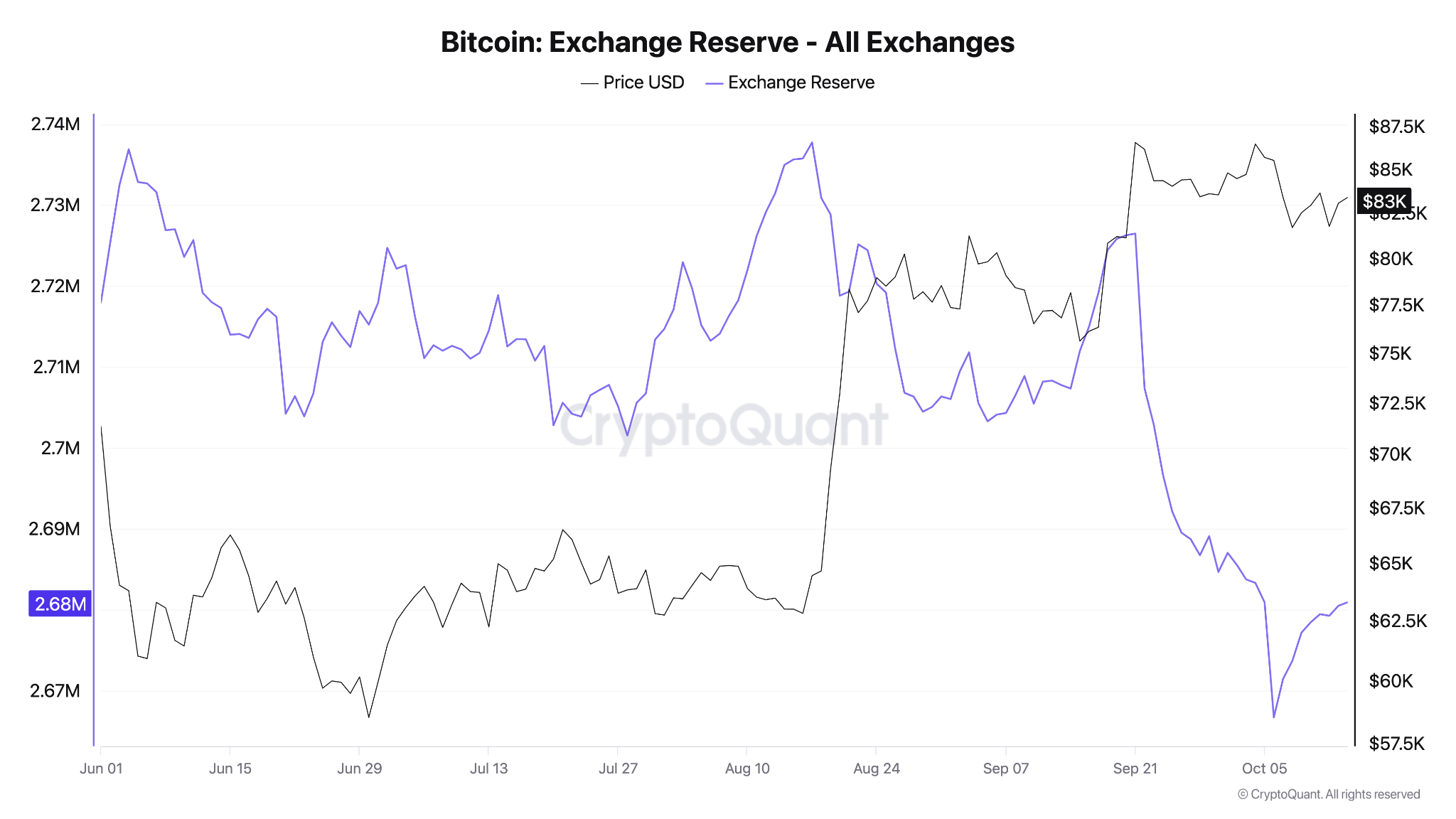
Bitcoin exchange BTC reserves. Source: CryptoQuant

At the same time, the combined holdings owned by large-volume investors, or whales, remain above 3 million BTC. The cohort’s urge to reduce exposure has survived BTC/USD dropping from $87,000 on Oct. 2 to near $80,000 on Oct. 8.
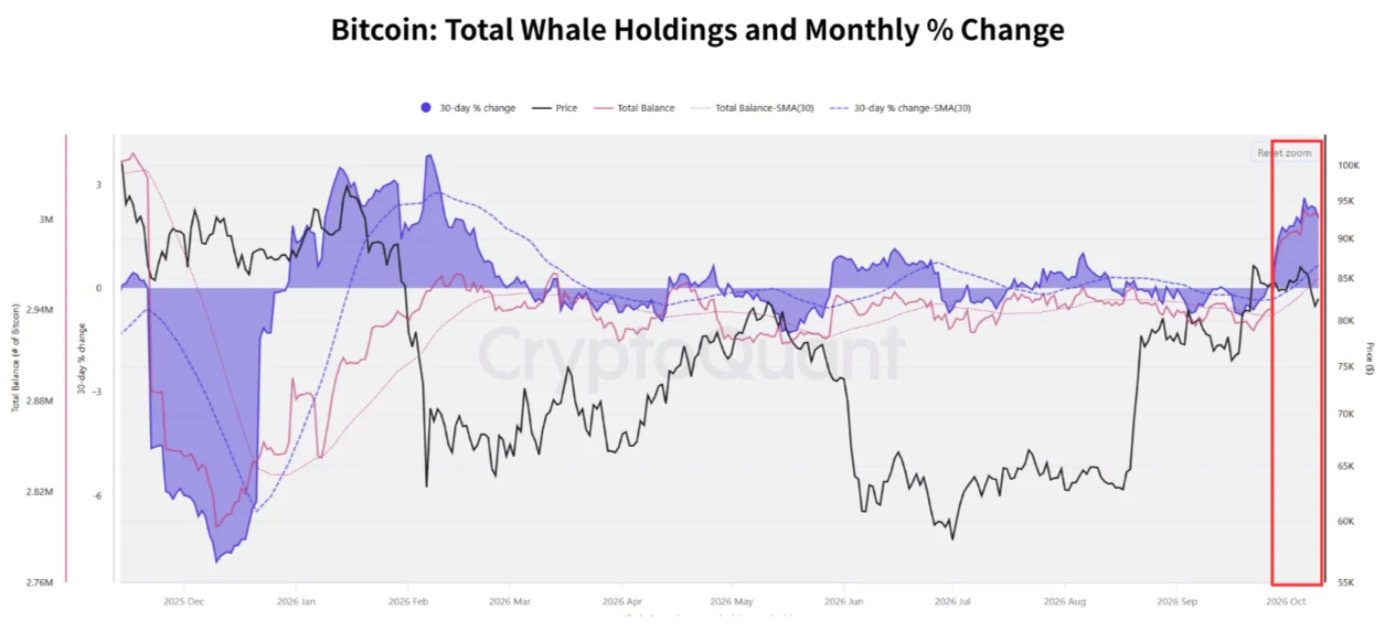
Bitcoin whale holdings (screenshot). Source: CryptoQuant

Bitcoin demand data stays bullish in October

Apparent demand, a measure that compares newly mined BTC with changes in dormant supply, shows overall demand remains supportive.

Related: Bitcoin keeps up pressure on $84K as US stocks skirt Korea tech sell-off

The metric has been negative throughout 2026, with a brief period of positive 30-day readings in the second half of August. Since then, demand has been negative, but has recovered to near-neutral levels as of this week.

“These developments suggest conditions for a bottom are improving. Confirmation requires sustained ETF inflows, stronger US spot buying and continued demand recovery,” XWIN said.

“‘Uptober’ need not mean uninterrupted gains: a correction can build the foundation for the next advance.”
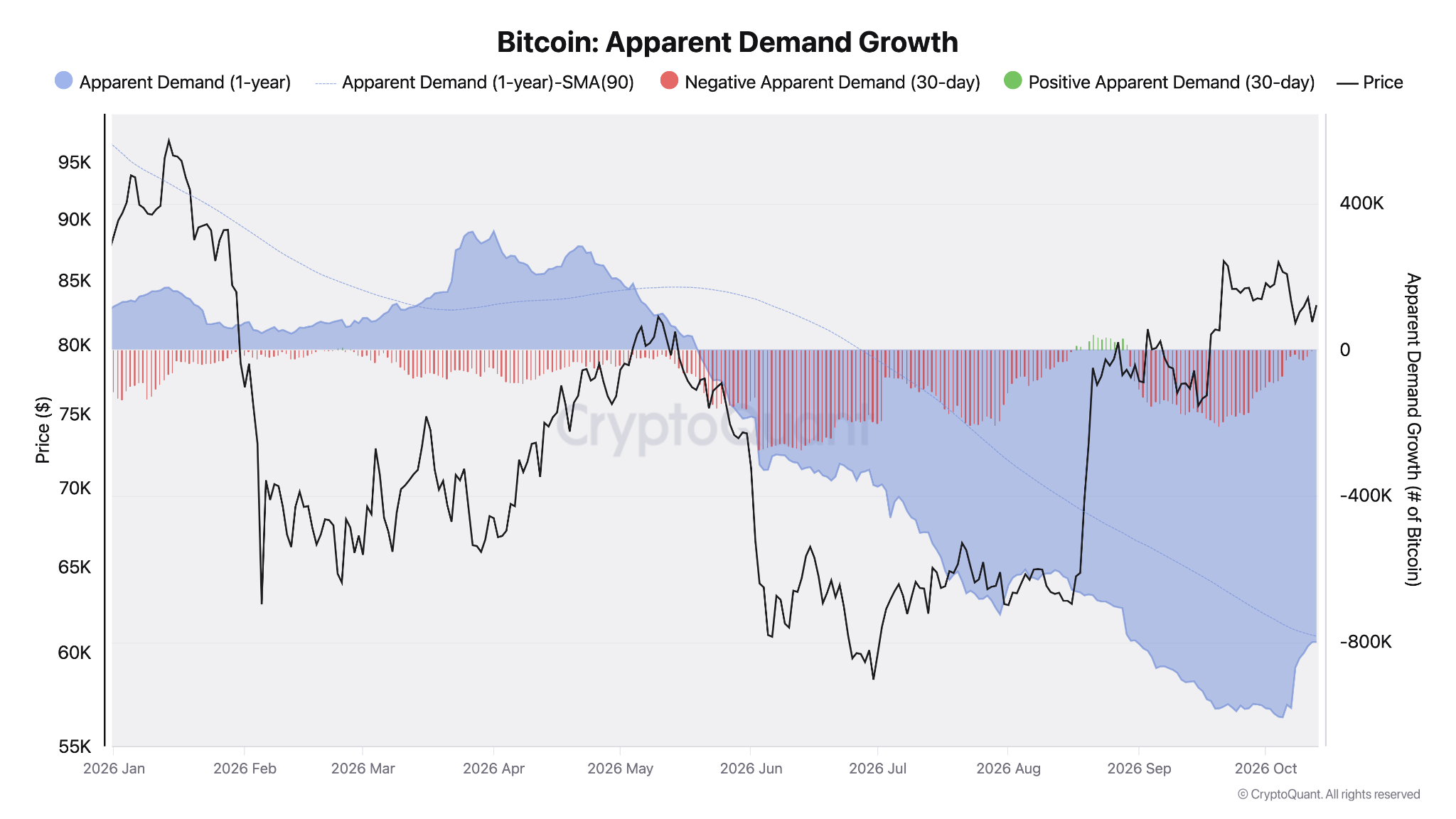
Bitcoin apparent demand growth. Source: CryptoQuant

This week, crypto asset manager Bitwise said that Q3 onchain data pointed to “crypto spring” after historically significant performance. CryptoQuant CEO Ki Young Ju, meanwhile, announced what he saw as the start of a new crypto bull market in late August, calling the bear market “over.”

Trending Cryptos

Related Questions

QWhat is the main argument presented by CryptoQuant for Bitcoin's 'Uptober' thesis remaining valid?

ACryptoQuant argues that on-chain data points to a potential local price bottom forming for Bitcoin, suggesting the traditionally strong October performance could still occur. Key signals include decreasing exchange reserves, whales avoiding selling, and apparent demand nearing positive territory.

QAccording to the article, what are the three specific on-chain metrics that XWIN Research highlights as reasons for optimism?

AThe three specific on-chain metrics are: 1) Bitcoin exchange reserves falling by 1.7% since mid-September, 2) whale holdings remaining above 3 million BTC despite price drops, and 3) apparent demand (comparing newly mined BTC to dormant supply changes) recovering to near-neutral levels.

QWhat macroeconomic and geopolitical factors were mentioned as headwinds for Bitcoin's price?

AThe headwinds mentioned include 24-year highs in US bond yields, rising oil prices, and cooling capital inflows to Bitcoin exchange-traded products (ETFs).

QWhat conditions does XWIN say are needed to confirm a market bottom for Bitcoin?

AXWIN states that confirmation of a market bottom requires sustained ETF inflows, stronger spot buying in the US, and a continued recovery in demand metrics.

QHow does the article characterize the overall state of the cryptocurrency market based on Q3 data and CEO comments?

ABased on Q3 on-chain data, asset manager Bitwise pointed to a 'crypto spring.' Furthermore, CryptoQuant CEO Ki Young Ju announced in late August what he saw as the start of a new crypto bull market, declaring the bear market 'over.'

Related Reads

Crypto Stocks Weekly丨Strategy Adds 1,036 BTC but Holdings Fall Below Cost Basis; Bitmine Holds 4.97% of ETH Supply (November 10)

The article begins by noting that Democrats swept both chambers of Congress, ushering in a divided-government phase, after which markets shifted focus to AI regulation and capex payback cycles, with Anthropic's IPO seen as a bellwether for AI stocks. US equities fell sharply (Nasdaq -5.52% and Philadelphia Semiconductor Index -12.24% on Nov 5) before a Monday rebound driven by falling oil prices and oversold buying—characterized as a repair, not a new high. Macro data showed October nonfarm payrolls +165k and unemployment at 4.1%, keeping 10-year Treasury yields near 4.86% and rate-hike expectations alive. Citi cut US equities and global tech to neutral while upgrading Europe ex-UK, citing unstable AI sentiment; Goldman noted AI stocks are ~40% of the S&P 500 versus ~15% of STOXX 600. Crypto diverged from the equity rebound: US spot Bitcoin ETFs saw $1.282B in weekly net outflows (BlackRock's IBIT -$12.09B... actually $1.209B), Ethereum ETFs -$365M for a sixth straight weekly outflow, with continued outflows on Nov 9. NYSE-affiliated tokenized securities platform chose Avalanche for settlement infrastructure. Corporate treasury updates: Strategy bought 1,036 BTC at ~$79,012 (total 850,364 BTC, average cost ~$75,456, now above spot), funded partly by ATM share sales, with most proceeds used to repurchase STRC preferred shares. Strive added 29 BTC (total 43,153). Listed companies now hold over 6% of Bitcoin's supply (1.2664M BTC across 199 firms). Bitmine added 9,587 ETH, holding 6,070,092 ETH (~4.97% of supply, ~99% of its 5% goal). DeFi Development Corp's SOL rose to 2,609,829. Hyperliquid Strategies raised $911M in Q3, bought ~9.1M HYPE (holdings up to 38.5M, ~16% of circulating supply), and repurchased ~2.7M PURR shares.

marsbit15m ago

Crypto Stocks Weekly丨Strategy Adds 1,036 BTC but Holdings Fall Below Cost Basis; Bitmine Holds 4.97% of ETH Supply (November 10)

marsbit15m ago

When Will the Chip Stock 'Capitulation-Style Selling' End? BofA: Perhaps in Early 2027, Stock Price Pullbacks Typically Lead Fundamental Inflection Points by 6-9 Months

The SOX semiconductor index has fallen 38% (from 14,634 to 9,011) since its June 22, 2026 peak, over 136 days—exceeding the average historical peak-to-trough decline of 32% but less than half the average 253-day duration of past downturns (2011, 2015, 2018, 2022). BofA analyst Vivek Arya expects this "indiscriminate selling," driven by AI capex slowdown fears, to end around early 2027. Historically, SOX declines lead actual semiconductor sales declines by 6–9 months, implying real EPS cuts may emerge from Q1 2027, with capex reductions reflected in H2 2027—though stocks may already price in much of the bad news. SOX currently trades at 13.7x forward P/E versus 17.7x for the S&P 500 (a 22% discount, down from a 15% premium at the AI peak), leaving roughly 12% downside to the historical trough valuation of ~12x. US cloud capex runs at ~$300B/quarter (~$1.2T annualized) versus $1.555T consensus for 2027—about 23% below expectations if spending holds steady, equating to ~30 GW of compute deployment versus BofA's 40+ GW base case. A 20% capex cut would pressure AI semiconductor revenue by 20%+ and EPS by 35–40%. BofA outlines three scenarios: base case ( ~10% downside, bottoming Q1 2027, favor segment leaders), bear case (pressure into mid-2027, favor EDA, high-FCF analog, low-AI-exposure names), and bull case (favor memory, optics, quantum, CPUs). Potential stabilizers include policy clarity in Q1 2027, buybacks (Lam $25B, Nvidia, Micron starting Dec 9), and slower capex extending the upcycle.

marsbit35m ago

When Will the Chip Stock 'Capitulation-Style Selling' End? BofA: Perhaps in Early 2027, Stock Price Pullbacks Typically Lead Fundamental Inflection Points by 6-9 Months

marsbit35m ago

TSMC: October Revenue Up 60%, with Month-over-Month Growth Still Accelerating

TSMC reported October consolidated revenue of NT$586.89 billion, up 59.7% year-over-year and 14.7% month-over-month, signaling accelerating momentum. Converted to RMB, that is about RMB 119.4 billion, with cumulative revenue for the first ten months reaching NT$4.49 trillion, up 43.3% year-over-year. The near-60% growth came on top of an already high base, while the sequential acceleration confirms strengthening demand rather than a slowdown. The report arrived at a delicate moment. The Philadelphia Semiconductor Index had plunged 12.25% over two sessions, its worst single-day drop since March 2020, as political changes in the U.S. prompted new governors in Texas and Ohio to pause approvals for new data center projects. Markets pessimistically priced in a halt across the AI data center supply chain. Sentiment rebounded sharply on November 9, with the semiconductor index jumping 6.86%, and Taiwan's weighted index surging 1,960.06 points, its second-largest single-day gain on record, supported by government stabilization funds and short-selling restrictions. TSMC stands apart from other AI assets. As the only foundry capable of mass-producing 3nm and 2nm chips, it holds about 90% of the global AI chip foundry market, with advanced-node capacity booked through 2028. Its diversified revenue mix—68% high-performance computing, 21% smartphones, 4% automotive and 4% IoT—provides a buffer, allowing it to reallocate capacity to flagship phone chips, automotive computing, and edge AI if data center approvals slow. October's results validate management's guidance of roughly 44% full-year dollar revenue growth and capital spending of US$60-64 billion. Expansion continues, with 2nm ramping and Arizona's second fab moved up to Q3 2027; Goldman Sachs raised its 12-month target price to NT$3,300. Google's expanded eighth-generation TPU lineup adds further demand, with TSMC and other Taiwanese suppliers in the ecosystem. TSMC's ADR trades at about 24x trailing earnings, low relative to its growth. Risks include a prolonged U.S. data center approval freeze and geopolitical or oil-price shocks. In A-shares, domestic substitution names such as SMIC and NAURA remain driven by rising localization rather than Texas approvals.

marsbit36m ago

TSMC: October Revenue Up 60%, with Month-over-Month Growth Still Accelerating

marsbit36m ago

Trading

Spot

Hot Articles

What is $BITCOIN

DIGITAL GOLD ($BITCOIN): A Comprehensive Analysis Introduction to DIGITAL GOLD ($BITCOIN) DIGITAL GOLD ($BITCOIN) is a blockchain-based project operating on the Solana network, which aims to combine the characteristics of traditional precious metals with the innovation of decentralized technologies. While it shares a name with Bitcoin, often referred to as “digital gold” due to its perception as a store of value, DIGITAL GOLD is a separate token designed to create a unique ecosystem within the Web3 landscape. Its goal is to position itself as a viable alternative digital asset, although specifics regarding its applications and functionalities are still developing. What is DIGITAL GOLD ($BITCOIN)? DIGITAL GOLD ($BITCOIN) is a cryptocurrency token explicitly designed for use on the Solana blockchain. In contrast to Bitcoin, which provides a widely recognized value storage role, this token appears to focus on broader applications and characteristics. Notable aspects include: Blockchain Infrastructure: The token is built on the Solana blockchain, known for its capacity to handle high-speed and low-cost transactions. Supply Dynamics: DIGITAL GOLD has a maximum supply capped at 100 quadrillion tokens (100P $BITCOIN), although details regarding its circulating supply are currently undisclosed. Utility: While precise functionalities are not explicitly outlined, there are indications that the token could be utilized for various applications, potentially involving decentralized applications (dApps) or asset tokenization strategies. Who is the Creator of DIGITAL GOLD ($BITCOIN)? At present, the identity of the creators and development team behind DIGITAL GOLD ($BITCOIN) remains unknown. This situation is typical among many innovative projects within the blockchain space, particularly those aligning with decentralized finance and meme coin phenomena. While such anonymity may foster a community-driven culture, it intensifies concerns about governance and accountability. Who are the Investors of DIGITAL GOLD ($BITCOIN)? The available information indicates that DIGITAL GOLD ($BITCOIN) does not have any known institutional backers or prominent venture capital investments. The project seems to operate on a peer-to-peer model focused on community support and adoption rather than traditional funding routes. Its activity and liquidity are primarily situated on decentralized exchanges (DEXs), such as PumpSwap, rather than established centralized trading platforms, further highlighting its grassroots approach. How DIGITAL GOLD ($BITCOIN) Works The operational mechanics of DIGITAL GOLD ($BITCOIN) can be elaborated on based on its blockchain design and network attributes: Consensus Mechanism: By leveraging Solana’s unique proof-of-history (PoH) combined with a proof-of-stake (PoS) model, the project ensures efficient transaction validation contributing to the network's high performance. Tokenomics: While specific deflationary mechanisms have not been extensively detailed, the vast maximum token supply implies that it may cater to microtransactions or niche use cases that are still to be defined. Interoperability: There exists the potential for integration with Solana’s broader ecosystem, including various decentralized finance (DeFi) platforms. However, the details regarding specific integrations remain unspecified. Timeline of Key Events Here is a timeline that highlights significant milestones concerning DIGITAL GOLD ($BITCOIN): 2023: The initial deployment of the token occurs on the Solana blockchain, marked by its contract address. 2024: DIGITAL GOLD gains visibility as it becomes available for trading on decentralized exchanges like PumpSwap, allowing users to trade it against SOL. 2025: The project witnesses sporadic trading activity and potential interest in community-led engagements, although no noteworthy partnerships or technical advancements have been documented as of yet. Critical Analysis Strengths Scalability: The underlying Solana infrastructure supports high transaction volumes, which could enhance the utility of $BITCOIN in various transaction scenarios. Accessibility: The potential low trading price per token could attract retail investors, facilitating wider participation due to fractional ownership opportunities. Risks Lack of Transparency: The absence of publicly known backers, developers, or an audit process may yield skepticism regarding the project's sustainability and trustworthiness. Market Volatility: The trading activity is heavily reliant on speculative behavior, which can result in significant price volatility and uncertainty for investors. Conclusion DIGITAL GOLD ($BITCOIN) emerges as an intriguing yet ambiguous project within the rapidly evolving Solana ecosystem. While it attempts to leverage the “digital gold” narrative, its departure from Bitcoin's established role as a store of value underscores the need for a clearer differentiation of its intended utility and governance structure. Future acceptance and adoption will likely depend on addressing the current opacity and defining its operational and economic strategies more explicitly. Note: This report encompasses synthesised information available as of October 2023, and developments may have transpired beyond the research period.

5.0k Total ViewsPublished 2025.05.14Updated 2025.05.14

What is $BITCOIN

Discussions

Welcome to the HTX Community. Here, you can stay informed about the latest platform developments and gain access to professional market insights. Users' opinions on the price of BTC (BTC) are presented below.

活动图片