CFTC joins SEC in proposing crypto framework after failed CLARITY vote

cointelegraphPublished on 2026-10-06Last updated on 2026-10-06

Abstract

CFTC Chair Michael Selig announced that the agency is moving forward with a proposed crypto regulatory framework, named 'CTX,' following President Donald Trump's direction to act "with or without legislation." The proposal, presented at a Fordham Law symposium, would allow crypto companies to operate under uniform CFTC oversight instead of a state-by-state patchwork. Key elements include a new "crypto asset market" (CAM) category for exchanges and rules for retail trading on a margined or leveraged basis. Ordinary spot exchanges remain under state laws, though the CFTC retains anti-fraud authority. This action comes after the Senate failed to pass the CLARITY Act, which would have expanded the CFTC's regulatory role. The SEC also recently proposed its own crypto securities regime. Both agencies are currently understaffed, with the SEC down to two commissioners after Hester Peirce's departure and the CFTC led solely by Selig. The White House has indicated plans to nominate new commissioners soon.

US Commodity Futures Trading Commission (CFTC) Chair Michael Selig said that the agency will move forward on crypto regulation at the direction of President Donald Trump “with or without legislation” from Congress.

Speaking at the Fordham Law Blockchain Regulatory Symposium on Monday, Selig announced proposals giving crypto companies the option to operate under the CFTC’s umbrella rather than dealing with the patchwork of regulations offered by individual US states.

According to written remarks from the event, the CFTC chair said that it had issued an advanced notice of proposed rulemarking for companies “offering retail customers the ability to trade crypto assets on a margined, leveraged, or financed basis,” calling the regulation ‘CTX.’

Selig said that the agency planned to establish a new category of designated contract market (DCM) called a “crypto asset market,” or CAM, giving certain exchanges the option to register as either.

“These rules would codify a pathway for crypto asset exchanges to operate under uniform national oversight by the CFTC pursuant to the same statutory authorities that the prior administration instead utilized to regulate by enforcement,” said Selig.
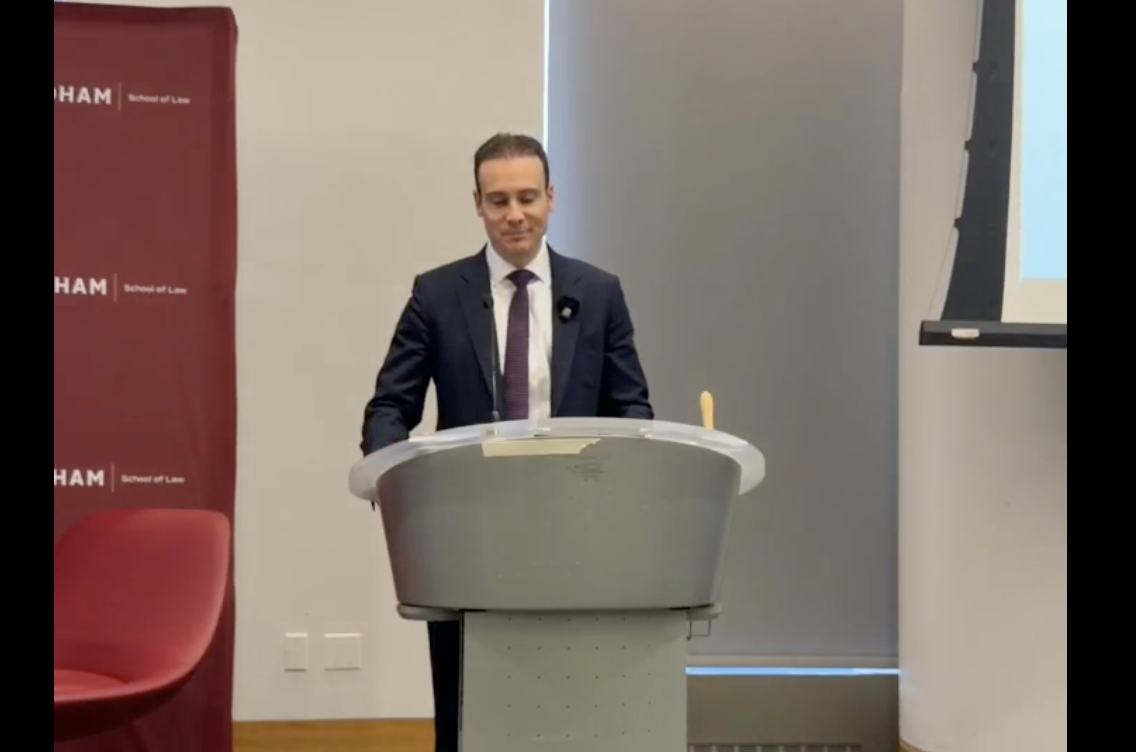
CFTC Chair Michael Selig on Monday.
Source: Fordham Law Blockchain Regulatory Symposium

The proposed rules would not extend to what the chair called “ordinary spot crypto exchanges” that are “generally regulated under state money transmission laws.” For companies offering spot trading on crypto assets like Bitcoin (BTC), the CFTC would still have the authority to enforce anti-fraud and anti-manipulation regulations.

Selig’s proposed regulatory framework for crypto companies came a few weeks after lawmakers in the US Senate failed to approve passage of the Digital Asset Market Clarity (CLARITY) Act, a bill that had been expected to give the CFTC more authority in overseeing and enforcing crypto regulations.

The Securities and Exchange Commission already announced its own version of a proposed “tailored securities offering regime” for crypto assets in August before the failed CLARITY vote, setting the expectation that both agencies would move forward with regulation without legislation codifying such rules from Congress.

Selig said that Trump promised to deliver a crypto asset regulatory market structure with or without legislation, and the regulators will help him deliver it using existing statutory authorities.

“The opponents to CLARITY may have not bargained for the seeming readiness of the executive branch to act in the absence of any constraint from the legislative branch,” said ProChain Capital’s David Tawil, in a post on Monday.

Both regulators still understaffed as they advance crypto proposals

Friday was SEC Commissioner Hester Peirce’s last day at the agency, wrapping up eight years of service, just ahead of the 18-month extension for her second term. Her planned departure leaves just two commissioners leading the SEC and Selig heading the CFTC as its sole commissioner and chair.

A White House official told Cointelegraph last week that Trump intended to nominate commissioners to both agencies “in the near future.” As of Monday, the administration had not announced any replacements for Peirce or the other six commissioner seats.

Magazine: Former SEC boss made AI Czar, Bitcoin may hit $600K this cycle: Hodler’s Digest

Related Questions

QWhat is the main purpose of the regulatory framework proposed by CFTC Chair Michael Selig?

AThe main purpose is to give crypto companies the option to operate under the CFTC's uniform national oversight, as an alternative to dealing with the patchwork of regulations from individual US states. This includes a proposal for a new category of designated contract market called a 'crypto asset market' (CAM).

QHow does the proposed 'CTX' regulation relate to crypto asset trading?

AThe proposed 'CTX' regulation is an advanced notice of proposed rulemaking for companies that offer retail customers the ability to trade crypto assets on a margined, leveraged, or financed basis.

QWhy are the CFTC and SEC moving forward with their own regulatory proposals for crypto?

AThey are moving forward because the US Senate failed to pass the Digital Asset Market Clarity (CLARITY) Act, which was expected to give the CFTC more authority. President Trump has directed the agencies to proceed 'with or without legislation' from Congress, leading them to use their existing statutory authorities.

QAccording to the article, what type of crypto exchanges would not be covered under the CFTC's new proposed rules?

AThe proposed rules would not extend to 'ordinary spot crypto exchanges' that are generally regulated under state money transmission laws. However, the CFTC would still have authority to enforce anti-fraud and anti-manipulation regulations for these spot trading platforms.

QWhat staffing challenge is mentioned for both the SEC and CFTC as they advance their crypto proposals?

ABoth agencies are understaffed. SEC Commissioner Hester Peirce has left, leaving just two commissioners at the SEC. The CFTC has Michael Selig as its sole commissioner and chair. The White House intends to nominate new commissioners, but no replacements had been announced as of the article's publication.

Related Reads

Can using a chip for two more years really help get through the cold winter?

The smartphone industry is grappling with rising memory chip costs that are driving up device prices, forcing manufacturers to find ways to stay competitive. A recent leak about a chip called "SM7635" with a 2.96GHz peak CPU frequency and Adreno 810 GPU suggests Qualcomm may be reusing its Snapdragon 7s Gen3 (originally launched in 2024 at 2.5GHz) yet again. The chip already spawned a 2025 variant (SM7635-AC, renamed Snapdragon 7s Gen4) with a 2.7GHz clock, and the new 2.96GHz version will likely become the Snapdragon 7s Gen5—marking a third generation from one original design. This practice of reusing and overclocking mid-range SoCs is not new. MediaTek's Helio X20/X23/X25/X27 and Dimensity 1100/1200/1300, as well as Qualcomm's Snapdragon 615/616/617, 765/765G/768G, and 778G/778G+/782G, followed similar patterns. Previously, however, this was mainly done to widen the gap between flagship and non-flagship products and give flagship buyers more perceived value—not primarily to cut costs. Mid-range buyers were assumed not to care much about chip model numbers. Now the situation is different. One brand recently launched a mid-to-low-end phone with the Snapdragon 7s Gen4 priced at 3699 yuan—a price that a year ago could buy a flagship with a fifth-generation Snapdragon 8 Elite, roughly three to four times more powerful. While SoC isn't the only cost component, consumers clearly get less value for the same money today. Counterpoint Research reports global smartphone SoC shipments fell 21% year-over-year in Q3 2026. Even flagship lines show signs of chip reuse—the Dimensity 9600M appears to be an overclocked Dimensity 9500. With few flagships using fully-specced memory and storage, rumors suggest next year's devices may widely reuse current-generation flagship SoCs while upgrading memory and storage instead. This helps control costs but may further dampen consumers' willingness to upgrade, making such reuse an unsustainable strategy. Restoring market confidence will require both chipmakers and device brands to offer consumers more tangible benefits.

marsbit3h ago

Can using a chip for two more years really help get through the cold winter?

marsbit3h ago

Former OpenAI Employee Disgusted: AI Developing AI Crosses the Line to "Ultimate Superintelligence"—Even Stopping Global Data Center Construction Is Too Late

A Harvard physicist and computer scientist, Alex Wissner-Gross, argues in a recent podcast that AI has passed the "superintelligence escape velocity"—existing algorithms and installed compute alone are enough to push all the way to superintelligence, meaning even shutting down all new data centers tomorrow could not stop it. His claim rests on METR evaluation charts showing Anthropic's unreleased Model 4 breaking above the exponential trend line into "super-exponential growth," indicating AI has deeply taken over its own R&D and entered a recursive self-improvement loop. METR researcher Ajeya Cotra's analysis warns that AI capabilities are compounding: since hardware compute grew only at normal speed while overall capability growth doubled, software "compute multipliers" improved 2.5–3x, implying Anthropic researchers gained roughly 10x efficiency—matching员工 self-reports of 12x with Model 4. Each doubling of research speed takes half the time of the last—12 months, then 6 months, 3 months, 6 weeks—converging within a year toward "ultimate superintelligence," with no marginal diminishing returns yet visible. Timeline trackers show internal models already surpass public ones by about 9 months, with a "superhuman coder" threshold (2,000 hours of independent work) projected for April 2027, followed by superhuman AI researcher (Sept 2027), superintelligent AI researcher (Nov 2027), and full ASI (Dec 2027). Meanwhile, OpenAI, Anthropic, and Google DeepMind have reportedly achieved fully autonomous research, with models selecting their own research directions and first AI-initiated results to be published this month. A former OpenAI employee described feeling physically sick and fearful for family and friends after reading the report.

marsbit3h ago

Former OpenAI Employee Disgusted: AI Developing AI Crosses the Line to "Ultimate Superintelligence"—Even Stopping Global Data Center Construction Is Too Late

marsbit3h ago

Trading

Spot
活动图片