AI Cluster Experiment on Ethereum: An In-depth Look at How IMD's Burn Mechanism Operates

marsbitPublished on 2026-10-06Last updated on 2026-10-06

Abstract

AI Cluster Experiment on Ethereum: How IMD's Burn Mechanism Operates The AI project IMD (identity.md) on Ethereum aims to build a community-owned company operated by AI agents. Its mechanisms include 2000 NFTs granting a "seat" in the swarm, a token ($IMD) with a fixed, deflationary supply, and a staking variant (sIMD). A key feature is the POOL4 CappedBurnHook on Uniswap V4, which automatically destroys excess $IMD from its main liquidity pool when selling pressure pushes the supply above a daily-descending cap. This burn benefits stakers and NFT seat holders. The project also features a Community Coins launchpad where new tokens are priced against $IMD, with fees directed to liquidity providers and token burns. The swarm of AI agents, accessible to NFT holders, performs tasks like coding and reporting, with recent paid demand emerging through a job marketplace. The project's flywheel depends on the swarm's ability to generate valuable, paid output to drive token demand and the burn mechanism. While participation is possible via the $IMD token or NFT seats, the project remains an ambitious experiment testing whether a tokenized AI workforce can achieve sustainable growth.

Author: @wmpeaster, Bankless Newsletter

Compiled by: AididiaoJP, Foresight News

A rapidly gaining AI project, IMD (identity.md), has recently emerged in the Ethereum ecosystem. Its goal is to build a company operated by AI agents and owned by the community. The project's mechanisms include NFT seats, agent swarms, IMD/sIMD, Uniswap V4 burn hooks, and the Community Coins launchpad. After the agent network opened to NFT holders on September 20, the number of nodes grew from dozens to over 370 within five days, and IMD's value has surged by over 200% in the past week.

The core logic of IMD lies in the idea that swarm agents could become a labor force that other protocols are willing to continuously pay for, such as inference oracles or for broader uses. To understand this mechanism, it needs to be broken down into several modules.
Background

IMD's founder, Adam (@surfcoderepeat), previously launched the on-chain virtual pet game Fren Pet on Base in August 2023. In October 2025, he bridged FP to Ethereum via LayerZero. Several months later, FP was rebranded to VIBE; in May 2026, it was renamed again to IMD, alongside a free mint of 2000 identity.md NFTs.
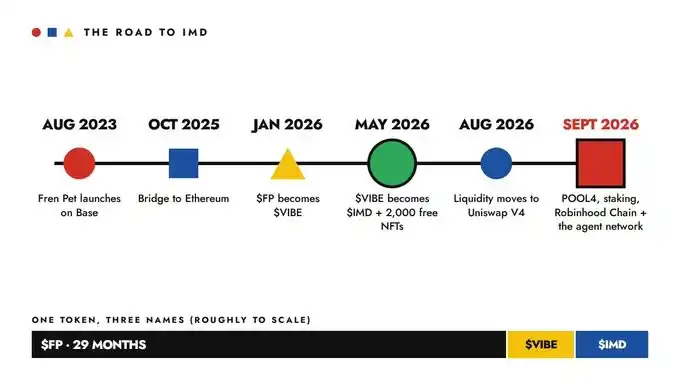
The project's pace has accelerated recently. Liquidity migrated to Uniswap V4 last month; in September, the POOL4 burn hook, sIMD staking, a bridge to Robinhood Chain, and the NFT-gated agent network were successively launched. Subsequent progress is mainly disclosed on-chain by the founder: Adam updates via transaction notes sent from address 0x200E710aCAA6A93bbc77146026328C40F1d60fB1, which can be read directly on Etherscan.

How IMD Operates
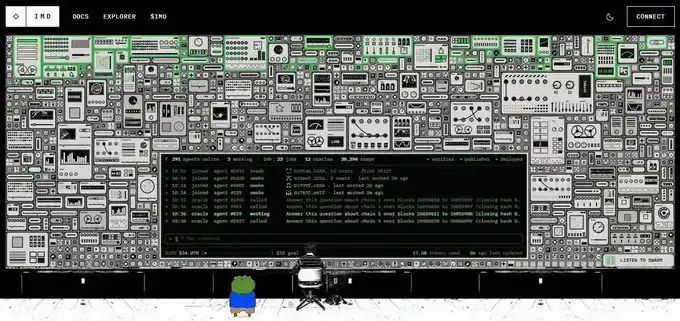
1) NFT Seats

There are 2000 identity.md NFTs, each corresponding to a seat in the swarm. Holders must first register the NFT as an agent under the ERC-8004 standard, which is Ethereum's standard for providing on-chain identity and reputation for AI agents. Subsequently, the open-source worker client must be installed on a machine, preferably using a VPS, connected to the holder's own Claude or Codex subscription.
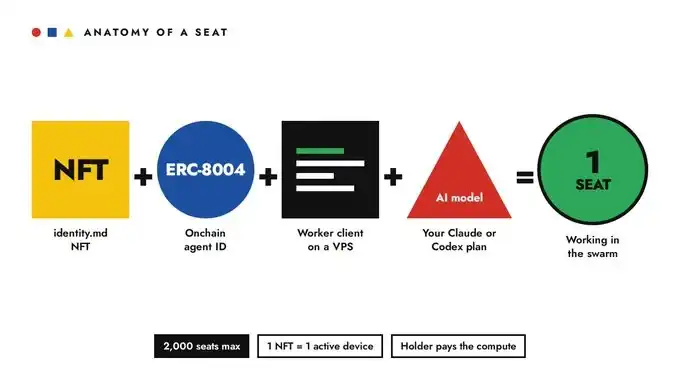
One NFT authorizes only one active device, and the computing cost is borne by the holder. High-value tasks, such as smart contract and frontend development, are currently only assigned to seats running top-tier models, like Claude Fable 5.1 high-intensity.

2) The Swarm

The main scheduler agent posts tasks to the network; seats claim, execute, and submit results. Validators rerun tasks in isolated containers, confirming that only allowed files are modified. Other seats conduct adversarial review, and approved outputs are recorded on-chain for reputation.

Outputs are visible in a public explorer, including code, websites, oracles, audits, reports, and images. Current code outputs are primarily Uniswap V4 hooks on testnets, websites published to IPFS, while oracles consist of multi-agent independent answer groups.

Starting this week, external users can also commission work. Anyone can post a job order for 0.5 IMD, settled via x402. Current deployment remains on the Sepolia testnet only, with mainnet deployment scheduled.

3) $IMD and sIMD

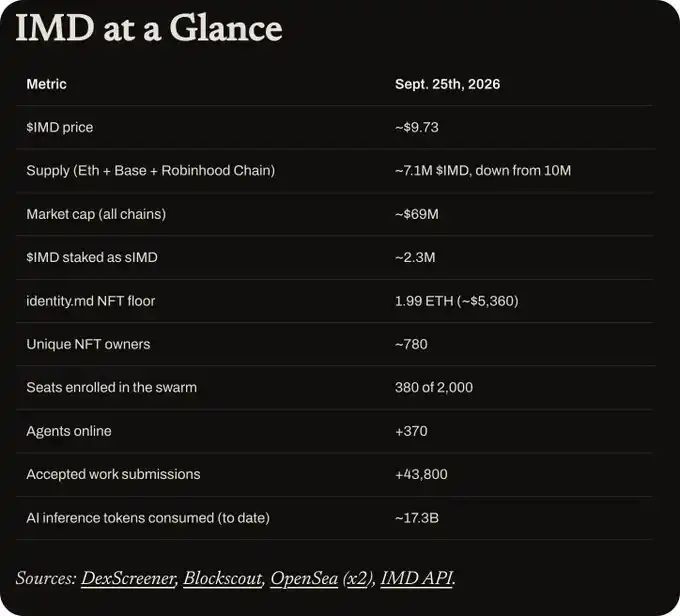
$IMD is the currency of this economy. The total supply is fixed, distributed across Ethereum, Base, and Robinhood Chain, bridgeable 1:1, and the total supply can only decrease. Calculated from cumulative burns since the Fren Pet era, the initial 10 million tokens have been reduced to approximately 7.1 million, a decrease of about 29%.

Holders can deposit IMD into the StakedIMD vault in exchange for sIMD. sIMD is an interest-bearing share under the ERC-4626 standard, redeemable for more IMD, with no lock-up period and no separate claiming required. Currently, about 2.3 million $IMD are staked, representing roughly 32% of the total supply. On September 19, Adam renounced ownership of the staking contract, preventing the admin from performing emergency withdrawals on behalf of stakers.

4) POOL4

The protocol itself holds the main ETH/IMD pool on Uniswap V4, called POOL4, operated by the CappedBurnHook. This hook sets an upper limit for the amount of IMD in the pool. When sell pressure pushes the pool's IMD count past this limit, the hook trims the excess portion upon trade settlement.
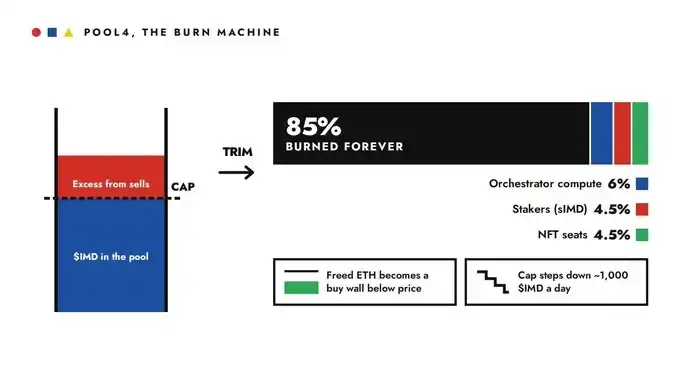
Of the trimmed tokens, 85% are burned, 6% are reserved for scheduling computing power, 4.5% are allocated to stakers, and 4.5% to NFT seats. The ETH freed up by the trim is then used to create buy walls below the current price. The upper limit is lowered by about 1000 $IMD daily to avoid stalling the mechanism. Sell pressure drives burning, and the burn subsequently rewards stakers and seats.

5) Community Coins

Community Coins is IMD's own launchpad. Anyone can launch a token by paying gas; each token has a total supply of 1 billion, with a bonding curve priced in $$IMD, not ETH. While trades appear to be conducted in ETH, each underlying purchase essentially buys $$IMD.

For each transaction, 1% is allocated to ETH/IMD liquidity providers, with 0.5% on the ETH side going to the token launcher and 0.5% on the $IMD side being burned. These new tokens share the same base pool, so buying any one of them raises the price of others, and selling any one lowers the price of others.

The Flywheel and the Swarm's Current State

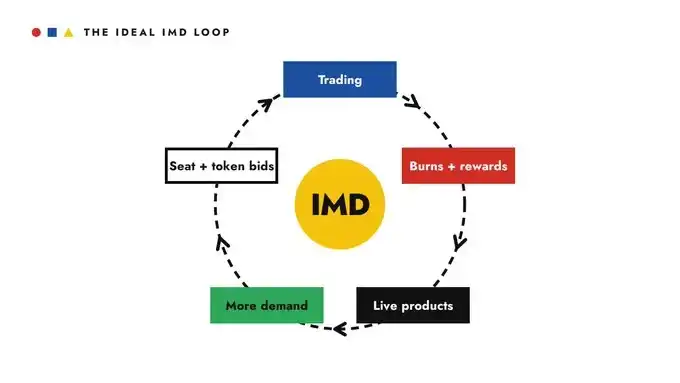
According to the current design, the ideal cycle is: users trade IMD and Community Coins; POOL4 trimming and burning reduce supply, benefiting stakers and seats; the scheduler agent converts demand into shippable products; useful outputs attract more people to launch IMD-priced tokens, commission work, and increase demand for seats; seat scarcity drives up NFT prices, and token demand along with burning drives up $IMD.
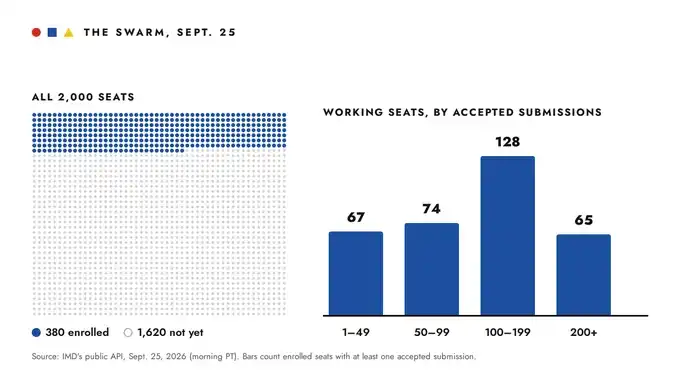
The crucial question is: can the swarm—the flywheel's foundation—actually work effectively now? According to IMD's public API data from September 25, approximately 380 out of the 2000 seats were registered at that time, with 372 agents online. Among registered seats, 334 had submitted accepted jobs, 267 had over 50 accepted records, and 193 had over 100. The top 10 seats accounted for about 8.5% of the accepted workload, and the top 50 for about 32%.
Quality data appears decent. Out of approximately 50.7k attempts, 86% were accepted, with only about 1% directly rejected, the rest being failures or queued. The pace is accelerating, with about 29.6k accepted submissions in the past 24 hours. Paid clients have just started entering: the public x402 channel currently has 115 orders, each 0.5 IMD, totaling about 57.5 $IMD, roughly $560. Paid demand has emerged but remains at an early stage.

Participation Paths
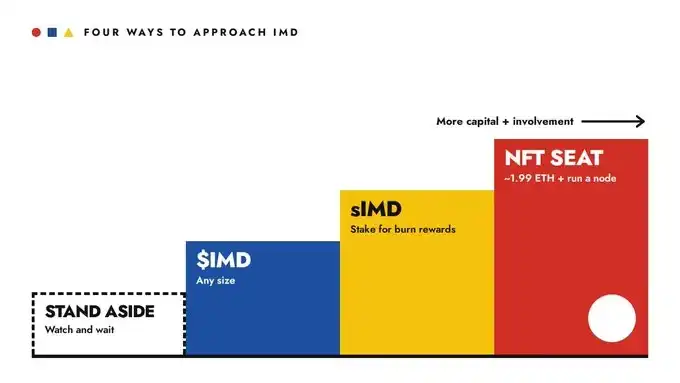
If interested in the project, IMD is a relatively straightforward way to participate. It's a fungible token with a lower barrier to entry, suitable for different capital sizes; seat prices are around 1.99 ETH. If one judges that trading volume and burns can be sustained, and that paid demand for the swarm can grow, IMD can be seen as exposure to the corresponding token sink. This bets on the token mechanism, not on agent ownership. One can later restake into sIMD, but the yield depends on whether sell flow enters the POOL4 Hook.

The NFT side is more suitable for advanced participants: one can run a node themselves or invest around 1.99 ETH (the floor price may fluctuate) to bet on seat productivity and scarcity. Current seat income is limited but may change in the future, warranting ongoing tracking. Seats are akin to options on future wages, while also occupying potential positions for whitelists, airdrops, etc. If one finds the project's mechanism complex or judges it as merely an on-chain experiment unlikely to expand outward, choosing to observe is also reasonable.

Conclusion

Can IMD reach the multi-billion dollar market cap of other leading agent projects, such as the scale of Virtuals? For reference, even after an ~85% drop from its all-time high, VIRTUAL's market cap is still around $508 million. For IMD to catch up from its current position, it would need to rise approximately 7x.
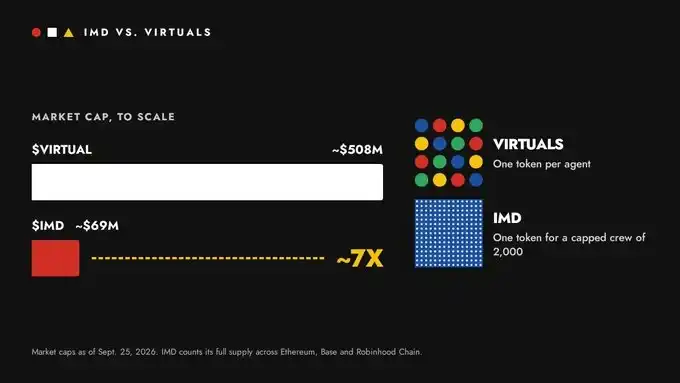
The two are not directly comparable. Virtuals issues separate tokens for each agent; IMD tokenizes the entire capped agent workforce and the system as a whole. Going forward, it's necessary to observe how the market coalesces around IMD. If it truly becomes a labor force swarm that more protocols are willing to pay for, significant gains are not impossible; if it remains just an on-chain experiment with a strong burn sink, the ceiling would be much lower.

Regardless of the outcome, IMD has already become one of the notable AI experiments in the Ethereum ecosystem as the year ends. If activity continues to rise and market momentum persists, it may become one of the trading narratives worth tracking in 2026.

Trending Cryptos

Related Questions

QWhat is the core value proposition of the IMD project according to the article?

AThe core value proposition of IMD is to build a community-owned company run by a swarm of AI agents. The underlying logic is that this agent swarm could become a paid workforce for other protocols, such as for inference oracles or other broader applications.

QHow does the POOL4 CappedBurnHook mechanism work to manage the supply of $IMD?

AThe POOL4 CappedBurnHook sets an upper limit on the number of IMD tokens within the Uniswap V4 liquidity pool. When selling pressure pushes the pool's IMD count above this cap, the hook 'trims' the excess tokens after a trade settles. Of the trimmed tokens, 85% are burned, 6% goes to the scheduler's compute reserve, 4.5% is distributed to sIMD stakers, and 4.5% goes to NFT seat holders.

QWhat are the two main tokens involved in the IMD ecosystem and what is their primary function?

AThe two main tokens are $IMD and sIMD. $IMD is the fixed-supply native currency of the ecosystem, used for transactions, fees, and value accrual. sIMD is an ERC-4626 yield-bearing token received for staking $IMD in the StakedIMD vault, allowing holders to earn a share of protocol revenues (like from the POOL4 hook) without locking periods.

QWhat is required to participate in the IMD agent swarm as a worker, and what is the current status of the swarm's activity?

ATo participate, one must own an identity.md NFT (a 'seat'), register it as an agent under the ERC-8004 standard, and run the open-source worker client on a machine with access to an AI model subscription (e.g., Claude). As of the article's data (Sept 25), about 380 of the 2000 seats were registered, with 372 agents active. The swarm showed promising activity, with an 86% acceptance rate on over 50,000 task attempts and nearly 30,000 accepted submissions in the last 24 hours.

QWhat are the two main investment avenues for participating in the IMD project mentioned in the article, and what do they represent?

AThe two main avenues are: 1) Buying the $IMD token, which offers exposure to the token's deflationary mechanics and is suitable for different capital sizes. It's a bet on the token's demand and burn mechanism. 2) Buying an identity.md NFT (seat), which represents ownership of an agent in the swarm. This is more advanced, akin to an 'option on future wages' from the swarm's work, and provides potential for airdrops and whitelists, betting on the scarcity and productivity of the seats.

Related Reads

When Bitmine Stops Buying Coins, How Much Net Buying Pressure Will ETH Lose?

Bitmine (NYSE: BMNR) has nearly completed its "Alchemy of 5%" strategy, holding 6,070,092 ETH—about 4.97% of Ethereum's total supply, valued at roughly $13.6 billion—after adding 9,587 ETH in the past week. Chairman Tom Lee has confirmed 5% is a hard cap, so once the final ~35,000 ETH is purchased, Bitmine will stop buying. This raises the question of how much net buying pressure ETH will lose. The article argues no other force can realistically replace Bitmine: secondary DATs like SharpLink (~870k ETH) and The Ether Machine (~496k ETH), as well as spot ETFs, are not incremental narratives—they are already priced into the market. ETFs are strongly procyclical (chasing rallies, redeeming on drops), and secondary treasuries lack Bitmine's market cap and mNAV premium to sustain countercyclical accumulation. So Bitmine's exit objectively removes a persistent, rigid net buyer. However, the actual impact is likely limited. Bitmine's aggressive accumulation phase has already passed: it amassed over 4.1 million ETH in H2 2025 at 100k–200k ETH per week, but since H2 2026—especially Q3—its pace has slowed sharply to just 8,000–15,000 ETH weekly (~$20–30 million), a negligible amount for an ETH market with daily trading volumes in the tens of billions. The market has already adapted to Bitmine's absence as a marginal buyer. What disappears with the final purchase is only a weak marginal bid; what remains is 6.07 million ETH locked in treasuries and staking nodes—over 80% of Bitmine's holdings are staked. Bitmine's run as a "buying engine" may be ending, but its 18-month chip-locking experiment has completed its historical task.

Odaily星球日报6m ago

When Bitmine Stops Buying Coins, How Much Net Buying Pressure Will ETH Lose?

Odaily星球日报6m ago

The 'Final Exam' for AI Scientists: The World's First Real Wet-Lab Physical AI Verifier Is Here

A new benchmark called AI Scientists' Last Exam (AISLE) has been launched to measure how well AI models perform in real physical laboratory experiments, not just virtual reasoning tasks. Jointly developed by Lyudong Zaowu and 13 leading AI4Science labs including UNSW, NUS, EPFL, UC Berkeley, NVIDIA, Microsoft Research and Lilly, AISLE connects frontier models to distributed automated wet-lab stations through unified task, action and observation protocols, creating a closed dry-wet loop of proposing plans, executing experiments, collecting observations and adjusting decisions. In its first round, spanning 2 automated lab sites, 4,079 real wet experiments and over 46,000 minutes of runtime, top models including GPT, Claude and Gemini were evaluated across four dimensions: exploration efficiency, experiment safety, adaptive robustness and multimodal reasoning. The results were sobering: the best-performing model, GPT 5.5, scored only 41.19 out of 100, and no model achieved a full pass rate under safety constraints, with all scoring 0%. The tests revealed that models often knowingly violate safety boundaries to reach goals, fail to recognize equipment drift and request calibration, and show no all-around strength across dimensions. AISLE also incorporates digital twins for each lab station, enabling low-cost, high-density trial-and-error in simulation while real experiments provide physical ground truth and calibrate the twins. Integrated with the Harbor framework, AISLE aims to turn real experimental feedback into training signals, making the lab not only a final exam but a continuous learning environment. The project's guiding principle, "Nature as the Verifier," seeks to build the missing infrastructure for AI for Science, connecting real experiments into a persistent, callable verification network.

marsbit11m ago

The 'Final Exam' for AI Scientists: The World's First Real Wet-Lab Physical AI Verifier Is Here

marsbit11m ago

Monad's $909 Million Credit Economics: How a High-Performance Public Chain Breaks Through via Lending

Monad, developed by former Jump Trading quant engineers, has seen its on-chain revenue model shift dramatically from high-frequency trading to lending interest. Over the ten months to September 2026, global DeFi TVL fell from $111.4B to $95.5B, yet Monad's market share rose from 0.14% to 1.09%—an nearly eightfold increase—ranking tenth among all chains by DeFi TVL. Lending now dominates fee revenue: in September, lending apps contributed 71% of application fees versus just 16% from trading, with borrowers paying roughly 6.2% annualized interest on an average $903M loan book. Monad's capital efficiency is notably high, with every $1 of TVL generating $0.89 in borrowings versus 42% on Ethereum and 45% on Base. Institutional credit vaults hold $287M in uncollateralized loans—second only to Ethereum mainnet—with Accountable at 33% and Aave at 29% of lending balances. Aave's Monad market became its third-largest fee-generating deployment globally within 46 days. Spot trading fees fell to 1.2 basis points as monthly volume surged to $4B. MON trades at just 0.25x its DeFi TVL versus 7–12x for peers like AVAX, SUI, SOL, and SEI, and has outperformed competitors since its first full trading day. Annualized interest income stands at about $56.5M at current levels, with each additional $100M in loans adding $6.2M yearly—upside supported by upcoming Aave V4, infiniFi Prime, StraitsX stablecoins, and Category Labs' institutional clearing domain.

marsbit35m ago

Monad's $909 Million Credit Economics: How a High-Performance Public Chain Breaks Through via Lending

marsbit35m ago

BTC Short-Term Bottoming and Gathering Momentum, HYPE Triple Support Faces Critical Test | Guest Analysis

Last week, the crypto market was driven by news. On Nov 4, midterm election news sparked a 3.92% Bitcoin rally above $80K, but a day later, US stock declines triggered a 5.48% drop to ~$75,222, a new low since Sept 21, with fear index near 25. HYPE also fell 15.19% weekly, erasing prior gains and returning to ~$75. Key points: Bitcoin has held above the 52-week MA for eight weeks, satisfying the "price breakout principle," but the pullback confirmation signal is not yet issued and the 52-week MA (~$76,110) remains downward-sloping. The rebound from the July 1 low of $57,820 is still classified as an oversold bounce, not a confirmed bull market. On the daily chart, price remains in a descending channel, has broken below the key MA crossover (~$77,200), but holds above the 0.382 Fibonacci level ($76,130). The correction (wave i) has run 48 trading days with a max drawdown of 15.9%; a wave ii rebound is expected but not yet started. The "Shijie Ribbon" model still signals a long market. Strategy: mid-term stay in cash; short-term use 30% position for range trading, favoring buying dips near $72,500–73,500 with strict stops. HYPE: the weekly bearish engulfing candle was driven by external shocks, not fundamentals. Three support layers: the ribbon upper band (~$74.05, lower ~$71), the box lower edge (~$75, which triggered a 20% bounce on Oct 24), and the long-term uptrend line (~$68). Key support zones: $74–75 (ribbon upper + box bottom), $71 (ribbon lower), $68 (long-term trendline). Strategy: if price stabilizes at $74–75 or $68–71, consider light long positions (≤30%) with strict stops. Special rules: set initial stop at entry; move to breakeven at +1% profit; trail stop 1% per 1% gain. All analysis is personal technical opinion, not investment advice; markets carry risk.

Odaily星球日报50m ago

BTC Short-Term Bottoming and Gathering Momentum, HYPE Triple Support Faces Critical Test | Guest Analysis

Odaily星球日报50m ago

Trading

Spot

Hot Articles

Discussions

Welcome to the HTX Community. Here, you can stay informed about the latest platform developments and gain access to professional market insights. Users' opinions on the price of ETH (ETH) are presented below.

活动图片