This article is from:Max
Compiled by|Odaily Planet Daily(@OdailyChina);Translator|Azuma(@azuma_eth)
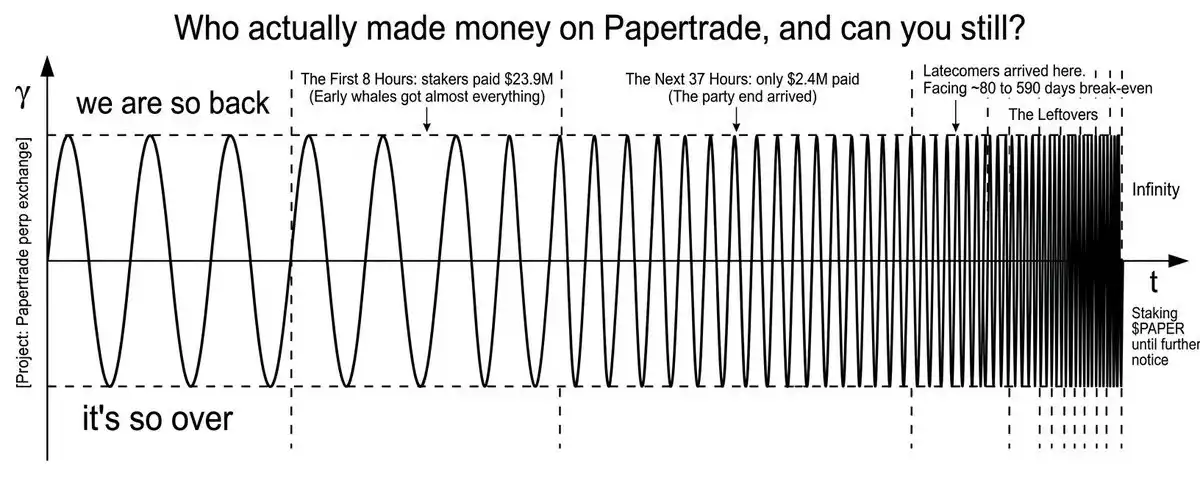
Within the first 8 hours of its launch, Papertrade distributed a total of $23.9 million in dividends to stakers; in the subsequent 37 hours, only $2.4 million was distributed.
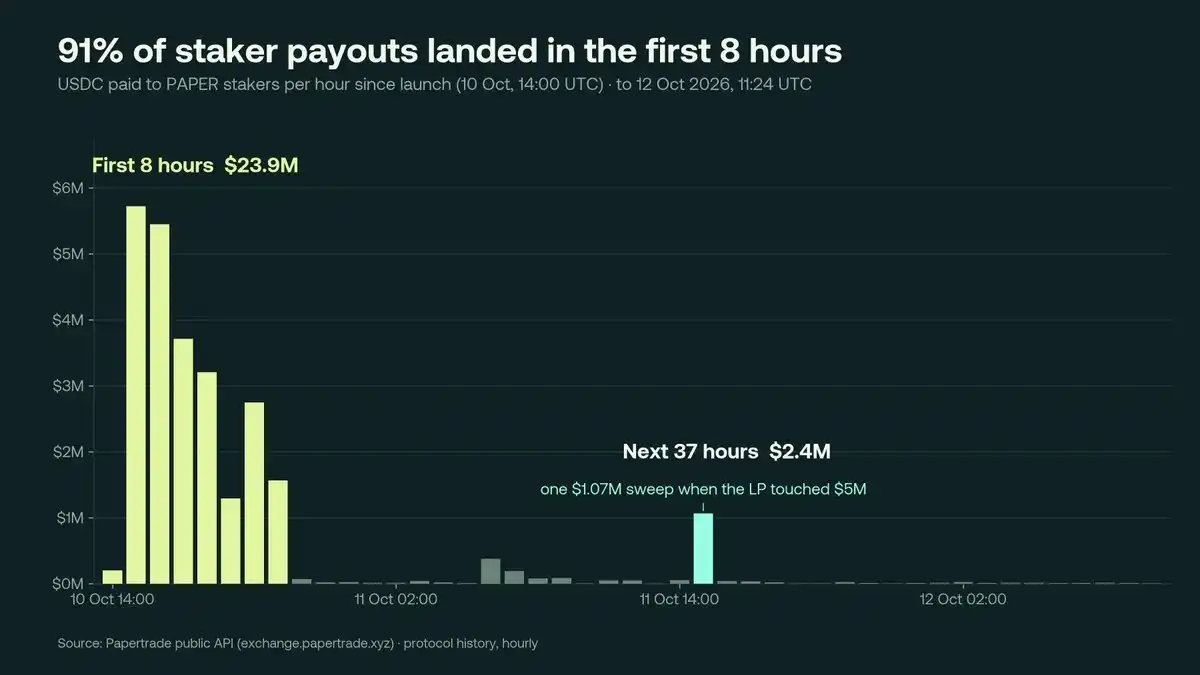
These two numbers essentially summarize the state of the game. However, who exactly made the money, and how they did it, is still worth a few minutes to unpack, especially if you plan to farm PAPER tokens this week.
All Research Reports Understood the Mechanism but Misjudged the Timeline
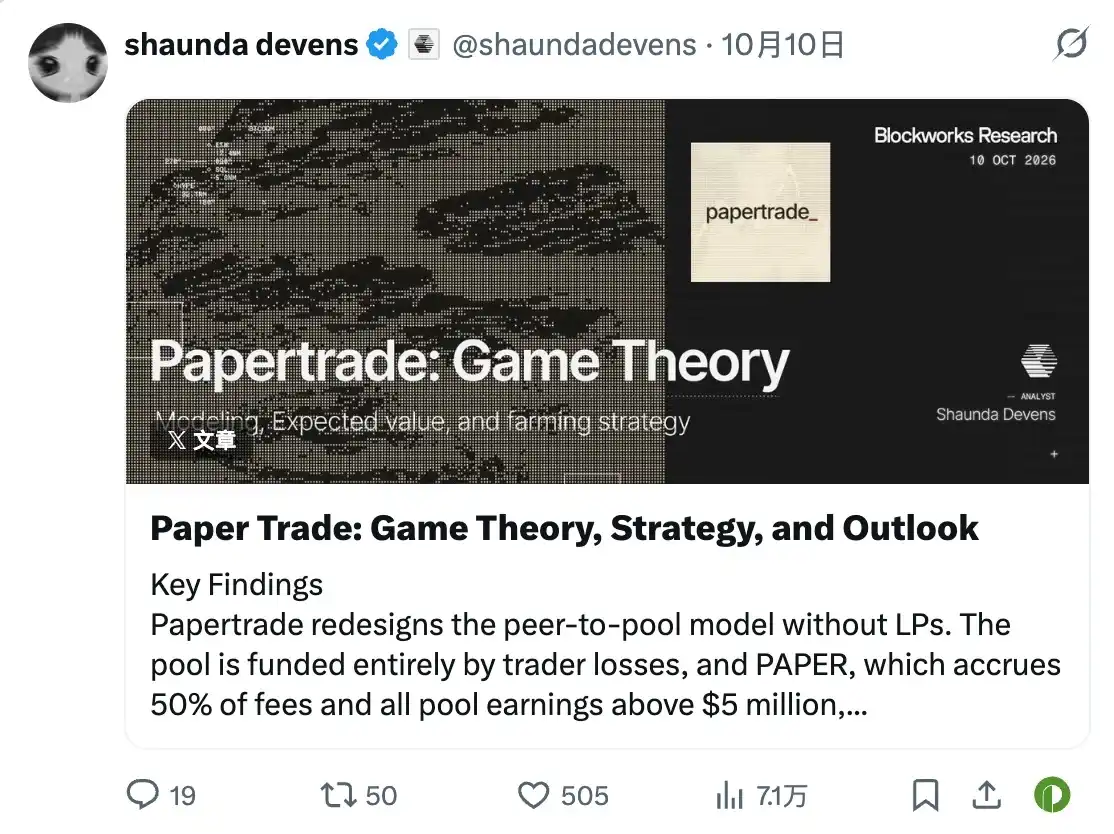
The highest-quality pre-launch research came from Shaunda Devens of Blockworks Research, tempest of Delphi Digital, and another investment firm, schema. All three explained the underlying mechanism thoroughly, but they all estimated the game would last for weeks.
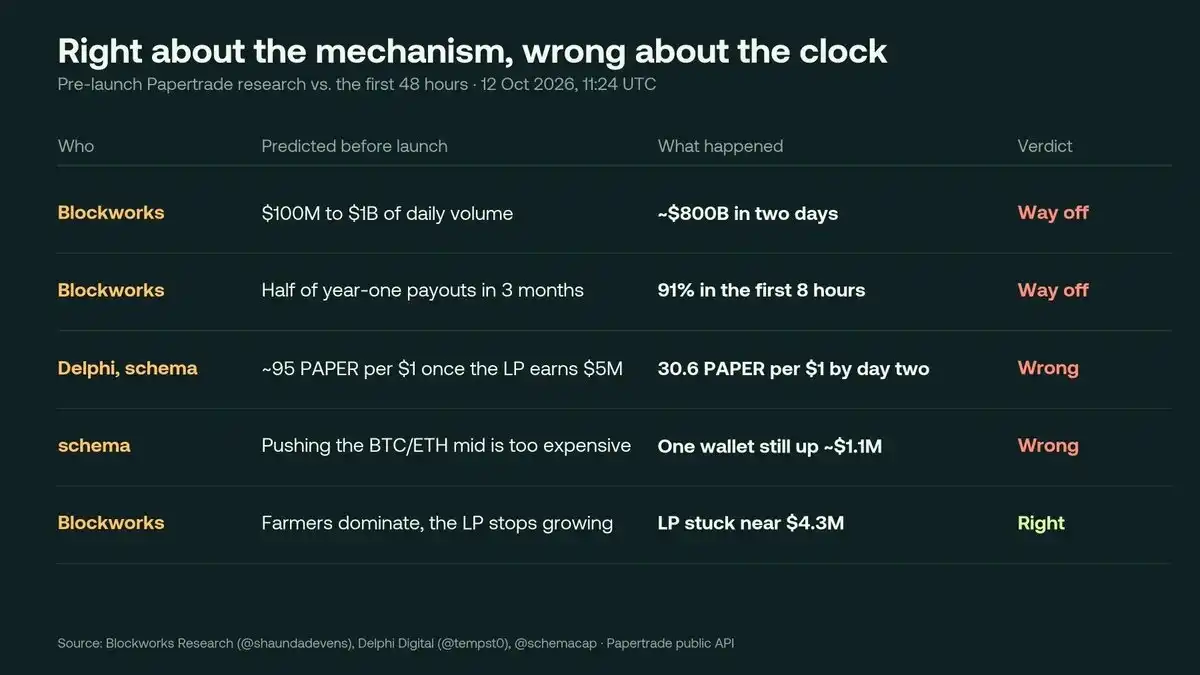
The only warning that stood the test of time was an unsettling one – Blockworks Research had cautioned that hedging arbitrage farmers could crowd out real traders, leading the protocol's LP into stagnation. This is precisely our current situation.
To be honest, nobody was foolish; it's just that the mechanism evolved far faster than anyone had priced in.
Who Actually Made Money?
Real traders incurred a net loss of $32.4 million on Papertrade, of which:
- $26.3 million flowed to PAPER stakers;
- $4.3 million settled in the house LP pool;
- The remainder went to developer fees and small amounts.
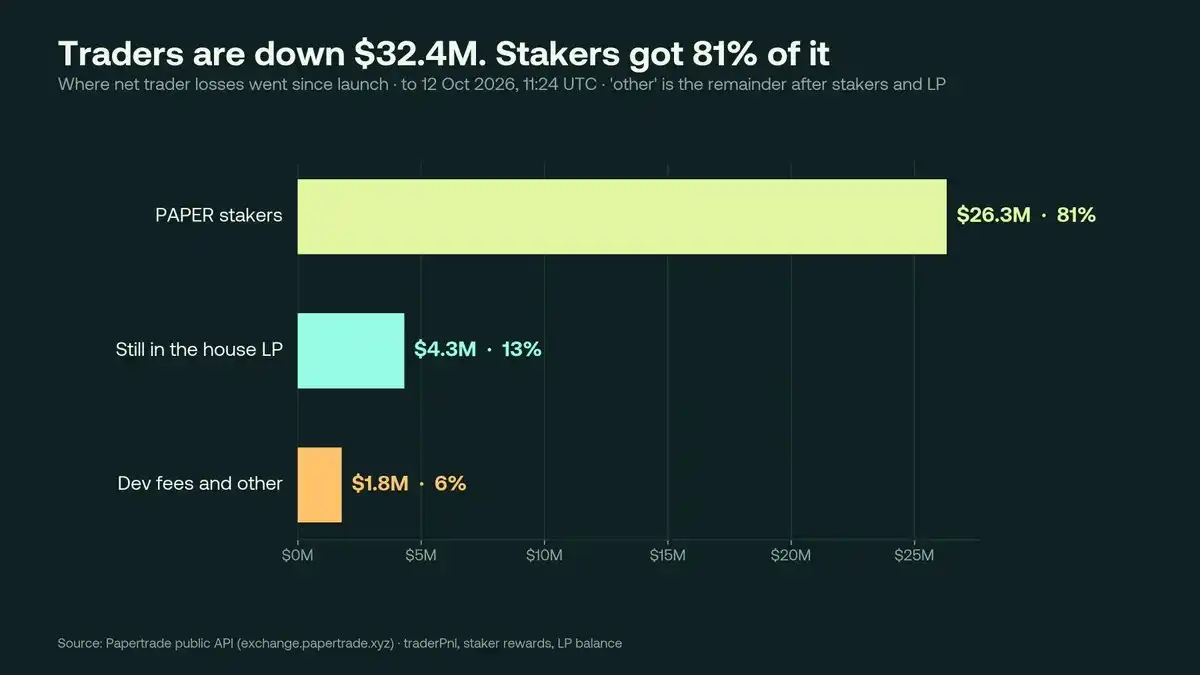
The vast majority of this $26.3 million was divided among early users who staked before approximately 22:00 UTC on launch day. In practice, this meant "whales took all" – Papertrade's relayer prioritized large orders, causing an order of about $75,000 to be queued beyond position 3000, while eight-figure orders could be matched within seconds.
Two of the most representative addresses showcase two distinctly different profit strategies.
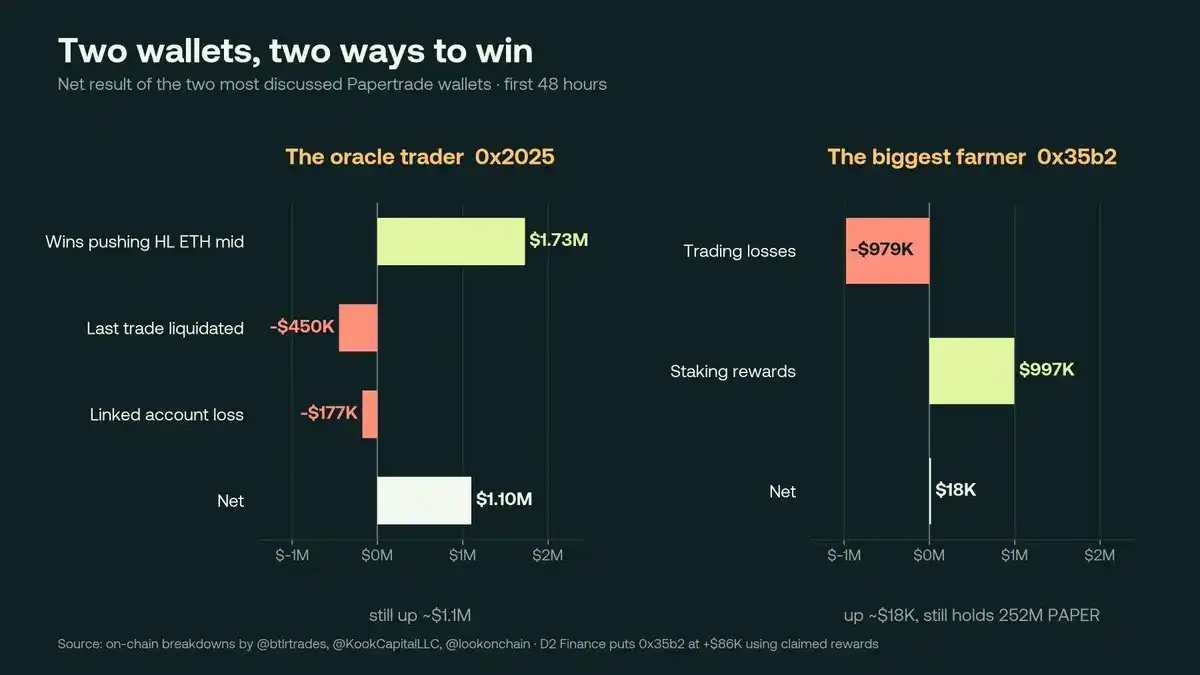
- Address starting with 0x2025 (Arbitrage Looter Type):
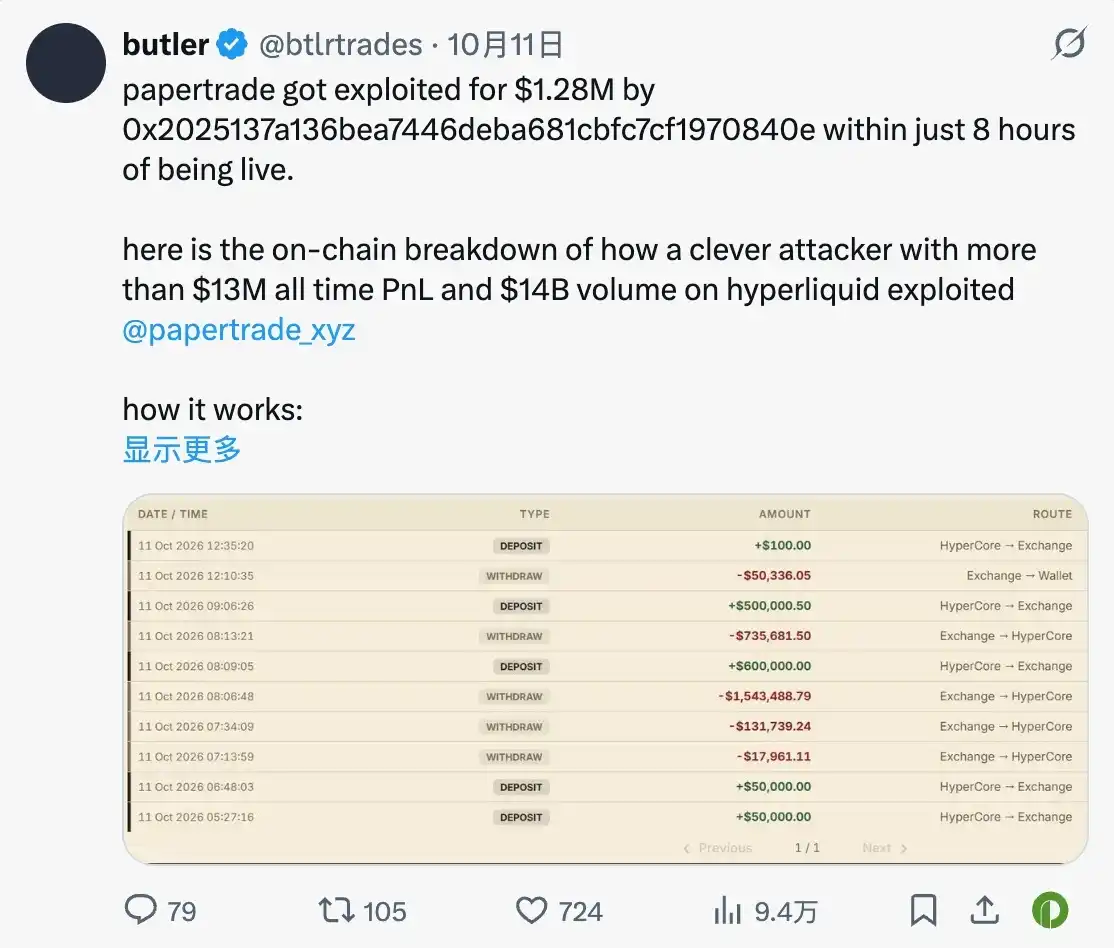
This address would move the ETH mid-price by 10 to 20 basis points on Hyperliquid, then place massive orders of around $200 million in the opposite direction on Papertrade. Out of 305 trades, they won 296, with an average holding time of only 98 seconds. Although one stuck order liquidated for a loss of $450,000, they still netted about $1.1 million. The Papertrade team (Jez, Blurr) claimed he returned most of the funds, but on-chain analysts butler and kook presented seemingly contradictory on-chain evidence.
- Address starting with 0x35b2 (Scale Volume Grinder Type):
According to Lookonchain data, this address generated $10.1 billion in trading volume, incurred a loss of $979,000, but recouped about $1 million in cash through staking, basically breaking even in fiat terms. However, the key point is they still hold 252 million PAPER tokens (about 4% of the total staked supply). At the current yield rate, these tokens generate roughly $14,000 in passive income per day. This is the true big winner.
By the way, let's debunk a rumor: the Papertrade team did not "slash staking yield from 99% to 1%" as on-chain analyst onchainmonk claimed.
The rule for staking rewards is – distribute the surplus from the LP pool exceeding $5 million, plus half of the 2% fee from profitable orders. As the LP pool dropped below $5 million, the surplus distribution automatically paused. The rule never changed; only the state of the pool did.
Can You Still Make Money Entering Now?
Here's the formula for newcomers planning to enter today:
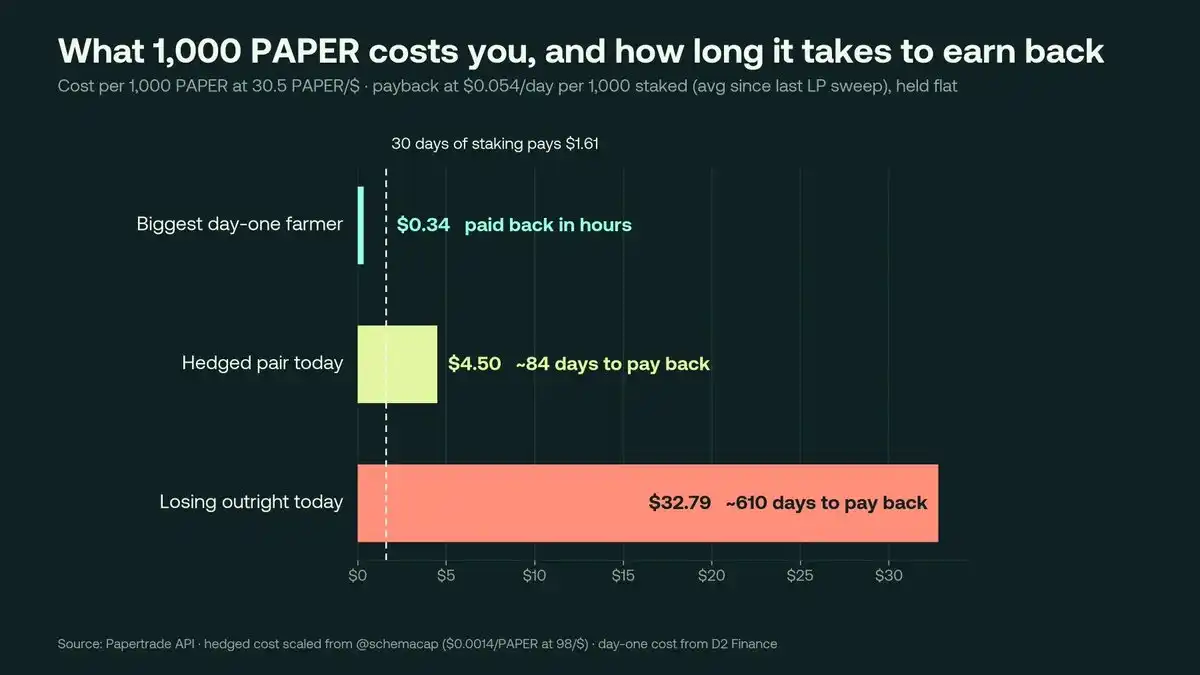
- Active Wear-and-Tear is Suicide: At today's minting rate, incurring a hard loss to acquire 1,000 PAPER costs about $33;
- Hedged Volume Grinding: Using a hedged long-short combo (opening 100x long and short positions, closing when volatility reaches about 1%), the cost is approximately $4.50;
- Dividend Income: Since the last LP liquidation distribution, staking 1,000 PAPER earns about $0.055 per day.
This means:
- The payback period for hedge farmers is about 80 days;
- The payback period for one-sided hard-loss farmers is as long as 590 days.
- This assumes stable yields and no one else continuing to mint new tokens – which is fundamentally impossible.
Even more critically, the difficulty will sharply increase starting October 17th, when the dividend trigger line will be raised from $5 million to $10 million on that day. As I write this, the house LP pool has only $4.3 million. This means that approximately $5.7 million of future trader losses will entirely refill the LP base pool before any dividends are distributed to stakers. Until the base pool is filled, stakers will only receive pure fee revenue.
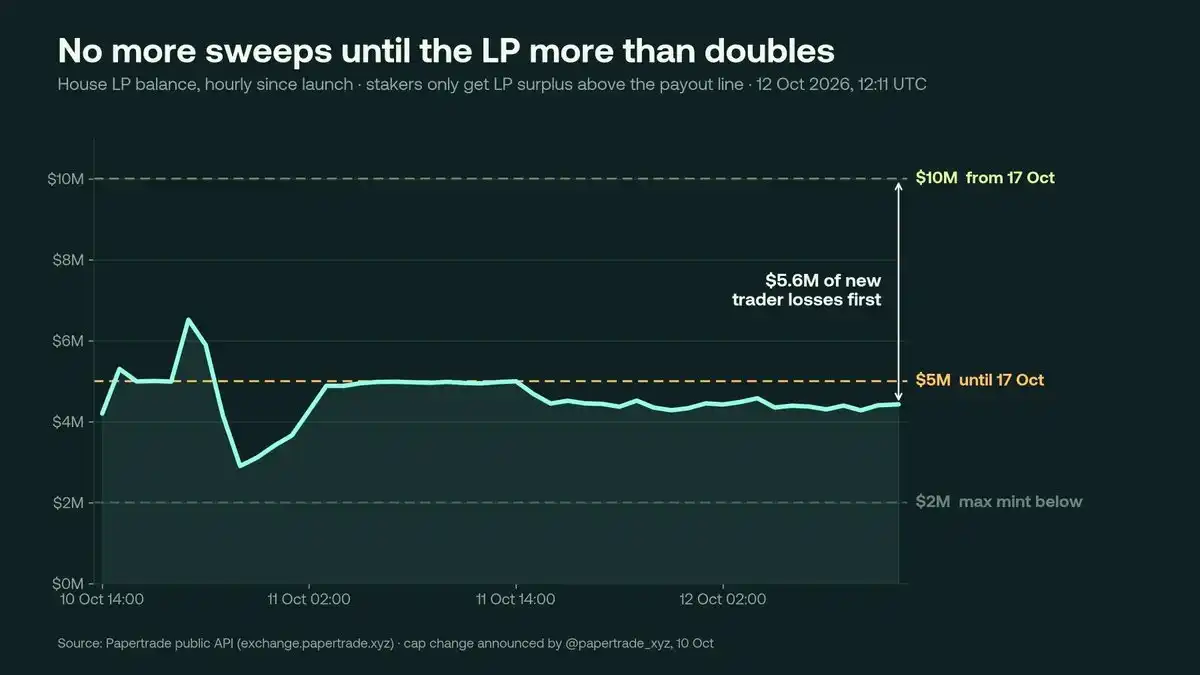
Personally, I believe entering to farm now is not a stable income strategy, but a gamble – a bet that genuine gamblers will continue to come in and lose money, and that the losses will be sufficient to push the LP pool past the $10 million mark. If you subscribe to this logic, then use 100x leverage for hedging, strictly guard against one-sided liquidation, and ensure both sides of your orders are truly matched; if you don't believe it, there's no need to rush in now.
Four Key Metrics
Four key metrics will determine whether this is just the first act or the grand finale:
- The LP pool breaking through $8 million and climbing steadily: This is the prelude to the next large dividend distribution.
- Non-mining real trading volume: Only directional speculative traders can inject liquidity into the LP; hedged farmers are essentially just inflating the supply.
- Net long open interest (OI): The current net long exposure is about $150 million, while the base pool holds less than $4 million. A clean 2.5% market pump would mean profitable positions need to be paid via the queue, not immediate cash settlement.
- Whether the settlement queue can consistently remain at zero.
I will revisit this with the same data model after October 17th.