Aave weighs closing 6 V3 blockchain markets, offboarding 50 low-use reserves

cointelegraphPublished on 2026-07-31Last updated on 2026-07-31

Abstract

A governance proposal in the Aave ecosystem recommends a major consolidation. It calls for shutting down Aave V3 markets on six blockchains (Sonic, Scroll, zkSync, Metis, Soneium, and Aptos) and offboarding 50 low-use token reserves, affecting approximately $98.1 million in supplied assets and $15.6 million in debt. The move follows the adoption of a new risk framework and aims to reduce the protocol's economic and technical risk. Notably, the Aptos market would be exited just 11 months after its launch due to low liquidity and revenue. The proposal emphasizes this is not a reversal of Aave's multichain strategy but a strategic refocus, with continuous risk assessment for all deployments to continue.

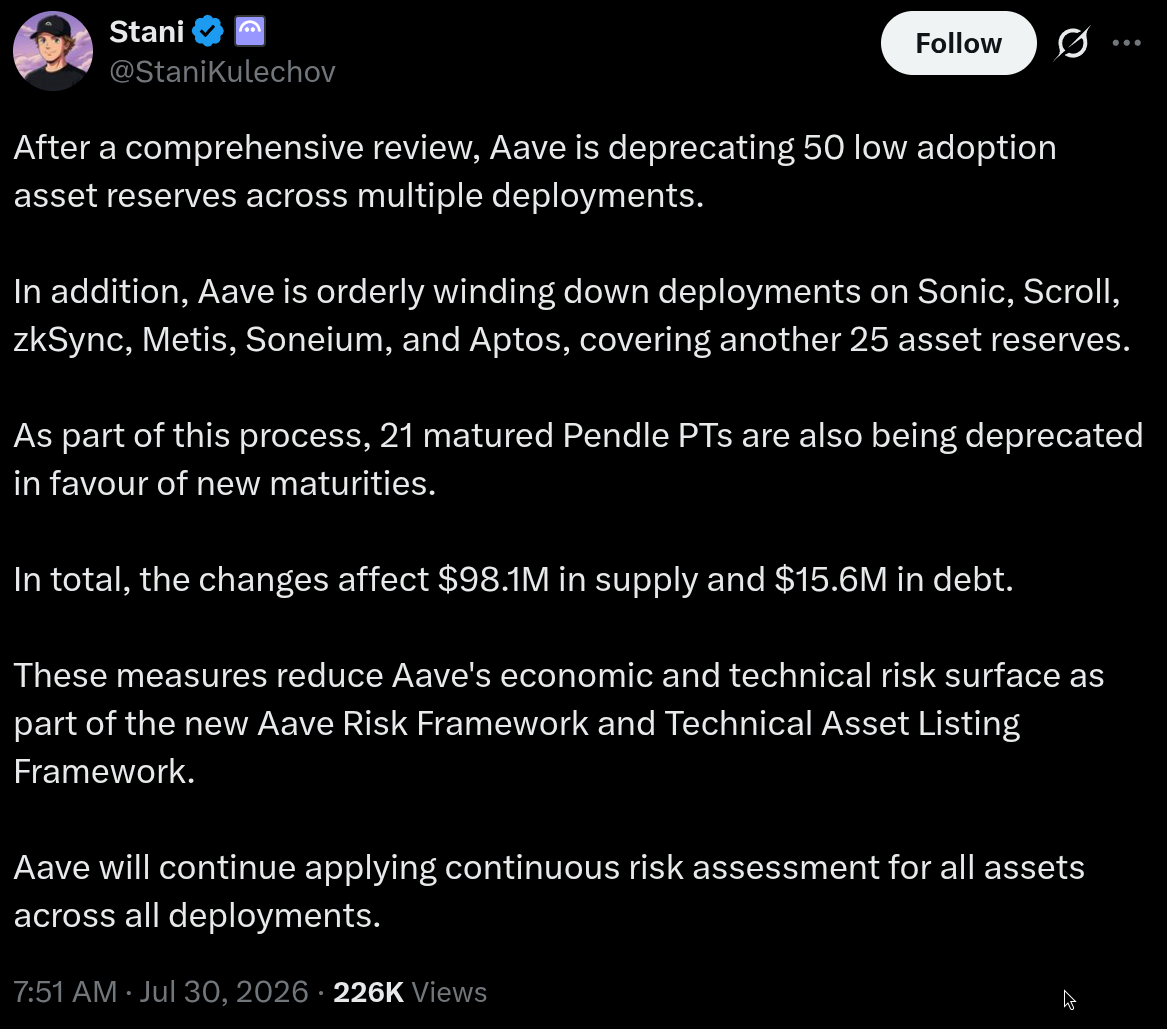
An Aave governance proposal would wind down the lending protocol’s V3 markets on six blockchains and retire dozens of low-use token listings, a cleanup covering $98.1 million in supplied assets and $15.6 million in debt.

Risk service provider LlamaRisk, working with other Aave service providers, recommended offboarding 50 low-use reserves and 21 matured Pendle principal token listings across 11 deployments. It also proposed retiring all 25 reserves on Sonic, Scroll, zkSync, Metis, Soneium and Aptos. The balances were measured on July 28.

An ARFC is a detailed proposal and precursor to an Aave Improvement Proposal; it is not, by itself, proof of a completed final onchain vote or execution.

Aptos exit follows recent launch

The proposed Aptos exit comes just 11 months after Aave launched its V3 market there, with available liquidity down 94% over six months and quarterly revenue below $1,000, according to LlamaRisk.

Every reserve on Scroll, zkSync, Metis and Soneium was already frozen, whereas Sonic and Aptos remained active and are recommended for freezing. The temp check on Aave’s multichain strategy concluded on Dec. 5, 2025, with 923,400 votes in favor and under 1% against increasing the reserve factor on underperforming instances, shutting down the instances on zkSync, Metis and Soneium, and establishing a $2 million annual revenue floor for new instance deployment.

Related: Aave positioned to capture tokenized asset growth in DeFi: Standard Chartered

Scroll was then added to the affected protocols through an accelerated process in April, as LlamaRisk filed a direct-to-AIP proposal to freeze every Scroll reserve and raise selected reserve factors, describing the measure as completing Scroll’s deprecation after a rapid deterioration in network liquidity and Aave market activity. Aave also published an updated risk framework on June 9, covering asset, bridge, monitoring and chain risk and criteria for winding down reserves or deployments, and this month’s announcement indicated de facto adoption of those rules by the protocol.
Aave founder comments on development

Source: Stani Kulechov

Aave founder Stani Kulechov said in a Thursday post that this will also “reduce Aave’s economic and technical risk surface as part of the new Aave Risk Framework and Technical Asset Listing Framework.”

Related: Aave brings V3 lending and GHO stablecoin to Monad

Still, this is not a reversal of Aave’s multichain expansion strategy, rather a strategic refocusing on select protocols. “Aave will continue applying continuous risk assessment for all assets across all deployments,” Kulechov said. The comments also follow Aave launching on Avalanche earlier this month.

Magazine: The real reason DeFi projects that survived 2022 crash are shutting down now

Related Questions

QAccording to the article, what is the total value of supplied assets and debt covered by Aave's proposed cleanup?

AThe proposed cleanup covers $98.1 million in supplied assets and $15.6 million in debt.

QHow many low-use reserves across how many deployments does LlamaRisk recommend offboarding?

ALlamaRisk, working with other Aave service providers, recommended offboarding 50 low-use reserves across 11 deployments.

QOn which six blockchains does the governance proposal recommend winding down all Aave V3 market reserves?

AThe proposal recommends retiring all reserves on the Sonic, Scroll, zkSync, Metis, Soneium, and Aptos blockchains.

QWhat was the reason given for adding Scroll to the list of affected protocols via an accelerated process?

AScroll was added due to a rapid deterioration in network liquidity and Aave market activity on the protocol.

QAccording to Aave founder Stani Kulechov, what is the primary goal of this strategic refocusing, and does it mean an end to multichain expansion?

AThe primary goal is to reduce Aave's economic and technical risk surface as part of the new risk framework. It is not a reversal of the multichain strategy but a strategic refocusing on select protocols, with continuous risk assessment continuing for all assets across all deployments.

Related Reads

ENS DAO Proposes Transferring Treasury Management Authority to Foundation Board, Community Retains Ultimate Veto Power

ENS DAO has initiated an on-chain vote on Social Proposal 7.5, which seeks to restructure governance of its core treasury by transferring authority over the Investment Policy Statement (IPS) to the ENS Foundation Board. Under the plan, policy amendment rights currently held by all token holders through on-chain voting would move to the Foundation Board, which would also take over the MetaGov working group's oversight of professional funds and fund managers. The proposal addresses long-standing pain points in decentralized treasury management, including slow token-voting response cycles and the high threshold for financial parameter review. As the protocol delegates management of scaled funds to Karpatkey, requiring full network governance for minor adjustments to asset allocation or risk exposure has caused voter fatigue and risked missing market windows. The shift aims to remove administrative bottlenecks in professional treasury operations. To ensure rigor, the new rules require the Board to solicit community input on the ENS governance forum at least 7 days before proposing amendments. Formal resolutions must receive at least 4 director votes in favor, with conflicted directors recused and remaining eligible directors deciding unanimously. Each amendment must include written rationale and be published within 14 days of passage. ENS DAO has built in checks and balances: the minimum treasury reserve duration and major withdrawals still require full token-holder approval, as does any change to IPS Section 3 governing amendment authority and Board duties. Crucially, ENS DAO retains a permanent override power to overturn any Board amendment via a social proposal, and external fund manager Karpatkey must continue monthly public financial reporting. The proposal reflects mature Web3 infrastructure exploring a balance between modern legal-entity governance and on-chain native democracy, offering a model for compliant, efficient decentralized treasury operations. As of the latest Snapshot data, Proposal 7.5 has 179,900 votes in favor with 100% support and no opposition or abstentions. The vote closes on November 22; if passed, the ENS Foundation will publish IPS v2.1 incorporating the revisions.

marsbit14m ago

ENS DAO Proposes Transferring Treasury Management Authority to Foundation Board, Community Retains Ultimate Veto Power

marsbit14m ago

Ethereum Upgrade Testing Exposes Hidden Risks: Transactions Show Success, but Payments May Fail

Ethereum's proposed Glamsterdam upgrade has exposed compatibility risks in smart contracts during testing on the Sepolia testnet. Simulations of Juicebox payment contracts showed that some transactions confirm successfully at the outer level while internal payments silently fail, causing fund distributions or fee payments to be skipped. The issue stems from changes to the underlying execution gas accounting logic, which affects existing contracts that rely on traditional exception handling. In NFT purchase tests, buyers received NFTs even when the internal payment failed due to gas exhaustion, leaving funds stranded in the payment project. In token distribution tests, cross-project payments were interrupted, so beneficiaries received the project's original tokens instead of the intended cross-project settlement. Cash redemption tests revealed that within a gas range of 679,622 to 817,622, users could redeem funds while the internal 2.5% protocol fee was not charged, effectively waiving the fee. Juicebox developer mejango linked the problem to tiered changes in opcode gas costs and contract error-handling mechanisms, specifically EIP-8037, which sharply raises the gas cost of state creation and new storage writes. Because internal payment subcalls exhaust gas before outer logic, and developers commonly use try/catch structures that isolate errors, the failed payments do not trigger a transaction rollback. On mainnet simulations, the same gas range produced only full transaction failures or complete payments, never silent internal skips. This contrast highlights the impact of gas pricing changes on already-deployed, non-upgradeable contracts, where gas reserves and error catching designed under the old model can turn into fund-leakage risks. The Ethereum Foundation has added the Juicebox report and PoC materials to its agenda and scheduled a special meeting on November 19 to discuss the scope of impact and possible responses. No final decision on adjusting proposal parameters has been made yet.

marsbit14m ago

Ethereum Upgrade Testing Exposes Hidden Risks: Transactions Show Success, but Payments May Fail

marsbit14m ago

Trading

Spot
活动图片