Bitcoin ETF inflows hit $3.8B in strongest three-week stretch of 2026

cointelegraphPublished on 2026-09-05Last updated on 2026-09-05

Abstract

US-listed spot Bitcoin ETFs recorded their strongest three-week inflow stretch of 2026, attracting $3.8 billion as Bitcoin traded near $80,000. Total net assets reached $101.3 billion. This marks a sharp turnaround from earlier outflows, though year-to-date flows remain slightly negative. Daily inflows cooled to $174.6 million on Friday, led by BlackRock's IBIT, after a surge the previous day. Concurrently, inflows into US spot Ether and XRP ETFs fell significantly compared to the prior week. Despite this slowdown, both Ether and XRP ETFs maintain positive net inflows for the year.

US-listed spot Bitcoin exchange-traded funds (ETFs) have recorded their strongest three-week inflow stretch of 2026 as Bitcoin traded around $80,000.

The funds attracted $986.9 million in the week ending Friday, bringing net inflows over the past three weeks to $3.8 billion, according to SoSoValue data.

Total net assets across the funds stood at $101.3 billion on Friday after briefly rising to $103.3 billion a day earlier, while cumulative net inflows reached $55.6 billion.

ETF demand marks a sharp turnaround from heavy outflows earlier in 2026, though year-to-date net flows remain roughly $1 billion negative.

Bitcoin ETF inflows cool after Thursday surge

US spot Bitcoin ETFs attracted $174.6 million in net inflows on Friday, down sharply from the nearly $731 million recorded a day earlier.

BlackRock’s iShares Bitcoin Trust (IBIT), the largest spot Bitcoin ETF by assets, drew $117.4 million on Friday, accounting for about 67% of the day’s total net inflows, according to Farside Investors data.
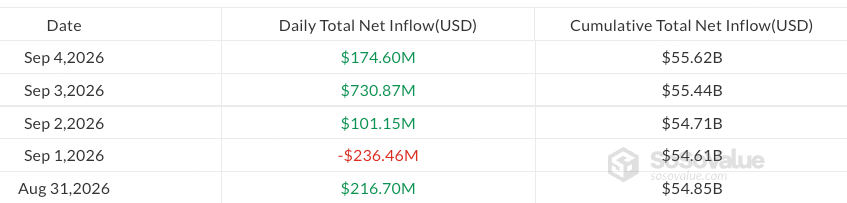
Daily spot Bitcoin ETF flows from Monday through Friday. Source: SoSoValue

Fidelity’s Wise Origin Bitcoin Fund (FBTC) was the only other fund to record net inflows, attracting $57.2 million, while all other US spot Bitcoin ETFs recorded no net flows for the day.

Related: Surprise nonfarm payrolls print sends Bitcoin back below 80K

The slowdown came as Bitcoin fell from around $81,200 to briefly below $79,000 on Friday. Bitcoin traded at $79,716 at the time of publication, still up about 2.6% over the past seven days, according to CoinGecko.

Bitcoin ETF demand strengthens as Ether, XRP flows fade

Compared with the previous week, Bitcoin ETF inflows increased about 7%, while inflows into US spot Ether and XRP ETFs fell about 74% and 83%, respectively.

Spot Ether ETF inflows dropped to $218.4 million from $824.4 million, while XRP ETF inflows declined to $19 million from $110.5 million, according to SoSoValue.

Despite weaker inflows, Ether and XRP ETFs remain in positive territory for the year. US spot Ether ETFs have recorded about $863 million in net inflows year-to-date, while XRP ETFs have attracted roughly $515 million.

Magazine: BTC will hit $1M by 2030... but Arthur Hayes is buying ETH instead

Related Questions

QWhat was the total net inflow for US-listed spot Bitcoin ETFs over the strongest three-week stretch of 2026?

AThe total net inflow for US-listed spot Bitcoin ETFs over the strongest three-week stretch of 2026 was $3.8 billion.

QWhich specific Bitcoin ETF accounted for the majority of net inflows on Friday, and how much did it attract?

ABlackRock’s iShares Bitcoin Trust (IBIT) accounted for the majority of net inflows on Friday, attracting $117.4 million, which was about 67% of the day's total.

QHow did the weekly net inflows into Bitcoin ETFs compare to those of Ether and XRP ETFs in the same period?

ACompared to the previous week, Bitcoin ETF inflows increased about 7%. In contrast, inflows into US spot Ether ETFs fell about 74% and inflows into XRP ETFs fell about 83%.

QWhat were the cumulative net inflows for US spot Bitcoin ETFs as of the Friday mentioned in the article?

AAs of the Friday mentioned in the article, the cumulative net inflows for US spot Bitcoin ETFs reached $55.6 billion.

QWhat is the year-to-date net flow status for Bitcoin ETFs despite the recent strong three-week inflow stretch?

ADespite the recent strong three-week inflow stretch, the year-to-date net flows for Bitcoin ETFs remain roughly $1 billion negative.

Related Reads

Singapore Blockchain Week 2026 Returns This November, Puts Singapore and Johor, Malaysia Cross-Border Digital Economy Opportunities in the Spotlight

Singapore Blockchain Week (SBW) 2026 will take place from 13 to 17 November 2026 as a government-supported flagship event bringing together regulators, financial institutions, sovereign entities, family offices, founders, investors, enterprises, and ecosystem builders. The event features prominent speakers including H.E. Justin Sun (TRON), Jose Fernandez da Ponte (Stellar Development Foundation), representatives from VISA, J.P. Morgan, SAP, the United Nations Development Programme, Société Générale-Forge, Paxos, World Bank, and others. SBW 2026 is positioned as the world's first cross-border blockchain week, connecting Singapore and Malaysia's Johor-Singapore Special Economic Zone (JS-SEZ) to accelerate innovation, investment, and technology collaboration across Southeast Asia. It is supported by partners including Singapore Global Network – Economic Development Board, Singapore Tourism Board, Malaysia Digital Economy Corporation, Iskandar Regional Development Authority, and Johor Corporation. The week-long programme includes: Special Economic Zone Immersion (13 Nov), Tech-Enabled Sports (14 Nov), Learnathon (15 Nov), Inner Circle (16 Nov), and Institution Summit (17 Nov). The event focuses on the convergence of AI, DeFi, Real World Assets (RWA), and Venture Capital, positioning Singapore and ASEAN at the forefront of global digital transformation. Sebastian Zilliacus, Chair of the Advisory Committee, emphasised that the event aims to move beyond headlines so traditional finance and emerging technology "start building together." CK Ong of SBI Digital Markets noted that tokenisation's key question is now market viability, requiring alignment of regulatory clarity, distribution, custody, and commercial viability. Kiran Mistry of SAP highlighted the importance of interoperability between blockchain and enterprise systems, while Rahul Bhargava of the World Bank and Contour Network discussed addressing the $2.5 trillion trade finance gap through digital documentation and multi-rail settlements. Raymond Ngan of Singapore Innovation Centre noted the event strengthens Singapore and Southeast Asia's position, particularly as Singapore prepares for ASEAN Chairmanship in 2027.

TheNewsCrypto40m ago

Singapore Blockchain Week 2026 Returns This November, Puts Singapore and Johor, Malaysia Cross-Border Digital Economy Opportunities in the Spotlight

TheNewsCrypto40m ago

BIT CCO Cynthia Wu Deconstructs Digital Asset Industry Pain Points: Buying Is Only the Starting Point; Holding It Properly Is the Real Competitive Edge

BIT CCO Cynthia Wu spoke at an FTAHK roundtable in Hong Kong on November 3, 2026, alongside Xapo Bank's Belle Leung and Anthea's Alex Pei, discussing the evolution of digital asset wealth management. She noted that after a full market cycle, family clients have shifted focus from prices to operational safety—asking not "can I buy it" but "can I hold it properly." Concerns center on custody, asset segregation, counterparty risk, and inheritance planning, with many families preferring familiar instrument types such as BIT's Swiss-listed spot bitcoin ETF (BBIT). On yield, Wu argued that yield itself is never the problem—unexplained yield is. Real yield is compensation for time and risk, so the key questions are whether risk is isolated, quantified, and capped. She advised families to ask every institution what risk their return corresponds to and where its boundaries lie. Regarding structured products like tokenized funds, RWA, and principal-protected notes, she stressed that structure can reallocate risk but cannot eliminate protocol-level or market risk; tokenization even adds smart-contract risk. Structures mainly change who bears the risk—citing SIX exchange's collateralized issuance since the Lehman crisis—while uncollateralized notes and buffer/income ETFs merely transfer risk at the cost of upside. The biggest red flag is a product promising protection against risks no structure can remove. On AI agents, Wu invoked equal rights and responsibilities: models are software without balance sheets, licenses, or duties of care, so liability rests with whoever deploys the agent and defines its limits, with attribution assessed over the long term as with human managers. "You can delegate trades, but not responsibility." Looking ahead three years, she predicted the first regulated, AI-agent-managed digital asset fund fully running on blockchain, with agents paid in bitcoin. BIT, founded in 2019 and headquartered in Singapore, manages over $6 billion in assets with licenses across multiple jurisdictions.

marsbit45m ago

BIT CCO Cynthia Wu Deconstructs Digital Asset Industry Pain Points: Buying Is Only the Starting Point; Holding It Properly Is the Real Competitive Edge

marsbit45m ago

Just Now, Gemini Omini 1.2 Tops the Leaderboard, 360p Video at $0.07 per Second, with Upscaling to 4K

Google DeepMind has released Gemini Omni 1.2 Flash, a new video generation model that ranks first on Arena.ai for both text-to-video and image-to-video, and third for video editing. It scored 1541 in text-to-video, up 27 points from Gemini Omni 1.1 Flash, with Google's Omni series now holding the top three spots. Key updates include: text-to-video duration extended to 15 seconds, with editing of source clips up to 15 seconds; native audio support; editing of 3–15 second source videos with up to 7 reference images; clip extension of 3–10 seconds per call up to 30 seconds total; re-editing of any output via videoId in later calls; and support for 360p, 720p, 1080p and 4K in 16:9 or 9:16 aspect ratios. Unlike prior waitlist approaches, it is fully available in Google AI Studio and the Gemini API. Pricing is 30% lower than the previous generation. The model introduces a "draft-then-refine" workflow: users generate quick 360p or 720p drafts at about $0.07 per second (roughly 5 cents USD), make multi-turn conversational edits to fix details without regenerating whole clips, then upscale the best draft to 1080p or 4K. This drastically cuts trial-and-error costs for ad agencies, e-commerce sellers and indie filmmakers. Other features include multimodal reference adherence (face portraits, character sheets, product images, motion reference clips up to 3 seconds, audio cues), enhanced cinematic camera control with stable perspective in complex 3D spaces, and improved multi-character dialogue with accurate lip-sync and speaker distinction. Early hands-on tests show 1.2 Flash outperforming 1.1 in FPV camera moves through the Colosseum without flicker or distortion, generating convincing wildlife documentary footage from a single prompt, and maintaining character consistency across dancing and parkour clips, including mixed art styles (stop-motion, realistic 3D, comic, anime) interacting in one scene. The release marks AI video's shift into a third phase focused on cost, deliverability and workflow integration.

marsbit50m ago

Just Now, Gemini Omini 1.2 Tops the Leaderboard, 360p Video at $0.07 per Second, with Upscaling to 4K

marsbit50m ago

Three Harvard Girls Venture into the AI Startup World, She Raised Over $100 Million

This article contrasts the first generation of "Harvard girls"—epitomized by Liu Yiting, whose 1999 full-scholarship admission to Harvard became a bestselling parenting-book phenomenon—with a new wave of Harvard-educated Chinese women who are choosing AI entrepreneurship over traditional elite career paths. Three profiles stand out. Guo Wenjing, a "genius girl" admitted early to Harvard from Hangzhou No. 2 High School, earned degrees in math and computer science, interned at Meta AI, Microsoft, Google Brain and Epic Games, then dropped out of her Stanford PhD in 2023 to co-found Pika Labs, an AI video generation startup. Pika raised $135 million within about a year, reaching a valuation above $470 million. Her father's A-share listed company briefly surged on the "daughter concept stock" hype. Christine Zhang, 19, took a gap year from Harvard to co-found Veil, a GEO (generative engine optimization) startup helping brands become visible when consumers query AI chatbots. Veil raised a $1 million seed round within three months, serving nearly 500 clients with a six-person team. Avery Pan co-founded Class Companion, an AI education company that gives teachers AI-generated personalized feedback while retaining grading authority. It raised a $4 million seed round led by Index Ventures with OpenAI Startup Fund participation, and was acquired by Panorama Education in 2025, just two years after founding. The article notes this "Harvard + Chinese + dropout + AI startup" narrative is spreading beyond Harvard to Stanford and MIT, citing Jessica Wu (MIT dropout, Sola Solutions, ~$21 million raised) and Hong Letong (Stanford PhD dropout, Axiom Math, $200 million Series A, valuation over $1 billion). The generational shift is clear: the earlier narrative centered on being chosen by Harvard as proof of success, while the new one centers on refusing to be defined by Harvard—dropping out, taking gap years, and proving value through ventures and results. Both generations share a belief that timing, not just credentials, changes destiny—and AI provides the opportunity.

marsbit1h ago

Three Harvard Girls Venture into the AI Startup World, She Raised Over $100 Million

marsbit1h ago

Trading

Spot
活动图片