Hyperliquid's Path to U.S. Compliance: From Permissionless to Permissioned HIP-3

marsbitPublished on 2026-09-04Last updated on 2026-09-04

Abstract

Hyperliquid's evolution from a permissionless platform to a regulated one for the US market is its central narrative. Its core infrastructure, HyperCore, separates functions like trading, clearing, and brokerage in a modular, on-chain system. However, its permissionless, self-custody model conflicts with US regulations requiring registered exchanges (DCM), clearinghouses (DCO), and brokers (FCM). To address this, Hyperliquid has geoblocked the US and launched the Hyperliquid Policy Center (HPC) to advocate for regulatory modernization, allowing licensed entities to build compliant products on its infrastructure. The proposed solution involves HIP-3, a permissioned DEX framework on the testnet. This allows regulated deployers to list markets and whitelist KYC'd users, creating compliant order books. Crucially, liquidity can bridge between these and the native permissionless markets via market makers, preventing fragmentation. Features like direct account control ("PA" payload) mimic traditional broker authorities. The strategy aims to "onshore" Hyperliquid by enabling US firms to use its neutral infrastructure while fulfilling their regulatory duties, keeping the core protocol unchanged.

Author: shaunda devens

Compilation: Baihua Blockchain

Disclaimer: This article is reproduced content. Readers can obtain more information through the original link. If the author has any objections to the reproduction form, please contact us, and we will make modifications as requested by the author. Reproduction is for information sharing only and does not constitute any investment advice, nor does it represent the views or positions of Wu Shuo.

Full text as follows:

Hyperliquid continues to implement geographic blocking (geoblocked) for the U.S. market because its permissionless on-chain infrastructure conflicts with U.S. market structure laws—which strictly limit futures trading to registered trading platforms, clearinghouses, and brokers. The Hyperliquid Policy Center has urged the CFTC and SEC to modernize these regulatory frameworks, advocating that regulated entities should be allowed to build products on HyperCore through builder and deployer seats, as long as they undertake corresponding compliance obligations. Now, corroborated by Trump's statement, the most likely path for Hyperliquid's onshoring is through a permissioned HIP-3 DEX.

I. Core Details

Over the past year, much of our work on Hyperliquid has been to reposition it from a "decentralized perpetual contract trading platform" to "modern market infrastructure": a globally accessible, composable platform for financial instruments encompassing perpetual contracts, spot, and prediction markets.

Unlike monolithic crypto platforms like Coinbase and Binance that handle the entire process themselves (from user onboarding, custody to trade execution), Hyperliquid's infrastructure layer is more akin to the separation of duties across entities in traditional finance (TradFi): the trading platform (DCM) is responsible for listing contracts and matching trades; the clearinghouse (DCO) is responsible for providing margin and ensuring settlement; the broker (FCM) is responsible for user onboarding and routing trading access.

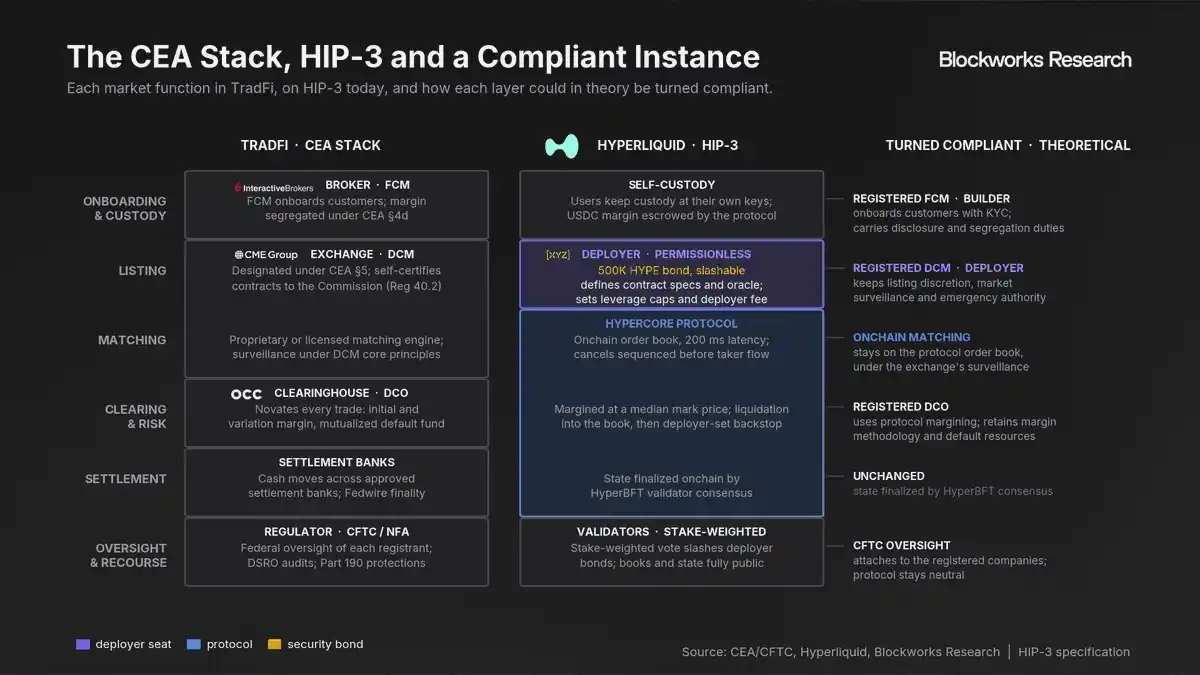
Similarly, Hyperliquid's modular technology stack embodies this exact same separation of duties. HyperCore (the trading platform and clearing layer) runs matching, margin calculation, and settlement as underlying protocol logic, marking positions to market based on validator oracles, and executing liquidations through a deterministic waterfall mechanism. Deployers must stake 500,000 HYPE as slashable margin, responsible for token listing, setting contract specifications, leverage limits and oracle configurations, and can retain up to 50% of the fees generated by their markets. Builders act as brokers, responsible for guiding user onboarding and routing trading flow to HyperCore, receiving a share of transaction fees.
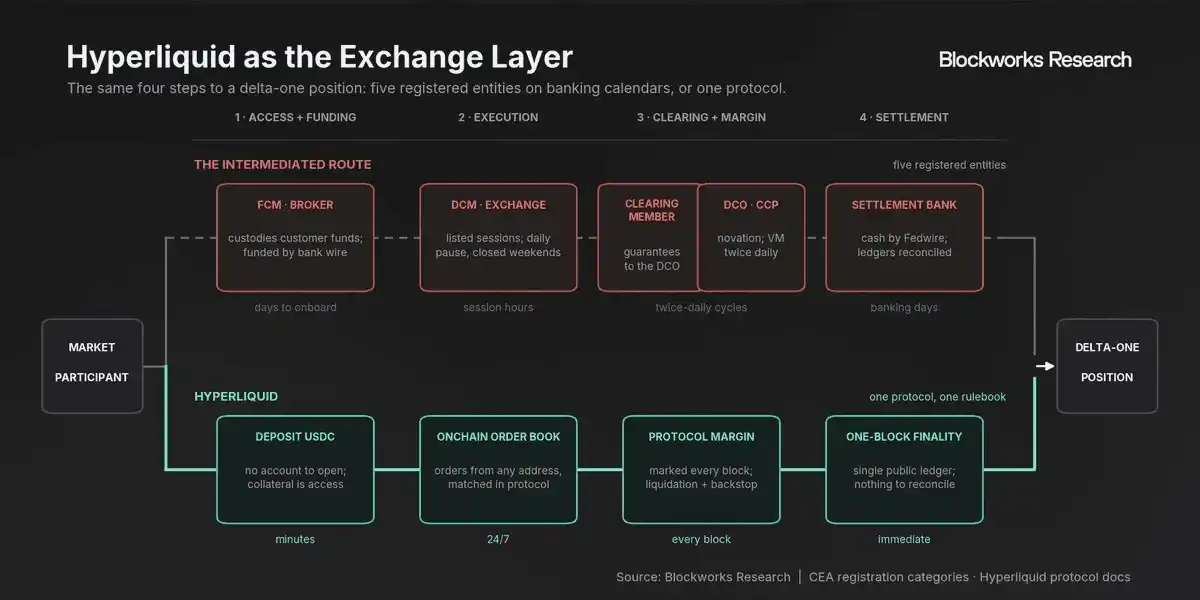
However, Hyperliquid reconstructs these layers on-chain and enforces them through programmed code: onboarding and market creation are permissionless, assets are fully self-custodied by users, other applications can be built on top of it, and all assets are traded 24/7 on a single global platform, eliminating the geographical and legal fragmentation of traditional finance.

II. Hyperliquid's Regulatory Dilemma

In this context, Hyperliquid's biggest challenge is regulation: U.S. market structure laws are tailored for traditional architecture, and each of its legally defined registered roles structurally conflicts with Hyperliquid's underlying design. For example:

• A Designated Contract Market (DCM) must adhere to 23 core principles under Section 5(d) of the Commodity Exchange Act (CEA), including market surveillance and customer identification. Yet anyone with a wallet can access HyperCore.

• A Derivatives Clearing Organization (DCO) must calculate margin using models approved by its board with 99% confidence levels and settle through approved settlement banks (17 CFR §§39.13–39.14). HyperCore relies on protocol logic for margin calculation and settles at the consensus layer.

• A Futures Commission Merchant (FCM) must segregate customer funds under CEA Section 4d. Hyperliquid users self-custody, which is fundamentally different from the custodial FCM model.

It is these stringent requirements that have forced even centralized KYC-enforcing platforms like Coinbase to register as FCMs and acquire existing DCM companies for their U.S. operations. Hyperliquid cannot replicate this model because acquiring a DCM and conforming to existing regulation would contradict its goal of "revolutionizing underlying infrastructure"; therefore, it chose to self-impose geographic blocking, withdrawing from the world's largest capital market.

Nonetheless, Hyperliquid's goal is not to remain offshore permanently: In February 2026, it announced the establishment of the Hyperliquid Policy Center (HPC), funded with 1 million HYPE (approximately $72.5 million at current prices), dedicated to bringing this new market structure within the U.S. legal framework.

In July, HPC, alongside Phantom, petitioned the CFTC to confirm that releasing on-chain software itself does not trigger licensing requirements, allowing existing licensed institutions to run matching, settlement, and margin calculation on on-chain infrastructure, and establishing exemptions that permit non-custodial wallets to route users to regulated derivatives. In August, HPC and TradeXYZ brought the same logic to the SEC, proposing a regulatory framework for Pre-IPO perpetual contracts (such as SpaceX and Cerebras, already trading on Hyperliquid), accompanied by disclosure and qualification rules necessary for opening them to U.S. investors. Early signs indicate the strategy is working and U.S. regulators are receptive, the most visible signal being Trump's announcement that Chairman Selig plans to push for Hyperliquid's onshoring.
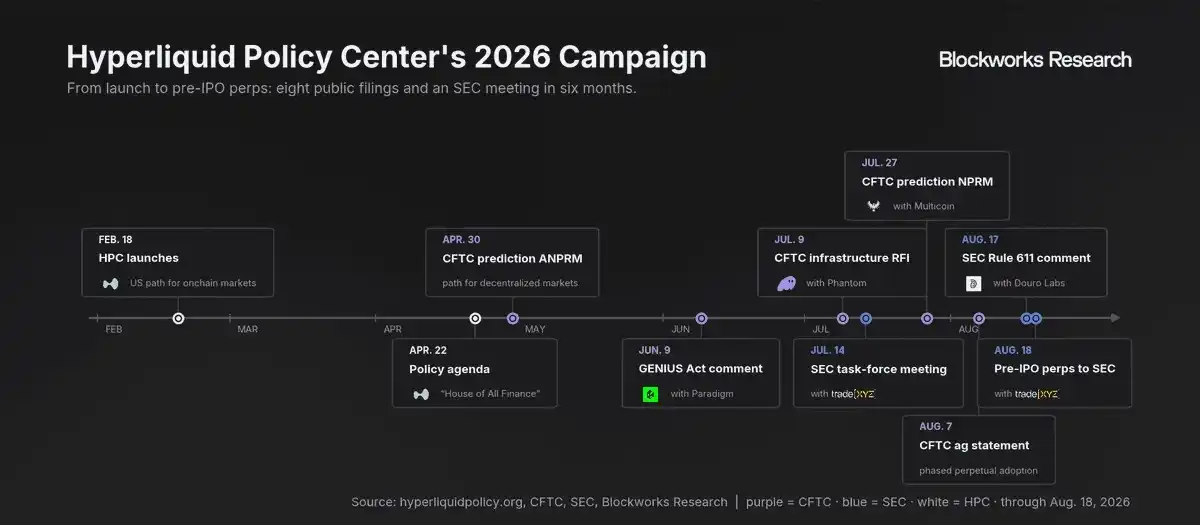
HPC's strategy is not to request opening Hyperliquid directly to U.S. investors without KYC, but to advocate for it as neutral infrastructure: if U.S. companies can use it while fulfilling their regulatory duties under current law, then it should be an option alongside traditional DCMs. For instance, brokers could route client trading flow to HyperCore as long as they fulfill KYC obligations; or deployers could take on the role of registered trading platforms, retaining listing discretion, market surveillance, and emergency intervention powers.
III. Hyperliquid's Compliance Examples

As policy advocacy progresses in Washington, Hyperliquid Labs has already rolled out updates on testnet, theoretically enabling such compliant access. The most typical example is the permissioned HIP-3 deployer: unlike Hyperliquid's native markets and existing HIP-3 deployments which are completely open, these new deployments are only accessible to whitelisted users. Such deployments provide a clear path for regulated entities to list markets, enforce KYC, and whitelist compliant users for trading.
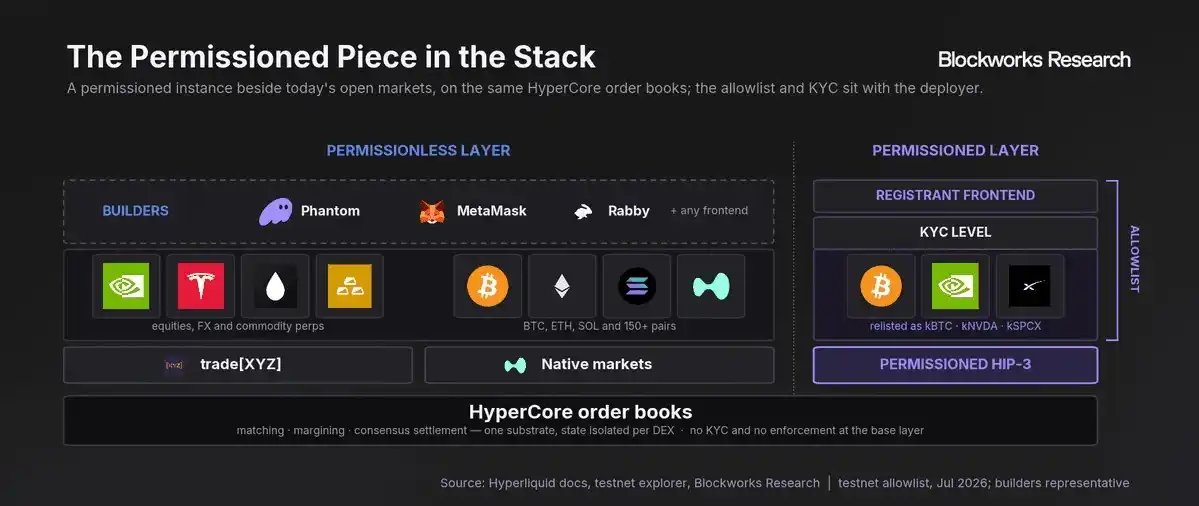
These compliance instances will manifest as fragmented order books, as all markets (e.g., BTC and RWA markets) need to be re-listed. However, whitelisted market makers will bridge liquidity between the two order books, thereby eliminating liquidity fragmentation, allowing the new deployments to inherit Hyperliquid's deep liquidity while maintaining independent order books. This independent order book model has precedents (e.g., early Binance US and Lighter's deployment on Robinhood Chain today), but the difference is that because both markets on Hyperliquid run on the same L1, sharing collateral and margin without the need for cross-chain or cross-exchange transfers, liquidity can flow seamlessly between order books rather than being isolated.
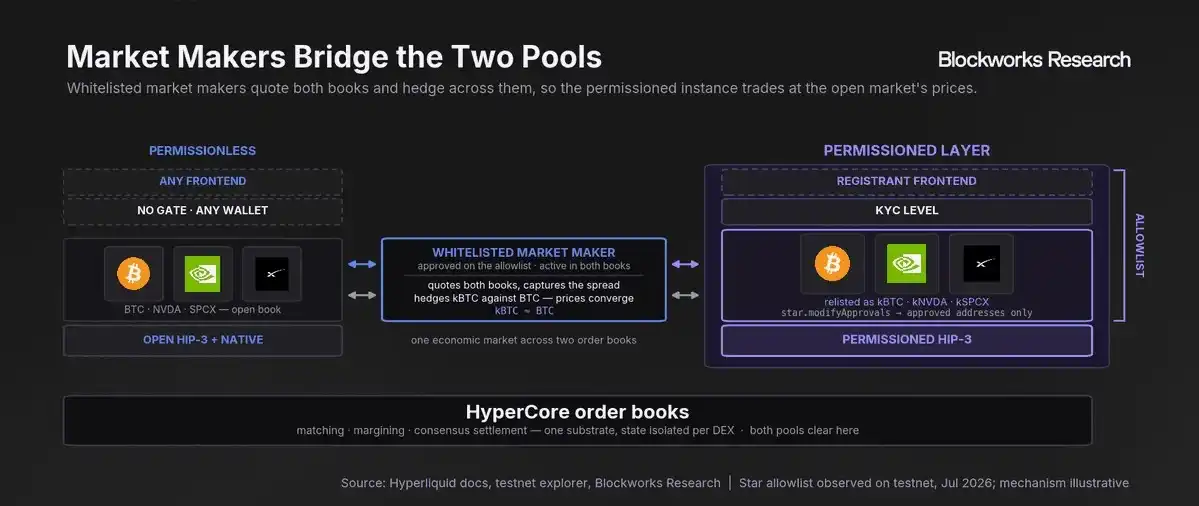
These trading platforms also include other parameters, such as the "PA" account operation permission in the payload, which allows the DEX to directly execute operations on user accounts: submitting reduce-only orders, canceling orders, and transferring USDC internally within the DEX, similar to the close-out authority an FCM has over client accounts. These elements collectively outline the future evolutionary path: U.S. brokers and institutions now have the tools to build compliant Hyperliquid products on HyperCore. This choice is additive—Hyperliquid's native markets remain permissionless, and its position as neutral infrastructure remains unchanged.

IV. Research View

Hyperliquid's recent moves in Washington indicate that gaining compliant entry into the U.S. domestic market is a current core priority; yet it is equally clear that operating directly through its native, KYC-free frontend is not compliant under current U.S. law. We believe HPC's efforts point to a path for achieving KYC-compliant access: allowing the use of Hyperliquid's underlying infrastructure, provided the enterprises offering access fully adhere to regulations. With enabling tools now live on testnet (permissioned HIP-3 deployers, PA account control), we expect this implementation method will provide a compliant channel for U.S. investors to participate in Hyperliquid's markets, while preserving the protocol's nature as neutral infrastructure.


Related Questions

QWhat is the main regulatory challenge Hyperliquid faces in the US market according to the article?

AHyperliquid faces a regulatory challenge because its permissionless, on-chain infrastructure conflicts with US market structure laws. These laws restrict futures trading to registered exchanges, clearinghouses, and brokers, which clashes with Hyperliquid's design where anyone with a wallet can access its core protocol (HyperCore) and where users self-custody assets.

QWhat is the primary strategy of the Hyperliquid Policy Center (HPC) for achieving compliance in the US?

AThe Hyperliquid Policy Center's strategy is to advocate for regulatory modernization. It urges the CFTC and SEC to update frameworks so that regulated entities (like brokers or exchanges) can build compliant products on Hyperliquid's neutral infrastructure (HyperCore) as long as they fulfill their corresponding legal obligations (like KYC). This allows the protocol to remain permissionless while enabling regulated access.

QHow does the article describe the functionality of a HIP-3 deployer with permissions management?

AA HIP-3 deployer with permissions management creates markets that are only accessible to a whitelist of users. This provides a clear path for regulated entities to list markets, perform KYC on users, and only allow compliant users to trade. It functions with a separate order book but can inherit liquidity from Hyperliquid's main markets through market makers bridging the two.

QWhat does the 'PA' (Payload Authority) operational permission allow a DEX to do, according to the article?

AThe 'PA' (Payload Authority) operational permission allows a DEX to directly execute actions on a user's account. This includes submitting reduce-only orders, canceling orders, and transferring USDC within the DEX. This is analogous to the close-out authority that a Futures Commission Merchant (FCM) has over a client's account in traditional finance.

QWhat is the ultimate goal of Hyperliquid's compliance efforts as presented in the article, and how does it aim to achieve it?

AThe ultimate goal is to 'onshore' Hyperliquid to the US market in a compliant manner without abandoning its core infrastructure principles. It aims to achieve this by positioning HyperCore as neutral infrastructure. The path involves regulated entities (brokers, exchanges) using tools like permissioned HIP-3 deployments to create compliant, KYC-gated products on top of Hyperliquid, thereby providing US investors access while the underlying protocol remains permissionless.

Related Reads

Strategy stock sheds 5% amid MSCI index removal, Bitcoin sell-off

Strategy (Michael Saylor's Bitcoin treasury company) fell 6.49% on Thursday to close at $114.41, after MSCI confirmed the company's removal from its global equity indexes, compounded by a broader crypto market sell-off. The removal takes effect after the Nov. 30 market close and could trigger selling by index-tracking funds; JPMorgan previously estimated roughly $2.8 billion in potential selling pressure. Ryan Kirkley, CEO of Global Settlement Network, said the decision could distinguish Bitcoin treasury companies from traditional operating businesses and limit indirect crypto exposure for passive investors, noting that index inclusion had given ordinary passive investors leveraged Bitcoin exposure they never chose. He added it raises questions about whether such companies should be classified alongside traditional operating businesses, arguing that buying and holding an asset isn't an operating business but rather a fund that doesn't follow fund rules. In its Aug. 31 response to MSCI's proposed rules, Strategy called the changes a pretext for targeting digital asset treasury companies and downplayed the impact, saying MSCI-linked funds held about 13 million of its shares, just 3.1% of basic shares outstanding. The decline coincided with a broader crypto sell-off, with Bitcoin near $71,340, down 4.3% in 24 hours, and total crypto market capitalization down 3% to about $2.49 trillion.

cointelegraph1h ago

Strategy stock sheds 5% amid MSCI index removal, Bitcoin sell-off

cointelegraph1h ago

US Justice Department, business groups and DeFi firms challenge Illinois crypto tax

The US Department of Justice, business and financial industry groups, and a coalition of DeFi firms have backed a legal challenge to Illinois' 0.2% digital asset tax, arguing it unfairly targets crypto transactions and could impose taxes even without profit. The Justice Department filed a statement of interest, while the US Chamber of Commerce and SIFMA submitted an amicus filing. A coalition including Andreessen Horowitz, Paradigm, Uniswap and Aave Labs also filed a brief. The law, enacted in June, taxes the value of digital assets exchanged, transferred or stored regardless of profit. The Digital Chamber sued Illinois officials in July, followed by a separate challenge from the Blockchain Association and Crypto Council for Innovation in August. Originally set for Jan. 1, 2027, the tax was delayed to July 1, 2027. Illinois projected $60 million in fiscal year 2027 revenue. SIFMA and the Chamber warned the tax would affect banks, broker-dealers, custodians and asset managers nationwide, exposing them to compliance costs and burdening customers—someone who loses money owes the same tax as someone who profits, and moving assets between accounts could trigger tax without a sale or gain. They argued it discriminates against digital assets and may violate federal internet tax protections and constitutional interstate commerce requirements. The DOJ said the tax undermines federal efforts to promote crypto innovation, citing the Strategic Bitcoin Reserve and GENIUS Act. The DeFi coalition warned the rules could impose obligations on software developers and blockchain participants lacking customer information or control over funds.

cointelegraph2h ago

US Justice Department, business groups and DeFi firms challenge Illinois crypto tax

cointelegraph2h ago

DTCC Plans Solana Expansion as Wallet Rules Limit Access

DTCC plans to connect its tokenization service to Solana in the second half of 2027, allowing certain securities held by its DTC subsidiary to be converted into digital tokens on the network. Analysts say the move could attract more traditional financial institutions to Solana, which is known for fast transactions and low fees and had about $4.94 billion in total value locked as of Nov. 12. However, the impact may be limited by US regulatory rules. Alex Lin of Reforge noted that Solana's experience handling memecoin trading served as a public stress test, giving the network credibility to handle retail-scale volume reliably. Still, under a December 2025 SEC no-action letter, DTC participants must register wallets to hold tokenized securities, and tokens can only be transferred between registered wallets. Lin said the near-term impact is overstated because the tokens remain in a walled garden, inaccessible to permissionless retail and DeFi liquidity until regulators allow these assets to function as true onchain collateral. DTCC launched its tokenization service on the Canton Network and its private Besu network on Oct. 28, with 20 DTC participants signed on, though it has not said whether any plan to use Solana. Kha Nguyen of Birdeye said Solana has already seen growing demand for tokenized stocks, with trading volume reaching around $4.9 billion in H1 2026 and over 1 million accounts holding tokenized stocks by late September. However, broader Solana activity has slowed, with transactions down nearly 40%, DEX volume down 34.4%, and fees down 39%, while tokenized RWA value rose almost 7% to $4.76 billion. Nguyen said DTCC's integration would need banks, brokers, and issuers to actively issue, trade, and settle on Solana, with enough liquidity for large trades. He stressed that assets must be active rather than idle—traded around the clock, used as collateral, and earning yield. Lin agreed that long-term impact depends on where assets are used for secondary trading and collateral activity, not where they are issued.

cointelegraph3h ago

DTCC Plans Solana Expansion as Wallet Rules Limit Access

cointelegraph3h ago

Trading

Spot
活动图片