Morgan Stanley Report Analysis: Foldable iPhone Expected to Contribute $14 Billion, Pro Models to See Price Increase Over $200

marsbitPublished on 2026-09-04Last updated on 2026-09-04

Abstract

Morgan Stanley Research Report Summary: Foldable iPhone and Pro Price Hikes Morgan Stanley's pre-iPhone 18 launch report maintains an Overweight rating on Apple with a $360 target. The key takeaway is the introduction of a foldable iPhone, seen as the most significant hardware change since the iPhone X, set to contribute approximately $14 billion in revenue in its first December quarter. The Pro models are expected to see their largest price increases in years, driven by rising memory costs, with the iPhone 18 Pro starting at $1,299—a $200 increase. The foldable iPhone, with a predicted base price of $2,399, is forecast to have strong initial demand. It features design trade-offs like an in-display fingerprint sensor instead of Face ID and a dual-camera system. The hardware launch coincides with new CEO John Ternus's debut as the keynote presenter. For the iPhone 18 Pro series, the core upgrade is the move to a 2nm A20 Pro chip, promising significant performance and efficiency gains to support advanced on-device AI. However, memory supply constraints pose a potential risk to production volumes. Overall, Morgan Stanley believes the combination of a lengthening iPhone upgrade cycle, global AI feature rollout, and the new foldable form factor will accelerate iPhone growth. The report highlights Ternus's presentation, the foldable's user experience, and Apple's pricing strategy as critical factors for the stock's performance post-launch.

Author: Rita

Apple's September 9th event will unveil its first foldable iPhone, while the Pro series sees its largest price hike in years. On September 1st, Morgan Stanley released its iPhone 18 launch preview report, maintaining an Overweight rating with a $360 price target. Morgan Stanley considers this the most significant iPhone hardware transformation since the iPhone X. The foldable model is projected to have initial production of 7 to 8 million units in the second half of 2026, with its first product cycle potentially reaching 20 million units, contributing approximately $14 billion in revenue in the December quarter alone.

This event holds another layer of significance: Tim Cook will no longer host, marking the first stage appearance for new CEO John Ternus. Morgan Stanley believes that Ternus's performance, the user experience of the foldable device, and how Apple balances price increases with market demand will determine the direction of Apple's stock price through the end of the year.

Foldable: The Biggest Hardware Shift Since iPhone X

Apple is entering the foldable phone market seven years later than Samsung. Morgan Stanley views this as the most significant change in hardware form factor since the iPhone X and the greatest test of Apple's pricing power. Market expectations for the foldable's starting price range from $2300 to $2500, with Morgan Stanley's base case forecast at $2399 (for the 512GB model). Every 1% penetration of the foldable model in overall iPhone shipments is expected to lift the Average Selling Price (ASP) by about 1.5 percentage points.

The foldable model makes some hardware trade-offs: it replaces Face ID with a fingerprint sensor, and the rear camera system includes only wide and ultra-wide lenses, omitting a telephoto lens. Its thickness when folded is thinner than the iPhone Air, and advanced hinge and screen technology nearly eliminate the crease.

Morgan Stanley's consumer survey indicates significant interest in foldable devices among iPhone users, particularly in the Chinese market. Market feedback for the Samsung Galaxy Z Fold 8 (starting at $1899) also suggests genuine demand for the book-style foldable form factor. Morgan Stanley expects the foldable iPhone to sell out quickly, with strong demand and constrained initial supply.

2nm Chip is the Real Upgrade for Pro Series

Hardware changes for the iPhone 18 Pro series are relatively conservative. The biggest upgrade comes from the chip: the first application processor, the A20 Pro, manufactured using TSMC's 2nm process. TSMC data indicates that the 2nm process offers a 10% to 15% performance increase at the same power consumption, or a 25% to 30% power reduction at the same performance level.

Apple's recently released M6 chip (also using 2nm) provides a reference point. Compared to the 3nm M5, the M6 adds two "super CPU cores" for the first time, increases GPU cores by two, and boosts Neural Engine peak performance by up to 100%. The A20 Pro is confirmed to use Wafer-Level Chip-on-Wafer (WLC) packaging technology, offering greater design flexibility, improved speed, and better thermal management compared to the Integrated Fan-Out (InFO) packaging used over the past decade.

Morgan Stanley believes the computational power boost from the 2nm chip will support two key Apple narratives: more powerful on-device AI capabilities (Siri AI) and higher product pricing.

Largest Price Hike, Memory Cost is Core Variable
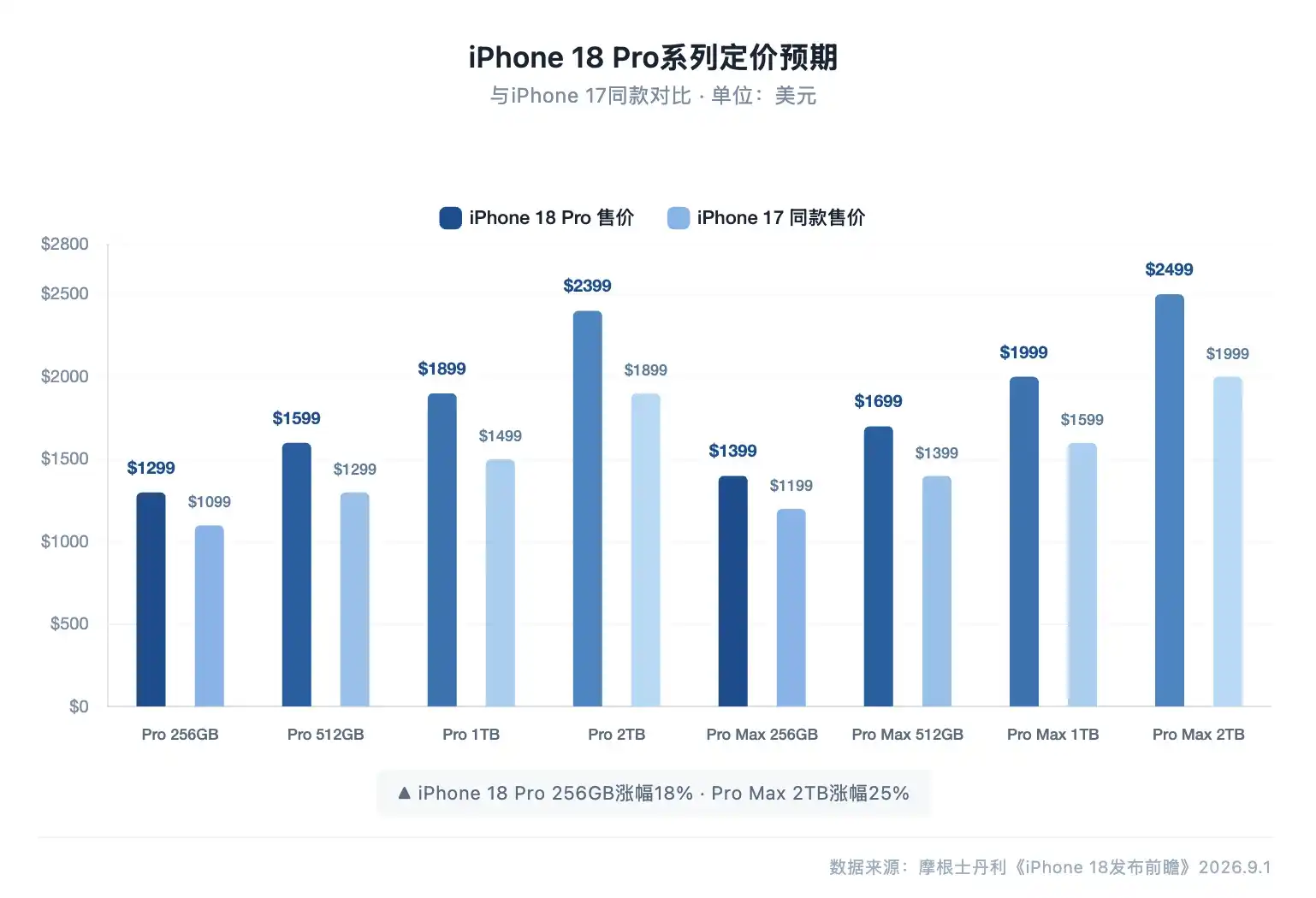
The Pro series is set for its most substantial same-model price increase in years. Morgan Stanley expects the iPhone 18 Pro (256GB) to start at $1299, a $200 (18%) increase from the iPhone 17 Pro's $1099 starting price. The iPhone 18 Pro Max (256GB) is forecast to start at $1399, also a $200 (17%) increase from the previous generation's $1199. Price hikes for the 1TB and 2TB models are even larger, with the Pro Max 2TB seeing a 25% increase.

The primary driver of the price increase is rising memory costs. Apple's DRAM consumption for iPhone production in the first half of 2026 grew nearly 50% year-over-year, while NAND consumption grew over 30%. Morgan Stanley calculates that the $200 price increase is sufficient to cover the memory cost inflation and maintain a gross margin of approximately 40%.

Morgan Stanley acknowledges the price hike is not without risk. Consumer price sensitivity, changes in trade-in values, and the prevalence of installment payment plans will all impact demand elasticity. Apple's supply chain plans suggest the company is currently more concerned about securing enough components than finding enough buyers.

Supply is the Bottleneck, Memory May Constrain Production

Apple's total component orders for 2026 iPhones are projected at 265 to 270 million units, representing 5% to 7% year-over-year growth. Combined production for the iPhone 18 Pro, Pro Max, and foldable models in the second half is estimated at around 81 million units. In the past week, TSMC's 2nm wafer orders saw a slight increase and pull-in, equivalent to adding an extra 2 to 3 million iPhone units to production. It is uncommon to increase supply chain forecasts before a product launch, especially when existing plans already reflect the company's internal "bull case" scenario.

Memory supply remains the biggest uncertainty. If Apple fully executes its current component order plan, DRAM consumption in the second half of 2026 would increase by about 15% year-over-year, and NAND by about 25%. This is an aggressive target given that the consumer memory market is already tight. Morgan Stanley has not yet incorporated the recent wafer order increase into its iPhone shipment forecasts, awaiting post-launch sales data for confirmation.

Recommendations and Risks

Morgan Stanley maintains an Overweight rating on Apple with a $360 price target, based on a price-to-earnings ratio of approximately 35x on its fiscal year 2027 earnings per share estimate of $10.30. The longest iPhone replacement cycle, the global rollout of AI features, and the new hardware form factor are expected to jointly drive accelerated iPhone growth.

Upside risks include the iPhone 18 exceeding expectations, higher-than-expected adoption of Apple Intelligence, new product line launches, and re-acceleration in services growth. Downside risks include consumer spending weakness limiting replacement rates, rising memory costs, slow progress in AI features, geopolitical tensions, and tighter App Store regulation.

The September 9th event carries narrative significance beyond hardware, marking the debut of the Ternus era. Morgan Stanley will closely watch three variables: Ternus's performance under the spotlight, whether the foldable's software and hardware experience can catalyze demand, and how Apple balances price increases, profit margins, and demand for new versus legacy models.

Disclaimer

This article is a compilation and interpretation by ChaoXiang Research of a third-party brokerage research report (Morgan Stanley, September 1, 2026), combined with publicly available market information. The ratings, price targets, earnings forecasts, and related judgments cited herein represent the views of the respective brokerage analysts, reflecting their institutional positions. They do not represent the views of ChaoXiang Research and do not constitute any investment advice.

The market involves risks, and decisions should be made independently. This article should not serve as the basis for buying or selling any securities.


Related Questions

QAccording to the Morgan Stanley report, what are the key factors that will determine Apple's stock price trajectory through the end of the year following the September 9th event?

AAccording to the Morgan Stanley report, the key factors are: 1) The performance of new CEO John Ternus in his first keynote presentation. 2) The user experience of the new foldable iPhone hardware and software. 3) How Apple balances the significant price increases with market demand.

QWhat is Morgan Stanley's rationale for the iPhone 18 Pro series price increase of over $200?

AMorgan Stanley states the primary driver of the price increase is rising memory costs. Apple's DRAM consumption for iPhone production in H1 2026 grew nearly 50% year-over-year, and NAND grew over 30%. The $200 price hike is calculated to cover these increased memory costs while maintaining Apple's gross margin around 40%.

QWhat does Morgan Stanley identify as the single biggest hardware form factor change for the iPhone since the iPhone X?

AMorgan Stanley identifies Apple's entry into the foldable phone market with the new foldable iPhone as the single biggest hardware form factor change since the iPhone X.

QWhat is the potential revenue contribution Morgan Stanley forecasts for the foldable iPhone in its first product cycle, specifically for the December quarter?

AMorgan Stanley forecasts that the foldable iPhone could contribute approximately $14 billion in revenue in just the December quarter of its first product cycle.

QWhat specific technological advancement is highlighted as the core upgrade for the iPhone 18 Pro series, and what are its expected benefits?

AThe core upgrade is the A20 Pro application processor, which will be Apple's first chip built on TSMC's 2nm process. TSMC data suggests the 2nm process offers a 10-15% performance increase at the same power, or a 25-30% power reduction at the same performance. This advancement is seen as foundational for more powerful on-device AI capabilities and justifying higher product pricing.

Related Reads

Crypto Stocks Weekly丨Strategy Adds 1,036 BTC but Holdings Fall Below Cost Basis; Bitmine Holds 4.97% of ETH Supply (November 10)

The article begins by noting that Democrats swept both chambers of Congress, ushering in a divided-government phase, after which markets shifted focus to AI regulation and capex payback cycles, with Anthropic's IPO seen as a bellwether for AI stocks. US equities fell sharply (Nasdaq -5.52% and Philadelphia Semiconductor Index -12.24% on Nov 5) before a Monday rebound driven by falling oil prices and oversold buying—characterized as a repair, not a new high. Macro data showed October nonfarm payrolls +165k and unemployment at 4.1%, keeping 10-year Treasury yields near 4.86% and rate-hike expectations alive. Citi cut US equities and global tech to neutral while upgrading Europe ex-UK, citing unstable AI sentiment; Goldman noted AI stocks are ~40% of the S&P 500 versus ~15% of STOXX 600. Crypto diverged from the equity rebound: US spot Bitcoin ETFs saw $1.282B in weekly net outflows (BlackRock's IBIT -$12.09B... actually $1.209B), Ethereum ETFs -$365M for a sixth straight weekly outflow, with continued outflows on Nov 9. NYSE-affiliated tokenized securities platform chose Avalanche for settlement infrastructure. Corporate treasury updates: Strategy bought 1,036 BTC at ~$79,012 (total 850,364 BTC, average cost ~$75,456, now above spot), funded partly by ATM share sales, with most proceeds used to repurchase STRC preferred shares. Strive added 29 BTC (total 43,153). Listed companies now hold over 6% of Bitcoin's supply (1.2664M BTC across 199 firms). Bitmine added 9,587 ETH, holding 6,070,092 ETH (~4.97% of supply, ~99% of its 5% goal). DeFi Development Corp's SOL rose to 2,609,829. Hyperliquid Strategies raised $911M in Q3, bought ~9.1M HYPE (holdings up to 38.5M, ~16% of circulating supply), and repurchased ~2.7M PURR shares.

marsbit10m ago

Crypto Stocks Weekly丨Strategy Adds 1,036 BTC but Holdings Fall Below Cost Basis; Bitmine Holds 4.97% of ETH Supply (November 10)

marsbit10m ago

When Will the Chip Stock 'Capitulation-Style Selling' End? BofA: Perhaps in Early 2027, Stock Price Pullbacks Typically Lead Fundamental Inflection Points by 6-9 Months

The SOX semiconductor index has fallen 38% (from 14,634 to 9,011) since its June 22, 2026 peak, over 136 days—exceeding the average historical peak-to-trough decline of 32% but less than half the average 253-day duration of past downturns (2011, 2015, 2018, 2022). BofA analyst Vivek Arya expects this "indiscriminate selling," driven by AI capex slowdown fears, to end around early 2027. Historically, SOX declines lead actual semiconductor sales declines by 6–9 months, implying real EPS cuts may emerge from Q1 2027, with capex reductions reflected in H2 2027—though stocks may already price in much of the bad news. SOX currently trades at 13.7x forward P/E versus 17.7x for the S&P 500 (a 22% discount, down from a 15% premium at the AI peak), leaving roughly 12% downside to the historical trough valuation of ~12x. US cloud capex runs at ~$300B/quarter (~$1.2T annualized) versus $1.555T consensus for 2027—about 23% below expectations if spending holds steady, equating to ~30 GW of compute deployment versus BofA's 40+ GW base case. A 20% capex cut would pressure AI semiconductor revenue by 20%+ and EPS by 35–40%. BofA outlines three scenarios: base case ( ~10% downside, bottoming Q1 2027, favor segment leaders), bear case (pressure into mid-2027, favor EDA, high-FCF analog, low-AI-exposure names), and bull case (favor memory, optics, quantum, CPUs). Potential stabilizers include policy clarity in Q1 2027, buybacks (Lam $25B, Nvidia, Micron starting Dec 9), and slower capex extending the upcycle.

marsbit29m ago

When Will the Chip Stock 'Capitulation-Style Selling' End? BofA: Perhaps in Early 2027, Stock Price Pullbacks Typically Lead Fundamental Inflection Points by 6-9 Months

marsbit29m ago

TSMC: October Revenue Up 60%, with Month-over-Month Growth Still Accelerating

TSMC reported October consolidated revenue of NT$586.89 billion, up 59.7% year-over-year and 14.7% month-over-month, signaling accelerating momentum. Converted to RMB, that is about RMB 119.4 billion, with cumulative revenue for the first ten months reaching NT$4.49 trillion, up 43.3% year-over-year. The near-60% growth came on top of an already high base, while the sequential acceleration confirms strengthening demand rather than a slowdown. The report arrived at a delicate moment. The Philadelphia Semiconductor Index had plunged 12.25% over two sessions, its worst single-day drop since March 2020, as political changes in the U.S. prompted new governors in Texas and Ohio to pause approvals for new data center projects. Markets pessimistically priced in a halt across the AI data center supply chain. Sentiment rebounded sharply on November 9, with the semiconductor index jumping 6.86%, and Taiwan's weighted index surging 1,960.06 points, its second-largest single-day gain on record, supported by government stabilization funds and short-selling restrictions. TSMC stands apart from other AI assets. As the only foundry capable of mass-producing 3nm and 2nm chips, it holds about 90% of the global AI chip foundry market, with advanced-node capacity booked through 2028. Its diversified revenue mix—68% high-performance computing, 21% smartphones, 4% automotive and 4% IoT—provides a buffer, allowing it to reallocate capacity to flagship phone chips, automotive computing, and edge AI if data center approvals slow. October's results validate management's guidance of roughly 44% full-year dollar revenue growth and capital spending of US$60-64 billion. Expansion continues, with 2nm ramping and Arizona's second fab moved up to Q3 2027; Goldman Sachs raised its 12-month target price to NT$3,300. Google's expanded eighth-generation TPU lineup adds further demand, with TSMC and other Taiwanese suppliers in the ecosystem. TSMC's ADR trades at about 24x trailing earnings, low relative to its growth. Risks include a prolonged U.S. data center approval freeze and geopolitical or oil-price shocks. In A-shares, domestic substitution names such as SMIC and NAURA remain driven by rising localization rather than Texas approvals.

marsbit30m ago

TSMC: October Revenue Up 60%, with Month-over-Month Growth Still Accelerating

marsbit30m ago

Trading

Spot
活动图片