Bitcoin short-term holders hit 30-day profit streak as bull-market odds improve: CryptoQuant

cointelegraphPublished on 2026-09-15Last updated on 2026-09-15

Abstract

According to CryptoQuant analysis, Bitcoin short-term holders (STHs) have maintained a profit streak for 30 consecutive days as of mid-September 2026, marking the longest such period of the year. STHs, defined as wallets holding Bitcoin for less than six months, currently hold $168.2 billion in profit versus $102.6 billion in loss. Analysts view this sustained profitability as a key historical indicator for a potential bull-market reversal, similar to patterns seen at the end of the 2022 bear market. The broader Bitcoin investor base has also been in net profit since August 19. Data shows the cost basis for newer STHs (1-3 month holders) is $63,372, while for more mature STHs (3-6 month holders) it is $73,190, suggesting investor confidence is clustering above the $70,000 level as Bitcoin retains most of its gains from a 25% August rally.

Bitcoin (BTC) speculators have held onto profits for nearly a month in what new analysis sees as a key sign of market strength.


Key points:


  • Bitcoin short-term holders were in partial profit for the past month, marking the longest consecutive in-profit stint of 2026.
  • STH profitability — a historical hallmark of bullish BTC price reversals — currently stands at $168.2 billion in profit versus $102.6 billion in loss.
  • The broader Bitcoin investor base has stayed in net profit since Aug. 19.


Short-term holders boost optimism over BTC price comeback


Data from onchain analytics platform CryptoQuant shows that a subset of Bitcoin’s short-term holder (STH) cohort has been in profit since Aug. 16.


STH investors are wallets holding an unspent transaction output (UTXO) for less than six months. They correspond to newer buyers who are more sensitive to short-term price moves and volatility, adding or reducing exposure more readily than seasoned Bitcoin holders.


Since Aug. 16, the STH investor base has been split in terms of profits on their existing exposure. STH coins held in profit total $168.2 billion as of Tuesday, while $102.6 billion are held below acquisition price.
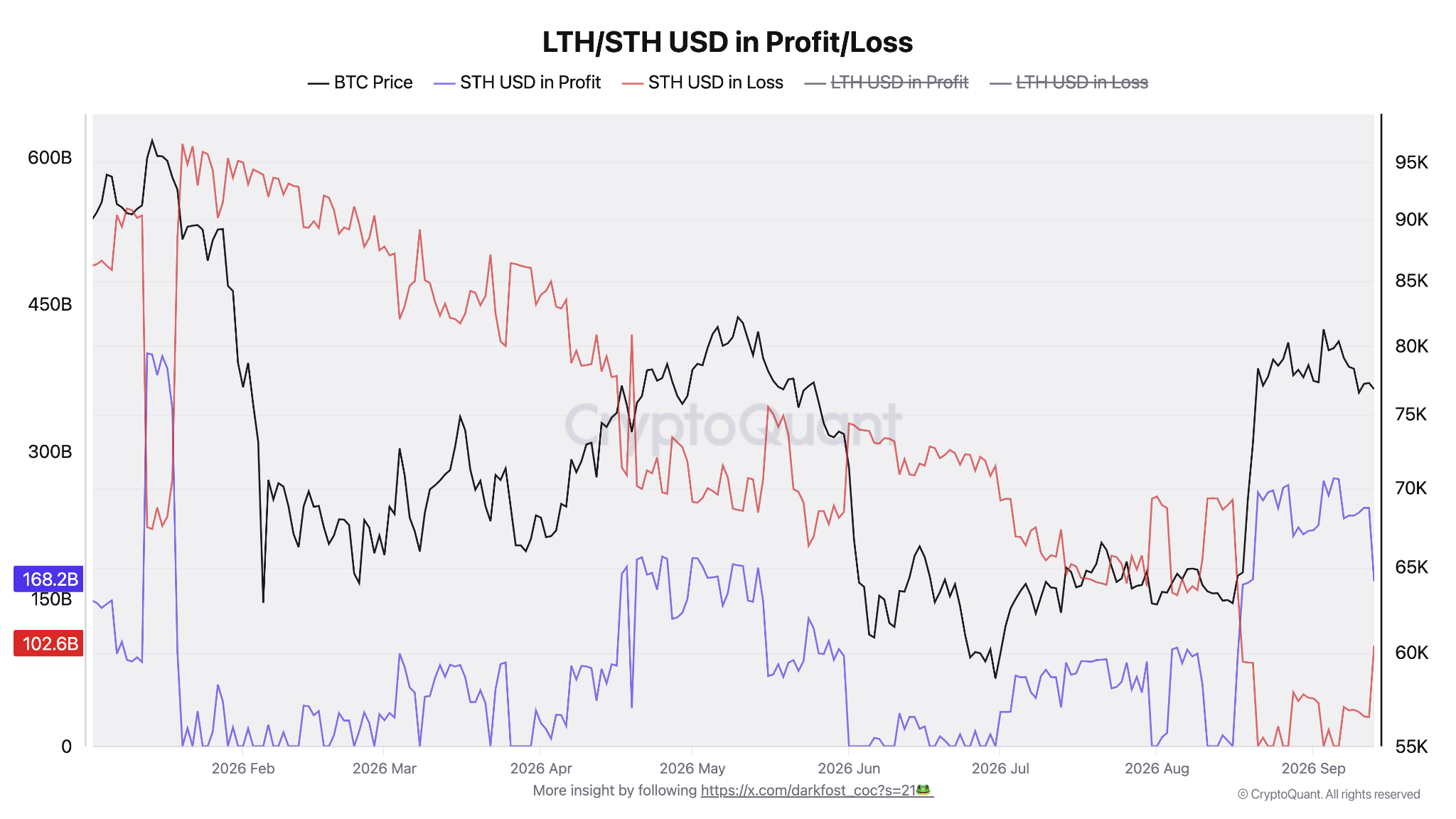

Bitcoin STH holdings in profit and loss. Source: CryptoQuant


To CryptoQuant, however, the ratio is less important than the fact that STHs have held onto at least some profit for 30 consecutive days.


“This is the first time STH have sat in profit territory for a sustained stretch since the market top. The last time was in January, but that episode didn’t last more than a week. In May, losses held by STH remained dominant,” it wrote in an accompanying blog post.


The phenomenon of lengthening uninterrupted periods of STH profitability is one that has characterized Bitcoin market recoveries throughout BTC price cycles. It was also observed at the end of Bitcoin’s 2022 bear market. CryptoQuant thus sees it as a prerequisite for the return of a long-term BTC price uptrend this cycle.


“The bear market trend only truly reverses once profits settle in for good STH and then push them to hold their positions and ride the upside,” it added.
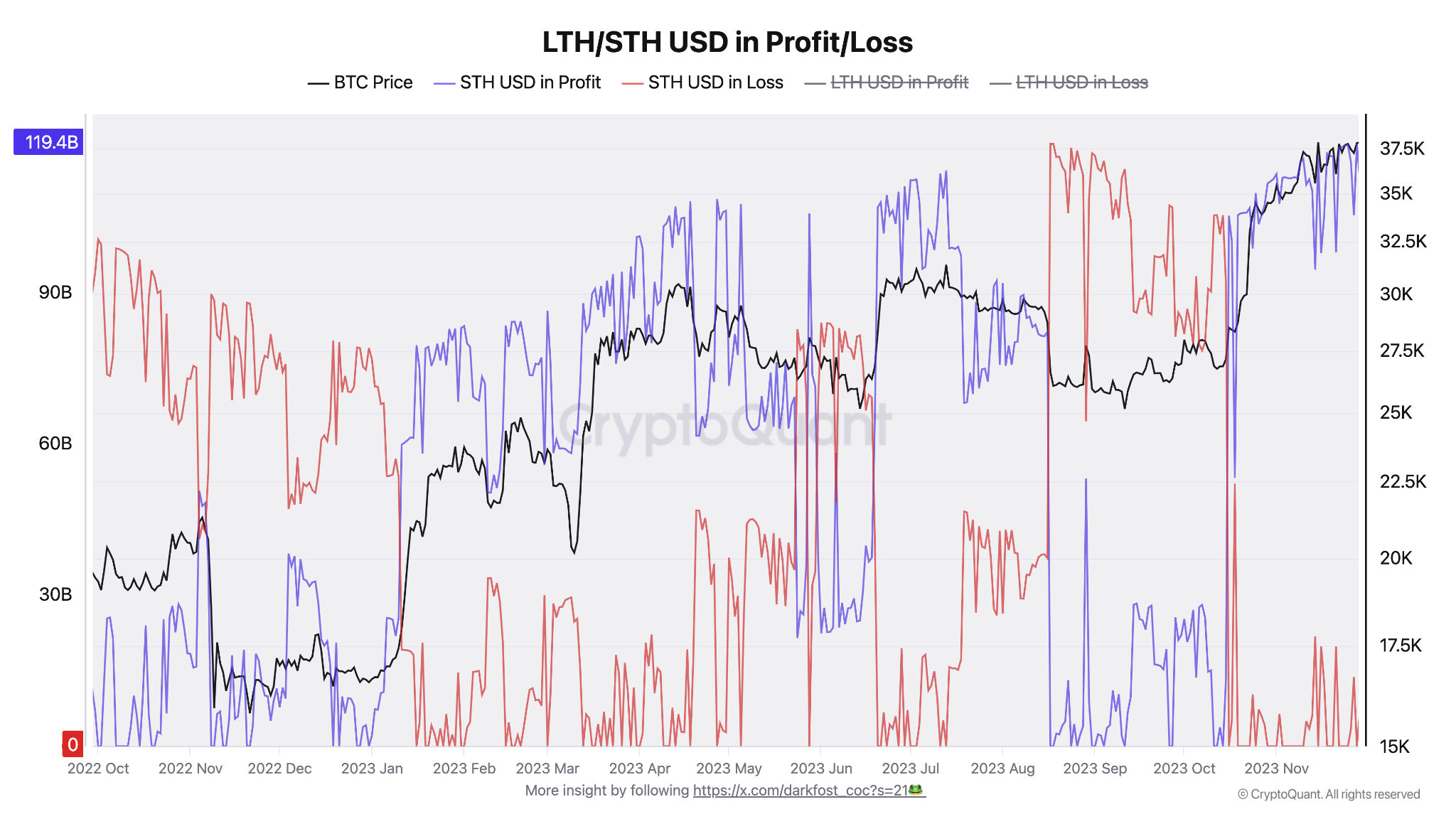

Bitcoin STH holdings in profit and loss through year-end 2023. Source: CryptoQuant


Newer investor cost bases cluster above $70,000


The data echoes a similar stint of aggregate profitability currently being witnessed across the Bitcoin investor base as BTC/USD retains the majority of its 25% August upside.


Related: CLARITY Act vote meets Fed rate hike: Five things to know in Bitcoin this week


As Cointelegraph reported, the spent output profit ratio (SOPR), which tracks net profits or losses across all investors, passed its breakeven level of 1 on Aug. 19 and has narrowly held above it since. Last week, onchain analytics suite Checkonchain argued that STH profitability in particular was “starting to look more like those early bull-market recoveries.”


STH profitability is currently being driven by entities holding between one and three months, CryptoQuant data shows, with that cohort having a cost basis (also known as realized price) at $63,372. The cost basis of the more mature end of the STH base — wallets holding for between three and six months — now sits at $73,190.
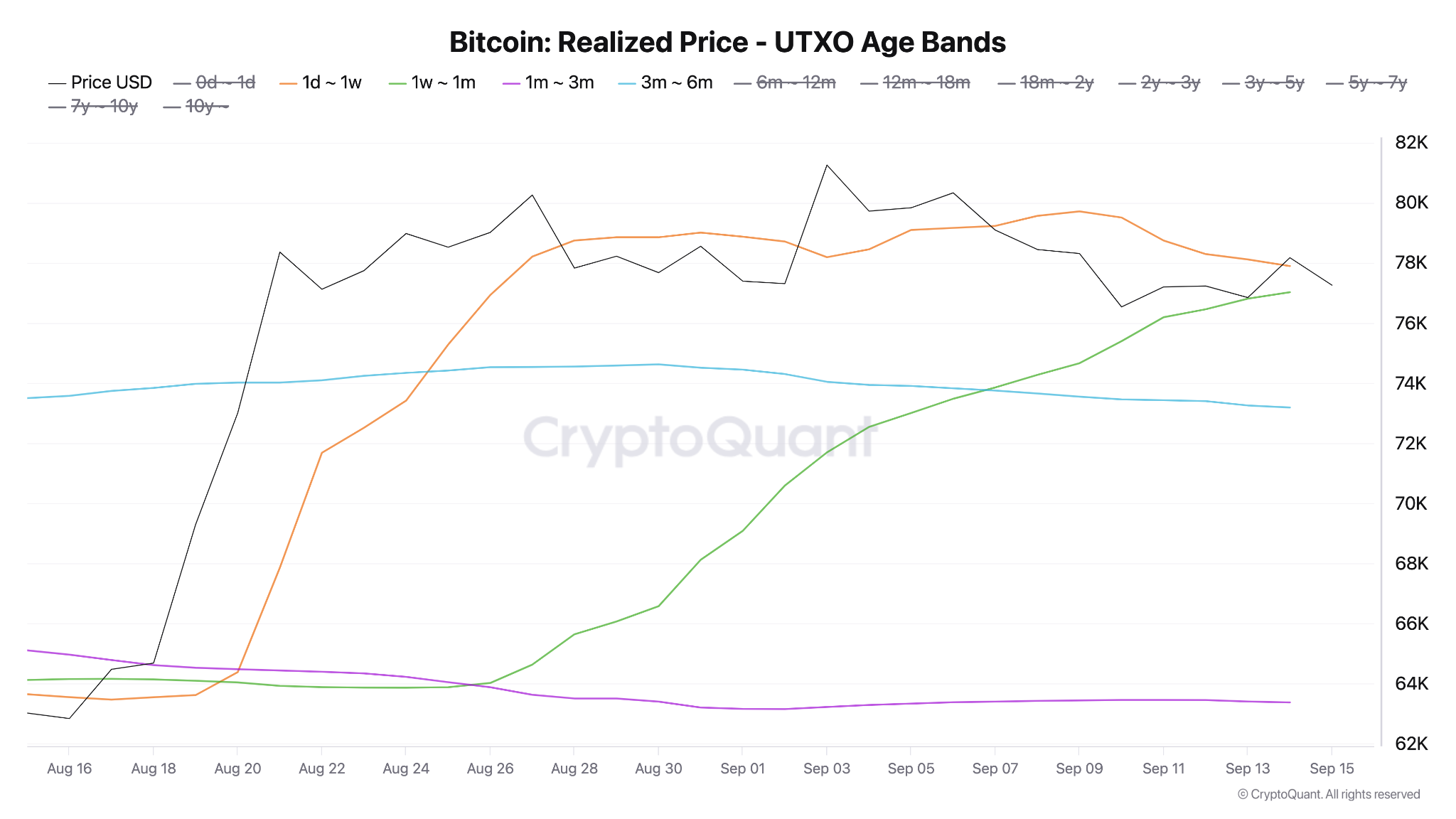

Bitcoin realized price by wallet age. Source: CryptoQuant


Related Questions

QWhat is a key indicator of market strength for Bitcoin according to the CryptoQuant analysis?

AA key indicator of market strength is that Bitcoin short-term holders (STH) have been in partial profit for 30 consecutive days, marking the longest such streak in 2026. Historically, sustained periods of STH profitability have signaled bullish price reversals.

QHow are 'short-term holders' (STH) defined in the context of this article?

AShort-term holders (STH) are defined as Bitcoin wallets holding an unspent transaction output (UTXO) for less than six months. They typically represent newer buyers who are more sensitive to short-term price moves and volatility.

QWhat is the current profit versus loss status for Bitcoin held by short-term holders as of the article's data?

AAs of the data referenced, Bitcoin held in profit by short-term holders totals $168.2 billion, while $102.6 billion is held at a loss (below acquisition price).

QWhy does CryptoQuant consider the lengthening period of STH profitability significant for the market cycle?

ACryptoQuant sees it as significant because lengthening uninterrupted periods of STH profitability have historically characterized Bitcoin market recoveries and the end of bear markets. It is considered a prerequisite for the return of a long-term BTC price uptrend, as it encourages these holders to maintain their positions and ride the market upside.

QWhat are the reported cost bases for the two key segments within the short-term holder cohort?

AAccording to CryptoQuant data, the cost basis (realized price) for STH wallets holding Bitcoin for one to three months is $63,372. For the more mature segment holding for three to six months, the cost basis is $73,190.

Related Reads

When Will the Chip Stock 'Capitulation-Style Selling' End? BofA: Perhaps in Early 2027, Stock Price Pullbacks Typically Lead Fundamental Inflection Points by 6-9 Months

The SOX semiconductor index has fallen 38% (from 14,634 to 9,011) since its June 22, 2026 peak, over 136 days—exceeding the average historical peak-to-trough decline of 32% but less than half the average 253-day duration of past downturns (2011, 2015, 2018, 2022). BofA analyst Vivek Arya expects this "indiscriminate selling," driven by AI capex slowdown fears, to end around early 2027. Historically, SOX declines lead actual semiconductor sales declines by 6–9 months, implying real EPS cuts may emerge from Q1 2027, with capex reductions reflected in H2 2027—though stocks may already price in much of the bad news. SOX currently trades at 13.7x forward P/E versus 17.7x for the S&P 500 (a 22% discount, down from a 15% premium at the AI peak), leaving roughly 12% downside to the historical trough valuation of ~12x. US cloud capex runs at ~$300B/quarter (~$1.2T annualized) versus $1.555T consensus for 2027—about 23% below expectations if spending holds steady, equating to ~30 GW of compute deployment versus BofA's 40+ GW base case. A 20% capex cut would pressure AI semiconductor revenue by 20%+ and EPS by 35–40%. BofA outlines three scenarios: base case ( ~10% downside, bottoming Q1 2027, favor segment leaders), bear case (pressure into mid-2027, favor EDA, high-FCF analog, low-AI-exposure names), and bull case (favor memory, optics, quantum, CPUs). Potential stabilizers include policy clarity in Q1 2027, buybacks (Lam $25B, Nvidia, Micron starting Dec 9), and slower capex extending the upcycle.

marsbit15m ago

When Will the Chip Stock 'Capitulation-Style Selling' End? BofA: Perhaps in Early 2027, Stock Price Pullbacks Typically Lead Fundamental Inflection Points by 6-9 Months

marsbit15m ago

TSMC: October Revenue Up 60%, with Month-over-Month Growth Still Accelerating

TSMC reported October consolidated revenue of NT$586.89 billion, up 59.7% year-over-year and 14.7% month-over-month, signaling accelerating momentum. Converted to RMB, that is about RMB 119.4 billion, with cumulative revenue for the first ten months reaching NT$4.49 trillion, up 43.3% year-over-year. The near-60% growth came on top of an already high base, while the sequential acceleration confirms strengthening demand rather than a slowdown. The report arrived at a delicate moment. The Philadelphia Semiconductor Index had plunged 12.25% over two sessions, its worst single-day drop since March 2020, as political changes in the U.S. prompted new governors in Texas and Ohio to pause approvals for new data center projects. Markets pessimistically priced in a halt across the AI data center supply chain. Sentiment rebounded sharply on November 9, with the semiconductor index jumping 6.86%, and Taiwan's weighted index surging 1,960.06 points, its second-largest single-day gain on record, supported by government stabilization funds and short-selling restrictions. TSMC stands apart from other AI assets. As the only foundry capable of mass-producing 3nm and 2nm chips, it holds about 90% of the global AI chip foundry market, with advanced-node capacity booked through 2028. Its diversified revenue mix—68% high-performance computing, 21% smartphones, 4% automotive and 4% IoT—provides a buffer, allowing it to reallocate capacity to flagship phone chips, automotive computing, and edge AI if data center approvals slow. October's results validate management's guidance of roughly 44% full-year dollar revenue growth and capital spending of US$60-64 billion. Expansion continues, with 2nm ramping and Arizona's second fab moved up to Q3 2027; Goldman Sachs raised its 12-month target price to NT$3,300. Google's expanded eighth-generation TPU lineup adds further demand, with TSMC and other Taiwanese suppliers in the ecosystem. TSMC's ADR trades at about 24x trailing earnings, low relative to its growth. Risks include a prolonged U.S. data center approval freeze and geopolitical or oil-price shocks. In A-shares, domestic substitution names such as SMIC and NAURA remain driven by rising localization rather than Texas approvals.

marsbit16m ago

TSMC: October Revenue Up 60%, with Month-over-Month Growth Still Accelerating

marsbit16m ago

Trading

Spot
活动图片