Circle to acquire Tazapay to expand USDC cross-border payments

cointelegraphPublished on 2026-09-08Last updated on 2026-09-08

Abstract

Circle has agreed to acquire Singapore-based cross-border payments platform Tazapay in a deal expected to close in 2027, pending regulatory approval. Tazapay, which processes over $25 billion in annualized payment volume and serves over 60 partners across 100+ markets, has been a Circle Payments Network design partner since 2025. Circle previously invested in Tazapay, including in its 2025 Series B round. Circle stated that stablecoins account for about 60% of Tazapay's transaction volume. The acquisition aims to expand Circle's global payment capabilities, particularly to and from Asia-Pacific and emerging markets, and advance its goal of making USDC the default rail for cross-border commerce. Tazapay customers are expected to see no service disruption. Financial terms were not disclosed.

Circle has agreed to acquire Singapore-based cross-border payments platform Tazapay in a deal expected to close in 2027.

The transaction will also require customary closing conditions and approval from the Monetary Authority of Singapore, Circle said in a Tuesday announcement.

Tazapay has more than $25 billion in annualized payment volume and serves more than 60 banking and fintech partners with local payout rails covering more than 100 markets. The company said in August 2025 that annualized payment volume was $10 billion.

Circle previously invested in Tazapay, including in the startup’s August 2025 Series B round that brought the total amount raised to $57.9 million, according to Traxcn data. XRP-issuer Ripple was also an investor in that round.

Stablecoins account for about 60% of Tazapay’s transaction volume, according to Circle. The company said the acquisition will expand its ability to route payments to and from Asia-Pacific and emerging markets.

“This acquisition will increase Circle’s capability to originate and terminate payments globally, near-instant and 24/7, which is a meaningful step toward making USDC the default payment rail for cross-border commerce,” said Irfan Ganchi, senior vice president of payments at Circle.

Tazapay has been a design partner for the Circle Payments Network since 2025. Circle said Tazapay customers should see no disruption to their services, APIs, pricing or support.

The financial terms of the deal were not disclosed. Circle did not immediately respond to Cointelegraph’s request for comment.

Circle’s (CRCL) NYSE-traded shares were down more than 2% in Tuesday’s premarket activity, at last look, according to Yahoo Finance.

Related: Bernstein sees new USDC growth cycle, sets $140 Circle price target

Related Questions

QWhat is the main objective behind Circle's acquisition of Tazapay?

AThe main objective is to expand Circle's ability to route cross-border payments, particularly using USDC, to and from Asia-Pacific and emerging markets. It aims to make USDC the default payment rail for global commerce by increasing near-instant, 24/7 payment capabilities.

QWhat is the expected timeline for the Circle-Tazapay deal to close?

AThe deal is expected to close in 2027, pending customary closing conditions and approval from the Monetary Authority of Singapore.

QHow much did Tazapay's annualized payment volume grow from August 2025 to the time of the announcement?

ATazapay's annualized payment volume grew from $10 billion in August 2025 to more than $25 billion at the time of the acquisition announcement.

QWhat percentage of Tazapay's transaction volume is accounted for by stablecoins?

AAccording to Circle, stablecoins account for about 60% of Tazapay's transaction volume.

QWho were some of the previous investors in Tazapay, as mentioned in the article?

APrevious investors included Circle itself and Ripple, the issuer of XRP. Both participated in Tazapay's August 2025 Series B funding round.

Related Reads

Changing Gas Metering Could Break Smart Contracts? Ethereum Urgently Halts Hoodi Fork to Investigate Eight Major Security Risks

Ethereum core developers have paused the Hoodi testnet upgrade after security auditors found that two upcoming Gas improvement proposals could invalidate long-standing assumptions underpinning many deployed smart contracts. The proposals, EIP-8037 and EIP-8038, part of the Glamsterdam upgrade, aim to reprice state storage by decoupling state creation from state access and setting dynamic weights for certain opcodes, in order to curb unchecked growth of Ethereum's state data. However, this overhaul disrupts static Gas constants that developers have relied on as fixed system parameters. ChainSecurity identified eight invariant risks. Many contracts and off-chain infrastructure depend on hardcoded Gas limits, for example to prevent reentrancy or bound execution scope; higher costs could cause cross-contract calls to run out of Gas and revert. Other risks lie in error-handling logic that relies on precise prediction of inner execution costs, and in proxy contracts that forward Gas based on fixed ratios, potentially distorting execution paths or locking funds in incomplete state-machine branches. To avoid systemic compatibility failures and cascading disruptions across multisig wallets, bridges, and lending protocols, developers agreed at an ACD meeting not to hard-fork Hoodi until the affected contracts are fully mapped and compatibility guidance is issued. Because much logic lives off-chain in proprietary routing, settlement scripts, and liquidation bots, the Ethereum Foundation acknowledged it cannot audit the entire ecosystem alone. It has published a public repository detailing the eight affected invariants, sample problem code, and prompt templates for audit and scanning tools, so teams can check their own logic. Findings will be reviewed at next week's ACD meeting, when Hoodi activation conditions will be reassessed.

marsbit1h ago

Changing Gas Metering Could Break Smart Contracts? Ethereum Urgently Halts Hoodi Fork to Investigate Eight Major Security Risks

marsbit1h ago

What Exactly Drives the Value of Layer 1?

This analysis by Marc Arjoon, CFA, examines what actually drives Layer 1 valuation through time-series regression on major L1 assets. Short-term, all L1 price movements remain dominated by Bitcoin beta. Over longer horizons, Ethereum's market cap has fully decoupled from its own protocol revenue—a deliberate policy outcome of Dencun and higher gas limits rather than a demand collapse—with its 2025 rally driven instead by spot ETF and corporate treasury demand. Solana, by contrast, shows revenue and market cap moving in tandem, both rising ~15x since January 2023 and peaking the same week. Active addresses and DEX volumes show weak weekly correlations and large divergences despite long-cycle drift. Testing Metcalfe's Law, the fitted elasticity of market cap to active addresses is only 0.56 for Ethereum and 0.62 for Solana and BNB—closer to the square root of addresses than the square. None of six valuation multiples reliably mean-reverts; Mcap/REV is the only one that predicts positive 13-week returns from low valuation quantiles on Ethereum and TRON. No L1 has Bitcoin's deep holder base: only 4% of Solana and 10% of Ethereum supply has been dormant over three years versus 42% for Bitcoin. Ethereum's pricing anchors to peer capital share—59% of L1 market cap, 70% of DeFi TVL, 75% of tokenized RWA—rather than on-chain activity, where it holds just 5% of active addresses. Across chains, market cap rank correlates strongly with TVL (Spearman 0.87) and stablecoin supply (0.63) but weakly with transactions (0.17). The core conclusion: L1s are valued less as fee-generating businesses and more as monetary assets competing for capital settlement and liquidity share.

marsbit1h ago

What Exactly Drives the Value of Layer 1?

marsbit1h ago

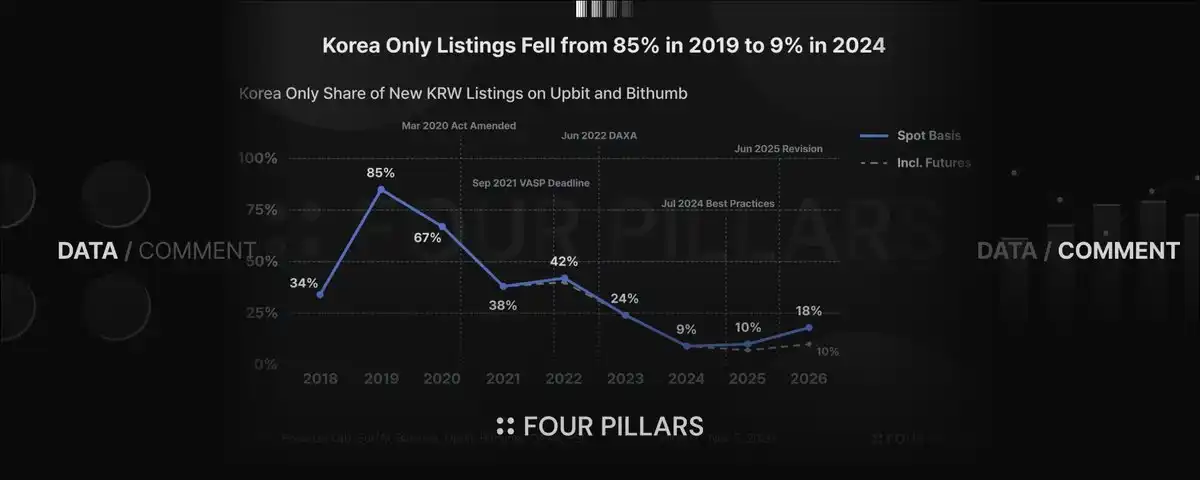
From 85% to 9%: The Dramatic Shift in Korean Exchange Listing Logic—Tokens Are Safer, but Is the Business Harder?

South Korea’s KRW crypto exchanges have fundamentally changed their listing logic. According to Bonanza Lab data across Upbit, Bithumb, Coinone, Korbit, and Gopax, the share of Korea-only token listings fell from 85% in 2019 to 9% in 2024, with a slight rebound to 18% in 2026 that drops back to about 10% when excluding assets first traded on overseas futures markets. The shift began with the 2021 Specific Financial Information Act, which required real-name bank accounts and traditional-finance-level AML compliance, and was reinforced by DAXA’s unified listing review guidelines effective July 2024, under which assets with two or more years of trading history on compliant overseas exchanges can automatically satisfy baseline disclosure and whitepaper requirements. Despite the collapse in local-first listings, total listings have grown: Upbit and Bithumb added 43 KRW-market tokens in 2022, 116 in 2023, 125 in 2024, and 238 in 2025. Listing timing remains cyclical—in the 2025 bitcoin high, 111 assets (47%) were brought to Korea within 30 days of overseas listing, while in 2026 mature assets with over a year of overseas trading became the mainstay (52 assets, 31%), including older tokens such as CRV and RSR. The consequences are clear. The share of assets hit by investment warnings or delisting within two years fell from 24% for the 2020 cohort to 10% for 2024. Among 2020–2024 listings, 44 of 148 Korea-only tokens (30%) faced warnings or delisting within two years, versus only 26 of 279 overseas-first tokens (9%). Overseas seasoning also reduces post-listing drawdowns: assets listed in Korea within 30 days of overseas launch saw a median 30-day price decline of 39%, compared with just 7% for assets with over a year of overseas trading history. The trade-off is revenue. Heavily traded overseas assets generate limited first-day speculative volume, and since Korean exchanges rely overwhelmingly on spot trading fees, weaker listing-day surges can hurt earnings. A renewed bull market could temporarily revive listings of newly launched overseas assets, but exchanges cannot build a durable, cycle-resistant business on listing structure alone. Their core challenge is to create new trading demand and diversify revenue beyond listing-driven fees.

marsbit1h ago

From 85% to 9%: The Dramatic Shift in Korean Exchange Listing Logic—Tokens Are Safer, but Is the Business Harder?

marsbit1h ago

Didn't We Agree on Decoupling? BTC Fell Along With US Stocks Again

Bitcoin's "decoupling" from tech stocks proved short-lived. On Nov 4, the Dow rose 3% and BTC rebounded to $81K; just 24 hours later, a massive AI-driven selloff sent Nasdaq down 5.5% and BTC back to $75.2K. The trigger had nothing to do with crypto: after Democrats won Congress, markets feared slower data-center buildout, and chip stocks cratered (Nvidia -9.26%, AMD -17.26%, semiconductor ETF -12%, worst since March 2020). All 11 S&P sectors fell. BTC followed: it dropped about 5.5% to $76K, with over $1B liquidated in 24 hours—nearly 90% longs, about 210,000 traders forced out. The transmission path was simple: tech panic → institutions sell BTC ETFs → ETF outflows trigger on-chain leverage liquidations → accelerated decline. From Oct 30 to Nov 5, BTC ETFs saw roughly $1.5B in net outflows. The decoupling narrative keeps flipping. In February, Grayscale's Zach Pandl said BTC was highly correlated with high-growth tech software stocks. By August, the same analyst said BTC's correlation with gold had risen above 50% while its correlation with Nasdaq 100 fell from over 60% to about 33%—prompting talk that BTC was finally shifting toward gold. Two months later, K33 Research found BTC-Nasdaq synchronicity rising again. On Nov 5, Nasdaq fell ~6.5%, BTC ~5.5%, while gold rose 0.9%—BTC tracked Nasdaq, not gold. This isn't new. In early 2022, Kaiko found BTC-Nasdaq correlation at its highest since July 2020, while BTC-gold correlation was negative—the first data-driven blow to the "digital gold" thesis. In April 2025's tariff shock, BTC briefly decoupled, rising 13% while Nasdaq was flat, but correlation soon returned. Nov 5 mirrored April 2025: two shocks of similar magnitude; BTC withstood the first but not the second. Different institutions use different windows—Grayscale looks at 90 days, K33 at two-week returns—so conclusions change with the window. Correlation isn't a fixed conclusion; it keeps flipping. Notably, BTC and gold are both among 2025's worst performers. Charlie Bilello's Oct 23 ranking of 21 assets showed BTC down 7.3% and gold down 7.5%—the two worst—while short-term Treasuries rose 2.9% and commodities 52.5%. By Nov 5, BTC's year-to-date loss widened to about 13%. Bilello noted that since 2011, no year had seen BTC and gold both at the bottom. Gold itself fell about 27% from its January high near $5,600 to about $4,095, hit by war-driven inflation, higher yields, a stronger dollar, and leveraged selling. Yet in March, during the Iran war, BTC didn't follow stocks down—Grayscale's April report was titled "Resilience in War," noting equities, bonds, and precious metals all fell while crypto rose slightly, aided by Strategy's purchase of ~44,400 BTC. Same year: BTC held up in March but fell with tech in November. "Digital gold" is less a fixed property than a switching state. Pandl framed it honestly in February: "Is BTC a store-of-value asset like gold, or a growth asset like tech stocks? Short answer: we think it's both." The risk-asset side is visible—post-ETF institutional inflows make BTC trade like a high-beta tech stock. The store-of-value side needs a longer view: since 2011, BTC's average annual return is 120.6% versus gold's 6.3%. Even JPMorgan now includes BTC in long-term capital market assumptions, projecting 10% annualized returns over the next decade (above US large caps' 7.5%), though it flags 55% volatility and unstable correlations and excludes BTC from main portfolio models. Pandl added: "If BTC succeeds as a monetary asset long term, its price behavior may eventually look more like gold." Note the "if"—BTC is only 17 years old. Three indicators to watch: whether BTC-Nasdaq 100 90-day correlation stays above 0.5; whether spot ETFs see net outflows for more than a week; and whether BTC follows or decouples from tech in the next big move. At 17, BTC hasn't yet grown into itself.

marsbit2h ago

Didn't We Agree on Decoupling? BTC Fell Along With US Stocks Again

marsbit2h ago

After the US Midterm Elections, South Koreans Are in Complete Panic

After the U.S. midterm elections, a "blue wave" swept Congress and key AI-data-center states, triggering a global selloff in AI and semiconductor stocks. While most markets absorbed the shock without emergency action, South Korea reacted with alarming urgency: the deputy prime minister and finance chief convened an emergency market meeting, the financial services commissioner and a Bank of Korea deputy governor attended, and authorities announced a three-month exemption from the 140% credit-financing collateral requirement for brokerages, while the exchange triggered a Sidecar circuit breaker to halt programmatic selling. The panic is rooted in structure. In the month before the crash, Korean retail investors—the famous "ant army"—piled into Samsung Electronics and SK Hynix, often using borrowed money and single-stock leveraged ETFs, which regulators had already been tightening since July as leverage grew dangerously large. Retail investors hold roughly 60% of these leveraged products, and earlier declines had already wiped out 41% of their assets. Beneath them, the National Pension Service, the world's third-largest sovereign wealth fund, was heavily concentrated in the same chip stocks and rode them down from June's peak, losing about $137 billion. Korea's stock market is also a amplifier of social mood and a political risk, and the won is not a safe-haven currency: risk-off outflows hit the currency, import-dependent inflation rises, and a stock-FX-inflation "triple kill" becomes lethal. Foreign investors hold nearly 38-39% of market capitalization and over 46-50% of Samsung and SK Hynix, and have been massive net sellers—about $131 billion withdrawn this year, the most in Asia. Ultimately, the U.S. election was only the match; Korea's dependence on semiconductors is the fuel. Chips are now approaching 47% of exports, and semiconductor-related production contributed about half of Q3 GDP growth. With demand tied to U.S. AI capital spending, Korea catches a heavy cold whenever America sneezes—so its response is less market rescue than firefighting.

marsbit2h ago

After the US Midterm Elections, South Koreans Are in Complete Panic

marsbit2h ago

Trading

Spot
活动图片