Pembukaan Koin Minggu Ini: Pembukaan DBR Mencapai 11,4% dari Peredaran Pasokan Koin

marsbitPublished on 2026-07-12Last updated on 2026-07-12

Abstract

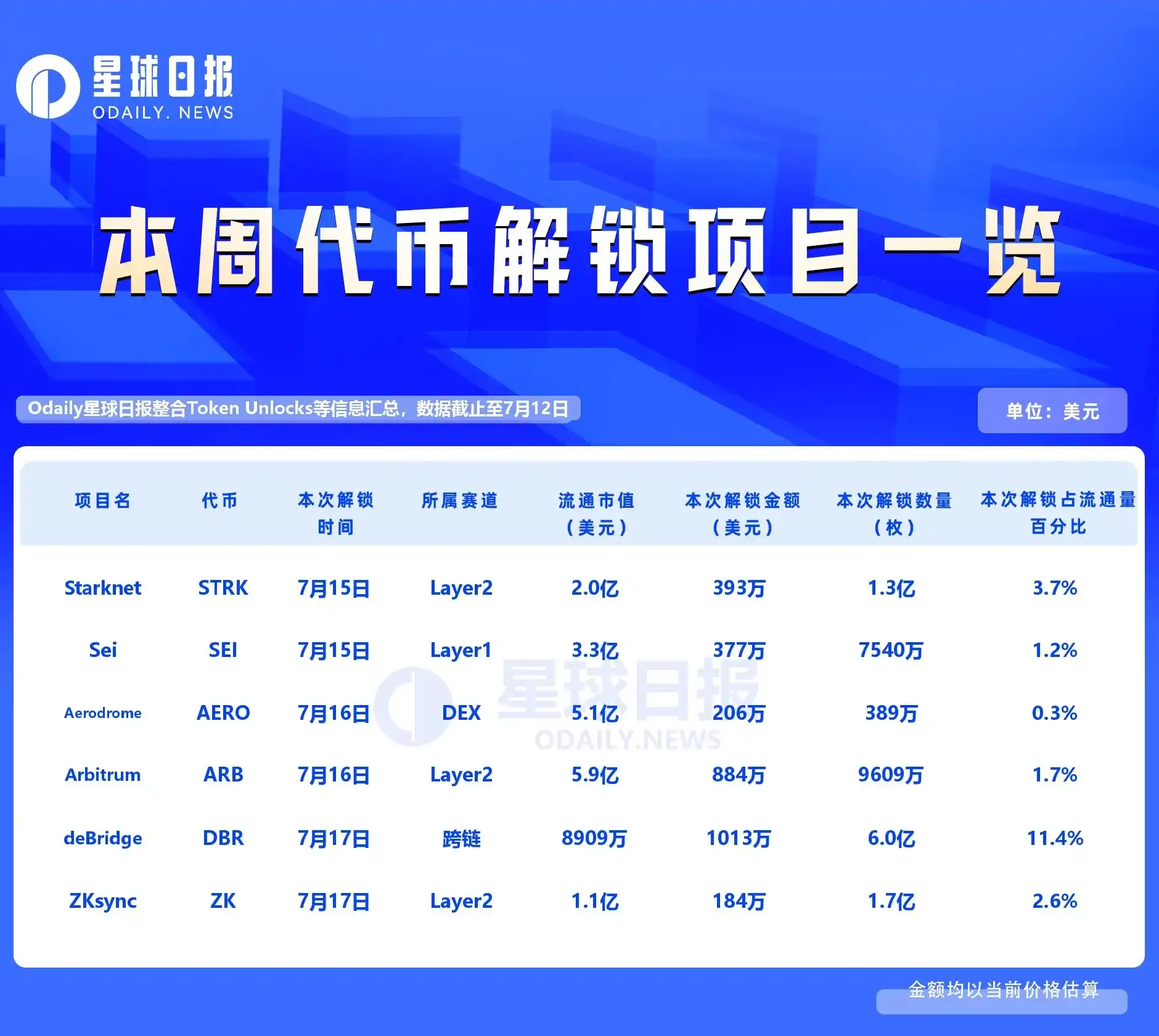
**Rangkuman Pengembalian Token Minggu Ini: DBR dan STRK** **deBridge (DBR):** * Jumlah token yang dikembalikan: 600 juta token. * Nilai pengembalian: Sekitar USD 10,13 juta. * **Poin penting:** Pengembalian ini setara dengan **11.4%** dari total pasokan token DBR yang beredar saat ini. * Deskripsi: deBridge adalah lapisan interoperabilitas terdesentralisasi untuk Web3 yang memungkinkan transfer pesan dan aset antar berbagai blockchain. Validasi transaksi lintas rantai dilakukan oleh jaringan validator independen. **Starknet (STRK):** * Jumlah token yang dikembalikan: 130 juta token. * Nilai pengembalian: Sekitar USD 3,93 juta. * Deskripsi: Starknet adalah Layer 2 Ethereum yang menggunakan teknologi zk-STARKs untuk meningkatkan kecepatan dan mengurangi biaya transaksi. Ini meringankan beban komputasi jaringan dengan tidak mengharuskan semua node memvalidasi setiap operasi. Kedua artikel menyertakan grafik yang menunjukkan kurva pelepasan token untuk masing-masing proyek.

deBridge

Twitter Proyek: https://x.com/deBridgeFinance

Situs Web Proyek: https://debridge.finance/

Jumlah Pembukaan Kali Ini: 600 juta token

Nilai Pembukaan Kali Ini: Sekitar $10,13 juta

deBridge adalah lapisan interoperabilitas aman untuk Web3, yang mendukung transmisi pesan dan nilai secara terdesentralisasi antar blockchain yang berbeda. Validasi transaksi lintas rantai dilakukan oleh jaringan validator independen yang dipilih oleh dan bekerja untuk tata kelola deBridge.

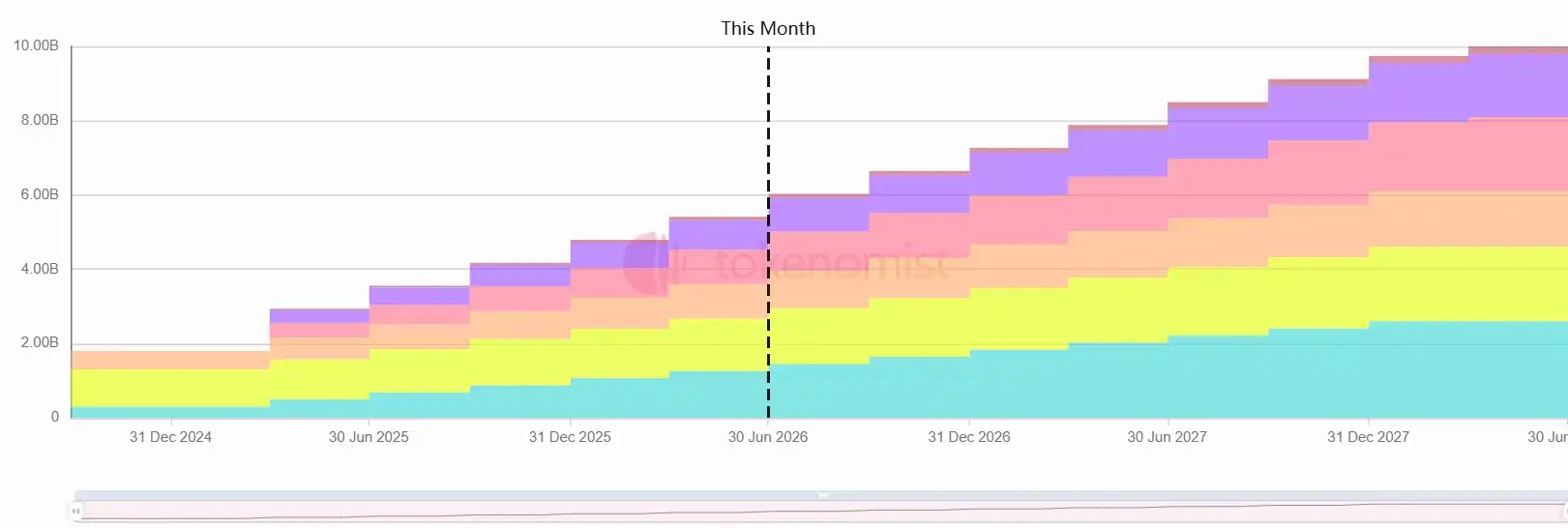
Kurva pelepasan detail adalah sebagai berikut:

Starknet

Twitter Proyek: https://twitter.com/Starknet

Situs Web Proyek: https://starknet.io/

Jumlah Pembukaan Kali Ini: 130 juta token

Nilai Pembukaan Kali Ini: Sekitar $3,93 juta

Starknet adalah Layer2 Ethereum yang memanfaatkan teknologi zk-STARKs untuk membuat transaksi di Ethereum lebih cepat dan dengan biaya yang lebih rendah. Perusahaan induk StarkNet, StarkWare, didirikan pada tahun 2018 dan berkantor pusat di Israel, dengan produk utama yang dikembangkan termasuk Starknet dan StarkEx. Dengan menggunakan STARK, Starknet memvalidasi transaksi dan komputasi tanpa memerlukan semua node jaringan untuk memverifikasi setiap operasi. Hal ini secara signifikan mengurangi beban komputasi dan meningkatkan throughput jaringan blockchain.

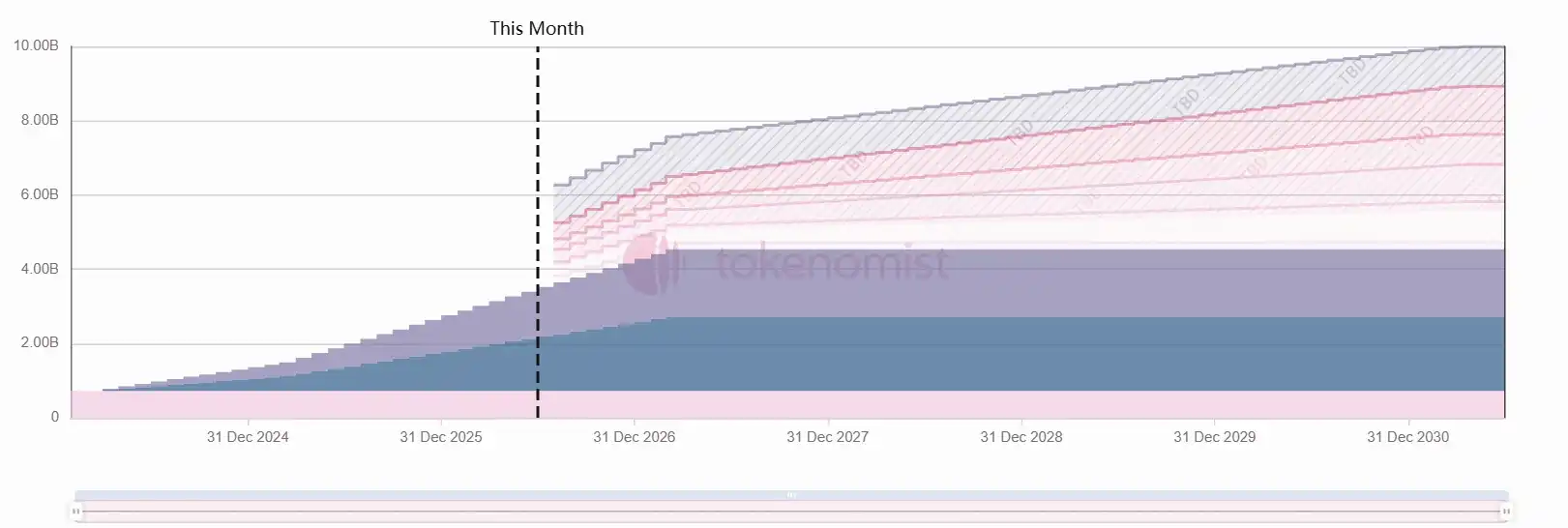
Kurva pelepasan detail adalah sebagai berikut:

Trending Cryptos

Related Questions

QBerapa jumlah token DBR yang akan di-unlock, dan berapa nilainya dalam USD?

AJumlah token DBR yang akan di-unlock adalah 6 miliar token, dengan nilai sekitar 10,13 juta USD.

QApa itu deBridge dan apa fungsinya dalam ekosistem Web3?

AdeBridge adalah lapisan interoperabilitas aman untuk Web3 yang mendukung transfer pesan dan nilai secara terdesentralisasi antar berbagai blockchain. Validasi transaksi lintas rantai dilakukan oleh jaringan validator independen.

QProyek apa selain deBridge yang disebutkan juga akan melakukan unlock token, dan berapa jumlahnya?

ASelain deBridge, proyek Starknet juga akan melakukan unlock token sebanyak 130 juta token STRK, dengan nilai sekitar 3,93 juta USD.

QApa teknologi inti yang digunakan Starknet untuk meningkatkan skalabilitas Ethereum?

AStarknet menggunakan teknologi zk-STARKs sebagai Layer 2 Ethereum untuk membuat transaksi menjadi lebih cepat dan mengurangi biaya, tanpa memerlukan semua node jaringan untuk memvalidasi setiap operasi.

QDi mana kantor pusat perusahaan induk Starknet, StarkWare, berada?

AKantor pusat StarkWare, perusahaan induk Starknet, berada di Israel.

Related Reads

Polygon's Tokenomics Inflection Point: Base Fee Burn Approaches New Coin Minting, POL Valuation Multiple Only Half of TRX

Polygon is undergoing a key tokenomics transition from a single scaling solution to a payment settlement base. Its acquisition of Coinme brought money transmitter licenses covering 48 U.S. states, and combined with its high-frequency on-chain stablecoin payment network, Polygon's base fee revenue has exceeded current token inflation minting for several months. In 2025, base network fees paid by users equaled only 5% of newly minted POL that year; from January to September 2026, that ratio climbed to 86%, and in five separate months burned base fees fully surpassed new minting. By September 2026, Polygon was the busiest stablecoin settlement network, processing 17.6 million stablecoin transfers daily—one-third of the nine major chains' total. Median transfer fees rose fivefold over 18 months while transfer counts surged 7.5x, showing strong payment demand. POL trades at less than half of TRX's valuation multiple: 41.2x trailing 12-month on-chain fees versus TRX's 87.5x. The base fee burn reserve is now nearly equal to newly minted POL, and stakers receive half of the validator priority fee pool via PIP-85. Stablecoin transfers drove 72% of gas consumption in the first nine months of 2026, with average transfer size of $175 versus $1,254 on Solana and $3,850 on Ethereum. POL's valuation multiple has compressed to around 30x, with a market cap of about $949 million against $31.6 million in annualized fees, suggesting the market is lagging in repricing Polygon's payment fundamentals.

marsbit57m ago

Polygon's Tokenomics Inflection Point: Base Fee Burn Approaches New Coin Minting, POL Valuation Multiple Only Half of TRX

marsbit57m ago

Behind the US Stock Market Crash and Rebound: Is Deleveraging Nearing Its End, or the Prelude to Medium- and Long-Term Risks?

U.S. stocks experienced extreme volatility over two trading days. On November 5, the market suffered its sharpest single-day selloff in 19 months, led by AI-related stocks, fueling social media rumors of hedge fund liquidations. The next day, however, chip stocks spearheaded a rebound: the Philadelphia Semiconductor Index rose 4.2%, AMD jumped 11%, and the Nasdaq gained 1.1%. Vanda Research showed retail investors turned net buyers in the final ten minutes of the previous session, purchasing over $100 million. A key factor was leveraged ETFs, which Nomura estimated needed to sell about $47 billion in equity exposure before the close on November 5—the second-largest single-day sale since records began in 2006. Once this passive selling concluded, short-term pressure eased, and dip buyers, short covering, and portfolio rebalancing combined to drive prices higher. JPMorgan noted the deleveraging cleared crowded trades, improving positioning. However, longer-term issues—policy expectations and doubts over AI capital spending returns—remain unresolved. The "hedge fund blowup" narrative was exaggerated. Bloomberg reported Tiger Global's flagship fund lost about 8.5% in October, Walleye Capital fell 5.9%, and Lone Pine lost 8.8%. Yet business contraction does not equal liquidation. Importantly, hedge funds began deleveraging in October. Goldman Sachs data showed global fundamental equity long/short funds lost about 3.5% in October, with systematic strategies down 3.6%—the first time both exceeded 3% losses in the same month since 2016. In mid-October, Goldman's hedge fund clients net sold $20 billion in tech stocks in just two weeks, fully unwinding AI long positions built since early 2025. By end-October, net leverage fell to 73.4%, down 4.2 percentage points—the largest monthly drop since March. Morgan Stanley reported the largest active reduction in stock-picking hedge funds in over a decade. Performance varied widely: Coatue gained 0.2%, Citadel rose 1.7%, and Quantedge surged 7.2%. Capital did not disappear but migrated. The first destination was U.S. Treasuries, with the 10-year yield falling to 4.84%, a September low. The second was the dollar, which regained safe-haven support. Meanwhile, oversold Korean won and Taiwan dollar drew attention; Bank of America noted their large current account surpluses would support long positions, and AI supply chain capital spending and export orders would not be canceled due to U.S. stock declines, providing underlying support over 6-12 months. The rapid rebound raises the question: is this the end of the decline or just a temporary recovery? History offers parallels. In August 2007, quant fund deleveraging saw the sharpest drop concentrated in four days, but the process lasted until year-end. In March 2020, the S&P 500 fell about 34% over a month with violent single-day rebounds, only recovering by August. Current action resembles the first case: the most intense selling may be over, but full positioning rebalancing and risk appetite recovery are far from complete. Optimists like Tom Lee see the selloff as a short-term buying opportunity, while analyst Mark Minervini warns of a possible 10-15% SPY decline or a 20-25% Nasdaq drop resembling a cyclical bear market. The Nasdaq's 1.1% gain barely offsets the prior 5.52% drop. After two days of turbulence, U.S. stocks stand at a crossroads—short-term leverage clearing may be ending, but mid-term debates over industrial policy and AI investment returns are just entering deep waters.

marsbit2h ago
Behind the US Stock Market Crash and Rebound: Is Deleveraging Nearing Its End, or the Prelude to Medium- and Long-Term Risks?

marsbit2h ago

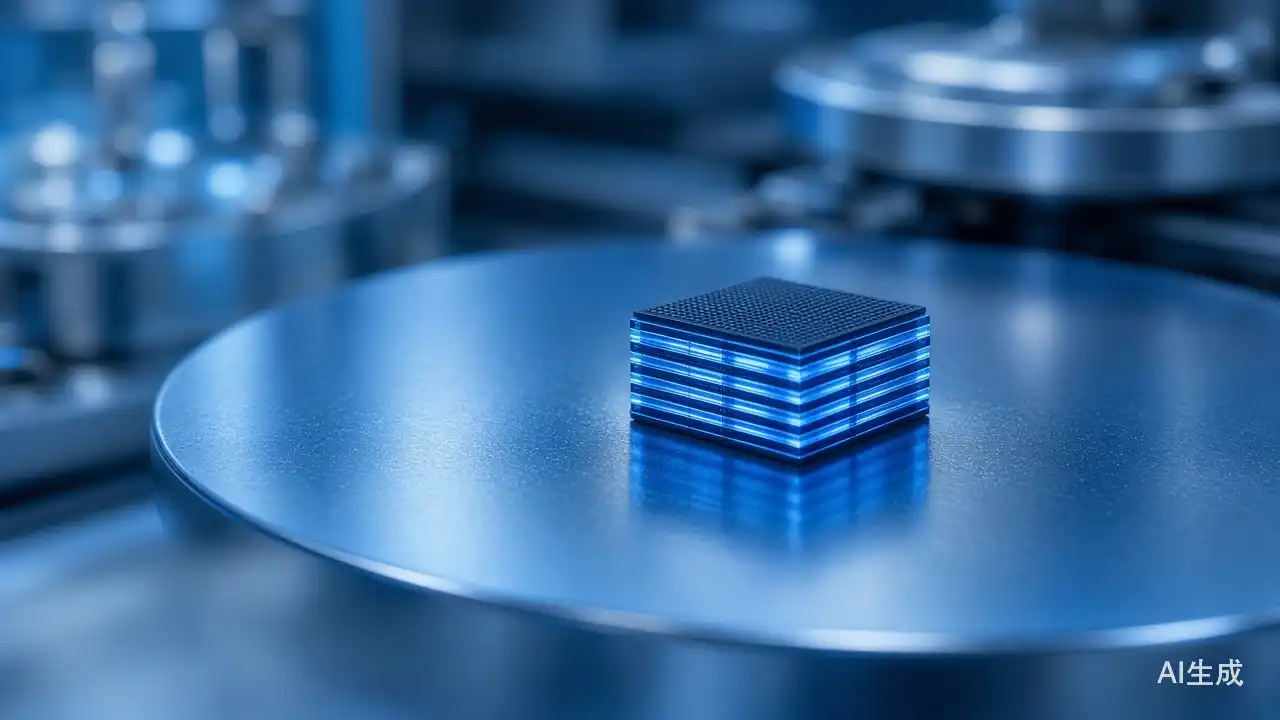
TSMC Enters 3D DRAM?

On November 6, foreign media outlet The Information reported that TSMC has begun planning a production scheme for 3D DRAM, driven directly by its largest customer, Nvidia. The AI computing race has caused memory shortages and price surges, pushing Nvidia to seek supply paths beyond the traditional three major memory makers, with TSMC thrust into the spotlight. If realized, TSMC would expand from logic chip foundry and advanced packaging into memory manufacturing long dominated by Samsung, SK Hynix, and Micron. However, the move appears to be a long-term game anchored to 2029 rather than an imminent production line investment. The plan is reportedly led by Hsu Kuo-chin, TSMC's vice president of advanced packaging, who previously served as chairman of Micron Taiwan, suggesting the consideration is backed by experienced leadership rather than a whim. TSMC's official response was cautious, stating it does not comment on market rumors and remains focused on its core foundry business. TSMC's technical accumulation shows patents preceding official roadmaps: it applied for US patents on high-density 3D DRAM cells and capacitor structures in 2020, and published vertical DRAM structure patents in 2025. Additional patents cover vertical channel transistors, stacked capacitors, multiple patterning, and thin-film transistor-based 3D arrays. These should be understood as technology exploration rather than production readiness. A stronger signal comes from TSMC's roadmap, which lists DRAM-on-logic for 2029, targeting roughly 3x the bandwidth of HBM5E at under 1 pJ/bit. TSMC's potential advantage lies not in making memory cells but in stacking logic and memory with high density and low power. If TSMC enters, it faces rivals already years into the 3D DRAM race. Samsung's roadmap is clearest, using 4F2 vertical channel transistors across 10a, 10b, and 10c nodes before shifting to 3D stacked DRAM at 10d, with 16-layer stacking verification completed. SK Hynix lists 3D DRAM as a core R&D direction below 10nm. Micron plans to skip 4F2 and extend 6F2 until 3D DRAM matures, emphasizing it as a parallel R&D路线 rather than a fixed plan. All three possess engineering experience, yield control, cost optimization, and capacity ramp-up that TSMC cannot easily replicate short-term. Building new lines could take years, and the memory industry's strong cyclicality poses profit volatility risks for TSMC, whose gross margins长期 exceed 50%. In conclusion, TSMC's wisest role may not be a fourth memory maker but an indispensable integrator in the 3D DRAM era—memory cells could be made by third parties, while TSMC excels at bonding memory and logic with minimal power and maximum bandwidth. Whether it takes the further step for Nvidia remains to be seen.

marsbit2h ago

TSMC Enters 3D DRAM?

marsbit2h ago

Trading

Spot

Hot Articles

How to Buy DBR

Welcome to HTX.com! We've made purchasing deBridge (DBR) simple and convenient. Follow our step-by-step guide to embark on your crypto journey.Step 1: Create Your HTX AccountUse your email or phone number to sign up for a free account on HTX. Experience a hassle-free registration journey and unlock all features.Get My AccountStep 2: Go to Buy Crypto and Choose Your Payment MethodCredit/Debit Card: Use your Visa or Mastercard to buy deBridge (DBR) instantly.Balance: Use funds from your HTX account balance to trade seamlessly.Third Parties: We've added popular payment methods such as Google Pay and Apple Pay to enhance convenience.P2P: Trade directly with other users on HTX.Over-the-Counter (OTC): We offer tailor-made services and competitive exchange rates for traders.Step 3: Store Your deBridge (DBR)After purchasing your deBridge (DBR), store it in your HTX account. Alternatively, you can send it elsewhere via blockchain transfer or use it to trade other cryptocurrencies.Step 4: Trade deBridge (DBR)Easily trade deBridge (DBR) on HTX's spot market. Simply access your account, select your trading pair, execute your trades, and monitor in real-time. We offer a user-friendly experience for both beginners and seasoned traders.

9.5k Total ViewsPublished 2024.10.17Updated 2026.09.11

How to Buy DBR

Discussions

Welcome to the HTX Community. Here, you can stay informed about the latest platform developments and gain access to professional market insights. Users' opinions on the price of DBR (DBR) are presented below.

活动图片