300 to 2: A Valuation Experiment on Real Protocol Revenue

marsbitPublished on 2026-09-09Last updated on 2026-09-09

Abstract

The article details a valuation experiment screening the top 300 cryptocurrencies to identify undervalued projects. The key screening criteria were: lower valuation than sector peers, revenue growth exceeding the market median, and token price appreciation lagging behind improving fundamentals. A critical adjustment was using a protocol's actual retained revenue (its real earnings) rather than total fees collected for valuation, as the latter can be misleading (e.g., Jito's P/E shifts from 4.5x to 73x). Initial filtering of 300 tokens left 38 with meaningful revenue data. Applying the three criteria sequentially narrowed the list to 2 final projects: Orca and Jupiter, both Solana-based DEXs. The analysis highlights that many seemingly cheap tokens are either fairly priced (like Pump), value traps with declining revenue, or overvalued despite price lag (like Jito on a retained revenue basis). The author emphasizes this is a screening tool, not investment advice, and notes limitations such as using Fully Diluted Valuation (FDV) and the influence of broader Solana market performance.

Written by: Edgy

Compiled by: Chopper, Foresight News

I am searching for cryptocurrencies with valuation advantages. I set three screening criteria for tokens ranked in the top 300 by market capitalization: revenue growth, valuation lower than industry peers, and token price not yet reflecting the improvement in fundamentals.

In the end, only two projects met all the standards, and they share common characteristics; the projects that were filtered out might be more worthy of in-depth investigation. Here are the conclusions of this research.

Explanation of Screening Rules

The goal of this screening is to identify projects that simultaneously meet all three conditions:

  • Lower valuation compared to peers in the same sector
  • Revenue growth rate outperforms the market average
  • Token price has not yet priced in the positive fundamentals

Using CoinGecko prices and DeFiLlama revenue as benchmarks, I compared data from the past 30 days with the previous 60 days. Then, I asked Claude to assist me with the analysis.

A key adjustment was made in this analysis: ranking is based on the protocol's actual retained revenue, not total fees. Fees are the total amount paid by users, while revenue is the profit actually retained by the protocol.

Take Jito as an example: for every $100 in fees generated, the protocol only retains about $6, with the vast majority distributed as MEV rewards to validators.

If valued based on total fees, Jito's P/E ratio is only 4.5x, appearing extremely cost-effective; but when calculated based on the protocol's actual retained revenue, the valuation is as high as 73x.

Lido similarly retains only about 6% of fees, and Uniswap's retention ratio is 8%.

If judged solely by fees, the "undervalued opportunities" you find are not real.

How 300 Tokens Were Reduced to Just 2

First round of preliminary screening, filtering down to 38 targets with valid statistical data:

  • Initial sample: 300 tokens
  • Among them, DeFiLlama can query revenue data: 117
  • Excluding public chain projects and overly small targets, filtering down to projects where the protocol can retain revenue: 38 remaining

Projects like Morpho, Ondo, Celestia, The Graph, EigenCloud were all excluded. While these projects generate fees, the profits do not flow back to the token itself.

Subsequently, three screening thresholds were applied sequentially, comparing each project to the median Fully Diluted Valuation (FDV) to Annualized Revenue in its own sector (Trading, Lending, Staking, and Others):

  • Valuation lower than peers → 18 remaining
  • Revenue growth higher than sector median → 9 remaining
  • Token price increase lags sector median → 3 remaining

Adding a stress test to eliminate targets with abnormal one-day spike revenue, only 2 remained in the end.

The industry median level is an average 18% increase in project revenue and a 25% average increase in token price. A target must have revenue growth exceeding 18% and a token price increase below 25% to qualify.

The Bias from Fully Diluted Valuation (FDV)

Using FDV instead of circulating market cap for valuation directly eliminated many projects with solid fundamentals. Hyperliquid is the most typical example: calculated based on circulating market cap, the revenue multiple is 28x; but using FDV calculation pushes the valuation to 120x, because the circulating token supply is only a quarter of the total supply.

This criterion might not be fair to HYPE, but this screening uniformly applies this rule.

Results

Cheap valuation, business growth, but price already fully reflects value.
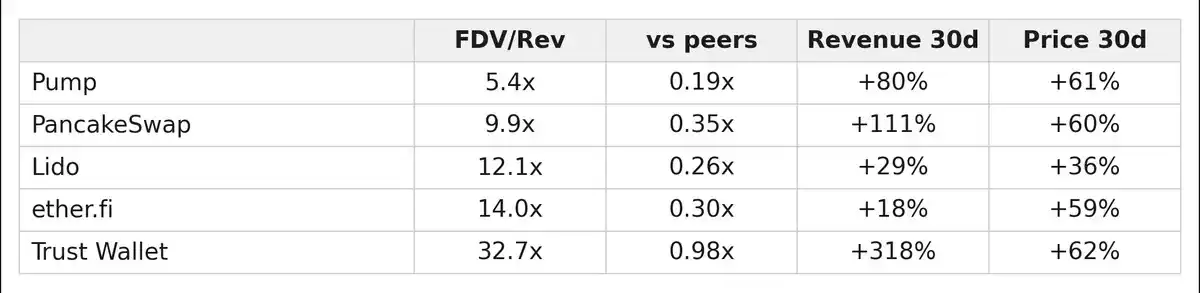
Pump remains the project with the strongest business model in this screening. 30-day revenue of $57 million, valuation less than 6x; revenue up 80%, token price up 61%. The market has already priced it fully, no undervaluation opportunity exists. The market pricing for this type of token is efficiently reasonable.

Low valuation, but out of market favor, business itself is no longer growing.
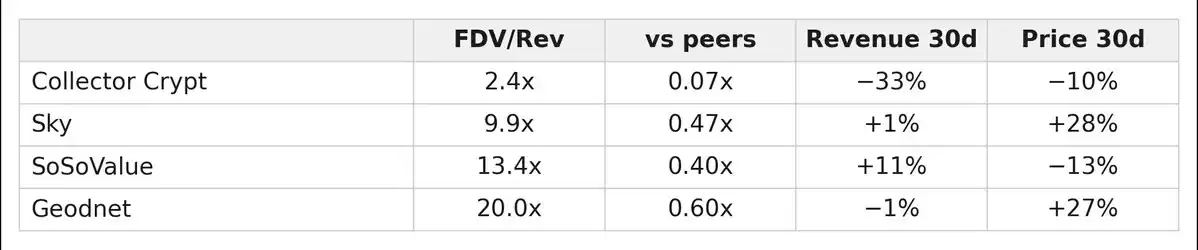
Value trap zone, low price does not equal undervalued. Collector Crypt revenue multiple is only 2.4x, the lowest valuation among the top 300 tokens, but its revenue dropped by one-third.

Business growth, low market attention, but valuation is not cheap.

Revenue continues to rise, token price is flat or even falling, seemingly a perfect deployment opportunity on the surface. But compared horizontally to competitors, their valuations are actually high.

If looking only at fee data, Jito can easily mislead investors: revenue up 44%, token price down 13%, fee-based valuation is only 4.5x. Seems like a perfect opportunity, but when converted to real retained revenue, the valuation reaches 73x.

Bonk has another issue. After removing the spike data from the last three days, the 57% revenue growth directly turns into a negative 17% decline. This growth is likely just a short-term pulse effect brought by the Solana market trend.

Meeting all three conditions.

Aethir failed the revenue stability stress test, with 65% of monthly revenue concentrated in a single-day spike. The underlying cause has not been deeply investigated yet, preliminary data suggests high risk.

Finally, Orca and Jupiter remained, both belonging to Solana ecosystem decentralized exchanges.

The Objective Variable Brought by the Solana Trend

The background must be stated objectively here: SOL increased by 42% that month, part of the exchange revenue growth came from the lagging effect of the Solana bull market, but there are also independent fundamental drivers. Both projects' revenue growth rates outperformed SOL itself, yet their token price increases lagged far behind the public chain.

Jupiter has a more mature business model:

  • 30-day revenue $6.4 million, revenue growth 44%
  • Fee retention ratio 34%, performing outstandingly in profit quality within this screening sample
  • Token price increase 22%, sector median is 25%, meeting the "price lag" screening condition by only a slight margin

Orca has a lower valuation and is a smaller project:

  • Monthly revenue $700k, ranked 293rd by market cap
  • Revenue doubled, and the growth was spread throughout the month rather than concentrated overnight, indicating genuine growth; the downside is the relatively small project scale.

Meteora is worth mentioning. It narrowly missed the growth target by 0.04 percentage points. Revenue grew 18.33%, target value was 18.37%, P/E ratio 7.9x.

Positioning and Limitations of This Screening List

This content does not constitute any buying advice. I will use another complete evaluation system to deeply investigate truly undervalued targets; subsequent comprehensive research across more dimensions is still required.

This screening selected projects with at least 60 days of revenue history, so Robinhood Chain tokens launched relatively recently are not within the statistical scope.

The core significance of this list lies in screening out crypto projects whose businesses are growing, but whose token prices have not yet reflected the upward potential.


Related Questions

QAccording to the article, what are the three screening criteria used to filter the top 300 tokens for undervalued opportunities?

AThe three screening criteria are: 1) The token's valuation is lower than its industry peers. 2) Its revenue growth outpaces the market average. 3) The token price has not yet reflected the improvement in fundamentals.

QWhy does the author emphasize using 'protocol actual retained revenue' instead of 'total fees' for valuation analysis?

AThe author emphasizes using 'protocol actual retained revenue' because total fees represent what users pay, but a large portion is often distributed elsewhere (e.g., as MEV rewards to validators). Retained revenue is the portion the protocol actually keeps as profit. Using total fees can create a misleading picture of value, as seen with Jito's P/E ratio appearing as 4.5x with fees but 73x with retained revenue.

QWhich two projects passed all three screening filters and the final pressure test in the analysis?

AThe two projects that passed all three screening filters and the final pressure test are Orca and Jupiter, both of which are decentralized exchanges (DEXs) on the Solana ecosystem.

QWhat is a key limitation mentioned regarding the use of Fully Diluted Valuation (FDV) in this screening process?

AA key limitation of using FDV is that it can unfairly penalize projects with a low token circulation. For example, Hyperliquid (HYPE) appears to have a reasonable 28x revenue multiple based on circulating market cap, but a much higher 120x multiple based on FDV because only about a quarter of its tokens are in circulation.

QWhat common characteristic did most projects eliminated in the first round of screening share?

AMost projects eliminated in the first round were those where fees or revenue generated do not accrue back to the token itself. Examples given include Morpho, Ondo, Celestia, The Graph, and EigenCloud, which generate fees but where the proceeds do not flow to the token holders.

Related Reads

GPT-6.1 Sol Participates in Live Brain Surgery! Three Rounds of Localization, Each More Accurate Than the Last

Exin Therapeutics CEO Gabriel Ocana-Santero reported an experiment in which GPT-6.1 Sol participated in three rounds of real mouse brain surgery positioning. The task involved locating Bregma and Lambda, two key skull landmarks used to calibrate stereotaxic coordinates for accurate targeting of brain regions. After each round, a professional surgeon corrected the model's positioning results, and the model retained its images, measurements, and expert corrections for reference in subsequent rounds. By the third round, GPT-6.1 Sol reduced landmark search time from 169 to 86 seconds, required corrections from four to two, and cut positioning error from 0.6 mm to 0.3 mm. Ocana-Santero described this as in-context learning from real-world experience. The team did not disclose how the experience records are integrated into the model or whether underlying weights are updated, so it cannot be described as autonomous training or parameter-level self-evolution. The sample is only three operations, far from proving stable surgical capability, but it demonstrates AI accumulating experience from real observations and expert feedback. This follows earlier Exin work in which AI selected gene therapy vectors, chose injection targets and coordinates, and controlled a stereotaxic device in a mouse experiment, with a licensed veterinarian supervising and safety limits in place. In a further experiment, Claude Sonnet 5, GPT-6.1 Sol, and Grok 4.7 chose different brain regions and treatment strategies for the same scientific goal, suggesting models may reason toward different experimental paths.

marsbit13h ago

GPT-6.1 Sol Participates in Live Brain Surgery! Three Rounds of Localization, Each More Accurate Than the Last

marsbit13h ago

From Drones to Nuclear Reactors: What Has Paradigm Invested in Since Leaving the Crypto World?

Paradigm, a venture capital firm known for crypto investments like Coinbase and Uniswap, is rapidly expanding into hard tech. In November, it co-led a $1.5 billion funding round for Zipline, a US drone delivery company now valued at $21.5 billion—nearly triple its valuation from January. Zipline, founded in 2014, began delivering medical supplies in Rwanda and now operates a large-scale automated logistics network, having completed 150 million miles of commercial autonomous flights. Walmart plans to add 300 new delivery sites, and Uber aims to scale their partnership to one million daily orders by 2029. Paradigm's broader portfolio now spans AI, robotics, manufacturing, semiconductors, space defense, and nuclear energy. Investments include open-source AI lab Nous Research, math-reasoning AI firm Harmonic, AI data company Idler, and GPU platform Andromeda. It also backs SendCutSend (metal parts manufacturing), Fab2 (compact semiconductor factories), True Anomaly (space defense), and Antares (micro nuclear reactors). In July, Paradigm launched a $12 billion new fund for frontier tech. This shift reflects a broader VC trend toward AI and physical technology, as crypto's path to sustained commercial revenue remains uncertain. Paradigm's bets focus on companies solving concrete industrial problems with existing markets, aiming to build a hard-tech network that transcends crypto cycles.

marsbit13h ago

From Drones to Nuclear Reactors: What Has Paradigm Invested in Since Leaving the Crypto World?

marsbit13h ago

Nomura: "Blue Wave" Hits US Data Centers, China's AI Benefits Instead

Nomura argues that the Democratic "blue wave" in the US midterms could paradoxically benefit China's AI economy. Democratic victories in key data-center states will likely tighten regulation, shift grid upgrade costs onto developers, and lengthen approval timelines, slowing US data-center expansion. Market reaction was sharp: the Nasdaq fell 5.5% in a single day, the SOX dropped nearly 15% over two days, Nvidia fell about 12%, and Micron about 24%. Because US cloud giants had been hoarding global GPU, HBM, and advanced logic chip capacity—driving black-market premiums of 200–300% at Asian logistics hubs—a US capex slowdown could collapse those speculative premiums, letting Chinese AI firms, cloud providers, and research institutions obtain GPUs, HBM modules, and advanced packaging materials more cheaply through intermediary trade hubs. China is also building a state-led national AI data-center network, with roughly RMB 2 trillion planned under the 15th Five-Year Plan to integrate regional computing by 2028, supported by low-cost renewable power in western hubs under the "East Data, West Computing" program. Morgan Stanley, meanwhile, does not see the blue wave as a real easing of US-China tensions; it expects strategic competition to persist but sees greater policy predictability. It prefers China's "self-sufficiency" AI trade—supported by both supply and demand under national policy priorities—over export chains tied to global AI capex. It also notes more balanced opportunities in Chinese equities, with valuations near historic lows.

marsbit13h ago

Nomura: "Blue Wave" Hits US Data Centers, China's AI Benefits Instead

marsbit13h ago

After GPT-6, Embodied Large Models Are Trapped in Their Own Territory! Next Year's Self-Research Budget Is Probably Up in the Air

The article discusses how the release of GPT-6 Astra (and the imminent GPT-6.2 Astra) has disrupted the embodied AI/robotics industry. General-purpose large models are now encroaching on capabilities that embodied AI companies previously developed in-house—such as in-context learning, out-of-distribution generalization, error correction, and open-vocabulary manipulation—often without task-specific post-training. On benchmarks like RoboDojo, teams combining general models with robot-use-agent techniques saw scores jump from 20–30 to 50–60, prompting many to question whether self-developing embodied foundation models still makes sense. Some companies have begun cutting algorithm roles. However, the article notes GPT-6 Astra still struggles with complex physical contact, force control, object deformation, and high-precision manipulation, and its cloud API inference latency is high (though this is not seen as a fundamental barrier). Experts argue that general models' current weaknesses shouldn't be treated as durable moats for embodied companies, since OpenAI is already hiring robotics talent and future models may absorb more robot operation data. The core argument is economic: embodied companies' opportunity lies not in building smarter models but in delivering better economic value. Stable, standardized industrial tasks may be better served by lightweight, specialized models or rule-based strategies, while open-ended tasks (e.g., home service robots) may benefit from general models. Ultimately, companies need to re-prioritize their R&D directions—leveraging general models for language understanding and task planning while focusing in-house efforts on physical interaction, embodiment-specific control, real-world adaptation, and deployment efficiency. The article concludes that the industry is moving past the demo-and-burn-investment stage, and the elimination round among the "hundred robot wars" has begun.

marsbit14h ago

After GPT-6, Embodied Large Models Are Trapped in Their Own Territory! Next Year's Self-Research Budget Is Probably Up in the Air

marsbit14h ago

Trading

Spot
活动图片