The live price of USD.AI (CHIP) is $0.02 USD and its current market capitalization is $-- USD.
Get real-time CHIP/USD updates on HTX. Stay informed with the latest data and market trends to make smart trading decisions. HTX, your trusted source for accurate cryptocurrency price information.
USD.AI Key Stats
24h Volume (USD)
$--
Price Change Today
+1.66%
Circulating Supply (CHIP)
2.00B
Sign up and trade to win rewards worth up to 1,500 USDT.Join Now
CHIP Price Performance
Track USD.AI price movements with chart views spanning 1 day, 30 days, 60 days, 90 days, 1 year, and the period since it was listed on HTX.View more data for the USD.AI prices
Time
Change
Change%
Highest Price
Lowest Price
No data
CHIP Market Information
Get the latest USD.AI price details on HTX: 24-hour high and low, all-time high (ATH), and daily price change percentage.
24h Low
$0
24h High
$0
All-Time High
$0
Market Cap
$0.00
24h Volume (USD)
$--
Circulating Supply
--
What is CHIP?
USD.AI is a permissionless lending protocol built to finance AI infrastructure. The protocol enables GPU operators to tokenize their hardware as collateral and access financing instantaneously.
It's super easy to buy CHIP on HTX. Simply click here to view a complete guide to buying USD.AI with ease.
Real-Time CHIP Markets
View real-time USD.AI prices on HTX's spot markets. Switch between spot and futures markets to instantly compare live prices and 24-hour price changes.
Based on the historical performance of USD.AI, our prediction tool estimates that the price of USD.AI (CHIP) could reach -- by --.
Predicted CHIP Price in --
Our most recent forecast indicates the price of USD.AI (CHIP) will increase to -- by --, with a price change of --% and a cumulative ROI of approximately --%.
Buy your first CHIP on HTXSign Up
CHIP FAQs
QWhat is the USD.AI (CHIP) price today?
AThe current price of USD.AI (CHIP) is $0.02 USD.
QWhat is the USD.AI (CHIP) market cap?
AThe current market capitalization of USD.AI (CHIP) is $0.00 USD, calculated by multiplying its circulating supply by its current price.
QWhat is the USD.AI (CHIP) circulating supply?
AThe current circulating supply of USD.AI (CHIP) is -- CHIP.
QWhat is the USD.AI (CHIP) all-time high?
AAs of 2026-07-31, the all-time high of USD.AI (CHIP) is $0 USD.
QWhat is the USD.AI (CHIP) 24h trading volume?
AThe 24-hour trading volume of USD.AI (CHIP) is -- USD on HTX.
QCan I buy USD.AI (CHIP) on HTX?
AYes, HTX offers industry-leading trading fees and deep liquidity, ensuring a smooth and secure USD.AI (CHIP) purchase experience.
The article examines the significance of recent data showing China's total R&D expenditure, measured by purchasing power parity (PPP), catching up to or slightly surpassing that of the United States in 2024. It argues that while this milestone reflects China's immense capacity to mobilize research resources, the competition in semiconductors now extends far beyond sheer financial input. The analysis highlights key differences: China's R&D is heavily skewed towards experimental development (over 80%), focusing on product engineering and industrialization, whereas the U.S. allocates a proportionally larger share (about 15%) to basic research. Furthermore, leading U.S. semiconductor firms reinvest a significant portion of their substantial global sales revenue into R&D, creating a sustainable commercial innovation cycle that is difficult to replicate. The article emphasizes that semiconductor progress depends on converting R&D into commercially viable products that pass rigorous customer validation and achieve repeat orders, not just on spending levels. It concludes that as China enters the top tier of R&D spenders, the critical challenges shift to improving resource allocation efficiency, fostering long-term basic research, and building effective mechanisms to bridge the gap between laboratory discoveries and reliable, market-ready industrial capabilities.
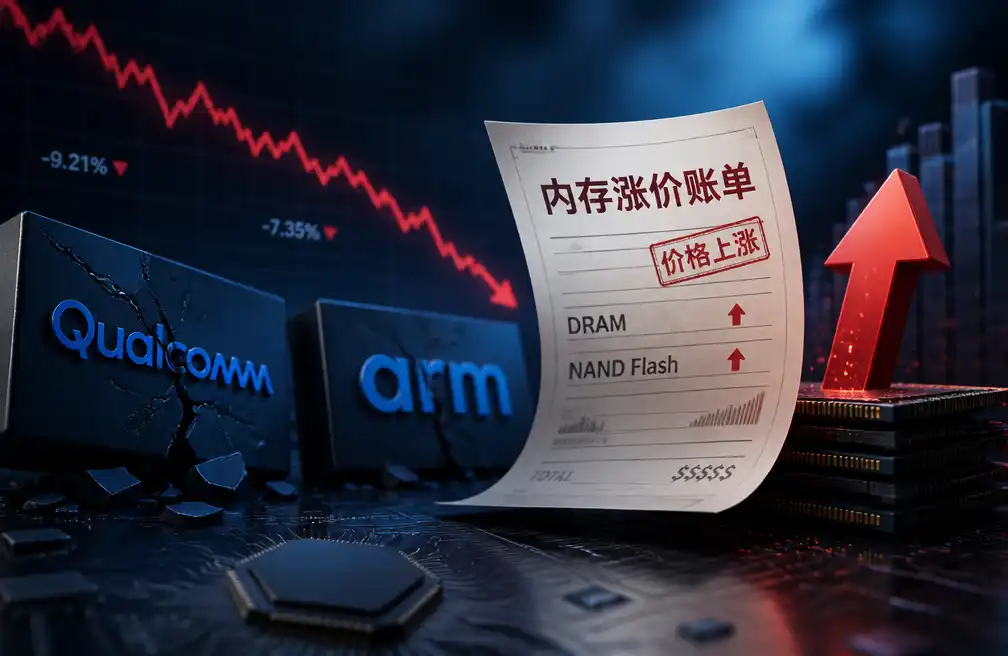
After posting Q2 FY2026 results, Qualcomm and Arm both saw their shares decline, reflecting the impact of memory price increases on the smartphone chip sector.
Qualcomm's revenue of $9.95B slightly beat expectations, but EPS of $2.21 fell short. More concerning was its guidance for next quarter, with EPS projections below analyst estimates. The company directly attributed a >$1.50 per share annual EPS headwind to rising memory costs and supply constraints in Android phones, prompting planned price hikes. While automotive revenue grew 61% and is approaching one-third of phone revenue, the mobile segment declined 20%. Qualcomm also confirmed a significant reduction in its modem share for the upcoming iPhone and outlined a plan for data center revenue to replace all Apple-related income by FY2027.
Arm's results surpassed expectations with revenue of $1.29B and EPS of $0.45, and its guidance was also strong. However, its stock fell. Key concerns included royalty revenue failing to set a new record and a downward revision to full-year royalty growth guidance from ~20% to the high-teens, citing weak smartphone demand and high memory prices. Despite robust growth in its data center business, Arm's premium valuation (over 100x forward P/E) means even beating expectations isn't enough to push the stock higher, as any sign of uncertainty is magnified. Ongoing global antitrust investigations add another risk factor.
The situation highlights a broader shift. Memory price surges, which boosted Samsung's profits, are now pressuring chip designers. Meanwhile, the semiconductor sector saw significant corrections in July, with the hardest-hit stocks often being those with the biggest AI-driven gains year-to-date. Qualcomm, lacking such a premium, was an exception.
On July 29, 2026 (US time), Qualcomm reported its Q3 FY2026 (Q2 CY) results. Revenue reached $9.95 billion, up 4% and beating estimates, but net profit fell 25% YoY to $2 billion. The "revenue up, profit down" trend is attributed to rising costs across semiconductor manufacturing, testing, packaging, and materials. In response, CEO Cristiano Amon announced price increases for all chip products, effective September 1, to pass on costs and restore historical profit margins. The stock fell over 5% in after-hours trading due to weaker-than-expected Q4 profit guidance.
Qualcomm's core chip business (QCT) revenue was $8.5 billion, down 5% YoY. Handset revenue dropped 20% to $5.09 billion, reflecting a weak global smartphone market with declining shipments. In contrast, Automotive revenue surged 61% to $1.59 billion, marking 23 consecutive quarters of double-digit growth, and IoT revenue grew 9% to $1.83 billion. The licensing division (QTL) revenue was $1.28 billion, down 3%.
Facing smartphone headwinds and a reduced component share in future iPhones, Qualcomm is aggressively diversifying. It is betting heavily on the data center AI market, maintaining a target of $5 billion in data center revenue for FY2027. The company completed the acquisition of AI software firm Modular to build an open software platform for generative AI.
For Q4 FY2026, Qualcomm forecasts revenue between $9.7B and $10.5B, roughly in line with expectations. However, non-GAAP EPS guidance of $2.05-$2.25 fell short of the $2.36 analyst consensus. Management expects the chip price increases to gradually improve margins after September 1, but near-term profitability pressure from costs and the weak handset market persists.
Qualcomm has officially announced a new round of price increases for its entire chip portfolio, effective September 1. The hikes, reaching up to 18% for the flagship Snapdragon 8 Elite Gen 6 Pro, follow similar moves by MediaTek, intensifying cost pressures on the already strained smartphone industry.
CEO Cristiano Amon confirmed the plan, citing the need to offset rising industry-wide costs and restore declining profit margins. Qualcomm's Q3 FY2026 results showed a 25% drop in net profit, with mobile revenue plunging 20% year-over-year, hitting its lowest level since 2021.
The surge in AI computing demand has led memory manufacturers to prioritize HBM production, creating a shortage in general-purpose DRAM and NAND Flash chips. Their prices soared by 93%-98% and 55%-60% respectively in Q1 2026, causing the memory cost share in smartphones to jump from 10%-15% to over 30%. Coupled with the soaring cost of advanced nodes like TSMC's 2nm and packaging, overall chip costs have reached historic highs.
These upstream pressures are forcing downstream smartphone brands like Xiaomi, OPPO, and vivo to cut orders for mid-to-low-end models by up to 20% and use cost-saving measures like older chipsets. Reportedly, the Snapdragon 8E5 will be repurposed as a "long-lasting" chip for sub-brand phones in H2 2026.
Amid this cost crisis, the Android market remains sluggish. Q2 2026 smartphone shipments in China fell 4.3% year-over-year, marking five consecutive quarters of decline. Major Android brands saw market share drop, while Huawei and Apple, with their in-house chip advantages, gained share.
Qualcomm is diversifying into automotive and IoT sectors to reduce reliance on smartphones, but these new segments cannot yet fill the mobile revenue gap. Industry observers warn that the full impact of component cost hikes will hit in the second half of 2026, likely leading to higher-than-expected price increases for Android flagships and a further contraction in the Chinese smartphone market.
The storage chip sector experienced a dramatic overnight rebound in US markets, with major stocks like SK Hynix and Micron surging over 17%. This sharp reversal is attributed to multiple factors: potential short-selling bans and market stabilization measures from South Korea, significant leverage unwinding (with leveraged ETF assets down ~70% from peaks), cooler-than-expected US inflation data easing rate hike fears, and a stellar Microsoft earnings report showing strong cloud/AI demand growth. Microsoft's results, highlighting Azure revenue crossing $100 billion, helped counter the "AI bubble burst" narrative that had pressured the sector.
However, the article cautions against declaring a sustained bull market. Key risks remain, including potential further interest rate hikes by the Bank of Japan, which could pressure global carry trades, and unanswered questions about whether high industry profits can be maintained amid the supply cycle and new competition. Investors are advised to monitor whether gains hold, watch for updates on HBM/DRAM/NAND pricing and orders, and await key upcoming events like NVIDIA's earnings. The conclusion emphasizes disciplined investing—avoiding panic selling or FOMO buying—and using strategies like hedging to manage risk in this volatile environment.
marsbit14小时前
Threads
Welcome to the HTX Community. Here, you can stay informed about the latest platform developments and gain access to professional market insights. Users' opinions on the price of USD.AI (CHIP) are presented below.
Related Questions
Welcome to the Crypto FAQ. Users' questions and answers on USD.AI (CHIP) are presented below.