The Scene From 1999 Is Repeating Itself

marsbitPublished on 2026-10-15Last updated on 2026-10-15

Abstract

The article draws a stark parallel between the current U.S. stock market and the period leading up to the 2000 dot-com crash. While the S&P 500 hovers near record highs, this strength is deceptive. Beneath the surface, 60% of its components are already in a technical bear market. The index is being propped up almost entirely by the "Magnificent Seven" tech giants, reminiscent of the narrow leadership seen in 1999. Prominent figures like Paul Tudor Jones of Tudor Investment are issuing strong warnings, comparing the present market structure to 1999 and predicting 2027 could be the worst year for stocks since 2002, citing massive upcoming equity supply from IPOs (e.g., Anthropic, OpenAI) and lock-up expirations. Analysts from Goldman Sachs, Morgan Stanley, and BTIG echo concerns about extreme concentration and deteriorating market breadth. Key risks identified include an over-reliance on a few AI-related stocks for index returns and earnings growth, signs of peaking profit cycles, and a potential shift in market leadership from semiconductors to software. The upcoming earnings season for cloud giants, particularly their capital expenditure guidance, is seen as a critical near-term catalyst. Furthermore, rising bond yields (10-year Treasury above 5%) and soaring corporate debt issuance costs add to the pressure. The summary concludes by noting a profound disconnect: despite a 16-fold total return in the S&P 500 since 2009, consumer sentiment is at near-record lows, highlighti...

Author: Wallstreetcn

The S&P 500 is just one step away from its all-time high, but under the surface, undercurrents are surging: 60% of its components have already fallen into a technical bear market, with only the "Magnificent Seven" tech giants holding it up on one leg. This inevitably reminds one of a past scene—that of 1999.

Paul Tudor Jones, founder of Tudor Investment and a legendary hedge fund figure, issued a rare, comprehensive bearish signal on U.S. stocks: the current market situation resembles that of 1999, roughly a year before the dot-com bubble burst in 2000. He predicts that 2027 will be the "worst year for stocks since 2002" and announced he will be shorting U.S. stocks for the entire year.

Before this, reports from Goldman Sachs, Morgan Stanley, and BTIG all pointed to the same year. Notably, both the bulls and the bears are referencing the year 2000.

The Index Is at Highs, but 60% of Stocks Are Already in a Bear Market

Michael Cembalest from J.P. Morgan Asset Management presented a set of numbers: 60% of S&P 500 components are down more than 20% from their respective all-time highs, while the index hovers near highs—an extremely rare occurrence since 1990. Only 30% of the index's components have outperformed the index over the past three years, the lowest reading since 1991. The last time this reading appeared was in 1999-2000. Goldman Sachs was even more direct. Strategist Tony Pasquariello wrote in a report defending the bulls: "The median S&P 500 stock is currently down 15% from its 52-week high, the worst reading since the internet bubble."

The Last Leg Is the "Magnificent Seven"

The index is still rising because a handful of stocks are rising.

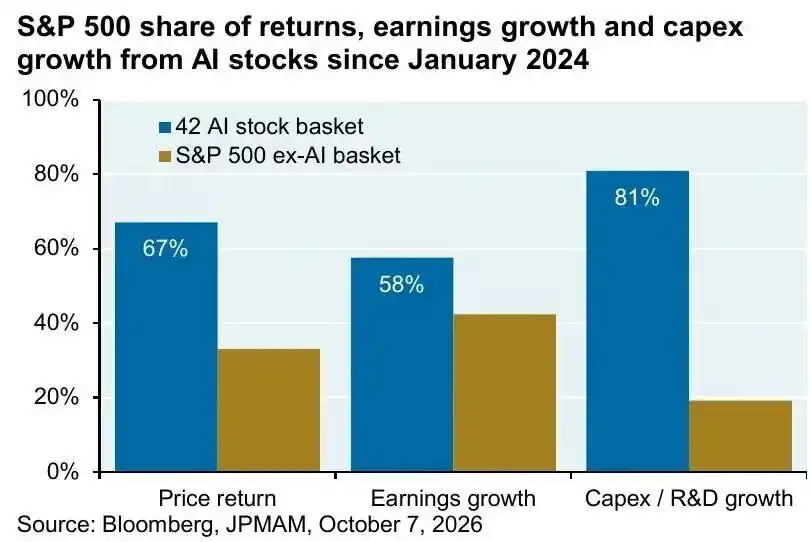
Another set of numbers from Michael Cembalest: Since January 2024, about 42 AI-related stocks have contributed to approximately 67% of the S&P 500's price return, 58% of its earnings growth, and 81% of its capital expenditure and R&D growth. Forty-some stocks are carrying two-thirds of the index.
Jonathan Krinsky of BTIG titled his report "The Last Line of Defense." His judgment is blunt: The "Magnificent Seven" tech sector is the only sector in the S&P 500 not yet showing signs of fatigue, and it is also the most crowded trade; once it turns, it could likely be the trigger for a sustained decline in the index. The numbers are on his side. The Roundhill Magnificent Seven ETF (MAGS) has already hit a record high, while surrounding sectors are broadly declining.

On Tuesday, against the backdrop of another decline in semiconductor stocks, the "Magnificent Seven" collectively rose about 1%, single-handedly propping up the S&P 500 index. Hedge funds are using these seven as a safe haven, hiding from geopolitical risks and Treasury yields above 5%. With too many hiding, concentration hit a record—the seven giants account for about 22% of the net exposure at Goldman Sachs' Prime Brokerage.

Goldman's Rich Privorotsky put it succinctly: "The market has become extremely overbought in one corner, while essentially being short everything else." Is an asset everyone holds as a safe haven still a safe haven? The Philadelphia Semiconductor Index (SOX) has closed lower for five consecutive sessions, marking its longest losing streak in nearly 17 months.

It sounds bad, but as of Monday's close, the SOX was still up about 72.8% year-to-date, with Micron up over 240%. Down for five days, yet still near highs—that's probably what 1999 looked like.

Jonathan Krinsky also overlaid the SOX's 1999-2000 price action with its current trajectory, finding the吻合程度 "disconcerting." The SOX has already pulled back nearly 18% from its June highs, which alone isn't significant, but plotted against the 1999-2000 curve, it looks ominous.
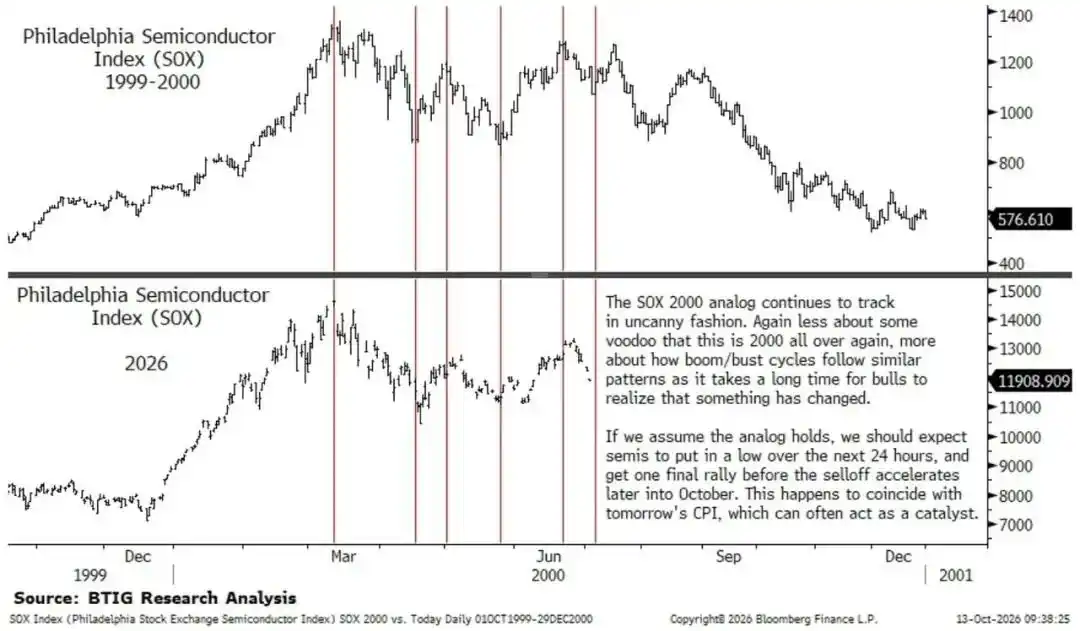
By his analogy, semiconductors will have a brief rebound first (with CPI as the catalyst), then accelerate their decline in late October. What happens in late October? The window for major cloud computing giants to report earnings.

Earnings Are Also Peaking, But No One Wants to Admit It

Goldman Sachs itself calculated that the S&P 500's Q3 earnings growth of 27-28% is the peak of this cycle, with a sequential slowdown thereafter.

Pasquariello stated that 2027 "will be a complex year." Profits are still concentrating in one direction. Since March 2023, rolling profits for about 55 "AI supply chain" companies have grown roughly fourfold, while for 190 "high AI adopters," they've grown only about 25%.

The shovel sellers are making a fortune, but the miners haven't struck gold yet. This script was played out in 1999.

The tech sector's contribution to U.S. GDP growth has risen from almost zero in 2022 to about one-third, yet planned data center pre-build capacity has dropped from a peak of around 62 GW to about 49 GW. The only capital expenditure engine that was expanding has begun scaling back plans.

The Real Downside Catalyst Is in 2027

The 1999 story has a second half—the real force that pushed the market down: supply. One pillar of the bull market over the past four years, rarely mentioned, has been the continuous shrinking of the float through corporate buybacks and M&A. This logic is now about to reverse.

Paul Tudor Jones made it plain on CNBC: the current supply-demand dynamic for U.S. stocks is the "worst since 2002," resembling 1999, the year before the bubble burst.

Major IPOs from Anthropic and OpenAI are imminent, while SpaceX's offering was just completed. Additionally, numerous companies will issue follow-on offerings to raise funds for AI buildouts. Jones believes these factors combined will create significant stock supply pressure in 2027.

He announced he will be short U.S. stocks for the entire next year—"there's just no value there at all." Goldman Sachs' internal report on 2027 U.S. equity supply and demand quantified this supply wave: $600 billion in primary issuance, including $175 billion in IPOs; buybacks and M&A providing about $2 trillion in demand; but lock-up expirations could release $1.7 trillion in supply.

$600 billion plus $1.7 trillion equals $2.3 trillion, versus only $2 trillion in demand. The net supply increase could be the largest since 2000.

If most insiders choose to cash out post-lockup, the buyback power that has propped up the market on every dip for the past decade could, for the first time, be overwhelmed by supply. The last time such a magnitude of net supply appeared, Pets.com was still in business.

Money itself is also getting more expensive. Tencent Holdings issued USD and Dim Sum bonds in Hong Kong on Tuesday, with the 10-year USD bond's initial yield guidance around 1.15 percentage points above Treasuries; SoftBank issued $4.5 billion in high-yield bonds last month, paying up to 9.75% interest; Firmus, partly owned by Nvidia, shelved a planned $5 billion Australian IPO last week.

BlackRock's research arm simply downgraded its U.S. equity outlook to "neutral" on Monday, turning bullish on short-term Treasuries instead; Broadcom CEO Hock Tan said capital might become one of the biggest constraints on AI industry growth.

The First Reaction Is in the Bond Market

The 10-year Treasury yield has already broken above 5%. As long as yields don't come down, the rationale for defensive capital staying in the seven mega-caps remains; once they retreat, that rationale diminishes. Goldman's short-term strategy is to short fixed income.

On the equity side, short-term judgment is less pessimistic. Goldman believes the "tactical setup for positioning is net positive," with room for technical improvement before the mid-term elections settle. Jones is looking at 2027—a different timeframe. Another market signal is the rotation between semiconductors and software.

The relative strength ratio of Software vs. Semiconductors (IGV/SMH) has reclaimed its 200-day moving average for the first time in 16 months. If it continues to break above the summer highs near 0.20, leadership could shift from semiconductors to software—a sector not heavily positioned in the market currently. Crude oil is one of the few clear bullish trades in this cycle.

Jones holds a long position, citing the U.S.-Iran conflict as difficult to resolve short-term: "I think it can go another $20 to $25." WTI is currently around $94 per barrel; another $20-$25 would surpass the 2026 closing high of around $113.

He warned that if oil prices really move that way, the stock market would "absolutely, thoroughly hate it." When could things derail? There are two thresholds. The trigger condition is the late October earnings reports from cloud giants. Once capex guidance slows, or the scale of lock-up expirations exceeds expectations, the "Magnificent Seven" will likely experience a catch-down decline.

The failure condition is if Q3 earnings beat expectations, Q4 guidance isn't lowered, and actual net supply is significantly below estimates—then this "supply overwhelming buybacks" scenario would need to be revised.

Watch the Cloud Giant Earnings Reports Next

The most critical thing to watch in the next two weeks is the cloud giants' earnings season, especially capex guidance—the source of the entire AI profit chain. Another easily overlooked factor: debt issuance rates. The coupons Tencent and SoftBank are paying are a barometer of AI financing costs. Not all signals point in one direction. Meta's stock rose about 3.4% on Monday after releasing a new model, bucking the broader market decline. The market is rejecting indiscriminate bets on infrastructure, not AI itself. At the end of Pasquariello's report, he paints another picture:

Since the lows of March 2009, the S&P 500 total return has risen 16-fold. During this journey, only one recession occurred, lasting about two months.

Yet, the University of Michigan Consumer Sentiment Survey reading today is lower than in March 2009—the just-released data (46.3) is the second-lowest reading since records began in 1952.
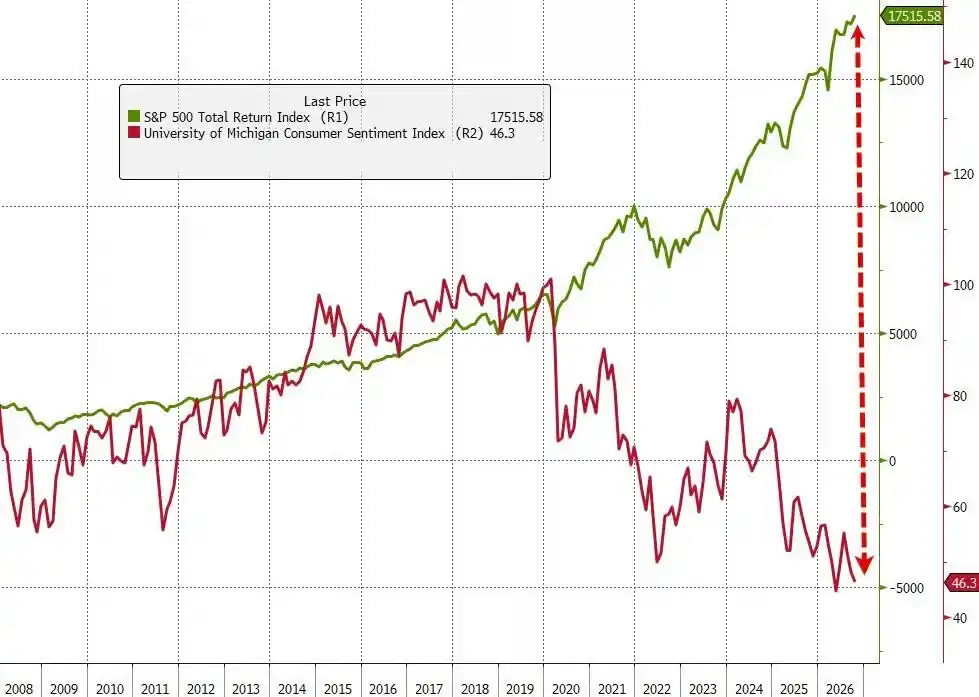
Pasquariello called this divergence "stunning, and somewhat perplexing." Over the same period, stock holders got a 16-fold return. Another segment got synchronously rising home prices, rents, and food prices, and the reality that with the 10-year Treasury yield above 5%, every new mortgage becomes a luxury......

What 1999 left for posterity is not the phrase "the bubble must burst," but the fact that standing one year before the bubble burst, the vast majority were still bullish.

Trending Cryptos

Related Questions

QAccording to the article, what key similarity is drawn between the current market and the year 1999?

AThe key similarity is the market's high concentration in a narrow group of stocks (now the 'Magnificent Seven' tech giants) while a majority of S&P 500 components are in or near a bear market. This echoes the 1999 scenario where a tech bubble was propping up indices before the 2000 crash.

QWho is Paul Tudor Jones, and what is his major market prediction for 2027 mentioned in the text?

APaul Tudor Jones is the founder of Tudor Investment and a legendary hedge fund manager. He predicts that 2027 will be the worst year for stocks since 2002. He is planning to short the U.S. stock market for the entire year due to an anticipated surge in equity supply from large IPOs and secondary offerings, creating the worst supply-demand imbalance since 2002.

QWhat is the significance of the 'Magnificent Seven' stocks in the current market structure, as per analysts cited?

AThe 'Magnificent Seven' tech stocks are the primary, and seemingly only, pillar holding up the S&P 500 index. They are described as the 'last line of defense.' Their performance has been responsible for a disproportionate share of the index's gains, and they have become an extremely crowded trade. Analysts warn that a downturn in these stocks could trigger a broader, sustained market decline.

QWhat potential market 'trigger' and 'failure condition' does the article identify for the bearish thesis?

AThe potential trigger is the upcoming earnings reports from major cloud computing companies in late October. If their capital expenditure guidance slows down or lock-up expirations release more shares than expected, the Magnificent Seven could fall. The failure condition would be if Q3 earnings beat expectations, Q4 guidance remains strong, and the actual net supply of new shares is significantly lower than projected, which would undermine the 'supply overwhelms buybacks' narrative.

QWhat striking contradiction in market sentiment does Goldman Sachs strategist Tony Pasquariello highlight at the end of the article?

APasquariello highlights a stark contradiction between market performance and consumer sentiment. Since the market low in March 2009, the S&P 500 has delivered a 16x total return with only one brief recession. However, the University of Michigan's Consumer Sentiment Index is currently at its second-lowest reading ever recorded (since 1952), lower even than it was at the market bottom in 2009, indicating deep public pessimism despite historic wealth creation for investors.

Related Reads

Singapore Blockchain Week 2026 Returns This November, Puts Singapore and Johor, Malaysia Cross-Border Digital Economy Opportunities in the Spotlight

Singapore Blockchain Week (SBW) 2026 will take place from 13 to 17 November 2026 as a government-supported flagship event bringing together regulators, financial institutions, sovereign entities, family offices, founders, investors, enterprises, and ecosystem builders. The event features prominent speakers including H.E. Justin Sun (TRON), Jose Fernandez da Ponte (Stellar Development Foundation), representatives from VISA, J.P. Morgan, SAP, the United Nations Development Programme, Société Générale-Forge, Paxos, World Bank, and others. SBW 2026 is positioned as the world's first cross-border blockchain week, connecting Singapore and Malaysia's Johor-Singapore Special Economic Zone (JS-SEZ) to accelerate innovation, investment, and technology collaboration across Southeast Asia. It is supported by partners including Singapore Global Network – Economic Development Board, Singapore Tourism Board, Malaysia Digital Economy Corporation, Iskandar Regional Development Authority, and Johor Corporation. The week-long programme includes: Special Economic Zone Immersion (13 Nov), Tech-Enabled Sports (14 Nov), Learnathon (15 Nov), Inner Circle (16 Nov), and Institution Summit (17 Nov). The event focuses on the convergence of AI, DeFi, Real World Assets (RWA), and Venture Capital, positioning Singapore and ASEAN at the forefront of global digital transformation. Sebastian Zilliacus, Chair of the Advisory Committee, emphasised that the event aims to move beyond headlines so traditional finance and emerging technology "start building together." CK Ong of SBI Digital Markets noted that tokenisation's key question is now market viability, requiring alignment of regulatory clarity, distribution, custody, and commercial viability. Kiran Mistry of SAP highlighted the importance of interoperability between blockchain and enterprise systems, while Rahul Bhargava of the World Bank and Contour Network discussed addressing the $2.5 trillion trade finance gap through digital documentation and multi-rail settlements. Raymond Ngan of Singapore Innovation Centre noted the event strengthens Singapore and Southeast Asia's position, particularly as Singapore prepares for ASEAN Chairmanship in 2027.

TheNewsCrypto44m ago

Singapore Blockchain Week 2026 Returns This November, Puts Singapore and Johor, Malaysia Cross-Border Digital Economy Opportunities in the Spotlight

TheNewsCrypto44m ago

BIT CCO Cynthia Wu Deconstructs Digital Asset Industry Pain Points: Buying Is Only the Starting Point; Holding It Properly Is the Real Competitive Edge

BIT CCO Cynthia Wu spoke at an FTAHK roundtable in Hong Kong on November 3, 2026, alongside Xapo Bank's Belle Leung and Anthea's Alex Pei, discussing the evolution of digital asset wealth management. She noted that after a full market cycle, family clients have shifted focus from prices to operational safety—asking not "can I buy it" but "can I hold it properly." Concerns center on custody, asset segregation, counterparty risk, and inheritance planning, with many families preferring familiar instrument types such as BIT's Swiss-listed spot bitcoin ETF (BBIT). On yield, Wu argued that yield itself is never the problem—unexplained yield is. Real yield is compensation for time and risk, so the key questions are whether risk is isolated, quantified, and capped. She advised families to ask every institution what risk their return corresponds to and where its boundaries lie. Regarding structured products like tokenized funds, RWA, and principal-protected notes, she stressed that structure can reallocate risk but cannot eliminate protocol-level or market risk; tokenization even adds smart-contract risk. Structures mainly change who bears the risk—citing SIX exchange's collateralized issuance since the Lehman crisis—while uncollateralized notes and buffer/income ETFs merely transfer risk at the cost of upside. The biggest red flag is a product promising protection against risks no structure can remove. On AI agents, Wu invoked equal rights and responsibilities: models are software without balance sheets, licenses, or duties of care, so liability rests with whoever deploys the agent and defines its limits, with attribution assessed over the long term as with human managers. "You can delegate trades, but not responsibility." Looking ahead three years, she predicted the first regulated, AI-agent-managed digital asset fund fully running on blockchain, with agents paid in bitcoin. BIT, founded in 2019 and headquartered in Singapore, manages over $6 billion in assets with licenses across multiple jurisdictions.

marsbit49m ago

BIT CCO Cynthia Wu Deconstructs Digital Asset Industry Pain Points: Buying Is Only the Starting Point; Holding It Properly Is the Real Competitive Edge

marsbit49m ago

Just Now, Gemini Omini 1.2 Tops the Leaderboard, 360p Video at $0.07 per Second, with Upscaling to 4K

Google DeepMind has released Gemini Omni 1.2 Flash, a new video generation model that ranks first on Arena.ai for both text-to-video and image-to-video, and third for video editing. It scored 1541 in text-to-video, up 27 points from Gemini Omni 1.1 Flash, with Google's Omni series now holding the top three spots. Key updates include: text-to-video duration extended to 15 seconds, with editing of source clips up to 15 seconds; native audio support; editing of 3–15 second source videos with up to 7 reference images; clip extension of 3–10 seconds per call up to 30 seconds total; re-editing of any output via videoId in later calls; and support for 360p, 720p, 1080p and 4K in 16:9 or 9:16 aspect ratios. Unlike prior waitlist approaches, it is fully available in Google AI Studio and the Gemini API. Pricing is 30% lower than the previous generation. The model introduces a "draft-then-refine" workflow: users generate quick 360p or 720p drafts at about $0.07 per second (roughly 5 cents USD), make multi-turn conversational edits to fix details without regenerating whole clips, then upscale the best draft to 1080p or 4K. This drastically cuts trial-and-error costs for ad agencies, e-commerce sellers and indie filmmakers. Other features include multimodal reference adherence (face portraits, character sheets, product images, motion reference clips up to 3 seconds, audio cues), enhanced cinematic camera control with stable perspective in complex 3D spaces, and improved multi-character dialogue with accurate lip-sync and speaker distinction. Early hands-on tests show 1.2 Flash outperforming 1.1 in FPV camera moves through the Colosseum without flicker or distortion, generating convincing wildlife documentary footage from a single prompt, and maintaining character consistency across dancing and parkour clips, including mixed art styles (stop-motion, realistic 3D, comic, anime) interacting in one scene. The release marks AI video's shift into a third phase focused on cost, deliverability and workflow integration.

marsbit53m ago

Just Now, Gemini Omini 1.2 Tops the Leaderboard, 360p Video at $0.07 per Second, with Upscaling to 4K

marsbit53m ago

Three Harvard Girls Venture into the AI Startup World, She Raised Over $100 Million

This article contrasts the first generation of "Harvard girls"—epitomized by Liu Yiting, whose 1999 full-scholarship admission to Harvard became a bestselling parenting-book phenomenon—with a new wave of Harvard-educated Chinese women who are choosing AI entrepreneurship over traditional elite career paths. Three profiles stand out. Guo Wenjing, a "genius girl" admitted early to Harvard from Hangzhou No. 2 High School, earned degrees in math and computer science, interned at Meta AI, Microsoft, Google Brain and Epic Games, then dropped out of her Stanford PhD in 2023 to co-found Pika Labs, an AI video generation startup. Pika raised $135 million within about a year, reaching a valuation above $470 million. Her father's A-share listed company briefly surged on the "daughter concept stock" hype. Christine Zhang, 19, took a gap year from Harvard to co-found Veil, a GEO (generative engine optimization) startup helping brands become visible when consumers query AI chatbots. Veil raised a $1 million seed round within three months, serving nearly 500 clients with a six-person team. Avery Pan co-founded Class Companion, an AI education company that gives teachers AI-generated personalized feedback while retaining grading authority. It raised a $4 million seed round led by Index Ventures with OpenAI Startup Fund participation, and was acquired by Panorama Education in 2025, just two years after founding. The article notes this "Harvard + Chinese + dropout + AI startup" narrative is spreading beyond Harvard to Stanford and MIT, citing Jessica Wu (MIT dropout, Sola Solutions, ~$21 million raised) and Hong Letong (Stanford PhD dropout, Axiom Math, $200 million Series A, valuation over $1 billion). The generational shift is clear: the earlier narrative centered on being chosen by Harvard as proof of success, while the new one centers on refusing to be defined by Harvard—dropping out, taking gap years, and proving value through ventures and results. Both generations share a belief that timing, not just credentials, changes destiny—and AI provides the opportunity.

marsbit1h ago

Three Harvard Girls Venture into the AI Startup World, She Raised Over $100 Million

marsbit1h ago

Trading

Spot

Hot Articles

How to Buy ONE

Welcome to HTX.com! We've made purchasing Harmony (ONE) simple and convenient. Follow our step-by-step guide to embark on your crypto journey.Step 1: Create Your HTX AccountUse your email or phone number to sign up for a free account on HTX. Experience a hassle-free registration journey and unlock all features.Get My AccountStep 2: Go to Buy Crypto and Choose Your Payment MethodCredit/Debit Card: Use your Visa or Mastercard to buy Harmony (ONE) instantly.Balance: Use funds from your HTX account balance to trade seamlessly.Third Parties: We've added popular payment methods such as Google Pay and Apple Pay to enhance convenience.P2P: Trade directly with other users on HTX.Over-the-Counter (OTC): We offer tailor-made services and competitive exchange rates for traders.Step 3: Store Your Harmony (ONE)After purchasing your Harmony (ONE), store it in your HTX account. Alternatively, you can send it elsewhere via blockchain transfer or use it to trade other cryptocurrencies.Step 4: Trade Harmony (ONE)Easily trade Harmony (ONE) on HTX's spot market. Simply access your account, select your trading pair, execute your trades, and monitor in real-time. We offer a user-friendly experience for both beginners and seasoned traders.

7.6k Total ViewsPublished 2024.03.29Updated 2026.09.28

How to Buy ONE

Discussions

Welcome to the HTX Community. Here, you can stay informed about the latest platform developments and gain access to professional market insights. Users' opinions on the price of ONE (ONE) are presented below.

活动图片