Organized & Compiled: Deep Tide TechFlow
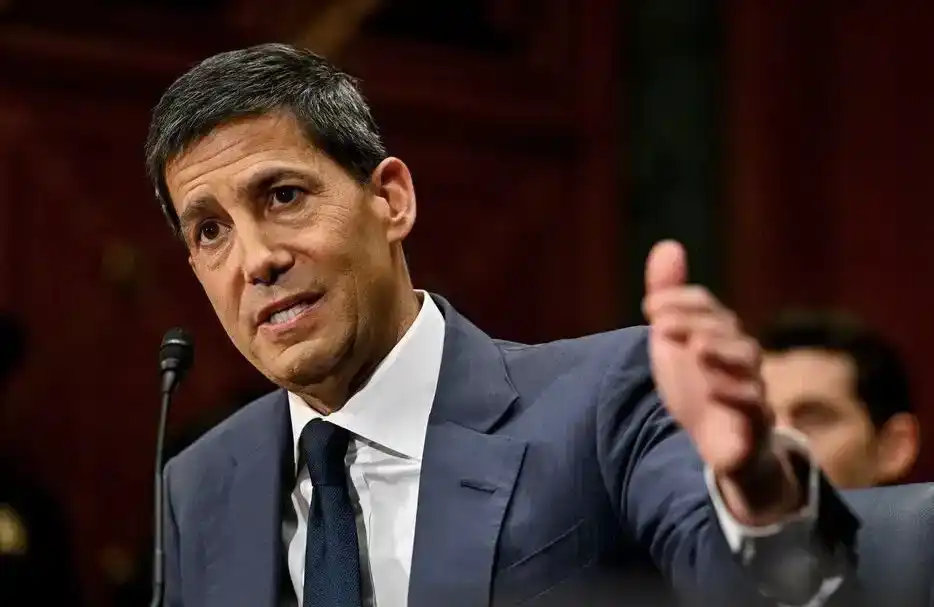
Guest: Scott Bessent, U.S. Treasury Secretary
Host: Wilfred Frost
Podcast Source: The Master Investor Podcast with Wilfred Frost
Original Title: Scott Bessent: Inside Trump’s Treasury; War Costs; & Why Bond Market is King
Broadcast Date: March 13, 2026
Key Points Summary
Scott Bessent (U.S. Treasury Secretary and one of the most successful global macro investors of his generation) came to the Treasury's Cash Room for a rare and wide-ranging conversation with Wilfred Frost, covering markets, geopolitics, and public service.
From his current position, Scott deconstructs, with an almost dimensionally reduced perspective, why 85% of the consensus is just meaningless noise, and the true excess returns (and the deep motivations behind policies) lie within the "15% of the 'world's imagination'."
He not only reviewed the "cognitive gap" behind classic campaigns like shorting the yen but also disclosed for the first time his survival philosophy as a "bond market lifeguard" amidst the 2026 geopolitical conflicts and energy fog. If you want to see through the macro truth overlooked by most and understand why he warns against letting yourself slide off the edge of your skis, the following summary of viewpoints is a cognitive threshold you must cross.
Highlights Summary
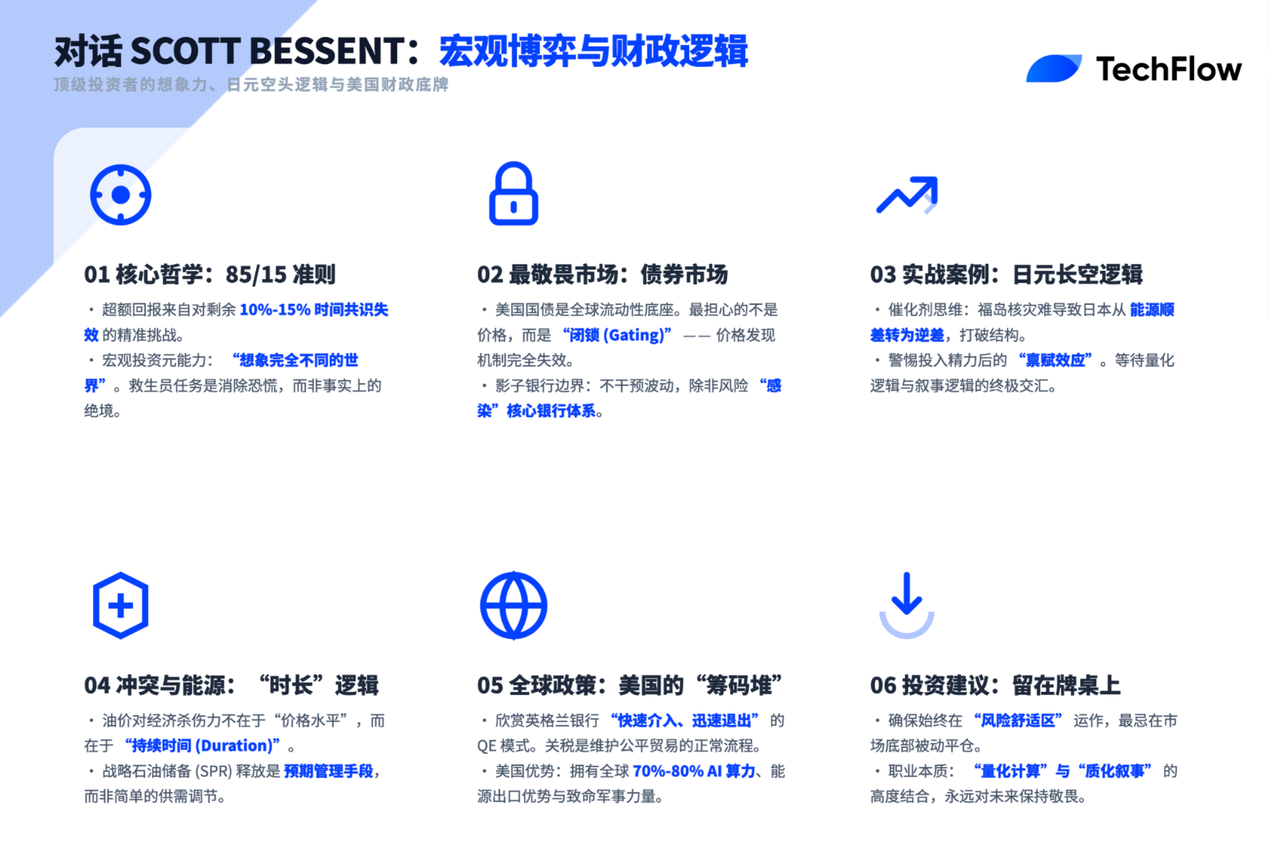
On "Consensus" and "Huge Returns"
Most of the time, the market consensus is correct. About 85% to 90% of the time, the market momentum makes sense. But what's truly important is when things start to turn, or when you can imagine a different outcome, that's the time to challenge the consensus and achieve huge returns.
On "Imagination" and Investment Logic
My father collected a vast amount of science fiction... this taught me how to imagine a completely different world. This ability is very important in finance. You need to be able to imagine a different state of the world and believe it might happen.
What's really important is whether you can imagine a different state of the world, predict when, why, and how it might happen, and also judge whether the market is underestimating this possibility, and act accordingly.
On "Shorting the Yen" and Abenomics
I didn't know (if these policies would work for the Japanese economy), but it was going to be the trade of a lifetime.
A consistent strength of my team and me has been the ability to deeply research an idea and then 'shelve' it, waiting for the right moment.
On the "Bond Market" and "Real Risk"
Ultimately, the most important thing is the bond market. The U.S. Treasury market is the deepest, most liquid, and most solid market in the world, and in this building, we are the guardians of this market.
In my 35-year career, the truly panicky moments were when the market completely shut down—when the price discovery mechanism broke, or the market faced the threat of 'gating'.
On Deep Observations of "Oil Prices"
I think the key is not the level of the oil price, but its duration. If you look back at history, even in 2008, oil prices soared to a record $147, but the question was how long that high price was maintained.
On the "Lifeguard" Metaphor
As a lifeguard, you find that drowning people sometimes try to pull you under, and this happens in investing and politics too. But ultimately your goal is always to save them, to bring them back to safe shores. In fact, many drowning people just need to realize they can stand up to be saved. Often, people in a crisis are mainly panicking.
Core Advice for Investors
Know the risks you can take, and ensure you always operate within your comfort zone. Don't let yourself 'slide off the edge of your skis'—that is, don't put yourself in a position where you are forced to sell at the bottom of the market or chase prices at the top.
You never know what will happen.
On "Shadow Banking"
My job is not to directly regulate shadow banking, but to ensure that its interaction with the regulated banking system and the insurance industry does not trigger systemic risk. Currently, while we observe some volatility, there is no sign of systemic problems in the shadow banking system. However, we will continue to monitor to prevent any potential risks to the regulated financial system.
Scott Bessent's Mental Backdrop: Lifeguard Metaphor, Sci-Fi, and World Imagination
Wilfred Frost: Welcome to the Master Investor Podcast. Today's guest is U.S. Treasury Secretary Scott Bessent. He is not only a heavyweight in global finance but also one of the greatest investors of our time. In the 90s and 2000s, he worked at Soros Fund Management for 20 years, eventually becoming Chief Investment Officer (CIO). In 2015, he founded his own hedge fund, Key Square, before moving into public service as Treasury Secretary.
Before we dive in, I'd like to quote something you said in an October 2025 interview with the Financial Times (FT). You said: "Unlike most of my predecessors, I maintain a very healthy skepticism of elite institutions and elite opinions, which I don't think they did. But I have a healthy respect for the markets." That struck me. Has this become your guiding principle since transitioning from investing to politics?
Scott Bessent:
Yes, I think this was indeed a core principle in my investing: most of the time, the market consensus is correct. About 85% to 90% of the time, the market momentum makes sense. But what's truly important is when things start to turn, or when you can imagine a different outcome, that's the time to challenge the consensus and achieve huge returns.
Some of the biggest successes in my career were often on the opposite side of elite opinion. For example, Japan was thought to never escape deflation and low growth, that the 'lost decades' would continue forever, but when I met Shinzo Abe, I thought he could be a catalyst for change.
So, I'm always looking for where the consensus might be wrong. We need to ask ourselves: Is the existing framework flawed? Are we missing something?
Wilfred Frost: Given this healthy respect for the markets, which market do you think is the most important? Ultimately, is it the bond market you respect the most?
Scott Bessent:
Yes, ultimately the most important is the bond market. The U.S. Treasury market is the deepest, most liquid, and most solid market in the world, and in this building, we are the guardians of this market.
We are committed to maintaining market transparency and also ensuring the market is operationally and settlement-wise resilient. Whether after Liberation Day last year or now facing the Iran conflict, the market's operation and settlement have been very smooth, which is always our focus.
Wilfred Frost: Have there been times when the bond market made you worried or nervous? Like last April or this January?
Scott Bessent:
As I mentioned, there might be operational challenges at those times, but I watch the bond market every day. The market always fluctuates, but we focus more on its continuity and operation. In my 35-year career, the truly panicky moments were when the market completely shut down—when the price discovery mechanism broke, or the market faced the threat of 'gating'. We focus on ensuring the market keeps running, that there are buyers and sellers, and that they can transact smoothly.
Wilfred Frost: You once thought about being a lifeguard, a computer scientist, even a journalist. Later you entered finance, starting as a bank analyst at Brown Brothers, but ultimately chose global macro investing. Did you ever consider lifeguarding as a long-term career?
Scott Bessent:
No, it wasn't a long-term career. Whether due to physical limitations or long sun exposure, a lifeguard's career is short. As a lifeguard, you find that drowning people sometimes try to pull you under, and this happens in investing and politics too. But ultimately your goal is always to save them, to bring them back to safe shores. In fact, many drowning people just need to realize they can stand up to be saved. Often, people in a crisis are mainly panicking.
Wilfred Frost: So as a macro investor, you not only need to predict what might happen in the world but also judge whether the market has mispriced these predictions. Do you think the key to investment success lies in discovering this mispricing?
Scott Bessent:
I'm often asked: 'What prepared you for your career?' My answer usually goes back to childhood. My father collected a vast amount of science fiction, probably the largest collection in South Carolina—though that's a low bar. He often read to me when I was young. I've always said that before I could find Chicago on a map, I knew how to point to Alpha Centauri.
This taught me how to imagine a completely different world. This ability is very important in finance. You need to be able to imagine a different state of the world and believe it might happen. As the legendary macro investor Bruce Kovner said: 'I have the ability to imagine a different state of the world and believe it might happen.'
So, what's really important is whether you can imagine a different state of the world, predict when, why, and how it might happen, and also judge whether the market is underestimating this possibility, and act accordingly.
Long-Term Yen Short Logic Construction and the Secretary's Identity Shift
Wilfred Frost: In the 2010s to early 2020s, the yen was very strong, the exchange rate once below 80. You held this trade for a decade, eventually witnessing the yen depreciate to around 150! Can you share what you saw in 2011 or 2012 (whenever you specifically started this trade) that others didn't?
Scott Bessent:
This goes back to timing. In psychology, there's a big bias called the 'Endowment Bias'. When you invest a lot of time and effort into something, you have a strong impulse to execute it immediately. I think a consistent strength of my team and me has been the ability to deeply research an idea and then 'shelf' it, waiting for the right moment. The yen trade was such an example.
I first went to Japan in 1990, right around the peak of the Nikkei. I stayed at the famous Okura Hotel in Tokyo for about three months; the rate was $500 a night then, and by 2011, the same room was $350. That fully illustrates Japan's long-term stagnation and malaise.
I witnessed Japan's rise, experienced its decline, and even during its long stagnation, I kept watching its development. 2011 was a key turning point. On March 11, 2011, Japan experienced the Fukushima nuclear disaster, a devastating tragedy including an earthquake, tsunami, and near meltdown threat. The Japanese government decided to shut down all nuclear reactors, which showed me a potential catalyst.
Before that, shorting the yen was very difficult because Japan had a huge current account surplus, 3% of GDP. But after shutting down the reactors, they had to start importing massive amounts of fossil fuels, causing the current account to shift from surplus to deficit.
Even so, the yen exchange rate then hovered between 78 and 83, not changing much. Until one day, a Japanese friend of mine—Mr. Funabashi, a senior Japanese journalist, thinker, and policy expert—called me and said: 'There's a man named Shinzo Abe, he was prime minister before, might come back to power. His campaign is about 'restoring Japan's economic vitality and national strength,' and he will push an economic policy agenda centered on reflation.'
This information was a revelation because I knew the Bank of Japan (BOJ) was about to have three board vacancies. This meant the new prime minister would have the chance to reshuffle the central bank leadership, including a new governor, and the BOJ had long been dominated by deflationists or low-inflationists, so this reshuffle could bring a major policy shift. From that moment, all the factors started to align.
Wilfred Frost: I remember in your November 2024 interview on the Capital Allocators Podcast, your boss George Soros asked you: 'Will Abenomics and these policies work for the Japanese economy?'
And your answer impressed me—you said: 'I don't know, but it's going to be the trade of a lifetime.' It turned out you were right, you made a lot of money on this trade. But now, you've transitioned from investor to policymaker, you need to assess 'whether the policy can truly be implemented,' not just judge 'if the market is mispriced.' Is this a big change for you?
Scott Bessent:
Regarding Japan and Abenomics, the 'three arrows' policy was indeed hugely successful. Initially, it had an immediate effect at the market level. Over time, Japan's policy execution, while as always prudent and gradual, perhaps slower than Westerners would like, made excellent efforts to reshape the economy and investment environment.
For example, they increased shareholder rights, improved return on capital, and encouraged female participation in the labor market through 'Womenomics'. You have to know Japan's labor market had long had almost no mobility, but they are actively pushing change. Overall, Japan has achieved remarkable results in reshaping its economy.
Wilfred Frost: Now as a policymaker, not an investor, do you need to ignore market pricing and focus more on whether policies can truly be implemented?
Scott Bessent:
I still get information from the market, as it can reflect important signals sometimes. But my role now is more from a policy perspective, thinking 'what can be done, what should be done, what will be done,' and predicting the actual impact of these policies on the economy and markets.
For over 30 years, my job was to gather as much information as possible about policymakers' intentions—sometimes even trying to 'eavesdrop' on their meetings. But now I sit at the policymaking table, needing to judge the feasibility of policies, how to implement them, and potential market reactions.
Whenever I give a policy-related speech—whether after Liberation Day last year or about the current Iran conflict—I try to think from a market participant's perspective. I ask myself: If I were still an investor, what kind of guidance would I want from policymakers? How can I provide a clear framework for the market, the American people, and other global policymakers without disclosing any material non-public information?
Wilfred Frost: Transitioning from an extremely successful, extremely wealthy investor, being your own boss, to now being a policymaker who has to report to the President—was this difficult for you?
Scott Bessent:
I'm no stranger to working with people, and our cabinet team is excellent, especially in this high-pressure environment, everyone has shown extremely high professionalism. Our situation room has a series of morning meetings every day, the team's performance was already outstanding, but under current circumstances, it's even better.
In a sense, I feel I've been preparing for this job for a long time. In the past, when I attended G7 or G20 meetings as an investor, I knew many central bank governors and finance ministers. Then, their task was to 'soothe' investors like me. Now, I work with them as a peer and colleague discussing policy.
Global Energy and Geopolitical Games: Scott Bessent on the Iran Conflict and U.S. Economic Strategy
Wilfred Frost: Right now WTI crude is around $94.95. At the beginning of the year it was under $60, and earlier this week it spiked to $114-$115. For the U.S. economy, at what oil price level does it start to 'hurt'?
Scott Bessent:
I think the key is not the 'level' of the oil price, but its 'duration'. If you look back at history, even in 2008, oil prices soared to a record $147, but the question was how long that high price was maintained.
President Trump's energy policy provides a big buffer for the U.S. Current U.S. liquid fuel production, including crude and natural gas, is at an all-time high. Also, natural gas prices are relatively stable, and natural gas prices directly affect energy costs and household bills.
The President's primary task is to degrade Iran's military capabilities, including its missile capabilities, manufacturing capacity, air force and navy, especially its ability to project military power beyond its borders. At the same time, the President is determined to 'cut off the head of the snake,' completely eliminating Iran's capacity as the world's primary sponsor of terrorism.
Wilfred Frost: The U.S. government and the International Energy Agency (IEA) recently announced the release of strategic petroleum reserves, the largest release in history. However, in the short term, this doesn't seem to have had much impact on the rising oil price. How do you view this?
Scott Bessent:
We need to look at this from a longer-term perspective; the market always prices in future expectations. Last Sunday night oil spiked $30, but then the Financial Times reported the IEA was considering releasing 300-400 million barrels from strategic reserves, and we saw the largest single-day price reversal in history that day.
This Monday, we had a G7 finance ministers meeting focusing on energy. Then, energy ministers met on Tuesday, and finally at the leaders' meeting on Wednesday, the President confirmed the decision to release 400 million barrels from strategic reserves, an unprecedented scale.
Wilfred Frost: Even so, oil is still about $50 higher than at the start of the year. If this persists, would sending naval escorts for tankers through the Strait of Hormuz be considered?
Scott Bessent:
Such possibilities are always in our planning. We have done scenario analysis, including plans for the U.S. Navy or an international coalition to escort tankers through the Strait of Hormuz. In fact, some tankers are already passing through, including those flying Iranian and Chinese flags. We know Iran has not mined the Strait.
Wilfred Frost: So, from now on, will the number of vessels passing through the Strait of Hormuz improve?
Scott Bessent:
Once military conditions permit, the U.S. Navy—likely under an international coalition framework—will escort vessels safely through the Strait of Hormuz. We have been doing scenario planning for this for months, even weeks, to ensure the operation's success.
Wilfred Frost: A few more questions about this war. Can you disclose the current 'daily running cost' of this war? Is it $1 billion or $10 billion per day?
Scott Bessent:
I don't directly track the daily running cost of the war because in the U.S., the Treasury and the Office of Management and Budget (OMB) are separate. That's also why it's called Treasury Secretary, not Finance Minister. But according to data released today, the cumulative cost so far is about $11 billion.
Wilfred Frost: Long term, how long do you expect this war to last? Can U.S. finances withstand this pressure?
Scott Bessent:
$11 billion is indeed a huge sum, but we have set aside sufficient fiscal buffer for this. We are not worried about funding. In fact, overseas demand for U.S. Treasuries continued to grow last year. The U.S. Treasury market performed excellently, it was the only G7 bond market where the 10-year yield fell.
Wilfred Frost: Last question: The U.S. government recently granted a 30-day waiver to Indian refiners, allowing them to buy Russian oil. Does this mean Russia benefits from this conflict? What's your view on this?
Scott Bessent:
It is unfortunate, but we must consider supply availability. We granted the 30-day waiver because these Russian tankers were already at sea, and for Indian refineries, this is a quick source of energy. From another perspective, this oil might eventually go to China. So, we hope this benefit is limited to a 'very brief period'.
New Oil Price Normal and Gold Revaluation: The Fed Needs to Find a 'Slimming' Solution in a Liquidity Trap
Wilfred Frost: Let's talk about the Fed, and the short and long-term direction of domestic policy. Starting short-term, do you think current oil price volatility will affect the pace of Fed easing?
Scott Bessent:
This requires balancing multiple factors. I think the Fed might worry that rising energy prices could push up inflation expectations; on the other hand, they also need to observe whether the impact of higher oil prices on the economy is a short-term 'impulse' or leads to a long-term 'momentum' decline. If it's just a short-term shock, the economy might bounce back quickly.
Another point worth noting: if oil was below $60 at the start of the year, and this conflict ends in a way favorable to the U.S., then medium-term, we might enter a new normal of lower oil prices.
Wilfred Frost: If the Fed has to raise rates in the future, and your debt management currently relies more on short-term bill issuance, would you consider shifting to more long-term bond issuance?
Scott Bessent:
We work closely with the Fed to coordinate debt management strategy. As for whether the Fed will restart quantitative easing (QE), that possibility seems very distant now, not even worth discussing.
Wilfred Frost: You are an Anglophile, having lived in the UK for a long time. Do you admire the way the Bank of England operates more than the Fed's model?
Scott Bessent:
The Fed and the Bank of England are very different institutions. The Fed is a larger, more decentralized organization, with multiple regional Feds and board members, and only some have voting rights. In contrast, the Bank of England's structure is more centralized, divided into the Monetary Policy Committee and the Executive Committee, with only the Governor participating in both.
Wilfred Frost: The Bank of England model has several features, like an inflation target with a +/-1% band, and unconventional measures like QE requiring Chancellor approval. Do you think these features are worth the Fed considering?
Scott Bessent:
I think the inflation target setting is a practice worth referencing, but I don't think the Fed needs to fully adopt the Bank of England model. As for QE, I do think the Bank of England's operations are more in line with the nature of unconventional measures. The Bank of England briefly intervened in the market early in COVID to stabilize UK gilt functioning, then quickly exited. The Fed, however, kept buying assets for the next four years, which might be one reason for the 'Great Inflation' of 2022 and 2023.
Wilfred Frost: The U.S. holds a large gold reserve, but its book value is still calculated at an outdated $42/oz, while the market price is over $5,000/oz. If the gold were revalued and sterilized, could it provide an opportunity to shrink the Fed's balance sheet while avoiding a liquidity crisis?
Scott Bessent:
I think these are two completely separate things. If the Fed wants to adjust its balance sheet, they need to signal it well in advance and have a detailed plan. We also need to re-examine the impact of bank regulation since the Global Financial Crisis (GFC) on balance sheets, especially regarding the interbank market and the reserve system.
Currently, the Fed operates a high-reserve mode, but in the future might switch to a 'leaner' mode where banks provide reserves to each other. This transition requires time and thoughtful planning.
Wilfred Frost: You had the opportunity to become Fed Chair but chose to remain Treasury Secretary. Why did you think Treasury Secretary was the more suitable role for you?
Scott Bessent:
I enjoy interacting with cabinet colleagues, and the Treasury Secretary role allows me to directly participate in national policy making and execution.
As Treasury Secretary, my responsibilities include maintaining the dollar's global dominance, managing the national debt, and running the U.S. sanctions system. These tasks concern not just the economy but also national security. I believe these jobs are particularly important in this special historical period.
Wilfred Frost: The private credit area has attracted much attention lately. If problems arise there, should the investors who profited in the market bear the consequences themselves, rather than the government stepping in?
Scott Bessent:
That's precisely why we call it the 'shadow banking system.' It doesn't belong to the traditional regulated banking system.
My job is not to directly regulate shadow banking, but to ensure that its interaction with the regulated banking system and the insurance industry does not trigger systemic risk. Currently, while we observe some volatility, there is no sign of systemic problems in the shadow banking system. However, we will continue to monitor to prevent any potential risks to the regulated financial system.
Geopolitical Coordination Under Tariff Pressure and New Consensus Under the 'Iran Threat'
Wilfred Frost: Having lived in the UK for years, you understand the 'special relationship' deeply. Recently, President Trump expressed dissatisfaction with the UK, saying the Prime Minister is no Winston Churchill. How do you view this assessment?
Scott Bessent:
President Trump expressed concern about some delays, particularly regarding the use of Diego Garcia airbase. Because U.S. B2 bombers need increased flight time and aerial refueling, this无形中增加了风险 (intangibly increased the risk). The President, as Commander-in-Chief, always prioritizes protecting military lives, so he is very sensitive to anything that might increase risk.
Wilfred Frost: So do you think the UK is also putting American lives at risk?
Scott Bessent:
We have a very deep historical relationship with the UK, and I believe we can overcome these differences and get back on track. But frankly, the Prime Minister was indeed late in reacting to committing resources to the region, but I believe our long-term relationship with the UK can withstand short-term fluctuations, and we will eventually get back on track.
Wilfred Frost: More broadly, over the past year and a half, especially with the recent announcement of new tariff investigations into multiple countries, including EU members, Switzerland, Singapore, South Korea, and Norway—allies—could this affect allied support for the U.S.? Especially at this critical time with the war ongoing.
Scott Bessent:
If returning to normal tariff levels would make some countries 'take the other side,' then they weren't truly our allies to begin with. We currently have a global 10% tariff level, and countries that have signed trade agreements with us want to maintain the status quo.
To be clear, these tariff investigations are part of the normal business process. The Supreme Court ruled the President cannot use the International Emergency Economic Powers Act (IEEPA) to levy tariffs, but we can rebuild the tariff system using Section 301 or Section 122 of the Trade Act. These measures are to ensure a fair trade environment, not target allies.
Wilfred Frost: Are you concerned that the U.S. policy style—for example, acting before allies fully agree—could be interpreted as 'U.S. isolation,' not 'America First'?
Scott Bessent:
I don't think so. In the recent G7 leaders call, all leaders expressed support for U.S. actions in the Middle East and congratulated us on successfully degrading the Iranian threat.
Furthermore, on the Strait of Hormuz issue, multiple countries have expressed willingness to provide mine-sweeper support, participating in an international coalition to ensure safe maritime passage. No country wants the Iranian regime to continue in its current form. Especially Arab states in the Gulf region were shocked by Iran's attacks, making them aware that if Iran's military capabilities grow stronger, the situation will be more dangerous.
Wilfred Frost: You mentioned that investing requires 'earning the right to take risk.' From this perspective, do you think the U.S.'s 'stack of chips' on the global stage is smaller today than in the past?
Scott Bessent:
On the contrary, I think the U.S. is stronger today than in the past. We have achieved dominance in energy, transforming from an energy importer to an exporter; we continue to lead globally in technology, especially in AI, where the U.S. currently holds 70% to 80% of global computing power; our military strength is at an unprecedented height, more powerful and lethal than ever.
Economically, the U.S. is growing much faster than Europe. For example, the EU celebrates 0.3% GDP growth, while we expect, once this conflict ends, the U.S. will achieve 3% growth, almost 10 times that of Europe.
Wilfred Frost: But U.S. debt levels are also rising, and oil reserves are declining. Could this become a hidden worry?
Scott Bessent:
The debt-to-GDP ratio has indeed risen globally, a legacy of the Global Financial Crisis and COVID. But in terms of relative strength, the U.S. still performs better than other countries in debt management and economic growth.
Within the Risk Comfort Zone, Waiting for the Convergence of Quant and Narrative
Wilfred Frost: Final question, can you give our listeners one core piece of investment advice and one career advice?
Scott Bessent:
For career advice, I want to tell everyone, you can never predict what will happen. When I graduated from Yale in 1980, I originally wanted to be a journalist or computer scientist, but ultimately found that investing combines the 'quant' part of calculation and the 'qual' part of narrative, which fascinated me deeply.
As for investing, my advice is: know the risks you can take, and ensure you always operate within your comfort zone. Don't let yourself 'slide off the edge of your skis'—that is, don't put yourself in a position where you are forced to sell at the bottom of the market or chase prices at the top.
Wilfred Frost: Do you think U.S. actions in the Middle East have 'slid off the edge of the skis'?
Scott Bessent:
Absolutely not. Our actions are progressing faster than planned; Iran's military capabilities are being degraded. As for whether Iran's Supreme Leader has lost capacity or faces internal threats, that's uncertain now.
Wilfred Frost: Do you think there could be a change in the Iranian regime in the coming days?
Scott Bessent:
Our goals are clear: degrade Iran's military capabilities, prevent it from making atomic weapons, and limit its external military projection ability. But once action starts, the situation often develops beyond expectations, creating its own dynamics.
Twitter:https://twitter.com/BitpushNewsCN
Bitpush TG Discussion Group:https://t.me/BitPushCommunity
Bitpush TG Subscription: https://t.me/bitpush