The Boundaries and Channels of Finance: The New Pricing Logic of Global Markets

比推Publié le 2026-03-11Dernière mise à jour le 2026-03-11

Résumé

The article "Financial Boundaries and Channels: The New Pricing Logic of Global Markets" explores the evolving relationship between traditional finance and decentralized finance (DeFi), focusing on the growing interest of asset management giants like BlackRock and Apollo in on-chain vaults and RWA (Real World Assets). It argues that while DeFi has adopted USDT/USDC as de facto standards due to their scale, this reliance on U.S. Treasury-backed stablecoins means DeFi is subject to external monetary policies without reciprocal influence. The piece highlights the absence of a native DeFi risk-free rate and examines past attempts, like algorithmic stablecoins, which failed to challenge this dominance. The author suggests that vaults and curators may become central to a new financial architecture, facilitating global capital flow and efficiency. However, these structures currently lack mechanisms for asset price inflation and face risks from code vulnerabilities and governance issues. The future may lie in broker-like channels that enhance capital fluidity beyond centralized exchanges, potentially leading to a more integrated and efficient global market system. Ultimately, the article concludes that while DeFi infrastructure matures, the real innovation opportunity resides in creating channels that enable seamless, scalable capital interaction, moving beyond traditional token economics.

Written by: Zuo Ye

Original Title: The Limits of Finance, The Channel Value of Global Markets


On-Chain Asset Management Vaults and Channels

No matter how many lies are woven, the truth will still illuminate the outline of light.

Asset management giants' interest in on-chain Vaults is growing daily, and the mainstreaming of the DeFi dream seems to be becoming a reality.

This is the best of times: BlackRock buys $UNI tokens, Apollo commits to buying hundreds of millions of dollars worth of $Morpho tokens, and Wall Street is collectively bullish on the future of DeFi.

This is the worst of times: BlackRock, Blackstone, and Blue Owl face concentrated redemption waves, and the founder of Aave warns that Wall Street is using RWA as a liquidity exit channel.

Crises always contain rare bargain prices. Faced with future asset price inflation, emerging forces are excited, completely disregarding the iceberg ahead.

No matter what it's called—DeFi/RWA/Vault—on-chain finance must eat the sugar coating and fire the cannonball back. Only by being good at breaking an old world can a new Eden possibly be built.

This sweet apple can even be made concrete—the risk-free rate.

The Dream of a Risk-Free Rate

Establish a risk-free rate market based on on-chain asset-backed stablecoins to have bargaining power against traditional asset management giants.

Let's start with a question to anchor our discussion: Why has DeFi not yet achieved a risk-free rate?

Or, reframe it as the linear narrative of how "U.S. Treasuries" became the benchmark rate for DeFi.
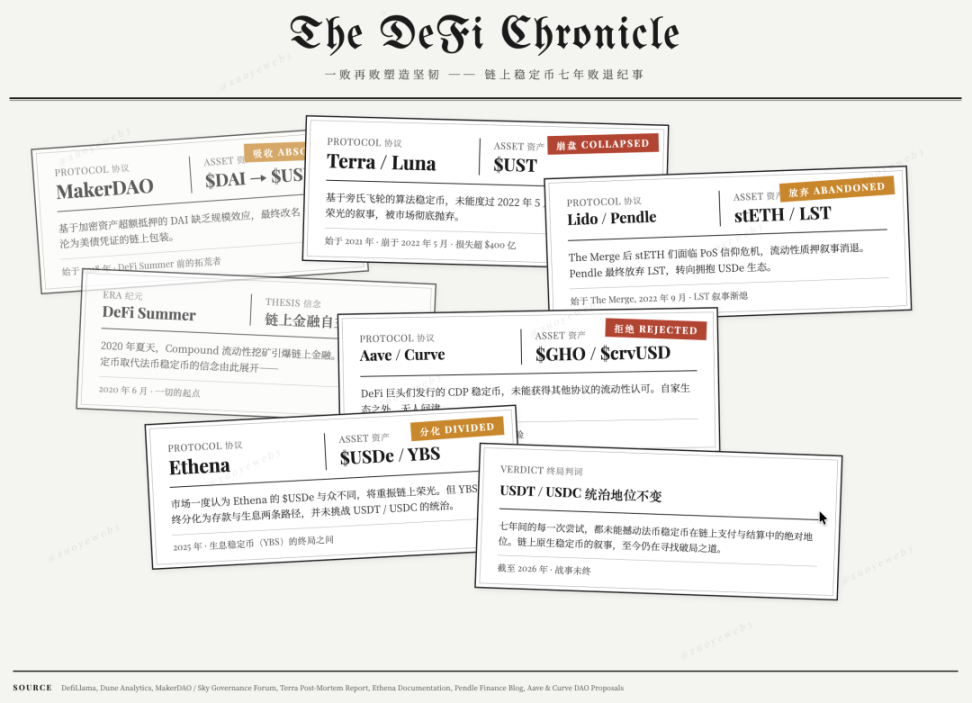
Image Caption: Stablecoin Chronicle

Image Source: @zuoyeweb3

Starting from the DeFi Summer of 2020, repeated defeats have forged resilience:

  • Starting in 2018, DAI based on crypto assets lacked scale, $USDS ultimately became a U.S. Treasury certificate

  • Starting in 2021, the ponzi-based $UST did not survive the 2022 bank run crisis; the story of rebuilding algorithmic stablecoin glory was abandoned

  • In 2022, stETH and others faced a PoS faith crisis post-The Merge; Pendle ultimately abandoned LST for USDe

  • In 2023/24, CDP stablecoins issued by DeFi giants like Aave/Curve were not recognized by other protocols

  • In 2025, the market once believed Ethena's $USDe was different, reviving on-chain glory, but yield-bearing stablecoins ultimately split into deposit and yield-bearing activities, failing to challenge the dominance of USDT/USDC in their respective domains.

The facts are very clear: it's not that USDT swallowed user profits, but that DeFi chose the scale effect of USDT/USDC.

Exchanging the Treasury profits generated by $300 billion for the entire market's trading foundation is not a bad deal for DeFi and the crypto market.

But at what cost?

The cost is not the evil claimed by yield-bearing stablecoin challengers that Tether takes profits, or the selfishness accused by Coinbase and Trump Jr. that banks prohibit interest-bearing accounts.

The bitter pill DeFi swallowed is that the U.S. Treasury rate, as the risk-free rate, is transmitted on-chain via stablecoins, but the U.S. Treasury is an asset of the U.S. government and its actions do not care about on-chain sentiments.

This is also the fundamental reason for the bankruptcy of tokenomics: UNI relies on A16Z, A16Z relies on USD financing, the USD is the embodiment of U.S. Treasuries, so UNI is just the fourth derivative relying on U.S. Treasuries. Why not just buy Treasuries directly, with no middleman taking a cut?

U.S. Treasuries are the de facto DeFi benchmark, but DeFi can only passively endure it, unable to interact with it bidirectionally. This is the root of all happiness or pain.
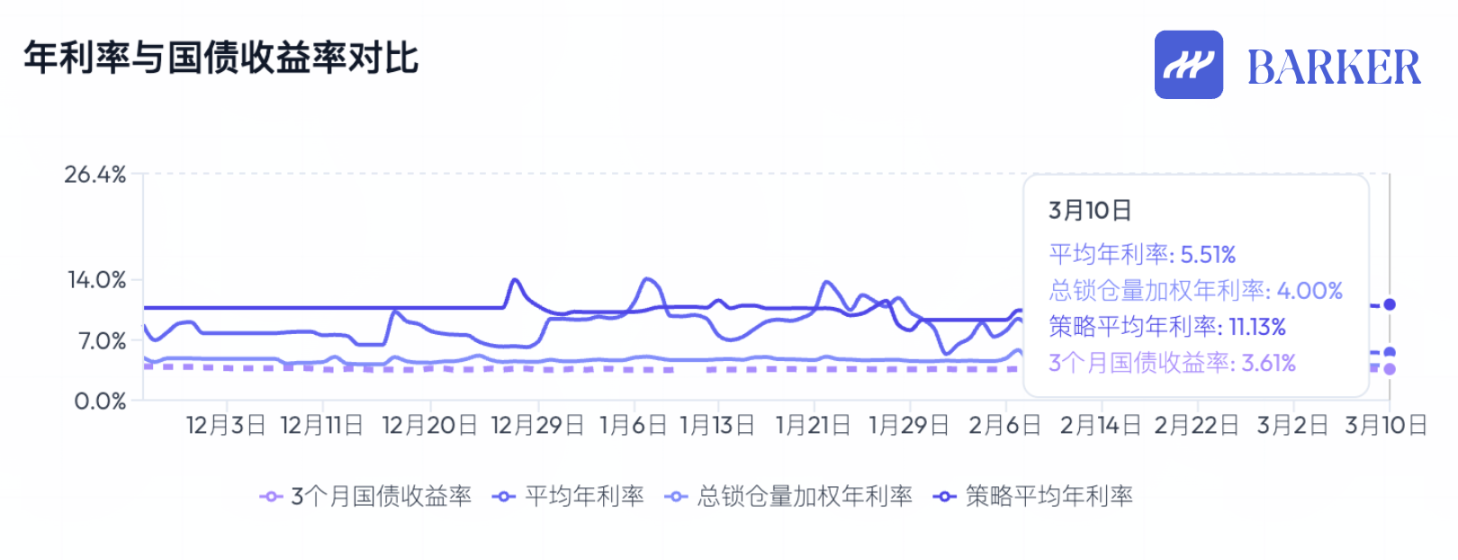
Image Caption: Comparison of On-Chain Stablecoin Yield APY and U.S. Treasuries

Image Source: @BarkerMoneyX

The salvation of DeFi never stops. Although tokenomics are bankrupt and DAO governance structures have collapsed, the overall direction of DeFi remains clear:

  1. Fixed-rate investment and financing,公认 risk grading system, unsecured credit lending –> The main themes of the next stage,蕴含某种形式的 mass-market products;

  2. The expansion period for public chains, exchanges, and DeFi protocols is over; new application forms are evolving into Vaults. It's not yet certain that Vaults are the form of mass-market products, but this is the starting point of the new stage.

Note here that public chains and exchanges are no longer the central links for value capture, but this does not mean their time is zero. Their period of asset price inflation is over, and only linear, steady growth remains.

This can also connect to the progressive relationship between UNI and U.S. Treasuries. Aave/Morpho are closer to asset management itself; their businesses don't have much narrative space, but are indispensable for the industry.

The real star products will definitely be Vaults used by the masses, based on public chains and DeFi protocols, utilizing分散 RWA assets, and triggering asset price inflation mechanisms.

For mass usage, Curators choose to ally with exchanges: Morpho enters Coinbase via Stakehouse, Aave expands to C-end users via Metamask and other U-cards.

Based on RWA assets, Curators partner with custodians like Galaxy to constantly maneuver between crypto and real-world assets, such as Grove buying Galaxy's CLO bonds.

But what's missing is the Vault that triggers the price inflation mechanism. Even before this wave of large-scale asset management moving on-chain, BlackRock's BUILD token was already live, and Circle's USYC also supports yield, but neither could replicate their own success.

It's not important that Vaults lack their own tokens. Asset price inflation is a mechanism. U.S. stocks, real estate, bonds, tulips, graphics cards, and Mac Minis all have their own price cycles. Current Vaults only have yield-bearing black boxes but始终 fail to solve two problems:

  1. Where does the high yield actually come from?

  2. How is high risk actually handled?

Towards a New Financial System

The form of channels is evolving; Vaults are not the endpoint.

The crypto industry evolves extremely fast. Before this year, we never dared to imagine that the global financial system would truly move on-chain, but today this is an undeniable ongoing process.

It's not yet time for a victory banquet. RWA can only serve as a funding source, Vaults are still boring deposit products, various Curators haven't demonstrated brand effects, and white-label Vaults like Veda are highly similar to SaaS, with the operator Curator only earning management fees.

This has no imagination for price inflation. If traditional asset management, with a scale of $2 trillion, endures cyclical煎熬, it's hard to imagine Vaults can withstand it.
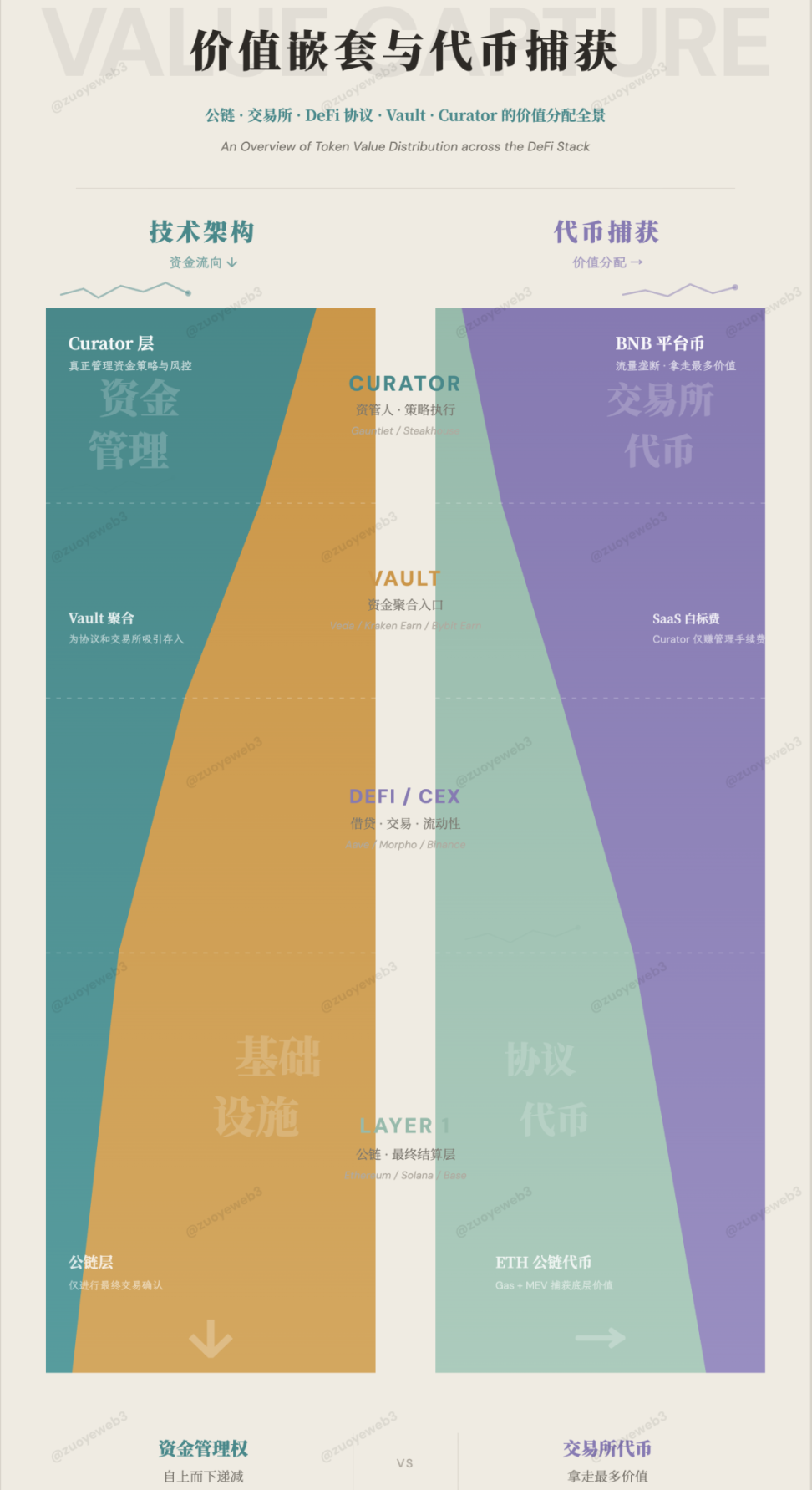
Image Caption: Fund Flows and Value Distribution

Image Source: @zuoyeweb3

Asset management moving on-chain is not driven by短暂 sentiment. In a sense, it's like the banking industry's IOE—you can't go back to the paper era. Even Spark has begun unifying the calculation of CEX/DEX position adjustment margins. DeFi is becoming the next step for TradFi.

Whether Vaults, after absorbing sufficient funds, will trigger the establishment of a risk-free rate is the biggest博弈 point of this cycle.

During the previous DeFi Summer, TVL was the decisive metric. The amount of资金 mapped to the get-rich coefficient of tokens, creating mining that continued into airdrop farming, studios, and Binance Alpha. The core logic was "projects need more funds to support token growth."

But with Vaults, for the first time, there is a huge demand for deposits but an inability to support their own tokens. Even if Morpho captures more market share from Aave, it cannot trigger a token surge.

Extending this, Hyperliquid compared to Binance, Lighter compared to Hyperliquid—their market sizes and token prices show a huge inversion. This is a great change unprecedented in DeFi.

On one hand, old infrastructure continues to吸血. For example, after the listing effect disappeared, $BNB should have declined, but CEXs still have a larger user base than the entire on-chain + DeFi. A very ironic fact: exchanges have retail users; DeFi protocols like Aave and Morpho have completely become the domain of a few professionals.

In this context, the high risk of Vault&Curator comes from code and structure:

  • Curve's immutable contract programming language can have problems; the xUSD team self-issued tokens

  • Aave ended the表面 harmony between the DAO and the development team; Re7 severely damaged on-chain asset management credibility

In this context, where does the high yield of Vault&Curator come from?

I know it's not regulatory arbitrage, HLP fees, or token incentives, but many still cling to these three, believing traditional finance's compliance creates too-big-to-fail credibility.

They completely forget that tokenomics are already bankrupt, while Vault deposits keep growing. Sky is already deeply integrated into the Morpho system, and the future of Aave V4 is also institutionalization and modularization.

Moreover, this article has always emphasized that the scale of Vault funds has not triggered some price inflation mechanism. This is the structural dilemma of Vaults.

The yield of Vaults essentially comes from the trading efficiency of global markets. If CEXs don't provide a certain Vault, then configure it on-chain. The personified Curator happens to be suitable for dealing with all sorts of people.

Even in TradFi's global markets, like U.S. stocks, one faces lengthy account opening, trading times, and process limitations. Can we really say that the gradual move towards全天候 trading for U.S. stocks and DTCC going on-chain is also for arbitrage?

The final question: What mechanism can actually trigger asset price inflation, allowing the funds沉淀 in Vaults to create a legendary price-to-dream ratio?

In other words, what is missing between Vaults and asset price inflation?

Channels are missing. Channels for funds to couple with each other. The personification of Curators hinders the programmability of DeFi Legos.

Currently, CEXs serve as a placeholder, still the fastest place for funds to intertwine.

Referencing the evolution of Perp DEXs, they are capturing market share from CEX futures. RWA funding sources are also抢夺 CEX market share.

CEXs only have存量. They themselves cannot solve user acquisition problems, let alone help Vaults expand to hundreds of millions of users. Vaults start by white-labeling, but in the future, they must build their own超级 factories.

I speculate the channel will be some form of Broker product.

Under高度 social division of labor, Super Apps like exchanges that integrate deposit/withdrawal, trading, custody, and清算 will gradually separate into different businesses. Binance's compliance framework in Abu Dhabi's ADGM is already divided into three parts.

This will fundamentally facilitate the professionalism of fund handling, utilize the unified ledger system of blockchain, and require the居中 coordination of Vault&Curator.

Referencing Neobrokers like Robinhood/Trade Republic, they attract年轻化, retail users to participate in professional trading, then build asset management, wealth management, and other business forms. The model of stablecoins at the front end and Curators managing Vaults is more efficient.

In summary, Binance monopolizes fund flow, BNB gets the strongest empowerment. Next, Brokers handle fund interaction. Some asset form, or even纯粹 business flow, could be highly profitable. After all, Robinhood is just a little disguise for a profitable market maker.

Conclusion

Compared to code and trading, regulation and tokens appear more stable.

Private credit and the RWA cycle have halted.抢先 issuing the 402 document feels prophetic. DeFi can serve as a liquidity exit channel, but it lacks the asset price inflation mechanism.

Asset Management ≈ Aave/Morpho will slowly, like public chains, end their historical mission. They will exist long-term but only with scale growth and stable token prices;

Vault&Curator ≈ Star fund managers are quickly acquiring customers and monopolizing markets. Giantization already shows preliminary signs. Whether they can continuously capture value is highly doubtful;

Channel ≈ CEX (temporary)反而 has the most innovation space. Facilitating the freedom of funds will always receive the highest reward.

A highly efficient global market is operating on a next-generation blockchain that doesn't need traditional tokens. This is the proposition of the next era, and everyone must provide an answer.


Twitter:https://twitter.com/BitpushNewsCN

Bitpush TG Discussion Group:https://t.me/BitPushCommunity

Bitpush TG Subscription: https://t.me/bitpush

Original Link:https://www.bitpush.news/articles/7618714

Questions liées

QWhy does the article claim that DeFi has no risk-free rate, and what is the role of US Treasury bonds in this context?

AThe article states that DeFi lacks a true risk-free rate because it relies on USDT and USDC, which are backed by US Treasury bonds. These stablecoins transmit the US Treasury yield on-chain, but DeFi cannot interact with or influence US monetary policy, making it a passive recipient of this benchmark rate rather than an active participant in setting it.

QWhat is the significance of Vaults in the current evolution of DeFi and traditional finance integration?

AVaults represent a new application layer in DeFi, acting as on-chain asset management products that attract institutional and retail capital. They are seen as the starting point for mass adoption and value capture, but they currently lack a mechanism for asset price inflation and face challenges in generating sustainable yields and managing risks.

QHow does the article describe the relationship between CeFi (like CEXs) and DeFi in the context of global financial markets?

AThe article suggests that centralized exchanges (CEXs) currently serve as temporary channels for capital flow and liquidity, but their role may evolve as DeFi infrastructure matures. It predicts that super-apps like CEXs will eventually unbundle into specialized services (e.g., brokerage, custody), with DeFi Vaults and Curators facilitating more efficient global market operations.

QWhat are the main challenges facing Vaults and Curators in achieving sustainable growth and value capture?

AVaults and Curators struggle with two core issues: the source of high yields (beyond temporary incentives like token rewards or regulatory arbitrage) and the management of high risks (including smart contract vulnerabilities and governance failures). They also lack a price inflation mechanism to drive token value, unlike earlier DeFi protocols that benefited from TVL-driven speculation.

QWhat does the article propose as the potential solution to DeFi's structural limitations in establishing a independent financial system?

AThe article suggests that the future lies in creating efficient 'channels' or brokerage-like products that enhance capital fluidity and interoperability between TradFi and DeFi. This would involve unbundling CEX functions into specialized services, leveraging blockchain's unified ledger, and enabling Vaults to act as intermediaries for global asset allocation, ultimately fostering a new price discovery mechanism.

Lectures associées

Trading

Spot
Futures

Articles tendance

Qu'est ce que G$

Comprendre GoodDollar ($G$) : Un plan pour un revenu de base universel décentralisé Introduction Dans le paysage en constante évolution des cryptomonnaies et de la technologie blockchain, les initiatives qui cherchent à résoudre des problèmes sociaux pressants ont suscité une attention accrue. L'un de ces projets est GoodDollar ($G$), une solution de revenu de base universel (RBU) basée sur le Web3. GoodDollar s'efforce de lutter contre l'inégalité et de réduire l'écart de richesse en créant et distribuant des ressources économiques accessibles aux plus nécessiteux. Grâce à son utilisation innovante de la finance décentralisée (DeFi), GoodDollar présente un modèle unique qui pourrait potentiellement transformer la manière dont l'assistance financière est perçue et délivrée à l'échelle mondiale. Qu'est-ce que GoodDollar ($G$) ? GoodDollar est un protocole de cryptomonnaie qui facilite l'émission et la distribution de jetons numériques, appelés $G$, à ses utilisateurs enregistrés sur une base quotidienne. Ces jetons fonctionnent comme une forme de revenu de base universel, promouvant l'autonomisation financière pour les individus de divers horizons, en particulier ceux traditionnellement exclus du système financier. Fonctionnant sur la blockchain, GoodDollar utilise plusieurs chaînes, notamment Ethereum, Celo et Fuse, garantissant un large accès et une bonne utilisabilité. L'objectif fondamental de GoodDollar est de rendre la cryptomonnaie accessible et bénéfique pour tous, indépendamment de leur point de départ économique. Le créateur de GoodDollar ($G$) Les détails concernant le créateur de GoodDollar demeurent quelque peu obscurs. Cependant, il est notable de souligner que le projet bénéficie d'un solide soutien de la part d'eToro, une plateforme d'investissement largement reconnue qui a fourni le financement initial et le soutien fondamental pour le développement de GoodDollar. La vision derrière le projet n'est pas uniquement motivée par le profit, mais se tourne fortement vers l'entrepreneuriat social, visant un changement systémique dans l'accessibilité économique. Les investisseurs de GoodDollar ($G$) GoodDollar bénéficie du soutien financier et opérationnel d'eToro. Ce partenariat a joué un rôle significatif dans le lancement du protocole et ses développements ultérieurs. Bien qu'eToro ait été instrumental dans l'établissement des bases du projet, GoodDollar envisage de transitionner vers un modèle financé par sa communauté sur le long terme. Ce passage au financement communautaire est en ligne avec l'engagement de GoodDollar envers la décentralisation, permettant à ses utilisateurs d'avoir une part directe dans l'avenir du projet. Comment fonctionne GoodDollar ($G$) ? Le cadre opérationnel de GoodDollar repose fortement sur les principes de DeFi pour générer des intérêts à partir des cryptomonnaies mises en jeu. Ce mécanisme permet au projet de frapper et de distribuer des jetons $G$ comme un revenu de base numérique pour les utilisateurs du monde entier. Plusieurs caractéristiques clés contribuent à l'unicité et à l'innovation de GoodDollar : Revenu de base universel (RBU) : Chaque jour, les utilisateurs enregistrés reçoivent des jetons gratuits, établissant un flux de revenu automatique destiné à alléger les pressions financières. Modèle économique durable : La tokenomics du projet vise à équilibrer l'offre et la demande de jetons $G$, garantissant que la valeur reste stable au fil du temps. Jetons adossés à des réserves : Chaque jeton $G$ est soutenu par une réserve de cryptomonnaies, lui conférant une valeur inhérente et une fiabilité, un aspect crucial pour maintenir la confiance des utilisateurs. Gouvernance décentralisée : GoodDollar adopte une approche démocratique de la prise de décision grâce à une gouvernance décentralisée alimentée par les jetons. Cela permet aux membres de la communauté de participer activement à l'orientation du projet, le rendant véritablement dirigé par la communauté. Accessibilité mondiale : GoodDollar a établi une empreinte communautaire considérable, comptant plus de 640 000 membres dans 181 pays. Un tel rayonnement est essentiel pour faciliter le RBU à l'échelle mondiale. Chronologie de GoodDollar ($G$) L'évolution de GoodDollar est marquée par plusieurs jalons significatifs au cours de son histoire : 2019 : Le lancement du portefeuille GoodDollar a marqué le premier pas vers la mise en œuvre de sa vision de délivrance du RBU par le biais de la cryptomonnaie. 2020 : Après le succès du portefeuille, le protocole GoodDollar a été officiellement lancé. Cela a marqué une phase cruciale dans sa mission de fournir un revenu distribué quotidiennement. 2021 : Le projet a progressé avec l'introduction de son Organisation Autonome Décentralisée (DAO), favorisant un plus grand niveau d'implication et de gouvernance communautaire. 2022 : GoodDollar a dévoilé sa version 2 (V2) axée sur la DeFi, s'efforçant d'améliorer l'engagement des utilisateurs et l'efficacité opérationnelle. La même année a également vu la transition vers une structure de gouvernance décentralisée via GoodDAO. 2022 : Une nouvelle feuille de route a été conceptualisée, axée sur des initiatives telles qu'un programme de subventions conçu pour promouvoir les projets entrepreneuriaux liés à $G$ et un marché GoodDollar amélioré. Caractéristiques clés de GoodDollar ($G$) Le projet GoodDollar introduit de nombreuses caractéristiques critiques visant à redéfinir le paysage du revenu de base : Revenu de base universel : La délivrance quotidienne de jetons gratuits à ses utilisateurs souligne fondamentalement sa mission d'éliminer la précarité économique. Opération multi-chaînes : Le fait de tirer parti de plusieurs réseaux blockchain améliore l'accessibilité et la scalabilité, garantissant une plus large participation. Engagement avec la finance décentralisée : L'utilisation de la DeFi permet un financement durable du modèle RBU, renforçant sa viabilité en tant que solution économique. Engagement communautaire et gouvernance : GoodDollar envisage un modèle où la communauté influence les opérations grâce à une participation démocratique, favorisant la transparence et la responsabilité. Communauté mondiale : Avec une communauté mondiale diversifiée, le projet est en mesure de mettre en œuvre des solutions de RBU adaptées à divers contextes culturels et économiques. Conclusion GoodDollar représente un saut transformationnel vers l'incorporation des principes de revenu de base universel à travers le prisme innovant de la technologie blockchain. En exploitant la finance décentralisée, le projet ne fournit pas seulement une solution à l'inégalité financière, mais engage également activement les utilisateurs dans sa gouvernance et ses opérations. Avec une communauté en croissance et une feuille de route évolutive, GoodDollar se positionne comme un acteur significatif à l'intersection des cryptomonnaies et du bien social, ouvrant la voie à un avenir financier plus équitable. Alors qu'il continue d'évoluer, le parcours de GoodDollar pourrait finalement inspirer d'autres initiatives à envisager des modèles similaires, favorisant ainsi la cause de l'autonomisation économique pour tous.

94 vues totalesPublié le 2024.04.05Mis à jour le 2024.12.03

Qu'est ce que G$

Comment acheter G

Bienvenue sur HTX.com ! Nous vous permettons d'acheter Gravity (G) de manière simple et pratique. Suivez notre guide étape par étape pour commencer votre parcours crypto.Étape 1 : Création de votre compte HTXUtilisez votre adresse e-mail ou votre numéro de téléphone pour ouvrir un compte sur HTX gratuitement. L'inscription se fait en toute simplicité et débloque toutes les fonctionnalités.Créer mon compteÉtape 2 : Choix du mode de paiement (rubrique Acheter des cryptosCarte de crédit/débit : utilisez votre carte Visa ou Mastercard pour acheter instantanément Gravity (G).Solde :utilisez les fonds du solde de votre compte HTX pour trader en toute simplicité.Prestataire tiers :pour accroître la commodité d'utilisation, nous avons ajouté des modes de paiement populaires tels que Google Pay et Apple Pay.P2P :tradez directement avec d'autres utilisateurs sur HTX.OTC (de gré à gré) : nous offrons des services personnalisés et des taux de change compétitifs aux traders.Étape 3 : stockage de vos Gravity (G)Après avoir acheté vos Gravity (G), stockez-les sur votre compte HTX. Vous pouvez également les envoyer ailleurs via un transfert sur la blockchain ou les utiliser pour trader d'autres cryptos.Étape 4 : tradez des Gravity (G)Tradez facilement Gravity (G) sur le marché Spot de HTX. Il vous suffit d'accéder à votre compte, de sélectionner la paire de trading, d'exécuter vos trades et de les suivre en temps réel. Nous offrons une expérience conviviale aux débutants comme aux traders chevronnés.

547 vues totalesPublié le 2024.12.10Mis à jour le 2025.03.21

Comment acheter G

Qu'est ce que @G

Graphite Network, $@G : Relier TradFi et Web3 Introduction à Graphite Network, $@G Dans le monde dynamique des cryptomonnaies et des projets web3, Graphite Network émerge comme un phare d'innovation. Avec son jeton natif, $@G, cette blockchain de couche 1, Proof-of-Authority (PoA), est conçue pour combler le fossé entre la finance traditionnelle (TradFi) et l'écosystème Web3 en pleine évolution. Alors que les monnaies numériques gagnent en traction, Graphite Network s'efforce d'offrir une plateforme blockchain qui privilégie la sécurité, la conformité et la rapidité, se présentant comme un facilitateur de confiance et de responsabilité. Qu'est-ce que Graphite Network, $@G ? Graphite Network n'est pas simplement un autre projet blockchain ; il vise à redéfinir la façon dont la décentralisation, la sécurité et la responsabilité des utilisateurs sont perçues dans le domaine de la finance numérique. Le projet se vante d'une série de caractéristiques distinctives : Blockchain Basée sur la Réputation : Au cœur de Graphite Network se trouve une politique d'un utilisateur, un compte, renforcée par des mécanismes intégrés de vérification et de notation Know Your Customer (KYC). Ce design assure un équilibre entre la confidentialité des utilisateurs et la transparence, un aspect critique des opérations financières dans le monde numérique d'aujourd'hui. Revenus des Nœuds de Point d'Entrée : Le réseau incite les utilisateurs à mettre en place des nœuds de point d'entrée, permettant aux opérateurs de gagner des récompenses provenant des transactions du réseau. Ce modèle de génération de revenus non seulement stimule l'engagement des utilisateurs mais renforce également la santé et la décentralisation du réseau. Compatibilité EVM : Avec une machine virtuelle (VM) compatible avec Ethereum, Graphite Network permet une intégration transparente des applications décentralisées (dApps) et des contrats intelligents Solidity existants, invitant ainsi les développeurs à tirer parti de ses capacités sans modifications étendues. Intégration KYC : À une époque où la conformité est primordiale, le cadre KYC intégré avec plusieurs niveaux de vérification améliore le contrôle des opérations financières sans participation obligatoire, établissant un précédent pour l'autonomie des utilisateurs. Qui est le Créateur de Graphite Network, $@G ? Graphite Network est né des efforts de la Graphite Foundation, une organisation à but non lucratif dédiée au développement, à la maintenance et à l'évolution de Graphite Network. L'engagement de la fondation souligne la vision du projet de créer un environnement blockchain sécurisé et durable axé sur un véritable engagement des utilisateurs et la conformité. Qui sont les Investisseurs de Graphite Network, $@G ? Actuellement, il existe peu d'informations disponibles sur les investisseurs spécifiques soutenant l'initiative Graphite Network. L'organisation fondatrice, la Graphite Foundation, fonctionne de manière indépendante pour favoriser la croissance du projet tout en recherchant des partenariats qui résonnent avec sa vision d'une plateforme blockchain conforme et accessible. Comment Fonctionne Graphite Network, $@G ? Le fonctionnement de Graphite Network repose sur son mécanisme de consensus unique Proof-of-Authority, qui trouve un équilibre impressionnant entre un haut débit et la décentralisation. Examinons les différents composants qui définissent son fonctionnement : Nœuds de Transport : Servant de nœuds de point d'entrée, ceux-ci sont critiques pour l'écosystème. Les opérateurs peuvent générer des revenus à partir des transactions qui traversent le réseau, ce qui non seulement donne du pouvoir aux utilisateurs individuels mais renforce également la décentralisation du réseau. Nœuds Autorisés : Au cœur de Graphite Network se trouvent des validateurs principaux qui subissent des tests de conformité rigoureux, englobant une vérification KYC robuste ainsi que des évaluations techniques. Ce niveau de confiance est essentiel pour garantir que les transactions au sein du réseau maintiennent un haut niveau d'intégrité. Système de Ticker : Graphite Network utilise un système de ticker distinctif pour ses jetons enveloppés, désignés sous le nom de @G. Cette fonctionnalité améliore la clarté dans l'intégration des actifs, rendant les transactions des utilisateurs compréhensibles et simples. L'approche innovante de Graphite Network reflète une avancée significative dans la résolution des problèmes cruciaux de la finance numérique, se positionnant favorablement pour l'avenir alors que de plus en plus d'utilisateurs passent des formes traditionnelles de finance au monde des applications décentralisées. Chronologie de Graphite Network, $@G Pour comprendre la progression et les jalons de Graphite Network, il est utile de passer en revue les événements clés de sa chronologie : 2021 : La création de Graphite Network par la Graphite Foundation marque le début d'un nouveau chapitre dans le développement blockchain, axé sur la conformité et l'autonomisation des utilisateurs. Développements Clés : Suite à son lancement, l'introduction des revenus des nœuds de point d'entrée, l'établissement d'un modèle basé sur la réputation, la vérification KYC intégrée et la fourniture de compatibilité EVM représentent des avancées significatives dans le projet. Activités Récentes : Les efforts continus de développement et de soutien de la Graphite Foundation se sont concentrés sur l'augmentation des fonctionnalités du réseau tout en favorisant la croissance de l'écosystème, démontrant un engagement à long terme envers la durabilité et l'innovation. Points Clés Supplémentaires Au-delà de ses composants fondamentaux, Graphite Network englobe plusieurs outils et fonctionnalités qui renforcent son utilité : Graphite Wallet : Une extension Chrome conviviale qui facilite l'accès à diverses fonctionnalités et applications du réseau sur des chaînes compatibles avec Ethereum, améliorant la commodité pour les utilisateurs. Graphite Bridge : Cet utilitaire permet des transferts transparents des actifs Graphite entre différents réseaux, favorisant un écosystème intégré et interopérable. Graphite Explorer : Servant d'outil essentiel au sein de l'écosystème, cette fonctionnalité permet aux utilisateurs de visualiser et de vérifier le code source des contrats intelligents, de suivre les transactions et d'explorer d'autres informations vitales en temps réel. Graphite Testnet : Le projet fournit un environnement de test robuste pour les développeurs, leur permettant d'assurer la stabilité et l'évolutivité avant le déploiement sur le mainnet. Cette initiative non seulement donne du pouvoir aux développeurs mais améliore également la fiabilité de l'ensemble du réseau. Conclusion Graphite Network, avec son jeton natif $@G, représente un pas significatif vers le rapprochement de la finance traditionnelle et de la technologie blockchain de pointe. En se concentrant sur la sécurité, la conformité et la décentralisation, cette plateforme innovante est prête à mener la transition vers l'ère Web3. À mesure que l'engagement des utilisateurs croît et que de plus en plus de projets tirent parti de ses capacités, Graphite Network est en bonne position pour apporter des contributions durables au paysage numérique en pleine évolution. En conclusion, Graphite Network est un témoignage de ce qui peut être accompli lorsque la pensée innovante rencontre les demandes croissantes de la finance moderne et de la technologie. Alors que le monde explore le potentiel de la finance décentralisée, Graphite Network restera sans aucun doute un acteur notable dans ce domaine.

13 vues totalesPublié le 2025.01.06Mis à jour le 2025.01.06

Qu'est ce que @G

Discussions

Bienvenue dans la Communauté HTX. Ici, vous pouvez vous tenir informé(e) des derniers développements de la plateforme et accéder à des analyses de marché professionnelles. Les opinions des utilisateurs sur le prix de G (G) sont présentées ci-dessous.

活动图片