Strategy Watch #4

insights.glassnodePublié le 2026-05-22Dernière mise à jour le 2026-05-22

Résumé

Strategy Watch #4 provides a monthly institutional analysis of digital asset fund performance and allocation trends. The report covers six sections. Key findings for April show mixed capital flows: Bitcoin outflows eased significantly, nearing neutral, while stablecoin inflows surged to multi-month highs, indicating a defensive rotation into dollar instruments. Ethereum remained in persistent net outflow. ETF and DAT flows were positive for Bitcoin, while Ethereum flows staged a notable late-month reversal from deep outflows to meaningful inflows. However, DeFi TVL on Ethereum reversed its March stabilization, with accelerated outflows suggesting sustained allocator caution toward on-chain yield strategies. CME basis yields for both BTC and ETH deteriorated sharply, turning deeply negative as futures moved into backwardation, removing carry opportunities. Across strategies, all sub-strategies posted gains for the month, a rare alignment. Despite a more constructive market backdrop, manager cash levels climbed to multi-year highs, indicating selective and cautious positioning. The report also includes a DeFi/Yield strategy deep dive, on-chain vault performance analysis, and updates on institutional allocations, including rising pension fund activity.

The full report is freely available in PDF format.

Download PDF version

Welcome to Strategy Watch #4

Strategy Watch was built to address a clear demand for high-signal, impartial analysis of fund-level performance and allocation trends in digital assets.

Our objective is straightforward — to make Strategy Watch a must-read monthly publication for the digital asset investment community.

This publication is strengthened by direct input from market participants. Funds and allocators that contribute data and insights help shape a more complete and valuable view of the landscape. If you have insights, data, or allocation updates worth sharing, we welcome your contribution.

Present your latest initiatives and updates to a curated audience of institutional allocators.

Share updates ↗

Inside the Latest Strategy Watch

The report is structured across six core sections, each focused on a distinct dimension of institutional activity in digital assets:

01 Institutional Flow Monitor | Defensive positioning persisted through April as BTC and ETH outflows eased further, stablecoin demand accelerated, and ETF inflows remained constructive.

02 Fund and SMA Performance | Every sub-strategy posted gains for the month, a level of cross-strategy alignment not seen in recent memory. Is this a rebound or repositioning?

03 Strategy Deep Dive: DeFi/Yield | Hear a CIO's perspective on where edge comes from as lending spreads compress and smart contract risk evolves

04 On-chain Vault Performance | Are ETH curators underperforming ETH staking yield?

05 Manager Monitor | Find out how more than 400+ managers are positioning for Q2, with cash levels climbing to multi-year highs despite a more constructive market backdrop.

06 Allocation Updates | Pension allocations rise alongside strategic acquisitions and new launches across yield, trading, and digital asset strategies.

in partnership with

The Premier Digital Assets Allocator Platform. Learn more


Institutional Flow Monitor

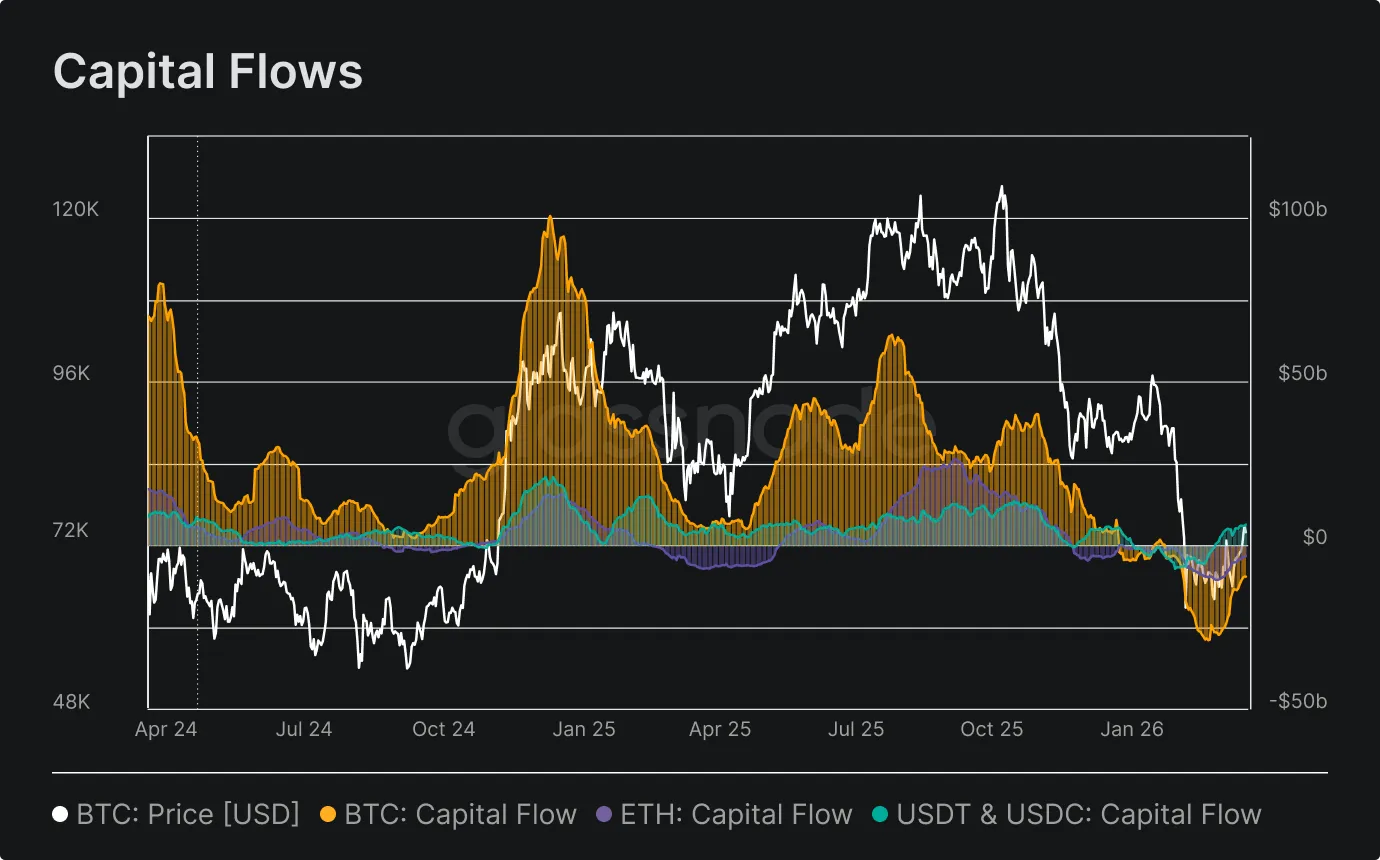
  • BTC capital flows nearly recovered to neutral through April while stablecoin inflows surged to multi-month highs, though ETH remained persistently in net outflow.

Bitcoin capital flows recovered materially through April, improving from -$6.9B at month-open to nearly neutral at -$0.7B by month-end, continuing the gradual deceleration of outflows observed in March. Stablecoins showed the strongest directional move, with inflows accelerating from +$1.8B in early April to +$5.4B by month-end, suggesting a meaningful rotation of capital into dollar-denominated on-chain instruments. Ethereum stood apart from both trends, remaining in persistent net outflow throughout the month and closing at -$1.6B, broadly unchanged from its March reading. The divergence between a stabilizing BTC, surging stablecoin demand, and a lagging ETH points to a selective rather than broad-based recovery in capital allocation.
ETF & DAT Net Flows

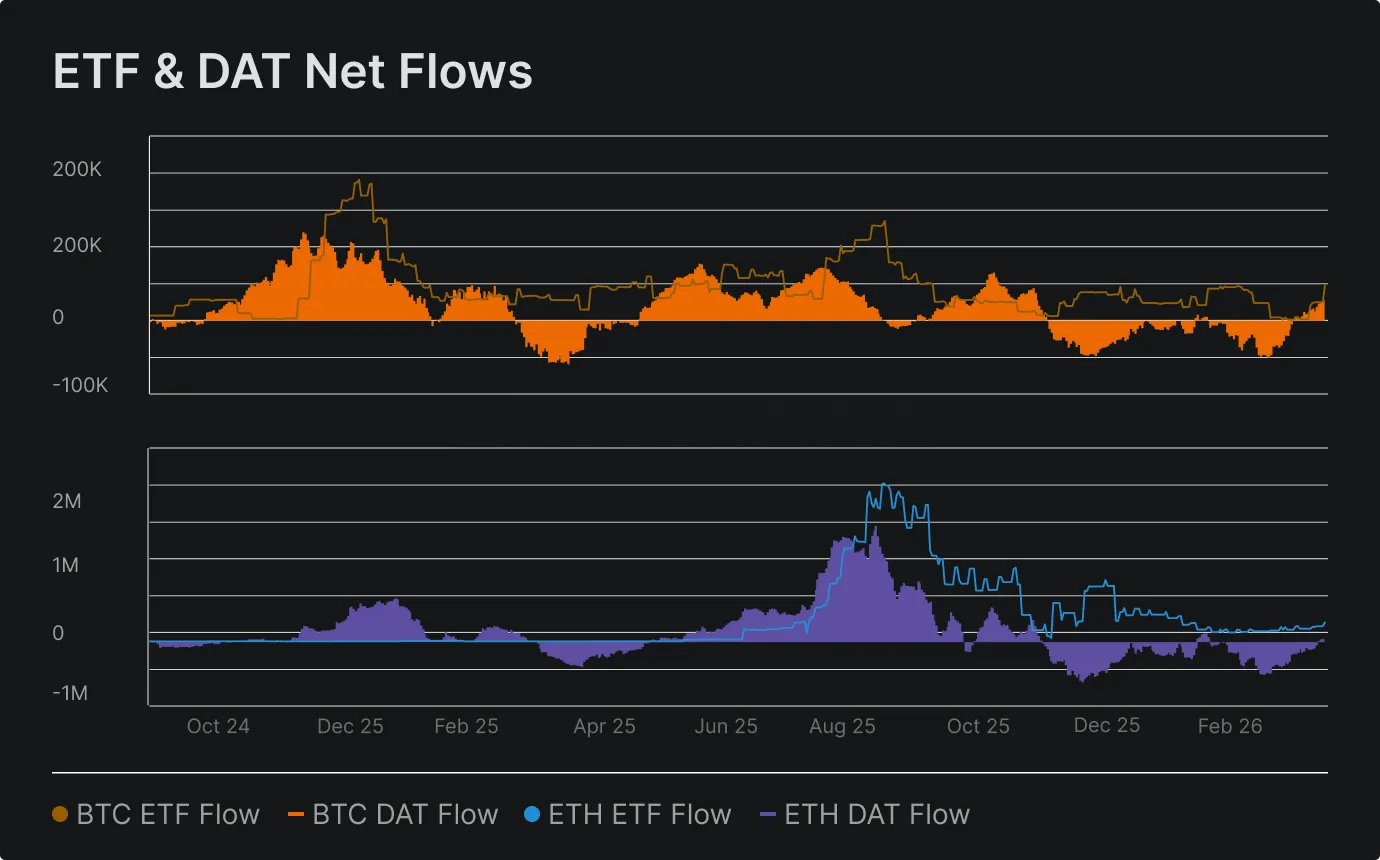
  • BTC ETF and DAT flows held positive through April while ETH staged a notable turnaround, flipping from deep outflow in early April to meaningful inflows by month-end.

Bitcoin ETF flows maintained positive territory throughout April, recovering from a mid-month dip to close at +26.3k BTC, while DAT flows strengthened progressively to +58.8k BTC by month-end. The more significant shift came from Ethereum, where ETF flows opened the month at -135k ETH before turning positive around April 18 and closing at +140.6k ETH. ETH DAT flows remained constructive throughout, finishing at +408.6k ETH. While BTC institutional demand showed consistency, the ETH turnaround is the more notable development, though it remains early and the magnitude of the late-month recovery warrants monitoring before drawing conclusions about a durable change in positioning.
DeFi TVL & Stablecoin Cap

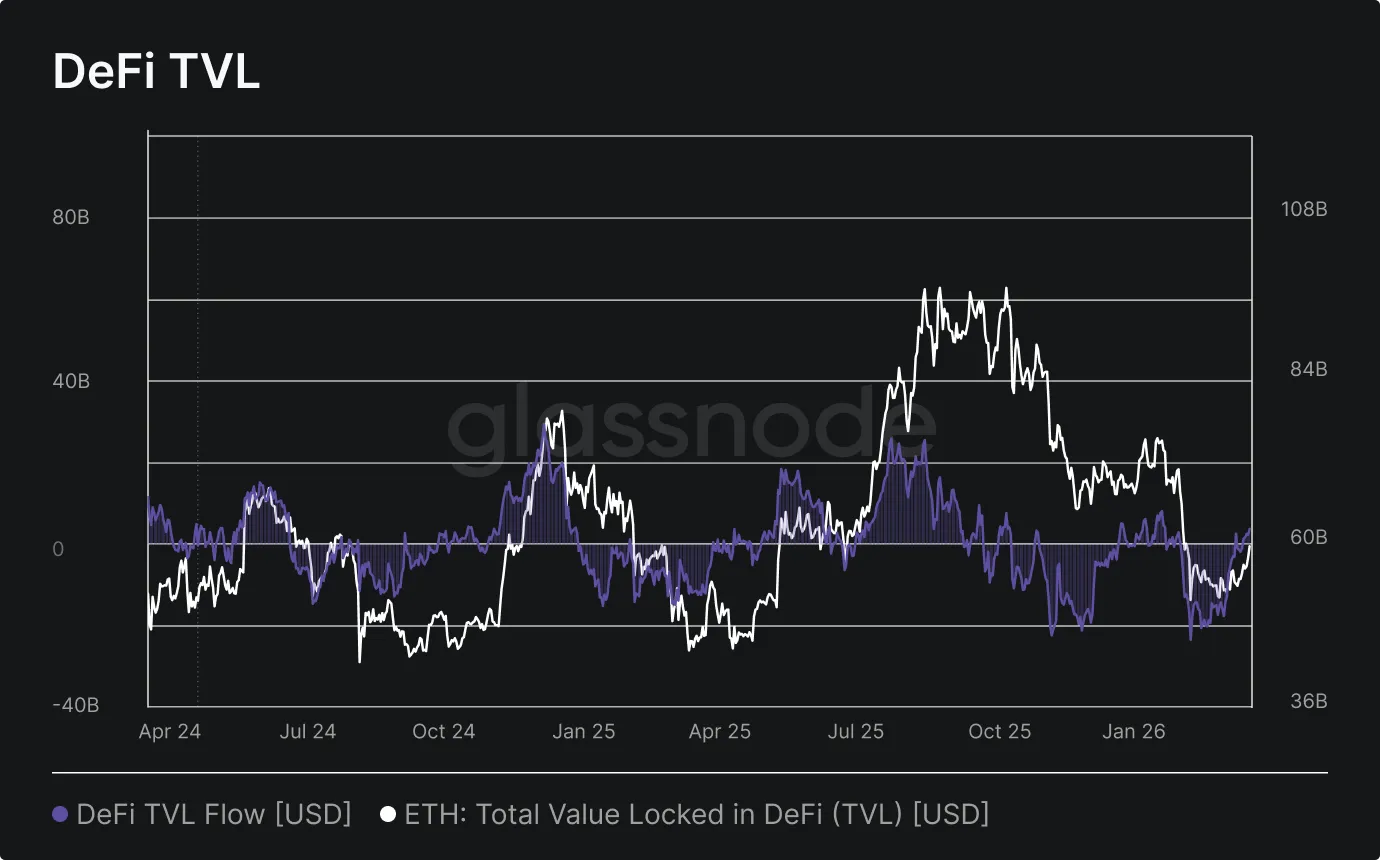
  • DeFi TVL flows on Ethereum reversed sharply in April, erasing the March stabilization as outflows accelerated to multi-month highs in the final week.

After nearly reaching neutral at month-end March, Ethereum DeFi TVL flows deteriorated steadily through April. The first half of the month was relatively contained, with flows oscillating near neutral before turning more negative around mid-month. The picture changed materially in the final ten days, with outflows accelerating to a peak of -$11.3B around April 25 before partially recovering to -$7.6B at month-end. Total ETH locked in DeFi fell from ~$54B at month-open to ~$44.9B by close. The reversal of March's stabilization trend suggests the earlier recovery was fragile, and the renewed pace of withdrawal points to sustained allocator caution toward on-chain yield strategies heading into May.
CME Basis Yield

  • CME basis yield deteriorated sharply through April for both BTC and ETH, with carry returns turning deeply negative by month-end as futures markets shifted into persistent backwardation.

After closing March at -$3.9M and +$0.9M respectively, BTC and ETH CME basis yields both briefly recovered in early-to-mid April, with BTC reaching +$3.3M and ETH +$1.7M around April 9-12. The recovery proved short-lived. Both assets deteriorated sharply through the second half of the month, with BTC closing April at -$21.2M and ETH at -$6.0M. The depth and pace of this reversal suggests futures markets moved into meaningful backwardation, removing the economic basis for cash-and-carry strategies entirely. For institutions running market-neutral books, the carry environment in April offered no compensation, reinforcing the broader picture of reduced leverage deployment and subdued institutional risk appetite.


Disclaimer: This report does not provide any investment advice. All data is provided for information and educational purposes only. No investment decision shall be based on the information provided here and you are solely responsible for your own investment decisions.
Exchange balances presented are derived from Glassnode’s comprehensive database of address labels, which are amassed through both officially published exchange information and proprietary clustering algorithms. While we strive to ensure the utmost accuracy in representing exchange balances, it is important to note that these figures might not always encapsulate the entirety of an exchange’s reserves, particularly when exchanges refrain from disclosing their official addresses. We urge users to exercise caution and discretion when utilizing these metrics. Glassnode shall not be held responsible for any discrepancies or potential inaccuracies. Please read our Transparency Notice when using exchange data.

Questions liées

QWhat is the primary objective of the Strategy Watch publication?

AThe primary objective of Strategy Watch is to become a must-read monthly publication for the digital asset investment community by providing high-signal, impartial analysis of fund-level performance and allocation trends in digital assets.

QAccording to the Institutional Flow Monitor, what was the trend for Bitcoin (BTC) and stablecoin capital flows in April?

AIn April, Bitcoin (BTC) capital flows nearly recovered to neutral, showing a significant improvement from a -$6.9B net outflow at the beginning of the month to nearly -$0.7B by month-end. In contrast, stablecoin inflows surged to multi-month highs, accelerating from +$1.8B to +$5.4B by month-end.

QHow did Ethereum (ETH) ETF flows change during the month of April?

AEthereum (ETH) ETF flows staged a notable turnaround in April. They opened the month at a deep outflow of -135k ETH, then turned positive around April 18th, and closed the month at a meaningful inflow of +140.6k ETH.

QWhat happened to DeFi TVL (Total Value Locked) on Ethereum in April?

ADeFi TVL flows on Ethereum reversed sharply in April. After nearly stabilizing in March, outflows accelerated, reaching a peak of -$11.3B around April 25th and closing the month at -$7.6B. Total ETH locked in DeFi fell from approximately $54B to $44.9B.

QWhat was the trend for CME basis yield for both BTC and ETH through April?

ACME basis yield for both BTC and ETH deteriorated sharply through April. After briefly recovering in early-to-mid April, both turned deeply negative by month-end, with BTC closing at -$21.2M and ETH at -$6.0M, indicating futures markets moved into persistent backwardation.

Lectures associées

Comment interpréter la répression sévère des courtiers transfrontaliers par huit ministères ?

Une action réglementaire conjointe de huit ministères chinois, dirigée par la CSRC, vise à éliminer les activités illégales de courtage transfrontalier en valeurs mobilières. Le plan de mise en œuvre, publié le 22 mai 2026, impose des sanctions sévères à des sociétés comme Futu et Tiger Brokers pour leur exploitation sans licence sur le marché intérieur. Leurs actions ont chuté de plus de 40% en pré-marché. Le fondement juridique repose sur le principe selon que toute activité de courtage en Chine nécessite une licence locale. Ces plateformes ont illégalement recruté des clients, traité des transactions et géré des fonds pour des investisseurs résidents chinois sans autorisation. La réglementation vise à combler cette faille et à mettre fin à une ère d'exploitation "grise". Les principales motivations des autorités sont la protection de la stabilité financière et des investisseurs. Ces canaux non réglementés facilitaient des sorties de capitaux non surveillées, potentiellement risquées pour la stabilité des changes et la sécurité des réserves de change. De plus, les investisseurs étaient exposés à des risques (gel de comptes, litiges) sans protection juridique locale et à des risques pour la sécurité de leurs données. L'impact sur les entreprises concernées est immédiat et sévère : interdiction des activités en Chine, obligation de liquider les portefeuilles des clients existants (achats interdits, ventes seulement), confiscation des profits illégaux et lourdes amendes. Environ 90 000 à 95 000 clients détiendraient des actifs d'une valeur estimée entre 250 et 280 milliards de yuans via ces canaux. Cette liquidation forcée sur deux ans exercera une pression à la vente soutenue sur les actions chinoises cotées à Hong Kong (H-shares) et aux États-Unis (ADRs), en particulier dans les secteurs technologiques et de la nouvelle économie privilégiés par ces investisseurs. Cela pourrait déplacer le pouvoir de fixation des prix vers les institutions étrangères. Pour le marché intérieur, les canaux de placement transfrontaliers légaux pour les particuliers (comme Hong Kong Stock Connect, avec un seuil de 500 000 yuans, et les fonds QDII, aux quotas limités) vont connaître une demande accrue. Les fonds QDII populaires sur les actions américaines pourraient voir leurs primes sur le marché secondaire augmenter durablement en raison de la pénurie d'offre. Parallèlement, une partie des capitaux des investisseurs à forte appétence pour le risque pourrait revenir vers les actions A, potentiellement vers les secteurs technologiques de croissance comme l'IA et les semi-conducteurs, avec un risque de surévaluation. En conclusion, cette répression vise à normaliser le marché, à contrôler les risques financiers systémiques et à protéger les investisseurs, et non à fermer les canaux d'investissement transfrontaliers. Elle souligne la nécessité pour les entreprises de se conformer à la réglementation et pour les investisseurs d'utiliser les voies légales pour une protection adéquate.

链捕手Il y a 8 h

Comment interpréter la répression sévère des courtiers transfrontaliers par huit ministères ?

链捕手Il y a 8 h

Anthropic publie le « manuel du fondateur » : les 4 étapes de l’entrepreneuriat entièrement repensées grâce à l’IA

Anthropic publie son "Guide du fondateur" pour les startups natives IA, restructurant l'entrepreneuriat en quatre phases. L'IA redéfinit la logique de création d'entreprise. Une startup native IA n'est pas une entreprise traditionnelle dotée de quelques outils, mais une entité dont les opérations sont pilotées par l'IA dès le premier jour. Le rôle du fondateur évolue vers celui d'un architecte et d'un décideur, coordonnant des agents IA pour les tâches d'exécution. Anthropic présente trois outils : **Claude Chat** (dialogue, recherche), **Claude Code** (génération de code) et **Claude Cowork** (automatisation des flux de travail). Le cycle de vie startup est décomposé en 4 étapes : 1. **Idée** : Valider le problème, pas la solution. Utiliser l'IA comme "avocat du diable" pour challenger les hypothèses et mener des études de marché. 2. **MVP** : Rechercher les premiers signes d'adhésion produit-marché. Utiliser l'IA pour coder (avec une architecture propre) et automatiser la collecte de retours utilisateurs. Éviter la dette technique et le "scope creep". 3. **Lancement** : Vérifier la capacité de croissance. Automatiser les opérations courantes (CRM, contenu) avec l'IA pour que le fondateur se concentre sur la stratégie, le financement et les clients. 4. **Mise à l'échelle** : Assurer la pérennité. Déléguer le contrôle opérationnel à l'IA et aux équipes. Une petite équipe peut, avec l'IA, réaliser la production d'une grande entreprise. La conclusion est claire : "Pouvoir construire" n'est plus la limite. L'avantage concurrentiel revient aux **qualités fondamentales** : le jugement, l'intuition et une compréhension profonde d'un problème et de son public.

marsbitIl y a 8 h

Anthropic publie le « manuel du fondateur » : les 4 étapes de l’entrepreneuriat entièrement repensées grâce à l’IA

marsbitIl y a 8 h

Trading

Spot
Futures

Articles tendance

Comment acheter 4

Bienvenue sur HTX.com ! Nous vous permettons d'acheter 4 (4) de manière simple et pratique. Suivez notre guide étape par étape pour commencer votre parcours crypto.Étape 1 : Création de votre compte HTXUtilisez votre adresse e-mail ou votre numéro de téléphone pour ouvrir un compte sur HTX gratuitement. L'inscription se fait en toute simplicité et débloque toutes les fonctionnalités.Créer mon compteÉtape 2 : Choix du mode de paiement (rubrique Acheter des cryptosCarte de crédit/débit : utilisez votre carte Visa ou Mastercard pour acheter instantanément 4 (4).Solde :utilisez les fonds du solde de votre compte HTX pour trader en toute simplicité.Prestataire tiers :pour accroître la commodité d'utilisation, nous avons ajouté des modes de paiement populaires tels que Google Pay et Apple Pay.P2P :tradez directement avec d'autres utilisateurs sur HTX.OTC (de gré à gré) : nous offrons des services personnalisés et des taux de change compétitifs aux traders.Étape 3 : stockage de vos 4 (4)Après avoir acheté vos 4 (4), stockez-les sur votre compte HTX. Vous pouvez également les envoyer ailleurs via un transfert sur la blockchain ou les utiliser pour trader d'autres cryptos.Étape 4 : tradez des 4 (4)Tradez facilement 4 (4) sur le marché Spot de HTX. Il vous suffit d'accéder à votre compte, de sélectionner la paire de trading, d'exécuter vos trades et de les suivre en temps réel. Nous offrons une expérience conviviale aux débutants comme aux traders chevronnés.

416 vues totalesPublié le 2025.10.20Mis à jour le 2025.10.20

Comment acheter 4

Discussions

Bienvenue dans la Communauté HTX. Ici, vous pouvez vous tenir informé(e) des derniers développements de la plateforme et accéder à des analyses de marché professionnelles. Les opinions des utilisateurs sur le prix de 4 (4) sont présentées ci-dessous.

活动图片