Standard Chartered pushes $2T stablecoin forecast to 2030 as transaction volumes grow

cointelegraphPublished on 2026-10-15Last updated on 2026-10-15

Abstract

Standard Chartered now projects the stablecoin market will reach a $2 trillion market capitalization by 2030, a delay of two years from its earlier forecast. This revision follows a market plateau at around $309 billion this year. The bank's research highlights that transaction volumes continue to grow despite the stalled overall value, indicating existing stablecoins are circulating more frequently as their use cases diversify. Analyst Geoffrey Kendrick outlines four distinct market segments: Tether's USDT leads in emerging-market savings, Circle's USDC is ahead in developed-market payments and AI agent transactions, while both USDC and Ethena's USDe are strong in crypto trading. Intense competition is expected in developed-market payments from new challengers, with the division of reserve yields being a key factor for gaining market share. The forecast comes alongside U.S. regulatory developments following the 2025 GENIUS Act, including proposed rules on issuance and reserve requirements, and potential accounting changes that could encourage broader business adoption for payments and settlements.

Standard Chartered says stablecoin transaction activity continues to grow even as the market’s overall value has stalled, suggesting existing stablecoins are circulating more frequently rather than new supply driving growth.

In a report shared with Cointelegraph, the bank said it now expects stablecoin market capitalization to reach $2 trillion by 2030, two years later than initially projected, after the market plateaued at roughly $309 billion this year.

Geoffrey Kendrick, StanChart’s head of digital assets research, said stablecoin usage continues to expand despite slower supply growth, with existing stablecoins changing hands more frequently as their use cases diversify.

Kendrick identified four distinct markets, each with different competitive dynamics. Tether’s USDt (USDT) dominates emerging-market savings, while Circle’s USDC (USDC) leads developed-market payments. USDC and Ethena’s USDe have established strong positions in crypto trading, while USDC also leads the much smaller market for transactions between AI agents.

The bank expects the most intense competition in developed market payments, where challengers such as USDG, M^0 and multibank stablecoin networks are pursuing alternatives to existing payment infrastructure.

According to Kendrick, how issuers and payment networks divide the yield generated by stablecoin reserves could ultimately determine which competitors gain market share.
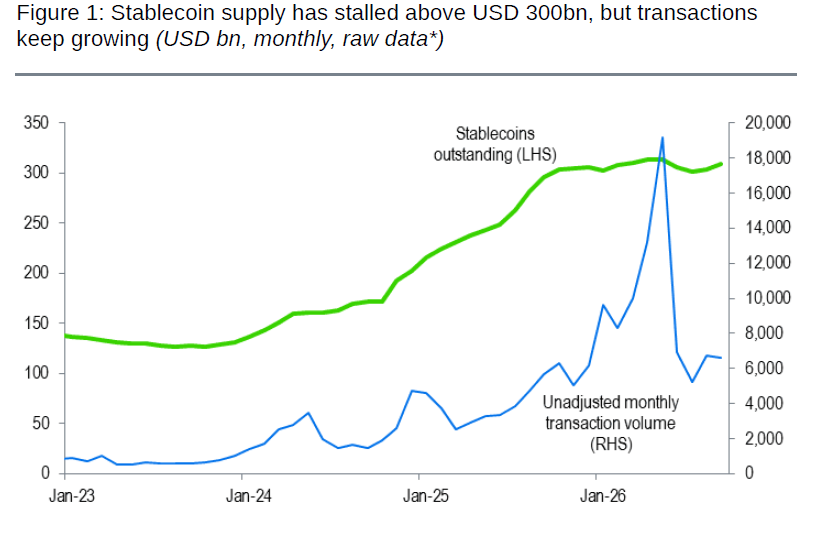
Source: Standard Chartered

Related: Crypto’s billions are back, but the premiums aren’t

US regulatory and accounting changes could shape stablecoin use

Standard Chartered’s revised forecast comes as regulatory and accounting developments in the United States could influence how businesses use stablecoins.

Since the GENIUS Act passed in 2025, US regulators have proposed rules governing stablecoin issuance, reserve requirements and consumer protections. Some measures have also clarified the limits of those protections, including a Federal Deposit Insurance Corporation (FDIC) proposal that would exclude stablecoin holders from pass-through deposit insurance.

The Treasury Department has also advanced implementation of the law. In August, it proposed rules restricting stablecoin issuance in the United States to federally or state-authorized issuers, with the licensing requirements expected to take effect in January 2027.

Separately, in August, the Financial Accounting Standards Board (FASB), which sets US accounting standards, proposed an update that could affect how companies report certain stablecoins on their balance sheets.

Blockchain payments company Tempo said the proposed changes could make it easier for businesses to use stablecoins for payments and settlement without introducing additional accounting complications.

Related: Crypto Biz: Wall Street and crypto fight for the same turf

Related Questions

QWhat is Standard Chartered's revised forecast for the stablecoin market capitalization by 2030, and what caused the delay?

AStandard Chartered revised its forecast to expect stablecoin market capitalization to reach $2 trillion by 2030, which is two years later than initially projected. The delay is due to the market plateauing at roughly $309 billion this year, despite stablecoin transaction activity continuing to grow.

QAccording to Geoffrey Kendrick, what is the primary driver of stablecoin growth currently, as opposed to the previous driver?

AAccording to Geoffrey Kendrick, the primary driver of stablecoin growth currently is the increased circulation frequency of existing stablecoins as their use cases diversify, rather than new supply entering the market.

QWhich four distinct markets for stablecoins are identified in the article, and what are their leading stablecoins?

AThe four distinct markets identified are: 1) Emerging-market savings, dominated by Tether's USDt (USDT). 2) Developed-market payments, led by Circle's USDC (USDC). 3) Crypto trading, where USDC and Ethena's USDe have strong positions. 4) Transactions between AI agents, a much smaller market also led by USDC.

QWhat US regulatory development from 2025, and its subsequent proposals, are mentioned as potentially influencing stablecoin use?

AThe article mentions the passing of the GENIUS Act in 2025. Subsequent regulatory proposals include rules governing stablecoin issuance, reserve requirements, consumer protections, and a Treasury Department proposal restricting U.S. stablecoin issuance to authorized issuers, with licensing requirements expected in January 2027.

QHow could the proposed update by the Financial Accounting Standards Board (FASB) affect businesses using stablecoins?

AAccording to the article, the proposed update by the FASB could make it easier for businesses to use stablecoins for payments and settlement by potentially simplifying how they report certain stablecoins on their balance sheets, thus avoiding additional accounting complications.

Related Reads

The Hidden Risks Behind Anthropic's Nearly $1 Trillion Bet

Anthropic's IPO filing reveals a fragile, high-risk financing mechanism behind its AI ambitions. The company has committed to up to $895.4 billion in data center spending through 2045, with profits squeezed by rising compute costs. Rather than paying upfront for hardware, Anthropic relies on supplier-backed financing: Broadcom arranged a $63 billion equipment financing deal under which it absorbs losses if Anthropic defaults—up to roughly $43 billion once equipment is delivered. Google and AMD similarly tie funding to hardware leases or deployments. This shifts risk onto chipmakers' balance sheets, and because custom TPUs serve a narrower ecosystem than Nvidia GPUs, resale risk is higher. Analysts warn that while individual loans appear safer, risk concentration across the system is rising and harder to assess. Anthropic also can issue up to $42 billion in convertible notes to Broadcom to cover rent, with interest rates rising from 9% to 13% and conversion terms worsening if revenue targets are missed. Despite holding $146.6 billion in liquidity as of September 30, its massive forward obligations and tangled partnerships could limit access to investment-grade financing. Key concerns: whether revenue growth can outrun compute costs and cover future commitments, and whether drawing on credit lines signals distress. Anthropic's Direct initiative—separating data center leasing from chip purchases—and IPO proceeds could give it more flexibility, but ultimately debt repayment depends on end-customer revenue.

marsbit7h ago

The Hidden Risks Behind Anthropic's Nearly $1 Trillion Bet

marsbit7h ago

Google Quietly Buys Qualcomm: Mobile Chip Giant Sets Sights on Data Centers, Targets Over $15 Billion in Annual Revenue

On November 6, Alphabet disclosed a stake of about 2.977 million Qualcomm shares worth roughly $548 million as of the end of Q3 2026, a position absent from its June filing. Qualcomm shares rose over 3% premarket on the news. The investment was quickly linked to Qualcomm's push into data centers as it seeks to reduce reliance on smartphone chips. CEO Cristiano Amon reiterated plans for $5 billion in data center revenue by fiscal 2027 and over $15 billion by fiscal 2029. However, The Information reported the stake may relate to Qualcomm's acquisition of AI software startup Modular, which used Qualcomm stock as consideration; Alphabet's GV had invested in Modular, and two GV funds were listed as selling shareholders holding about 3.196 million shares—a figure that doesn't fully match Alphabet's disclosed 2.977 million. Qualcomm's smartphone business is under pressure: fiscal Q4 2026 handset chip revenue fell about 26% year-over-year to $5.14 billion, amid slowing smartphone growth and Apple's shift to in-house modems. Qualcomm has expanded into automotive, IoT, and PCs, and now sees data centers as a major opportunity. In June 2026 it unveiled its data center roadmap, including the Dragonwing portfolio (C1000 CPU, AI300 inference accelerator, and high-bandwidth compute), targeting over $15 billion in data center revenue and $40 billion in non-handset revenue by fiscal 2029. The Modular acquisition adds software—the Mojo language and MAX inference platform—to ease AI model deployment across hardware. Competition is intense: Nvidia still leads with CUDA and full systems, while AMD, Broadcom (custom ASICs), and Marvell compete, and cloud giants design their own chips—Google TPU, AWS Trainium/Inferentia, Microsoft Maia, Meta MTIA. Qualcomm announced a multi-generation custom chip deal with AWS covering AI inference and optical interconnect, reportedly allowing up to $60 billion in purchases plus warrants for up to 25 million shares; it is also working with Microsoft and Meta. Supply chain constraints remain a challenge. Google both designs TPUs and relies on partners: Broadcom co-designs TPUs under a long-term deal through 2031, and Marvell has a custom chip arrangement with potential share rights up to $12.2 billion. Google also holds Arm shares and uses Nvidia GPUs. Qualcomm's low-power and heterogeneous computing expertise could fit Google's inference needs, but no public evidence shows a data center chip deal. Existing Google-Qualcomm ties center on mobile and automotive, including expanded automotive collaboration in January 2026 and Snapdragon X Elite powering Googlebook. Whether deeper industrial links exist behind the stake remains unclear, but chip-company–tech-giant relationships are shifting as AI compute competition intensifies.

marsbit7h ago

Google Quietly Buys Qualcomm: Mobile Chip Giant Sets Sights on Data Centers, Targets Over $15 Billion in Annual Revenue

marsbit7h ago

The AI Bills of the Magnificent Seven: Who Can Still Afford to Pay?

After the U.S. midterm elections, Wall Street's optimism about AI reversed sharply. On November 5, the "Magnificent Seven" lost about $1.04 trillion in market value in a single day, with Nvidia plunging 9.26% and shedding over $440 billion—far worse than its chip buyers Microsoft, Google, and Amazon. The selloff was triggered by fears that the new Congress could tighten AI regulation and slow data center construction. Despite strong fundamentals—Nvidia's revenue doubled year-over-year, and cloud and advertising businesses kept growing—investors worry that massive AI capex has not yet translated into equivalent profits. The four major buyers (Microsoft, Google, Amazon, Meta) are spending more than their operating cash flow can support: a year ago they had a $61.7 billion surplus, but in Q3 this became a $26.4 billion deficit. Companies are increasingly relying on debt, with the five largest cloud providers issuing about $121 billion in dollar bonds in 2025—over four times the previous five-year average. Nvidia is most exposed because over 90% of its revenue depends on data centers, and 40 of 41 local data center-related ballot measures in 10 states leaned toward restricting development, with 27 restrictive proposals passing. Texas alone accounts for nearly 30% of planned 2028 U.S. computing capacity. Analysts note that projects already under construction for 2027 are largely safe, but 2028 plans face real risk. Apple is relatively insulated due to its phone and services profit base, while Tesla fell the most, also hurt by Musk's political spending. The key question remains who will pay the next massive bill—and whether buyers can keep building fast enough to sustain Nvidia's growth.

marsbit8h ago

The AI Bills of the Magnificent Seven: Who Can Still Afford to Pay?

marsbit8h ago

Trading

Spot
活动图片