Russia Registers First Crypto Trading and Custody Firms Under New Rules

TheNewsCryptoPublished on 2026-10-07Last updated on 2026-10-07

Abstract

Russia has registered its first set of companies under its new digital asset legislation, with four crypto exchange operators and five digital depositories added to the Bank of Russia's official registers. Major institutions like Sberbank and VTB Bank are among those registered, with VTB listed in both categories. The new law, effective September 2026, defines the roles of these entities: digital depositories handle the recording and transfer of digital currencies and rights, while exchange operators facilitate buying and selling outside formal trading venues. Following the establishment of market admission procedures, Sberbank plans to launch its first crypto products, including Bitcoin and Ether, in December. VTB aims to offer retail crypto trading through its investment platform in November and via its own exchange in late 2026. The registered firms must comply with the new rules, with a full alignment deadline set for September 2027. The framework creates regulated channels for crypto activities but does not authorize cryptocurrencies as a general payment method.

Key Takeaways

  • Russia registered its first five digital depositories and four crypto exchange operators under its new digital asset framework.
  • Sberbank and VTB are among the registered firms, with VTB listed as both a digital depository and crypto exchange operator.

Russia has registered its first cryptocurrency exchange operators and digital depositories under the country’s new legal framework for digital currencies and digital rights.

The Bank of Russia added four cryptocurrency exchange operators and five digital depositories to its official registers on October 6, marking the first registrations under the new framework. The law governing digital currencies and digital rights came into force on September 1, 2026.

The five digital depositories are Russia’s largest lender, Sberbank, VTB Bank, Voltari, Cloud Infrastructure and Atomyze. The four registered cryptocurrency exchange operators are VTB Bank, Zefir, Sistema Crypto and T-Invest Lab. VTB is therefore listed in both registers.

Under the rules, digital depositories can provide services for recording and transferring digital currencies and digital rights. They can also give clients access to identifier addresses where those assets are recorded.

Cryptocurrency exchange operators, meanwhile, can buy and sell digital currencies in their own name and at their own expense outside organized trading venues.

Sberbank and VTB Prepare Crypto Services

The registrations come shortly after the Bank of Russia established the procedure for admitting digital depositories, cryptocurrency exchanges and other digital-asset infrastructure providers to the market. That procedure took effect on October 5.

Following that, Sberbank has said it plans to launch its first cryptocurrency products on December 1, subject to regulatory requirements and the readiness of the necessary rules. Its initial offering is expected to include Bitcoin, Ether and USDT.

Meanwhile, VTB is also preparing retail cryptocurrency services. The bank expects to offer digital-currency trading through VTB My Investments in November and through its own cryptocurrency exchange in December 2026, according to VTB Deputy CEO Vitaly Sergeichuk.

The registered firms must comply with transaction and accounting requirements from the date they enter the registers. They have until September 1, 2027, to bring their activities fully into line with the new digital-currency and digital-rights legislation.

The framework does not make cryptocurrency a general payment method for goods and services. Instead, it establishes regulated channels for cryptocurrency trading and the recording and transfer of digital assets through registered market participants.

[googlesitekit-end-of-content]
TagsCrypto LawCustodia BankRegulationRussiaSberbank

Related Questions

QWhich two major Russian banks are among the first firms registered under Russia's new digital asset rules?

AThe two major Russian banks are Sberbank and VTB. Sberbank is registered as a digital depository, while VTB is registered as both a digital depository and a crypto exchange operator.

QWhat are the permitted activities for a registered cryptocurrency exchange operator under Russia's new framework?

AUnder the new rules, registered cryptocurrency exchange operators are permitted to buy and sell digital currencies in their own name and at their own expense outside organized trading venues.

QBy what date do the newly registered firms have to fully comply with Russia's new digital-currency legislation?

AThe newly registered firms have until September 1, 2027, to bring their activities fully into line with the new digital-currency and digital-rights legislation.

QWhen does Sberbank plan to launch its first cryptocurrency products, and what are some of the initial offerings?

ASberbank plans to launch its first cryptocurrency products on December 1, subject to regulatory requirements. Its initial offering is expected to include Bitcoin, Ether, and USDT.

QWhat is the role of a registered digital depository according to the new Russian law?

ARegistered digital depositories can provide services for recording and transferring digital currencies and digital rights. They can also give clients access to identifier addresses where those assets are recorded.

Related Reads

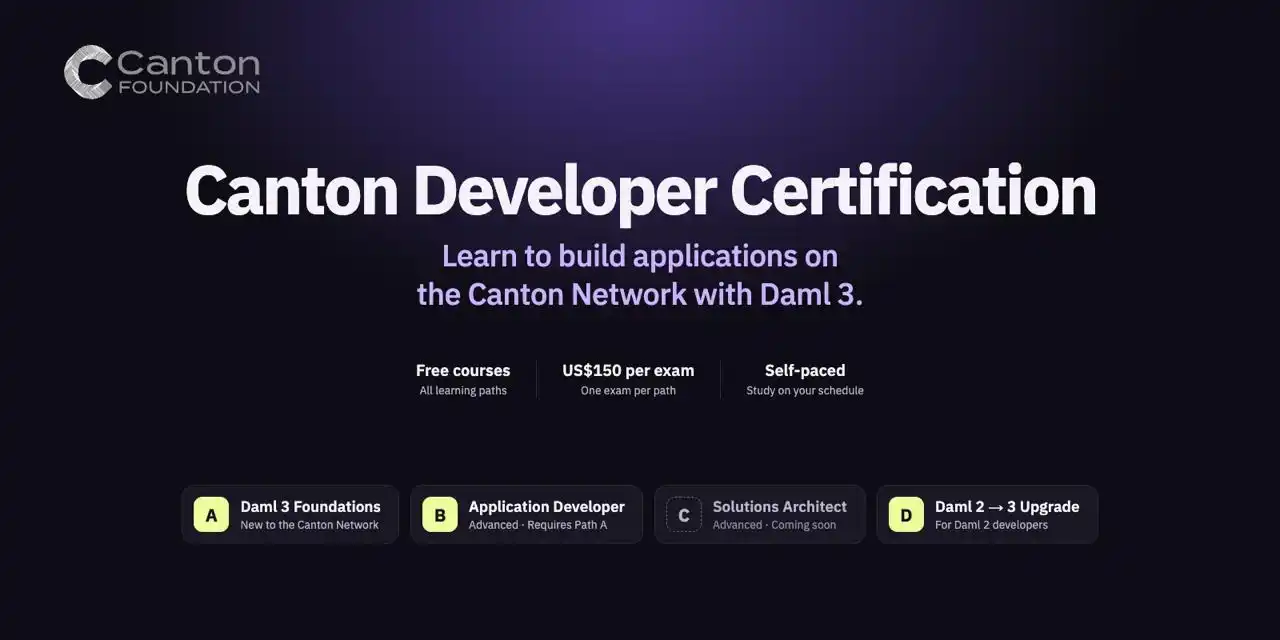
Canton Foundation Launches Official Daml 3 Certification, Expanding Developer Access and Establishing Institutional Finance Standards

Canton Foundation has launched the Canton Developer Certification, an official certification program for Daml 3, the smart contract language of the Canton Network. Combining a self-paced course with a certification exam, it offers developers worldwide a structured path to building applications for regulated financial markets. Canton Network is a public, permissionless blockchain designed for regulated finance, with over $6 trillion in on-chain assets processed by its supported applications. Daml is built to manage who may act on a contract and who may access its terms; the certification validates practical mastery of these authorization and privacy principles, establishing a recognized standard intended to strengthen institutional confidence in applications built on the network. The program is based on Daml 3 and Canton 3.x, the current technology underlying the network, letting newcomers start on the latest stack, helping production engineers deepen expertise, enabling institutional architects to design and integrate Canton deployments, and allowing existing Daml 2 developers to migrate their skills and codebases to Daml 3, unifying the community on a single, current platform. For ecosystem partners—financial institutions, application providers, system integrators, and validators—the certification provides a common technical foundation and a consistent way to assess developers' understanding of authorization and privacy requirements. Canton Foundation COO Amanda Martin said financial institutions need confidence that the applications they rely on are built by developers who understand regulated market requirements, and that the program both opens opportunities for developers globally and establishes a shared professional standard, building a stronger foundation for Canton's future growth by bringing the community together on Daml 3. The certification is now live at certification.canton.foundation; the course is self-paced and free to all developers, and the exam costs $150 per attempt. Canton Foundation is an independent nonprofit responsible for the governance and long-term development of Canton Network's shared infrastructure, supporting transparent and decentralized governance, ecosystem coordination, and broad participation by Global Synchronizer operators and network stakeholders, while working with financial institutions, technology providers, developers, and other participants to support the network's continued global growth and adoption.

marsbit6m ago

Canton Foundation Launches Official Daml 3 Certification, Expanding Developer Access and Establishing Institutional Finance Standards

marsbit6m ago

Nvidia Faces Independent Investigation, Bernstein Maintains $400 Target Price

Nvidia's board has launched an independent investigation following reports about CEO Jensen Huang's contacts with Megaspeed executive Alice Huang, though it says there is no reason to believe U.S. national security or company secrets were compromised. Three Republican House committee chairs have requested Huang attend a closed-door briefing on November 18 to explain the contacts and Nvidia's internal procedures for countering foreign intelligence activities, and Democratic Senator Chris Coons said Congress will investigate. Some reports suggested Alice Huang may have influenced Huang's lobbying to ease chip export restrictions to China, a claim Bernstein doubts, noting Huang has long publicly pushed to expand sales in China and that revenue from mainland China and Hong Kong has fallen sharply since export controls. Only H20 and limited H200 chips were approved for China sales, well behind Nvidia's most advanced products, and Bernstein sees limited room for recovery as Chinese customers prioritize domestic alternatives. Regulatory pressure may persist, with hawkish lawmakers potentially revisiting export limits. Bernstein maintains an Outperform rating and a $400 target price, about 114% above the November 6 close of $186.64, citing data center demand and earnings growth. It projects adjusted EPS of $4.77 for FY2026, $9.20 for FY2027 and $15.80 for FY2028. The target is based on average FY2028-2029 non-GAAP EPS of $19.04 at about 21x. Bernstein also flags Huang's succession as a key risk, given his central role and roughly 60 direct reports.

marsbit16m ago

Nvidia Faces Independent Investigation, Bernstein Maintains $400 Target Price

marsbit16m ago

Two Blocks Hit in 7 Hours: Two Retail Miners Take on the Entire Network's Hashrate and Walk Away with $476,000

Two individual solo miners using home mining rigs hit two Bitcoin blocks within seven hours on November 7, earning a combined $476,000. One miner using a Canaan AvalonQ home miner with roughly 80–87 TH/s earned about $239,000; the other earned roughly $237,000. A CKPool solo platform took about 2% (0.0629 BTC) as a service fee, with the rest going directly to the miners' wallets. Given current network difficulty of about 148.4 trillion, such a rig would normally need over a century to find a block, making the win a luck value of over 10,000%. This is part of a broader trend: in 2026 so far, solo miners have found 36 blocks, nearly one lucky winner per week. Earlier examples include a 6.5 TH/s Avalon Nano 3S worth a few hundred dollars earning $250,000 on October 27, another Nano 3S earning $232,000 on May 30, and a $150 Bitaxe Gamma earning $200,000 on July 10. Home solo mining is often called "plug-in lottery": a 1.2 TH/s mini miner has about a 1-in-16,000 annual chance of winning, far better than Powerball's 1-in-292 million, but rigs cost thousands of dollars and electricity runs $400–$1,100 monthly, with zero income until a block is found. Each viral win serves as free advertising for the industry. Rig manufacturers sell the dream of "maybe I'll win too"; solo pool platforms collect a steady ~2% fee from any winner; and the Bitcoin network preserves its "anyone can participate" narrative despite mining being dominated by large farms. The people paying for it all are ordinary buyers who purchase miners and pay electricity bills hoping for a life-changing jackpot.

marsbit32m ago

Two Blocks Hit in 7 Hours: Two Retail Miners Take on the Entire Network's Hashrate and Walk Away with $476,000

marsbit32m ago

NYSE Picks Avalanche, Why AVAX May Not Capture the Settlement Flow

On November 9, Ava Labs announced that a tokenized securities trading platform affiliated with the NYSE had selected Avalanche to provide core ledger technology for its clearing firm. The platform is a regulated alternative trading system (ATS) designed for 24/7 trading, clearing, and settlement, pending regulatory approval. The Wall Street Journal reported a stronger version: the NYSE would "exclusively" use Avalanche to settle tokenized stocks, with matching still handled by existing technology and a Q4 launch target—though Ava Labs' announcement gave no launch date and did not name the clearing firm. Markets traded the headline first, with AVAX rising roughly 8–11% to near $9 intraday. But the announcement places Avalanche at the clearing-ledger layer, not the main board on a public chain—a distinction that determines whether AVAX captures narrative or verifiable demand. Matching (who trades with whom at what price) stays on the NYSE's Pillar engine; settlement (how cash and securities transfer) goes to the blockchain ledger. Ava Labs said it provides core ledger tech for the clearing firm of the NYSE-affiliated ATS, without disclosing the firm's identity, contract value, or timeline. Tokenized stocks involve three layers: issuance, matching, and settlement. NYSE digital issuance head Dennis Lee said the platform will support stocks listed across multiple chains, but the settlement ledger must be fast, reliable, permissioned, and cost-predictable. Issuance can be multi-chain; settlement converges on one controlled system. The "exclusive" label refers to the settlement ledger, not the whole value chain. ICE previously said the platform combines Pillar with blockchain post-trade systems supporting multi-chain settlement and custody. Ava Labs CBO John Nahas said the NYSE will run a custom Avalanche-based chain tailored to regulatory needs, not use the public Avalanche chain—two very different things. A permissioned chain lets the exchange control access, node deployment, and fee pricing. Founder Emin Gün Sirer cited round-the-clock atomic settlement, predictable performance and cost, and regulatory control. This explains why AVAX's price reaction outpaced fundamental certainty: brand association arrived first, while fee capture remains undisclosed—whether the custom chain uses AVAX for pricing, staking, or fees was not answered. Charles Schwab's same-day addition of AVAX to retail trading offers a competing explanation for the gains. Three unresolved variables determine the significance: regulatory approval (no public status), the clearing firm's identity (unnamed legal entity), and token economics. AVAX's economic link is distant—a custom chain does not equal public-chain lockup or AVAX becoming a settlement asset. Issuer willingness also matters; the NYSE recently expanded transfer agents for issuer-sponsored tokenized securities to six, with Broadridge handling on-chain voting and governance, but whether tokenized equities enter this ATS depends on liquidity, compliance costs, and shareholder communication. Until the platform launches and the clearing firm appears, vendor selection is a necessary step, not realized demand.

marsbit35m ago

NYSE Picks Avalanche, Why AVAX May Not Capture the Settlement Flow

marsbit35m ago

Ethereum Foundation and Vitalik Taken to Court: A Cancer Patient's Dismissal and a "Seppuku Pledge"

In November 2026, a civil complaint filed in a Colorado federal court named the Ethereum Foundation and Vitalik Buterin as defendants. The plaintiff, Kayleen Fulton, former head of EF's Protocol Support team, alleges she was fired after being diagnosed with ovarian cancer, and that the real reason was her leading opposition to the controversial "EF Mandate" document and its "Source Seppuku License." The complaint describes a timeline in which Fulton received her highest performance rating and a 21.9% raise in September 2025, before the 38-page Mandate was published in March 2026, featuring Milady-style imagery and a clause demanding signers "voluntarily exit" if they violated its principles—wording invoking seppuku, published roughly a year after a colleague's suicide. Seventy-nine employees reportedly voted to remove the clause, and Buterin allegedly promised major revisions that never came; the Mandate was instead recorded permanently on-chain. Fulton was diagnosed with cancer on March 19; the next day, co-executive director Bastian Aue issued an ultimatum requiring all staff to sign a loyalty oath to the Mandate or be treated as having resigned. Fulton disclosed her diagnosis on March 24 and, with Trent Van Epps, drafted a letter signed by 53 protocol cluster members refusing to sign under duress while stating they had not resigned. Both Fulton and Van Epps were fired on April 6 without stated reasons. The complaint's most damaging element is a recorded May 1 call in which Buterin allegedly said he was considering what behavior patterns EF should reward—implying protesters should not receive positive outcomes. Buterin is accused of aiding and abetting discrimination and retaliation. The complaint raises 11 claims, including ADA and FMLA violations, Colorado anti-discrimination provisions, illegal confidentiality clauses, wrongful termination, and intentional infliction of emotional distress. Fulton signed a separation agreement on April 9 under severe psychological pressure and threat of losing health insurance, then revoked it on April 17. She seeks a jury trial, back pay, expected wages, punitive damages, $5,000 statutory penalties per violation, and attorney fees. The case unfolds amid massive EF turmoil: about 20% of staff (roughly 54 people) were cut, protocol cluster leaders Tim Beiko and Barnabé Monnot resigned, Alex Stokes took extended leave, co-executive director Tomasz Stańczak departed, and Fulton's former team was dissolved in July 2026. Buterin publicly framed the changes as becoming a "smaller ship" focused on CROPS. The lawsuit tests whether traditional labor protections apply to a Swiss foundation using employer-of-record arrangements while claiming to be "not an employer," and raises broader governance concerns for the crypto industry.

marsbit36m ago

Ethereum Foundation and Vitalik Taken to Court: A Cancer Patient's Dismissal and a "Seppuku Pledge"

marsbit36m ago

Trading

Spot
活动图片