Robinhood's Wealth Management Business Transformation Journey

marsbitPublié le 2026-04-14Dernière mise à jour le 2026-04-14

Résumé

Robinhood's 2025 Wealth Management Transformation: A Summary In 2025, Robinhood successfully pivoted its business model by aggressively expanding its wealth management services. This strategic shift, marked by the launch of disruptive products like a high-match-rate IRA, high-yield cash accounts, and comprehensive banking services, effectively guided its young user base from speculative trading toward long-term saving and investing. Key to this success was a highly internet-native customer acquisition strategy. Robinhood used aggressive cash match incentives (up to 3% for Gold members) to drastically lower the barrier for users to transfer retirement assets (e.g., 401(k) rollovers), effectively "buying" AUM with a high lifetime value. This was paired with a seamless, tech-driven transfer process. The company's revenue model evolved from a heavy reliance on volatile payment for order flow (PFOF) to more stable, recurring income streams. This included substantial net interest income from its massive cash sweep balances and a growing, high-margin subscription business from its Robinhood Gold program, which saw 4.2 million subscribers by Q4 2025. Robinhood built a powerful ecosystem, creating a super-app that seamlessly connects high-frequency trading (stocks, crypto) with low-frequency, sticky products (IRA, automated investing) and daily spending (credit card, banking). This allows for efficient cross-selling and user retention. To build trust for managing long-term saving...

Author: @BlazingKevin_, Blockbooster Researcher

Robinhood reached a turning point in its business model in 2025. By developing its wealth management business, including launching disruptive IRA retirement accounts with competitive rates, high-yield cash products, and comprehensive Robinhood Banking services, Robinhood successfully guided its young user base from high-frequency options and cryptocurrency trading towards long-term savings and investment.

In 2025, Robinhood's financial data fully validated the success of this strategy: full-year net revenue reached a record $4.5 billion, a 52% year-over-year increase; full-year net income reached $1.9 billion, a 35% year-over-year increase; retirement account Assets Under Custody (AUC) reached $26.5 billion by the end of Q4, a sharp 102% increase year-over-year; total platform assets reached $324 billion, a 68% year-over-year increase; full-year net deposits reached $68 billion.

This article will analyze the development trajectory of Robinhood's wealth management business in 2025 using data, and explore its strategic advantages across five core dimensions: customer acquisition and asset transfer mechanisms, evolution of the profit model, ecosystem flywheel, brand repositioning, and operational cost structure.

1. Customer Acquisition and Asset Transfer Mechanisms

Traditional wealth management typically relies on financial advisors for high-cost customer acquisition and relationship maintenance, whereas Robinhood adopted a highly internet-based subsidy and incentive mechanism to break down the barriers to asset transfer, thereby rapidly capturing assets under management.
1.1 Match Subsidy: The Economics of "Buying AUM"

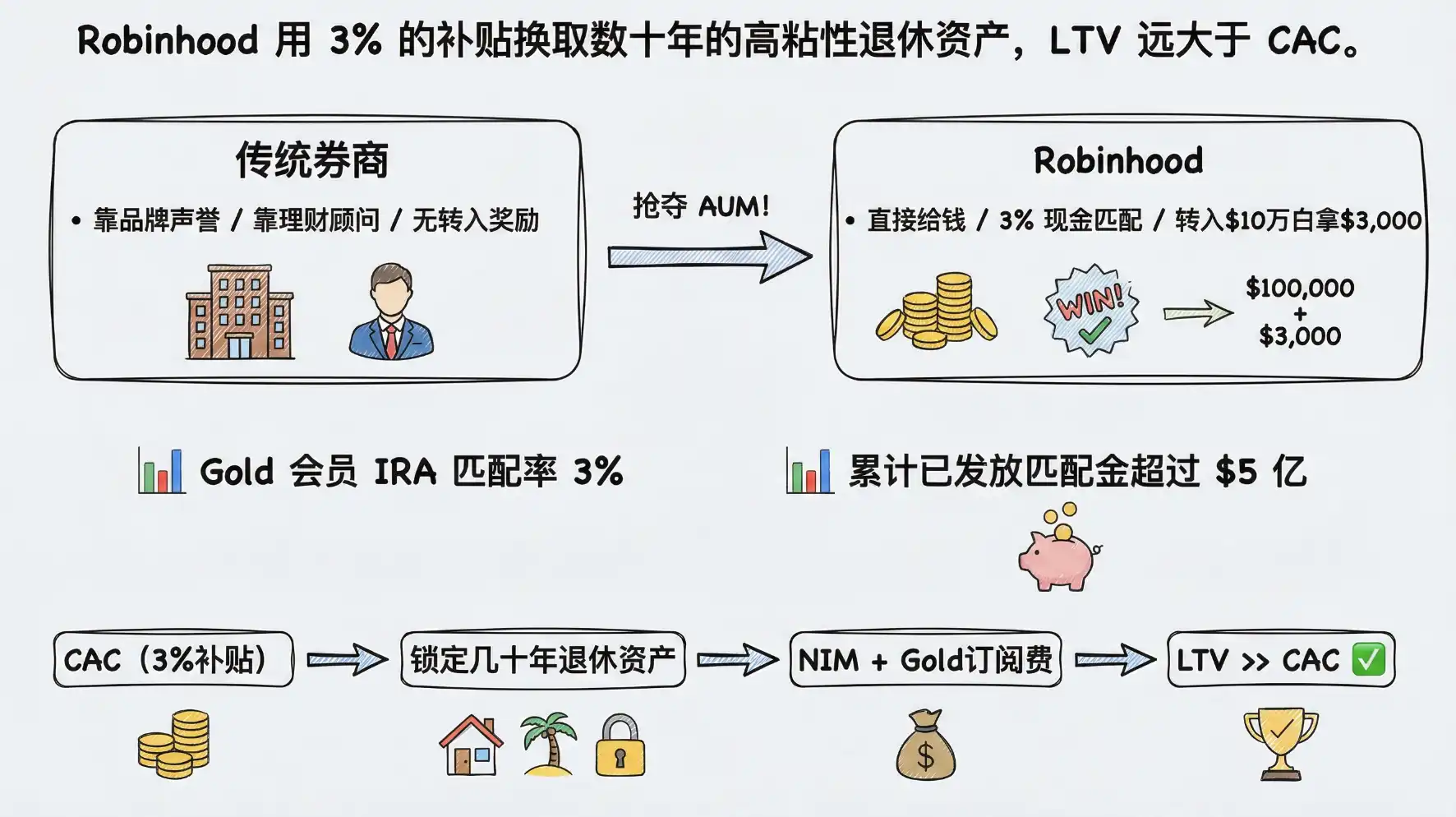
Traditional retirement account providers (e.g., Fidelity, Charles Schwab) typically rely on brand reputation and advisory services to attract clients, while Robinhood adopted a more direct and aggressive strategy: cash match subsidies. Using real monetary rewards to lower the psychological cost of user migration.

For Robinhood Gold members, the platform offers up to a 3% match on IRA deposits (1% for non-members). Based on the 2025 IRS contribution limit of $7,000 for individuals under 50, users could receive up to $210 in free matching funds annually. More aggressively, Robinhood also offers a match reward of up to 3% for 401(k) or IRA assets rolled over from other brokerages. This means a user transferring $100,000 in 401(k) assets into a Robinhood IRA could immediately receive a $3,000 cash reward.

Is this economically viable? We can analyze it from the perspective of Customer Acquisition Cost (CAC) and Customer Lifetime Value (LTV). By the end of 2025, customers had collectively received over $500 million in matching funds for retirement account transfers and contributions. This expenditure is treated by Robinhood as a customer acquisition cost. Given the extremely high stickiness of retirement accounts (typically held for decades), these assets not only generate long-term Net Interest Margin (NIM) and potential advisory fees but also lock users into becoming Gold members (annual fee $50). Compared to the often hundreds of dollars in CAC with high churn rates at traditional brokerages, Robinhood's 3% subsidy secures highly sticky assets for decades, with an LTV far exceeding CAC.
1.2 Frictionless Account Transfer: A Technological Overmatch

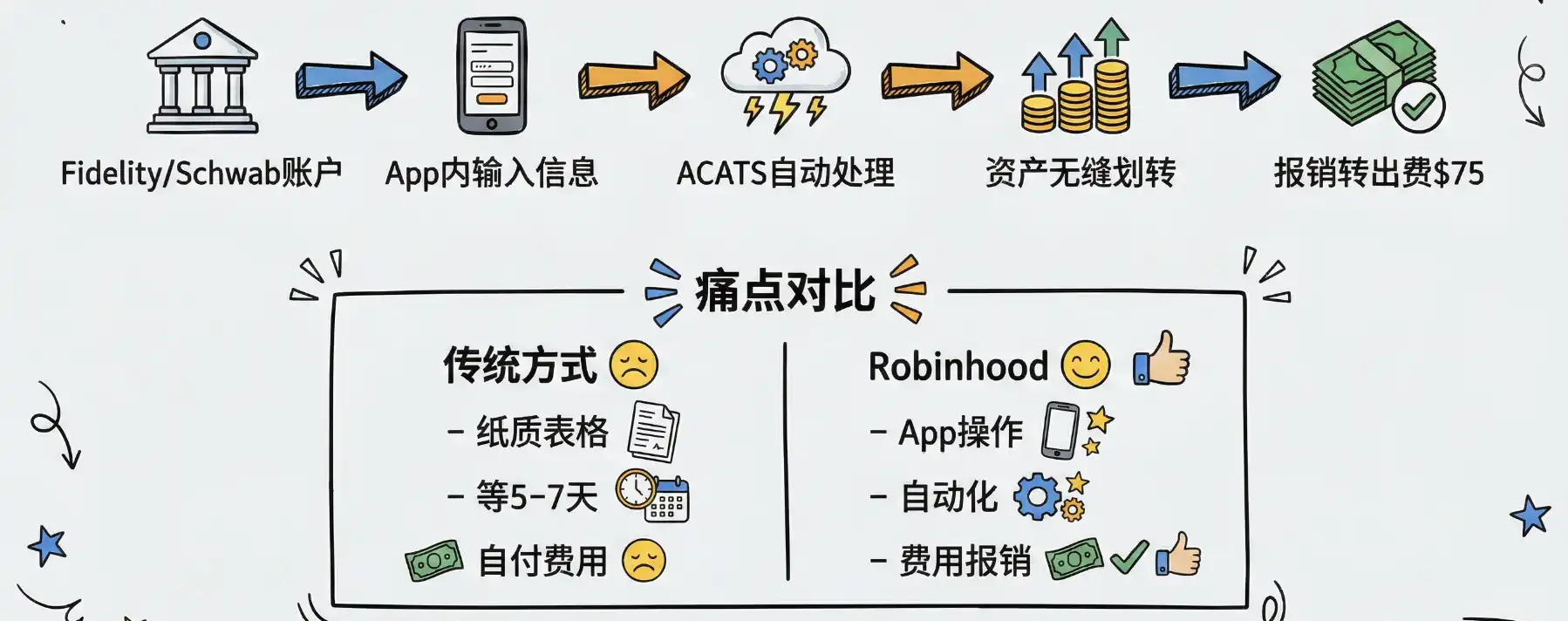
Subsidies alone are not enough; if the transfer process is cumbersome, users will still be deterred. Robinhood leveraged technology to significantly lower the barrier for users transferring from traditional brokerages.

By integrating the Automated Customer Account Transfer Service (ACATS), Robinhood enabled seamless cross-brokerage asset transfers. Users simply need to enter their previous brokerage account information within the app, often without manually liquidating existing assets, and Robinhood's clearing system automatically handles the asset transfer in the background. For outgoing transfer fees charged by some brokerages (typically $75), Robinhood also reimburses them if conditions are met. This "one-click move" experience completely dismantles the asset transfer barriers traditionally built on cumbersome processes.

2. Profit Model Evolution: From PFOF to Recurring Revenue

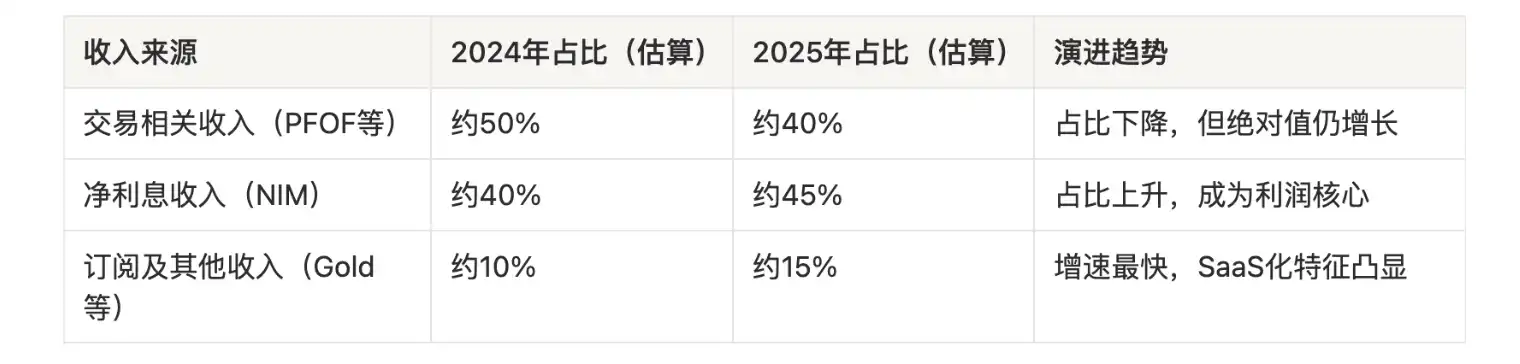
Previously, Wall Street's skepticism about Robinhood focused heavily on its reliance on Payment for Order Flow (PFOF) and high-frequency trading. This model is highly lucrative in bull markets but extremely fragile in bear markets. In 2025, Robinhood successfully evolved towards a more stable asset management profit model.
2.1 Net Interest Margin (NIM): Attracting Deposits with High-Yield Cash

By offering highly competitive cash yields, Robinhood liberated "cash management" from the low-yield trap of traditional banks, thereby attracting massive deposits.

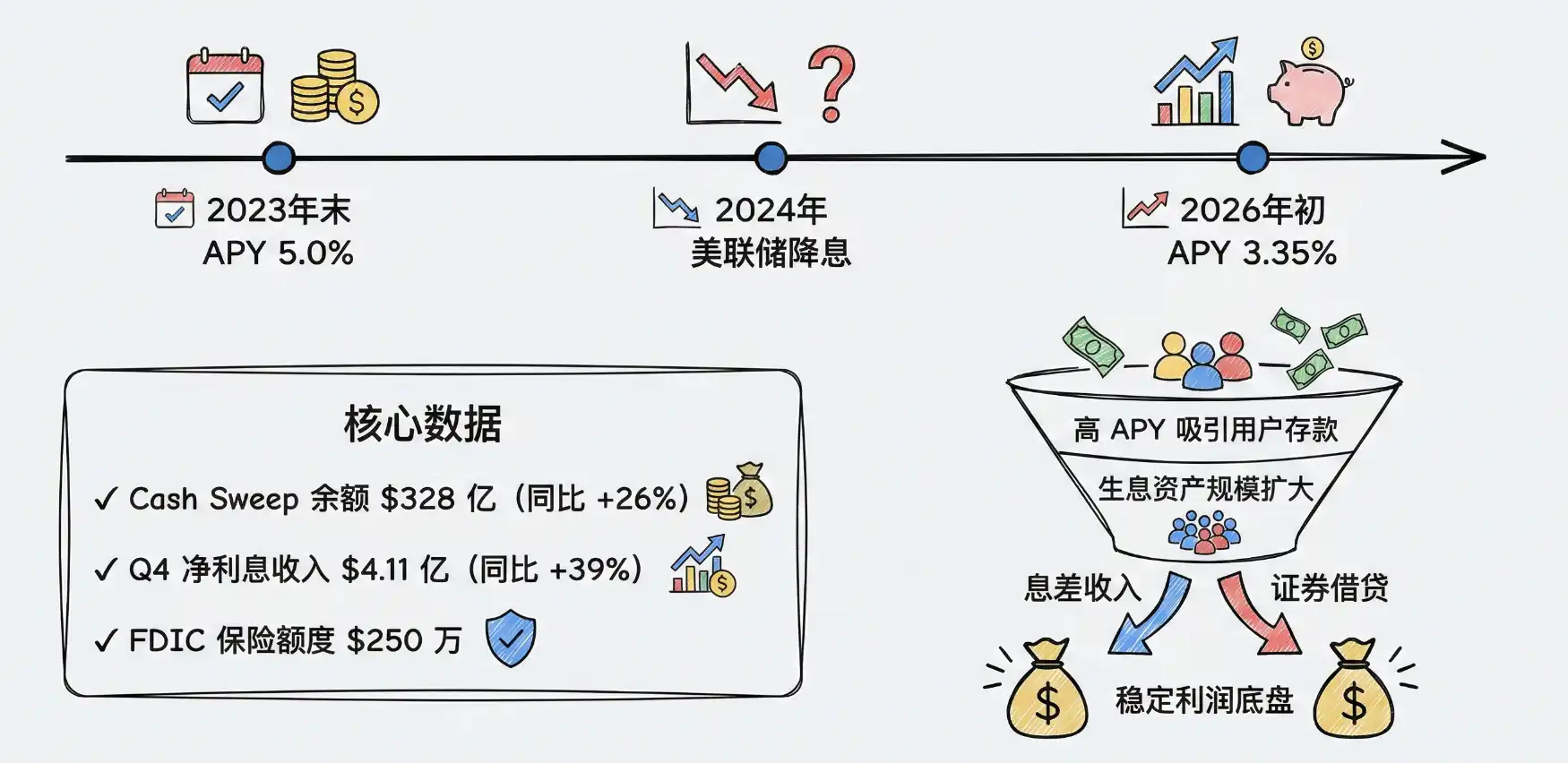
At the end of 2023, the APY for uninvested cash for Robinhood Gold members reached as high as 5.0%, far exceeding the national average savings account rate at the time. As the Fed cut rates, the APY was gradually adjusted (to 3.35% as of early 2026), but it still remained significantly higher than the checking account rates offered by major banks. In Q4 2025, Robinhood's Cash Sweep balance grew 26% year-over-year to $32.8 billion.

This massive pool of interest-earning assets generated substantial net interest income for Robinhood. In Q4 2025, its net interest income grew 39% year-over-year to $411 million, primarily driven by growth in interest-earning assets and securities lending activities. Under specific interest rate cycles, this "earning the spread" model provides a strong profit foundation.
2.2 Subscription Economy (Robinhood Gold): The SaaS-ification of Financial Services

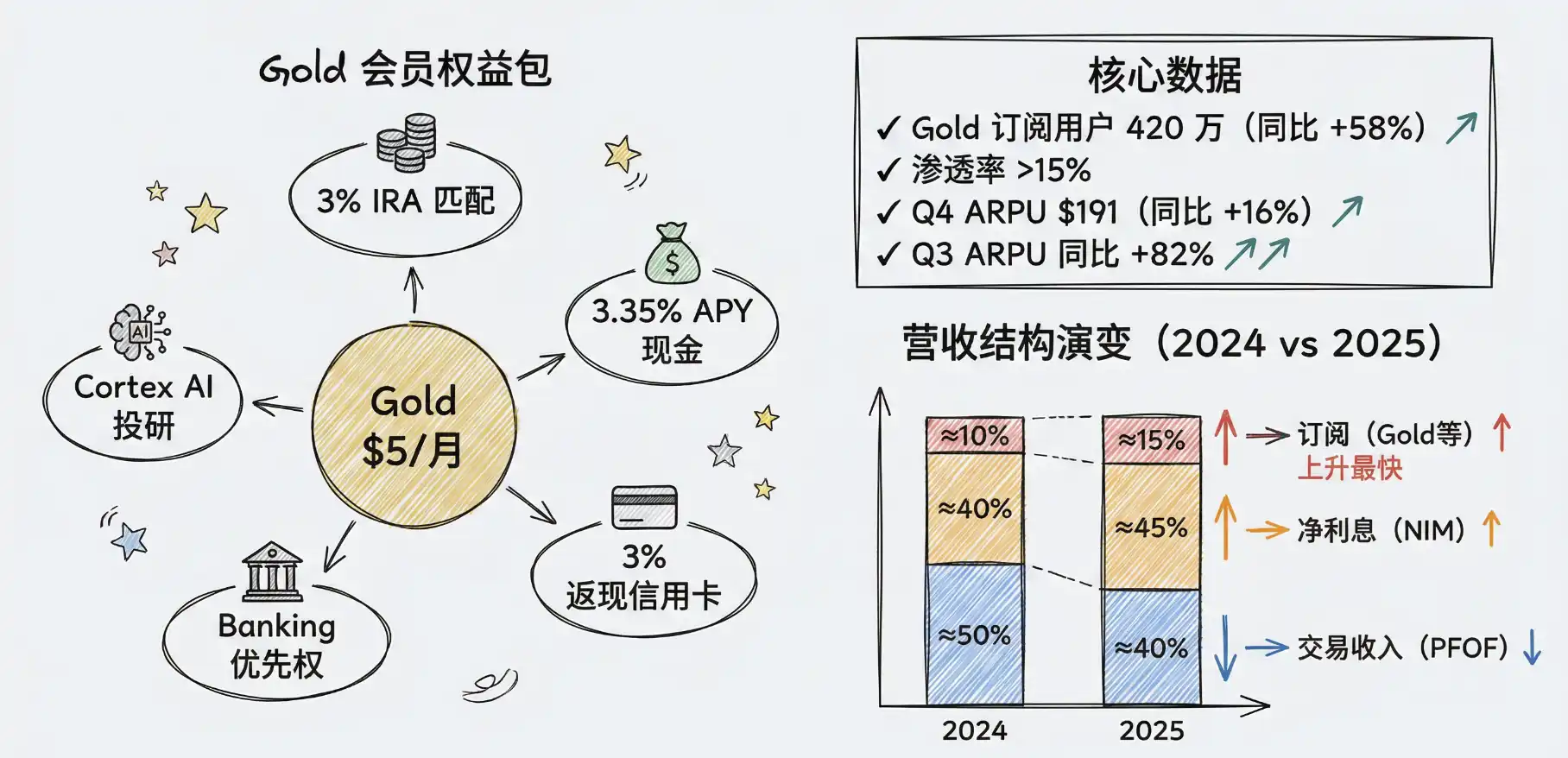
The Robinhood Gold subscription service ($5 monthly or $50 annually) is central to its profit model evolution. It exchanges a monthly fee for high interest rates, in-depth research reports, a 3% IRA match, and a 3% cash-back credit card on all categories. This is essentially an attempt to SaaS-ify financial services.

By the end of Q4 2025, Robinhood Gold subscribers reached a record 4.2 million, a 58% year-over-year increase, representing a penetration rate of over 15% among its 27 million funded customers. This subscription model significantly increases user stickiness and Average Revenue Per User (ARPU). Q4 ARPU increased 16% year-over-year to $191, and Q3 ARPU surged 82% year-over-year.

The table below shows the evolution of Robinhood's revenue structure:
3. The Ecosystem Flywheel

Young users dislike downloading multiple apps to manage their finances. Robinhood deeply understands this and is building a super-app encompassing investing, saving, spending, and borrowing.
3.1 One-Stop Experience: Seamless Integration of High and Low-Frequency Scenarios

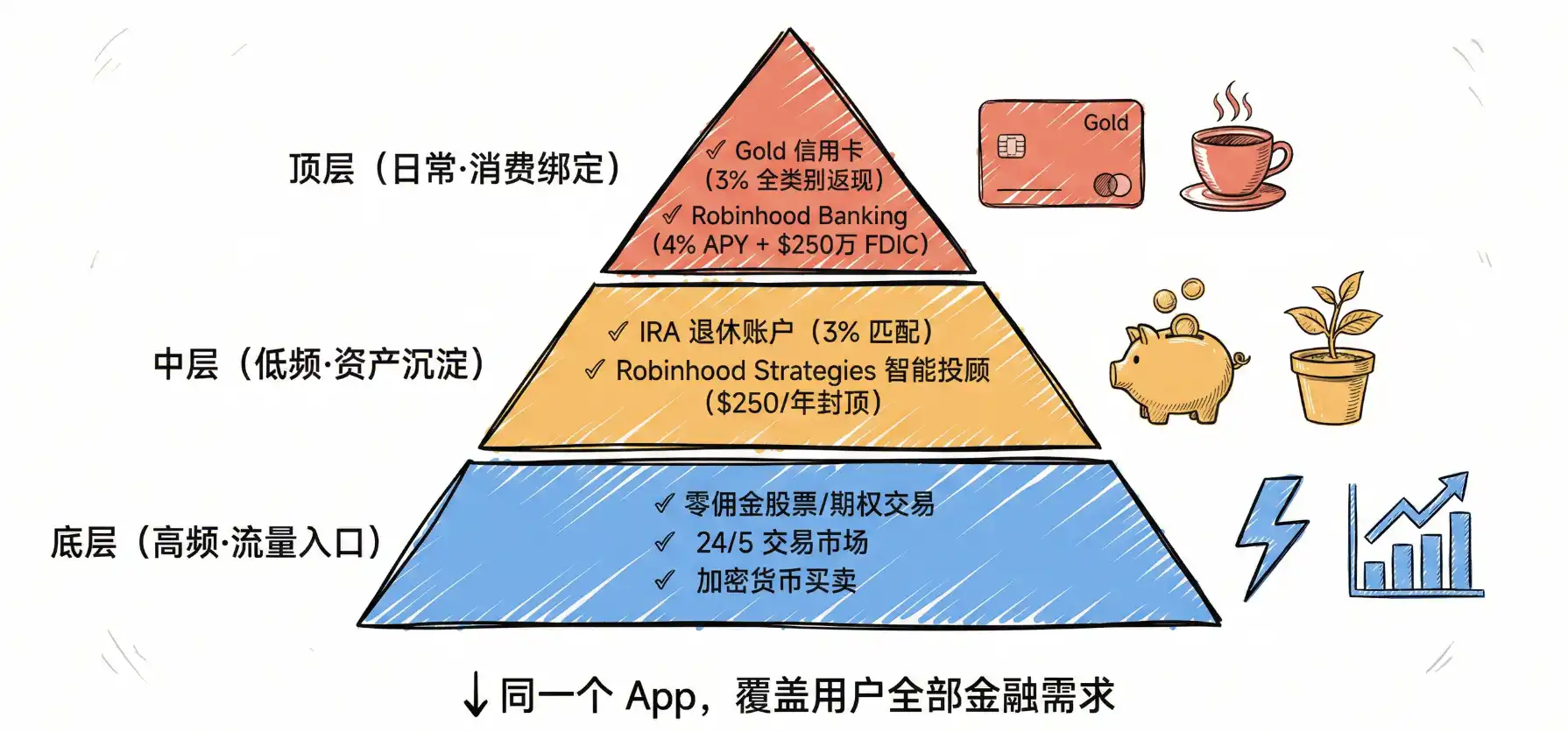
In 2025, Robinhood launched or upgraded several products, forming a complete ecosystem flywheel:

  • High-Frequency Scenarios: Zero-commission stock/options trading, 24/5 trading hours, cryptocurrency buying/selling.
  • Low-Frequency Defensive Scenarios: IRA retirement accounts (3% match), Robinhood Strategies robo-advisory (capped at $250/year management fee for Gold members).
  • Daily Spending Scenarios: Robinhood Gold credit card (3% cash back), Robinhood Banking (4% savings APY, FDIC insured).

Seamlessly integrating high-frequency speculative activities with low-frequency retirement investing and daily spending within the same app is Robinhood's killer feature.

3.2 Traffic Conversion: Smooth Cross-Selling from "IPO Investing" to "Retirement Planning"

Robinhood possesses the massive user traffic traditional asset managers dream of (27 million funded accounts by end of 2025). Its core strategy is: use high-frequency trading (e.g., meme stocks, crypto) and high-yield cash as traffic entry points, then smoothly cross-sell low-frequency but high-value wealth management products.

For example, when a 22-year-old Gen Z user downloads Robinhood to trade Dogecoin, they might be attracted by the 5% cash yield to sign up for Gold membership; subsequently, the app will use targeted notifications to inform them, "As a Gold member, you can get a 3% free match by opening an IRA"; when their assets grow to $100,000, the system might recommend "a robo-advisory service for only $250 per year."

This conversion path from "traffic funnel" to "asset沉淀 (precipitation/sedimentation - meaning accumulation)" allows Robinhood to acquire high-net-worth clients at extremely low marginal cost.

4. Building Trust

4.1 Compliance and Security Endorsement: Leveraging Traditional Finance's Safety Net

To reassure users entrusting their life's retirement funds, Robinhood cleverly leveraged traditional finance's safety net to endorse its innovative products.

SIPC Protection & Additional Insurance: Robinhood emphasizes its status as a SIPC member (providing $500,000 in basic protection) and has purchased additional commercial coverage, offering up to $50 million in securities protection and $1.9 million in cash protection per customer.

FDIC Deposit Insurance: When promoting Cash Sweep and Robinhood Banking, the platform, through partnerships with multiple banks, provides users with FDIC insurance up to $2.5 million, far exceeding the standard $250,000 coverage at ordinary banks.

This narrative strategy of being "safer than traditional banks" greatly alleviates young users' trust concerns about emerging Fintech platforms.

5. Operational Cost Structure

Robinhood's ability to offer a 3% IRA match and capped $250 advisory fees stems not only from confidence in LTV but also from its far superior employee efficiency and underlying technology costs compared to traditional institutions.

5.1 Technology-Driven Automation and High Efficiency Ratio

Robinhood lacks extensive physical branches and teams of financial advisors. All its advisory services (e.g., the ETF portfolios recommended by Robinhood Strategies) are highly automated, relying on algorithmic models for asset allocation and rebalancing.

This "asset-light" model results in an impressive efficiency ratio. Based on public data, Robinhood's total headcount was approximately 2,900 by the end of 2025. Calculating based on the full-year revenue of $4.5 billion, its revenue per employee is as high as $1.55 million. In contrast, traditional financial giants with tens of thousands of employees often have revenue per employee half of this or even lower.

5.2 Decreasing Marginal Costs: The Power of a Proprietary Clearing System

Robinhood freed itself from reliance on third-party clearing agencies (e.g., Apex Clearing) as early as 2018 by building its own proprietary clearing system. This infrastructure investment demonstrated massive operational leverage during the asset explosion of 2025.

When AUC surged from $193 billion to $324 billion, the marginal cost for handling additional transactions and asset transfers was almost negligible because the clearing system is proprietary and highly automated. According to macro trend data, Robinhood's total annual operating expenses for 2025 were $2.379 billion; despite revenue surging 52%, the growth in operating expenses was relatively controlled, directly contributing to a full-year GAAP net income of $1.9 billion and a significant increase in adjusted EBITDA margin.

6. Evolving User Profile

The core driver behind the success of Robinhood's wealth management business is the profound shift in the investment behavior of its young user base.

6.1 Youthful User Base: A Structural Advantage

According to research by ARK Invest, Gen Z and Millennials make up a high 63% of Robinhood's user base, compared to just 14% at Charles Schwab and relatively limited proportions at Vanguard. The median age of a Robinhood user is approximately 32-35 years old (2025 data), while the average client age at Schwab and other traditional brokerages is over 50.

This structural advantage is also reflected in platform asset density. Currently, Schwab's average Assets Under Custody (AUC) per client is around $250,000, far higher than Robinhood's current level of approximately $12,000. However, the essence of this gap is an age gap. As Robinhood's young user base gradually enters their peak wealth accumulation years, this gap will narrow.

6.2 From "Meme Stocks" to "Long-Termism": A Profound Shift in Investment Behavior

Robinhood CEO Vlad Tenev noted a trend occurring in late 2025: 19-year-old Gen Z individuals are actively opening retirement accounts.

This trend is supported by data. According to the latest savings data cited by USA Today, Gen Z's retirement savings rate has risen for several consecutive years, reaching 6.2% in 2025, up from 5.9% in 2024, while the savings rates for all other age groups are declining. Data from Fidelity shows that Gen Z investors allocate a high 95% of their IRA contributions to Roth accounts, indicating a clear understanding of long-term tax optimization.

6.3 Capturing the "Largest Wealth Transfer in Human History"

Over the next few decades, an estimated $124 trillion in assets is expected to transfer from the Baby Boomer generation to Millennials and Gen Z. Given Robinhood's dominant market share among young people, when these young users inherit wealth, they are highly likely to choose to keep the funds within the familiar and user-friendly Robinhood ecosystem rather than transferring them to the traditional brokerages their parents used.

Conclusion: The Rise of a Financial Super-App

2025 was a watershed year in Robinhood's history. It successfully shed the label of a "casino for retail speculation" and transformed into a comprehensive, mature, and highly competitive "financial super-app".

The core logic of this transformation lies in Robinhood's deep understanding of its user base's lifetime value. A 22-year-old Gen Z user might only buy a few ETFs on Robinhood today; tomorrow, they will open an IRA account and enjoy a 3% match; the year after, they will roll over their workplace 401(k) into Robinhood; a few years later, when their asset size grows to $100,000, they will activate Robinhood Strategies for capped-fee professional advisory; ultimately, when they inherit assets from their parents, they will naturally deposit them into Robinhood Banking.

Through aggressive acquisition mechanisms, a stable recurring revenue model, a one-stop ecosystem flywheel, a repositioned brand of trust, and an ultra-efficient cost structure, Robinhood has perfectly prepared its infrastructure to capture this "largest intergenerational wealth transfer in human history."


Questions liées

QWhat were the key financial results that validated Robinhood's wealth management strategy in 2025?

AIn 2025, Robinhood's full-year net revenue reached a record $4.5 billion, a 52% year-over-year increase. Full-year net income was $1.9 billion, up 35%. Retirement account assets under custody (AUC) surged 102% to $26.5 billion by Q4. Total assets on the platform grew 68% to $324 billion, and full-year net deposits were $68 billion.

QHow does Robinhood's 3% IRA match subsidy work, and why is it considered an economically sound customer acquisition strategy?

ARobinhood offers a 3% cash match on IRA contributions and rollovers from other brokers for its Gold members (1% for non-members). For example, rolling over a $100,000 401(k) would yield a $3,000 cash reward. This is considered a sound Customer Acquisition Cost (CAC) strategy because retirement accounts are highly sticky (held for decades), locking users into Gold membership and generating long-term Net Interest Margin (NIM) and potential advisory fees. The Lifetime Value (LTV) of these assets far exceeds the CAC.

QHow did Robinhood's revenue model evolve beyond Payment for Order Flow (PFOF) in 2025?

ARobinhood's revenue model evolved to include more stable, recurring revenue streams. Key drivers were Net Interest Income (NIM) from its high-yield cash sweep program, which grew to $4.11 billion in Q4 (up 39% YoY), and subscription revenue from its Robinhood Gold service, which had 4.2 million subscribers by Q4, a 58% increase. This shift reduced its reliance on the more volatile PFOF model.

QWhat are the core components of Robinhood's 'ecosystem flywheel' or super app strategy?

ARobinhood's ecosystem integrates high-frequency and low-frequency financial scenarios seamlessly in one app. The core components are: 1) High-frequency: $0 commission stock/options trading and crypto. 2) Low-frequency/defensive: IRA accounts with 3% match and Robinhood Strategies robo-advisory. 3) Daily spending: Robinhood Gold credit card (3% cash back) and Robinhood Banking (savings with high APY and FDIC insurance). This creates a closed loop for cross-selling and user retention.

QWhat demographic advantage does Robinhood possess, and how does it position the company for future growth?

ARobinhood's user base is significantly younger, with 63% being Gen Z and Millennials, compared to just 14% at traditional brokers like Charles Schwab. The median user age is 32-35. This is a structural advantage because as these users age and enter their peak wealth accumulation years, their assets on the platform are expected to grow substantially. Furthermore, Robinhood is well-positioned to capture a significant share of the estimated $124 trillion in wealth transferring from Baby Boomers to younger generations, who are already familiar with and prefer the Robinhood platform.

Lectures associées

Trading

Spot
Futures

Articles tendance

Qu'est ce que $S$

Comprendre SPERO : Un aperçu complet Introduction à SPERO Alors que le paysage de l'innovation continue d'évoluer, l'émergence des technologies web3 et des projets de cryptomonnaie joue un rôle central dans la façon dont se dessine l'avenir numérique. Un projet qui a attiré l'attention dans ce domaine dynamique est SPERO, désigné comme SPERO,$$s$. Cet article vise à rassembler et à présenter des informations détaillées sur SPERO, afin d'aider les passionnés et les investisseurs à comprendre ses fondations, ses objectifs et ses innovations dans les domaines du web3 et de la crypto. Qu'est-ce que SPERO,$$s$ ? SPERO,$$s$ est un projet unique dans l'espace crypto qui cherche à tirer parti des principes de décentralisation et de la technologie blockchain pour créer un écosystème qui favorise l'engagement, l'utilité et l'inclusion financière. Le projet est conçu pour faciliter les interactions entre pairs de nouvelles manières, offrant aux utilisateurs des solutions et des services financiers innovants. Au cœur de SPERO,$$s$, l'objectif est d'autonomiser les individus en fournissant des outils et des plateformes qui améliorent l'expérience utilisateur dans l'espace des cryptomonnaies. Cela inclut la possibilité de méthodes de transaction plus flexibles, la promotion d'initiatives dirigées par la communauté et la création de voies pour des opportunités financières via des applications décentralisées (dApps). La vision sous-jacente de SPERO,$$s$ tourne autour de l'inclusivité, visant à combler les lacunes au sein de la finance traditionnelle tout en exploitant les avantages de la technologie blockchain. Qui est le créateur de SPERO,$$s$ ? L'identité du créateur de SPERO,$$s$ reste quelque peu obscure, car il existe peu de ressources publiques fournissant des informations détaillées sur son ou ses fondateurs. Ce manque de transparence peut découler de l'engagement du projet envers la décentralisation—une éthique que de nombreux projets web3 partagent, privilégiant les contributions collectives plutôt que la reconnaissance individuelle. En centrant les discussions autour de la communauté et de ses objectifs collectifs, SPERO,$$s$ incarne l'essence de l'autonomisation sans désigner des individus spécifiques. Ainsi, comprendre l'éthique et la mission de SPERO reste plus important que d'identifier un créateur unique. Qui sont les investisseurs de SPERO,$$s$ ? SPERO,$$s$ est soutenu par une diversité d'investisseurs allant des capital-risqueurs aux investisseurs providentiels dédiés à favoriser l'innovation dans le secteur crypto. L'objectif de ces investisseurs s'aligne généralement avec la mission de SPERO—priorisant les projets qui promettent des avancées technologiques sociétales, l'inclusivité financière et la gouvernance décentralisée. Ces fondations d'investisseurs s'intéressent généralement à des projets qui non seulement offrent des produits innovants, mais qui contribuent également positivement à la communauté blockchain et à ses écosystèmes. Le soutien de ces investisseurs renforce SPERO,$$s$ en tant que concurrent notable dans le domaine en rapide évolution des projets crypto. Comment fonctionne SPERO,$$s$ ? SPERO,$$s$ utilise un cadre multifacette qui le distingue des projets de cryptomonnaie conventionnels. Voici quelques-unes des caractéristiques clés qui soulignent son unicité et son innovation : Gouvernance décentralisée : SPERO,$$s$ intègre des modèles de gouvernance décentralisée, permettant aux utilisateurs de participer activement aux processus de décision concernant l'avenir du projet. Cette approche favorise un sentiment de propriété et de responsabilité parmi les membres de la communauté. Utilité du token : SPERO,$$s$ utilise son propre token de cryptomonnaie, conçu pour servir diverses fonctions au sein de l'écosystème. Ces tokens permettent des transactions, des récompenses et la facilitation des services offerts sur la plateforme, améliorant ainsi l'engagement et l'utilité globaux. Architecture en couches : L'architecture technique de SPERO,$$s$ supporte la modularité et l'évolutivité, permettant une intégration fluide de fonctionnalités et d'applications supplémentaires à mesure que le projet évolue. Cette adaptabilité est primordiale pour maintenir la pertinence dans le paysage crypto en constante évolution. Engagement communautaire : Le projet met l'accent sur des initiatives dirigées par la communauté, utilisant des mécanismes qui incitent à la collaboration et aux retours d'expérience. En cultivant une communauté forte, SPERO,$$s$ peut mieux répondre aux besoins des utilisateurs et s'adapter aux tendances du marché. Accent sur l'inclusion : En proposant des frais de transaction bas et des interfaces conviviales, SPERO,$$s$ vise à attirer une base d'utilisateurs diversifiée, y compris des individus qui n'ont peut-être pas engagé auparavant dans l'espace crypto. Cet engagement envers l'inclusion s'aligne avec sa mission globale d'autonomisation par l'accessibilité. Chronologie de SPERO,$$s$ Comprendre l'histoire d'un projet fournit des aperçus cruciaux sur sa trajectoire de développement et ses jalons. Voici une chronologie suggérée cartographiant les événements significatifs dans l'évolution de SPERO,$$s$ : Phase de conceptualisation et d'idéation : Les idées initiales formant la base de SPERO,$$s$ ont été conçues, s'alignant étroitement avec les principes de décentralisation et de concentration sur la communauté au sein de l'industrie blockchain. Lancement du livre blanc du projet : Suite à la phase conceptuelle, un livre blanc complet détaillant la vision, les objectifs et l'infrastructure technologique de SPERO,$$s$ a été publié pour susciter l'intérêt et les retours de la communauté. Construction de la communauté et engagements précoces : Des efforts de sensibilisation actifs ont été entrepris pour construire une communauté d'adopteurs précoces et d'investisseurs potentiels, facilitant les discussions autour des objectifs du projet et recueillant du soutien. Événement de génération de tokens : SPERO,$$s$ a organisé un événement de génération de tokens (TGE) pour distribuer ses tokens natifs aux premiers soutiens et établir une liquidité initiale au sein de l'écosystème. Lancement de la première dApp : La première application décentralisée (dApp) associée à SPERO,$$s$ a été mise en ligne, permettant aux utilisateurs d'interagir avec les fonctionnalités principales de la plateforme. Développement continu et partenariats : Des mises à jour et des améliorations continues des offres du projet, y compris des partenariats stratégiques avec d'autres acteurs de l'espace blockchain, ont façonné SPERO,$$s$ en un acteur compétitif et évolutif sur le marché crypto. Conclusion SPERO,$$s$ se dresse comme un témoignage du potentiel du web3 et de la cryptomonnaie pour révolutionner les systèmes financiers et autonomiser les individus. Avec un engagement envers la gouvernance décentralisée, l'engagement communautaire et des fonctionnalités conçues de manière innovante, il ouvre la voie vers un paysage financier plus inclusif. Comme pour tout investissement dans l'espace crypto en rapide évolution, les investisseurs et utilisateurs potentiels sont encouragés à mener des recherches approfondies et à s'engager de manière réfléchie avec les développements en cours au sein de SPERO,$$s$. Le projet illustre l'esprit d'innovation de l'industrie crypto, invitant à une exploration plus approfondie de ses nombreuses possibilités. Bien que le parcours de SPERO,$$s$ soit encore en cours, ses principes fondamentaux pourraient en effet influencer l'avenir de nos interactions avec la technologie, la finance et entre nous dans des écosystèmes numériques interconnectés.

101 vues totalesPublié le 2024.12.17Mis à jour le 2024.12.17

Qu'est ce que $S$

Qu'est ce que AGENT S

Agent S : L'avenir de l'interaction autonome dans Web3 Introduction Dans le paysage en constante évolution de Web3 et des cryptomonnaies, les innovations redéfinissent constamment la manière dont les individus interagissent avec les plateformes numériques. Un projet pionnier, Agent S, promet de révolutionner l'interaction homme-machine grâce à son cadre agentique ouvert. En ouvrant la voie à des interactions autonomes, Agent S vise à simplifier des tâches complexes, offrant des applications transformantes dans l'intelligence artificielle (IA). Cette exploration détaillée plongera dans les subtilités du projet, ses caractéristiques uniques et les implications pour le domaine des cryptomonnaies. Qu'est-ce qu'Agent S ? Agent S se présente comme un cadre agentique ouvert révolutionnaire, spécifiquement conçu pour relever trois défis fondamentaux dans l'automatisation des tâches informatiques : Acquisition de connaissances spécifiques au domaine : Le cadre apprend intelligemment à partir de diverses sources de connaissances externes et d'expériences internes. Cette approche double lui permet de construire un riche répertoire de connaissances spécifiques au domaine, améliorant ainsi sa performance dans l'exécution des tâches. Planification sur de longs horizons de tâches : Agent S utilise une planification hiérarchique augmentée par l'expérience, une approche stratégique qui facilite la décomposition et l'exécution efficaces de tâches complexes. Cette fonctionnalité améliore considérablement sa capacité à gérer plusieurs sous-tâches de manière efficace et efficiente. Gestion d'interfaces dynamiques et non uniformes : Le projet introduit l'Interface Agent-Ordinateur (ACI), une solution innovante qui améliore l'interaction entre les agents et les utilisateurs. En utilisant des Modèles de Langage Multimodaux de Grande Taille (MLLMs), Agent S peut naviguer et manipuler sans effort diverses interfaces graphiques. Grâce à ces fonctionnalités pionnières, Agent S fournit un cadre robuste qui aborde les complexités impliquées dans l'automatisation de l'interaction humaine avec les machines, préparant le terrain pour d'innombrables applications en IA et au-delà. Qui est le créateur d'Agent S ? Bien que le concept d'Agent S soit fondamentalement innovant, des informations spécifiques sur son créateur restent insaisissables. Le créateur est actuellement inconnu, ce qui souligne soit le stade naissant du projet, soit le choix stratégique de garder les membres fondateurs sous le radar. Quoi qu'il en soit, l'accent reste mis sur les capacités et le potentiel du cadre. Qui sont les investisseurs d'Agent S ? Étant donné qu'Agent S est relativement nouveau dans l'écosystème cryptographique, des informations détaillées concernant ses investisseurs et soutiens financiers ne sont pas explicitement documentées. Le manque d'aperçus publiquement disponibles sur les fondations d'investissement ou les organisations soutenant le projet soulève des questions sur sa structure de financement et sa feuille de route de développement. Comprendre le soutien est crucial pour évaluer la durabilité du projet et son impact potentiel sur le marché. Comment fonctionne Agent S ? Au cœur d'Agent S se trouve une technologie de pointe qui lui permet de fonctionner efficacement dans divers environnements. Son modèle opérationnel est construit autour de plusieurs caractéristiques clés : Interaction homme-ordinateur semblable à l'humain : Le cadre offre une planification IA avancée, s'efforçant de rendre les interactions avec les ordinateurs plus intuitives. En imitant le comportement humain dans l'exécution des tâches, il promet d'élever l'expérience utilisateur. Mémoire narrative : Utilisée pour tirer parti des expériences de haut niveau, Agent S utilise la mémoire narrative pour suivre les historiques de tâches, améliorant ainsi ses processus de prise de décision. Mémoire épisodique : Cette fonctionnalité fournit aux utilisateurs un accompagnement étape par étape, permettant au cadre d'offrir un soutien contextuel au fur et à mesure que les tâches se déroulent. Support pour OpenACI : Avec la capacité de fonctionner localement, Agent S permet aux utilisateurs de garder le contrôle sur leurs interactions et flux de travail, s'alignant avec l'éthique décentralisée de Web3. Intégration facile avec des API externes : Sa polyvalence et sa compatibilité avec diverses plateformes IA garantissent qu'Agent S peut s'intégrer sans effort dans des écosystèmes technologiques existants, en faisant un choix attrayant pour les développeurs et les organisations. Ces fonctionnalités contribuent collectivement à la position unique d'Agent S dans l'espace crypto, alors qu'il automatise des tâches complexes en plusieurs étapes avec un minimum d'intervention humaine. À mesure que le projet évolue, ses applications potentielles dans Web3 pourraient redéfinir la manière dont les interactions numériques se déroulent. Chronologie d'Agent S Le développement et les jalons d'Agent S peuvent être encapsulés dans une chronologie qui met en évidence ses événements significatifs : 27 septembre 2024 : Le concept d'Agent S a été lancé dans un document de recherche complet intitulé “Un cadre agentique ouvert qui utilise les ordinateurs comme un humain”, présentant les bases du projet. 10 octobre 2024 : Le document de recherche a été rendu publiquement disponible sur arXiv, offrant une exploration approfondie du cadre et de son évaluation de performance basée sur le benchmark OSWorld. 12 octobre 2024 : Une présentation vidéo a été publiée, fournissant un aperçu visuel des capacités et des caractéristiques d'Agent S, engageant davantage les utilisateurs et investisseurs potentiels. Ces jalons dans la chronologie illustrent non seulement les progrès d'Agent S, mais indiquent également son engagement envers la transparence et l'engagement communautaire. Points clés sur Agent S Alors que le cadre Agent S continue d'évoluer, plusieurs attributs clés se distinguent, soulignant sa nature innovante et son potentiel : Cadre innovant : Conçu pour offrir une utilisation intuitive des ordinateurs semblable à l'interaction humaine, Agent S propose une approche nouvelle de l'automatisation des tâches. Interaction autonome : La capacité d'interagir de manière autonome avec les ordinateurs via une interface graphique signifie un bond vers des solutions informatiques plus intelligentes et efficaces. Automatisation des tâches complexes : Avec sa méthodologie robuste, il peut automatiser des tâches complexes en plusieurs étapes, rendant les processus plus rapides et moins sujets aux erreurs. Amélioration continue : Les mécanismes d'apprentissage permettent à Agent S de s'améliorer grâce à ses expériences passées, améliorant continuellement sa performance et son efficacité. Polyvalence : Son adaptabilité à travers différents environnements d'exploitation comme OSWorld et WindowsAgentArena garantit qu'il peut servir un large éventail d'applications. Alors qu'Agent S se positionne dans le paysage Web3 et crypto, son potentiel à améliorer les capacités d'interaction et à automatiser les processus représente une avancée significative dans les technologies IA. Grâce à son cadre innovant, Agent S incarne l'avenir des interactions numériques, promettant une expérience plus fluide et efficace pour les utilisateurs à travers divers secteurs. Conclusion Agent S représente un saut audacieux en avant dans le mariage de l'IA et de Web3, avec la capacité de redéfinir notre interaction avec la technologie. Bien qu'il soit encore à ses débuts, les possibilités de son application sont vastes et convaincantes. Grâce à son cadre complet abordant des défis critiques, Agent S vise à mettre les interactions autonomes au premier plan de l'expérience numérique. À mesure que nous plongeons plus profondément dans les domaines des cryptomonnaies et de la décentralisation, des projets comme Agent S joueront sans aucun doute un rôle crucial dans la façon dont la technologie et la collaboration homme-machine évolueront à l'avenir.

759 vues totalesPublié le 2025.01.14Mis à jour le 2025.01.14

Qu'est ce que AGENT S

Comment acheter S

Bienvenue sur HTX.com ! Nous vous permettons d'acheter Sonic (S) de manière simple et pratique. Suivez notre guide étape par étape pour commencer votre parcours crypto.Étape 1 : Création de votre compte HTXUtilisez votre adresse e-mail ou votre numéro de téléphone pour ouvrir un compte sur HTX gratuitement. L'inscription se fait en toute simplicité et débloque toutes les fonctionnalités.Créer mon compteÉtape 2 : Choix du mode de paiement (rubrique Acheter des cryptosCarte de crédit/débit : utilisez votre carte Visa ou Mastercard pour acheter instantanément Sonic (S).Solde :utilisez les fonds du solde de votre compte HTX pour trader en toute simplicité.Prestataire tiers :pour accroître la commodité d'utilisation, nous avons ajouté des modes de paiement populaires tels que Google Pay et Apple Pay.P2P :tradez directement avec d'autres utilisateurs sur HTX.OTC (de gré à gré) : nous offrons des services personnalisés et des taux de change compétitifs aux traders.Étape 3 : stockage de vos Sonic (S)Après avoir acheté vos Sonic (S), stockez-les sur votre compte HTX. Vous pouvez également les envoyer ailleurs via un transfert sur la blockchain ou les utiliser pour trader d'autres cryptos.Étape 4 : tradez des Sonic (S)Tradez facilement Sonic (S) sur le marché Spot de HTX. Il vous suffit d'accéder à votre compte, de sélectionner la paire de trading, d'exécuter vos trades et de les suivre en temps réel. Nous offrons une expérience conviviale aux débutants comme aux traders chevronnés.

1.4k vues totalesPublié le 2025.01.15Mis à jour le 2025.03.21

Comment acheter S

Discussions

Bienvenue dans la Communauté HTX. Ici, vous pouvez vous tenir informé(e) des derniers développements de la plateforme et accéder à des analyses de marché professionnelles. Les opinions des utilisateurs sur le prix de S (S) sont présentées ci-dessous.

活动图片